PART 1
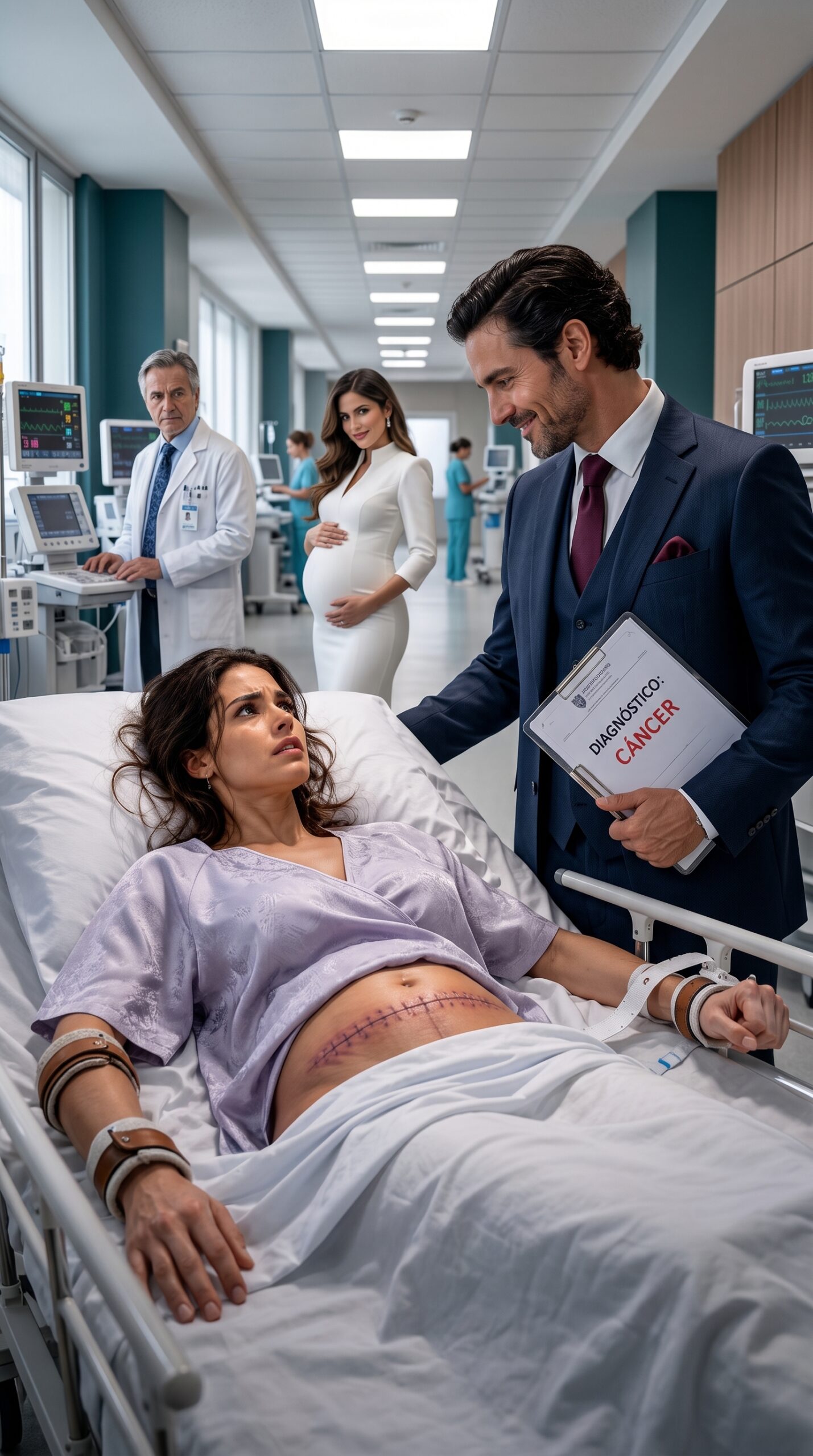
—When my wife falls back asleep, perform the hysterectomy. I don’t want her to ever have children again.
That phrase fell like a stone in the private hallway of San Gabriel Hospital in Guadalajara. Lucía Ortega stood barefoot, in a loose gown, one hand pressed against her belly and the other gripping the wall's railing.
Hours earlier, she had lost her baby.
Or at least, that’s what they had told her.
Her body trembled from the anesthesia, the blood, the pain splitting her back. But what hurt the most wasn’t the recent wound or the cries she couldn’t release. It was recognizing the voice of Adrián Montes, her husband, the man who every Sunday kissed her forehead in front of her mother and said she was “the blessing of his home.”
On the other side of the door, Dr. Raúl Ibarra breathed awkwardly.
—Mr. Montes, that requires signed consent.
—Then get it while she’s asleep —Adrián replied—. Or make something up. A tumor, a hemorrhage, life-threatening risk, whatever you want. I’ll pay for this entire floor so no one asks.
Lucía felt her legs buckle.
—My family can’t deal with another pregnancy of hers —he continued—. She’s already caused enough trouble. Fernanda is pregnant, and that child will be the heir of the Montes.
Fernanda.
The woman who worked as the image director in the family construction company. The same one who, during meals, would say, “Oh, Lucía, you rest, I’ll help Adrián with everything,” while adjusting the collar of Adrián’s shirt with too much confidence.
Lucía stepped back silently. She didn’t scream. She didn’t cry. Something inside her shut down so fiercely that even the pain seemed to obey.
She returned to her room before the nurse noticed her absence. On the table were white flowers, a new rosary, and a card written in Adrián’s handwriting:
“My love, God knows why He does things. I’m here to take care of you.”
Lucía looked at the card and felt disgust.
Shortly after, Adrián entered with red eyes, disheveled, perfect in his role as the devastated husband. He knelt beside the bed and took her hand.
—My love, why did you get up? I almost died from fright.
She didn’t respond.
—We lost the baby, Lu. But you’re alive. That’s all that matters.
The word “lost” sounded so false that she almost laughed.
Adrián picked up a glass with dark medication and brought it closer.
—Drink this. The doctor says you need to sleep. We’ll talk about everything tomorrow, okay?
Lucía looked at the liquid.
—I don’t want to.
Adrián’s smile hardened for just a second.
—Please don’t start. You’re agitated.
—I said no.
He clenched his jaw. Then he gestured to the nurse.
—Give her something to help her rest. She’s not herself.
Lucía tried to get up, but felt a stab in her arm. The room spun. The last thing she saw was Adrián leaning over her, whispering:
—I’m sorry, but it’s for your own good.
When she woke up, morning light streamed through the window. Her belly burned differently. Deeper. More empty.
With trembling hands, she lifted the sheet and saw a new scar cutting across her skin.
Adrián was sitting next to her.
—There were complications —he said in a broken voice—. They detected suspicious tissue. The doctor had to remove your uterus to save you.
Lucía stared at him without blinking.
He showed her a file with stamps, signatures, and medical jargon impossible to dispute.
Everything seemed legal.
Everything seemed clean.
Then the door opened.
Fernanda entered smiling, pregnant, with a basket of fruit wrapped in golden cellophane.
—Sorry, I came to visit Lucía. Poor thing, she must be devastated.
Adrián didn’t throw her out.
He only squeezed Lucía’s hand while looking at Fernanda’s belly with a tenderness he could no longer hide.
And in that moment, Lucía slipped her other hand under the pillow, touched the legal envelope her lawyer had left her weeks before, and understood that if they had turned her body into a false signature, she was going to turn that lie into the grave of them all.
PART 2
Lucía didn’t open the envelope in front of them.
She stood still, her lips dry, pretending the anesthesia had her confused. Adrián sighed in relief seeing her docile. Fernanda approached with the basket and placed the fruit on the table as if bringing an offering to a widow.
—I brought mango, pear, and pomegranate —she said with poisonous sweetness—. They say they help a lot after a loss.
Lucía looked at her.
Fernanda was dressed in beige, her hair loose, and wearing a thin chain with a St. Benedict medallion. She looked like she stepped out of a fine ladies’ magazine from Zapopan. But her eyes held no compassion. They held triumph.
—Thank you —Lucía replied.
Adrián tensed. Perhaps he expected screams. Perhaps he expected a crisis. But Lucía had understood something: women who survive betrayal don’t always start by smashing dishes. Sometimes they start by breathing slowly.
When Fernanda left, Adrián remained by the bed.
—I know this is very hard, my love. But we’re still a family.
Lucía turned her head toward him.
—A family?
—You and me. Like always.
She lowered her gaze to her scar.
—And what about Fernanda’s baby?
Adrián froze.
For three seconds he didn’t know what mask to wear. Then he chose the indignant one.
—Who put those ideas in your head? That girl works with me, that’s all. She’s pregnant by someone else.
Lucía didn’t argue.
—Sure.
That word made him more nervous than an accusation. Because in Lucía’s mouth, it sounded like a sentence.
At noon, Dolores, Adrián’s mother, arrived. She walked in with dark glasses, an expensive bag, and a rehearsed expression of martyrdom.
—Oh, my dear —she said, without touching her—. God knows why He doesn’t send certain blessings. The important thing is that my son isn’t a widower.
Lucía felt a horrible chill.
Doña Dolores sat in front of her and lowered her voice.
—And look, I’m telling you this as a woman: don’t throw a tantrum. Adrián is young. A man needs offspring. If he ever decides to help a child on the way, you should be grateful he still respects you as a wife.
There it was. It wasn’t just Adrián. It was the entire family protecting the last name, the money, the facade.
Lucía closed her eyes.
—I want to be alone.
—What a character, really —Dolores murmured—. No wonder things happen.
When they left, Lucía pulled the envelope from under the pillow. The cover read:
“Precautionary Measures. Ortega-Montes Estate. Confidential File.”
Her lawyer, Renata Fierro, had given it to her a month earlier, after Lucía discovered odd movements in the accounts of the company she inherited from her father. At that moment, she didn’t want to believe it. Renata had told her:
—Your husband isn’t just cheating you with money, Lucía. He’s surrounding you. And when a powerful man surrounds you, it’s not to embrace you.
Lucía had kept the envelope out of fear.
Now she opened it with a trembling hand.
Inside were certified copies of shares, revoked powers, a prepared lawsuit, and a letter signed by her father before he died. Don Ernesto Ortega had been the original partner of Montes Developments, but the Montes family sold the story that he had only been a minor supplier.
The letter said:
“Lucía, if the Montes ever try to take away what you are, remember that half of that company was born with my money. Don’t let them make you feel like a guest in a house that is also yours.”
Lucía cried for the first time.
Not for Adrián.
For herself, for her baby, for her father, and for all the years she had accepted being “the simple wife” while they treated her like an ornament.
That night, when everyone thought she was asleep, she hid her cell phone under the sheets and recorded.
Adrián entered with Dr. Ibarra.
—Did she sign the discharge yet? —Adrián asked.
—Not yet. But the file is closed. Incipient uterine cancer. Emergency surgery. No one will review that.
—And the consent?
—Fingerprint. With the sedation, she didn’t move much.
Lucía felt like tearing her skin off.
Adrián breathed.
—Good. As soon as she’s out, I’ll prepare the divorce. No children, no shares, and with a psychiatric diagnosis, she won’t be able to fight anything.
The doctor let out a nervous laugh.
—And the other patient?
—Fernanda stays protected. That child will carry my last name even if my old man screams. My mom is already convinced.
Lucía let the cell record until they left.
At 6 AM, Renata Fierro arrived dressed in black, with her hair tied up and a red folder under her arm. She didn’t come alone. She was accompanied by a notary, two police agents, and a forensic gynecologist sent by the Prosecutor’s Office.
Adrián was in the room, trying to feed Lucía porridge as if nothing were wrong.
—What is this? —he asked.
Renata placed the folder on the bed.
—Mrs. Lucía Ortega revokes from this moment any medical, patrimonial, and legal authorization granted to her husband. Furthermore, she requests an investigation for unauthorized surgery, falsification of medical records, and obstetric violence.
Adrián let out a laugh.
—My wife is medicated. She doesn’t know what she’s doing.
Lucía lifted her face.
—I’m more awake than ever.
The gynecologist reviewed the file. Her eyes hardened.
—This diagnosis does not justify an emergency hysterectomy. And there’s a serious irregularity here: the biopsy is dated one day before the sample existed.
Dr. Ibarra was called immediately. He arrived sweating, his lab coat unbuttoned.
—This is a misunderstanding.
Renata pulled out Lucía’s cell phone and played the audio.
Adrián’s voice filled the room:
“Without children, without shares, and with a psychiatric diagnosis, she won’t be able to fight anything.”
Doña Dolores, who had just entered, turned pale.
Fernanda appeared behind her, hand on her belly.
—Adrián, what’s happening?
He looked at her with fury.
—Shut up.
That word broke something in Fernanda. For the first time, her confidence crumbled. Her eyes filled with fear.
Renata observed her.
—Miss Fernanda, we also have a prenatal test registered in this hospital. Do you want us to discuss here who the real father of your baby is?
The silence was brutal.
Adrián turned to Fernanda.
—What did she say?
Fernanda swallowed hard.
—I didn’t know it was time...
Adrián stepped toward her, but the agents stopped him.
Renata opened another sheet.
—The preliminary genetic test indicates that the baby does not match the Montes line. And there’s more: Mr. Adrián Montes has a diagnosis of irreversible infertility from eight years ago, hidden even from his family.
Doña Dolores clutched her chest.
—No. That can’t be. My son, no.
Lucía looked at her with a calm that hurt.
—Then you already know why they removed my uterus. It wasn’t to save me. It was so no one would discover that the heir they were boasting about wasn’t his either.
Adrián lost control.
—You don’t understand anything! You were going to destroy my life!
—No —Lucía said—. You destroyed mine because you couldn’t stand the truth.
But the final blow didn’t come from Lucía.
It came from Fernanda.
The young woman started to cry and pulled a USB drive from her bag.
—I didn’t know about the surgery until yesterday. I swear I didn’t know. But I did hear something about your baby.
Lucía stopped breathing.
—What baby?
Fernanda looked at Adrián with terror.
—Lucía’s pregnancy didn’t end the way they told her.
The room froze.
—Speak —Renata ordered.
Fernanda explained that weeks earlier, she had overheard a discussion between Adrián and Dr. Ibarra. They talked about “interrupting the legal bond” and “registering the loss,” but they also mentioned that the product had vital signs. Lucía felt the world fall out from under her.
—Where is my child? —she whispered.
Adrián screamed that it was a lie.
But Dr. Ibarra broke when the agents separated him and mentioned jail. In less than twenty minutes, he confessed: the baby had been born alive, premature, and was transferred to a private clinic in Tepatitlán under the custody of a foundation linked to the Montes family.
Lucía didn’t faint because hatred held her up.
The transfer was immediate. Renata obtained an urgent order. The Prosecutor’s Office secured the hospital, and Lucía was taken by ambulance, still weak, still with fresh stitches, but with her eyes ablaze.
The clinic was called Casa Santa Emilia. It had a white facade, a garden with rose bushes, and a reception that smelled of cheap disinfectant. The director attempted to deny everything until she saw the agents.
Then she opened a door.
In an incubator, wrapped in a blue blanket, was a tiny, living baby with a false bracelet reading “N. N. male.”
Lucía approached as if walking on glass.
—Mateo —she said, because that was the name she had chosen with her father before getting married.
The baby moved a hand just slightly.
That movement returned her soul.
The DNA test took thirty-six hours, but no one needed to wait to understand. Mateo was Lucía’s son. He had been born alive. They hid him to erase her motherhood and control the inheritance.
The case exploded on social media when a journalist from Guadalajara published the first report:
“The wife of businessman Montes claims that they removed her uterus and hid her baby.”
In one day, all of Mexico was talking about Lucía. Some said it was impossible, that no “decent” family would do that. Others shared stories of doctors who didn’t ask for permission, of husbands who signed for them, of mothers-in-law who decided about other people’s bodies as if they were land.
Adrián tried to defend himself through a statement.
He said Lucía was unstable.
He said the baby had been protected.
He said it was all a campaign to take his company.
But then Renata published, with judicial authorization, parts of the audio. Adrián’s voice was clear, arrogant, confident in his impunity.
“Without children, without shares, and with a psychiatric diagnosis, she won’t be able to fight anything.”
That phrase sunk him.
In the hearing, Lucía walked in slowly, with Mateo in her arms and a medical girdle under her dress. She didn’t look powerful like in the movies. She looked pale, tired, broken. But no one in that room had more strength than her.
Adrián was handcuffed. Doña Dolores cried in the front row. Fernanda testified for three hours. She admitted to the affair, the pregnancy lie, the pressures from Adrián, and the network of payments to the hospital. She didn’t come out as a heroine. She didn’t intend to.
—I wanted to earn a place —she said—. But when I saw they could erase a mother this way, I understood they would erase me next.
Dr. Ibarra accepted to have falsified the records. The director of Casa Santa Emilia confessed that the foundation received donations from Montes Developments for “discreet management” of problematic births.
Then Renata presented Don Ernesto Ortega’s letter and the shareholder documents. The judge ordered accounts frozen, company files secured, and Lucía’s property rights temporarily recognized.
Adrián stood up desperately.
—This was all mine!
Lucía looked at him for the first time without fear.
—No. You only learned to put your last name on what you stole.
That phrase made it to every news outlet.
Months later, Adrián was linked to trial for obstetric violence, falsification of documents, minor abduction, corporate fraud, and organized crime. Doña Dolores lost her place on the board. San Gabriel Hospital was investigated. Dr. Ibarra ceased to practice. And the Montes family, who for years sat in luxury restaurants believing themselves untouchable, learned that in Mexico, shame can also knock on the door with a court order.
Lucía regained the part of the company that belonged to her father, but she didn’t live for last names anymore. She sold part of it and created a legal support foundation for women victims of medical and familial abuse. She named it “Mateo Ortega.”
Some asked her why she didn’t use the Montes last name.
She always answered the same:
—Because my son doesn’t need to carry the last name of someone who wanted to erase him.
Mateo grew up healthy. At first, Lucía couldn’t watch him sleep without crying. She touched his feet, hands, forehead, as if confirming that no one had taken him away again. The scar on her belly remained there, thick, impossible to ignore. There were days she hated it. Other days she looked in the mirror and remembered it wasn’t a mark of defeat, but proof of a war that didn’t kill her.
Fernanda disappeared from social media. She accepted to testify in all the processes and raise her child far from the scandal. Lucía never fully forgave her. But neither did she spend her life hating her. Some wounds don’t need reconciliation to close; they need truth.
Three years later, Lucía returned to the Basilica of Zapopan with Mateo by her side. She didn’t go to ask for miracles. She went to thank that justice, although slow and filled with rage, sometimes arrives.
Mateo tugged at her dress and asked:
—Mom, why do you have that line on your belly?
Lucía knelt in front of him.
—Because one day someone wanted to decide for me. And that line reminds me that no one has the right to touch your life without your permission.
The boy scrunched his nose.
—How ugly.
Lucía smiled sadly.
—Yes, my love. But also remember something beautiful.
—What?
She hugged him tightly.
—That I found you.
And as the bells rang, Lucía understood that not all women recover what is stolen from them. Some only recover their voice. But when a woman dares to tell what was done to her body, her child, and her name, that voice can topple an entire family built on lies.
Because Adrián thought a scar would silence her.
He never imagined that scar would be the proof that left him without freedom, without a company, and without the only last name he so desperately wanted to protect.





