PART 1
—Don’t let her in yet… if Valeria sees the baby up close, she’ll notice Adrian’s eyes.
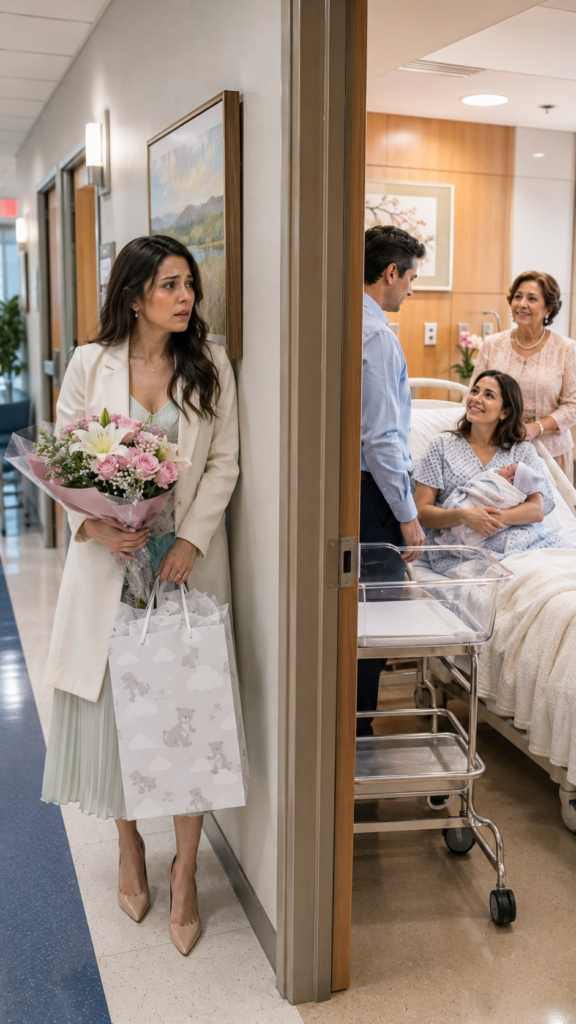
Valeria Castañeda stood frozen in front of room 312 at the Angeles Hospital in Puebla, a gift bag in hand and her heart pounding so hard she thought everyone inside could hear it.
She had come with excitement, truly.
Inside the bag was an embroidered blanket, three white onesies, and a brown teddy bear she had bought in Angelópolis, thinking of her younger sister, Camila, the same little girl who had once begged to sleep with the light on because she was afraid of the dark.
That day, Valeria still believed her family was complicated, but not cruel.
She believed that Adrian Molina, her husband, came home late because his job as an accountant at a construction company left him frazzled with deadlines, clients, and audits.
She believed her mother, Teresa, was cold to her because life had made her tough after years of carrying the household alone.
She believed Camila didn’t tell who the father of her baby was because she had gotten involved with an irresponsible man, one of those who leave as soon as they hear the word pregnancy.
And she believed, above all, that her marriage was going through a rough patch but that it could still be saved.
That morning, Adrian had left their apartment in Lomas de Angelópolis at 8:20, wearing a blue shirt, an expensive watch, and a rehearsed smile.
—Forgive me, love. They moved a meeting with the partners. You go to the hospital and tell Camila I’ll come by later.
Valeria hugged him.
—Okay. I’ll tell her you send blessings.
He gave her a quick kiss on the forehead.
—May God take care of both of you.
Nothing in his voice trembled.
Nothing in his face seemed false.
So when Valeria heard that same voice inside room 312, she didn’t understand immediately. At first, she thought she had misheard. Then she took a step closer to the slightly ajar door.
—Valeria still thinks the fertility treatment is still on —Adrian said, with a low laugh—. Last week she deposited again. Poor thing, she really thinks we’re going to try again.
Valeria felt the bag slipping from her fingers.
Then Teresa, her mother, spoke.
—As long as she stays calm, it’s better. Valeria has always been good at enduring. Camila, on the other hand, really needed a family.
Camila let out a weak sigh, as if she were the victim of it all.
—I don’t want Valeria to hate me.
—She won’t hate you if she doesn’t find out right now —Adrian replied—. Besides, when it’s known, there won’t be anything she can do. The child is my son.
Valeria stopped breathing.
She didn’t enter.
She didn’t scream.
She didn’t push the door.
She stood there listening to her husband, her sister, and her own mother talk about her life as if she were a useful fool, a wallet with legs, a woman born to pay for the dreams of others.
A few meters away was a metal trash can. Valeria walked slowly toward it, dropped the flowers she had brought for Camila, and clutched the gift bag to her chest.
Then she reached into her purse to look for her car keys.
But her fingers touched something cold.
Her little work recorder was still on from that morning when she had been taking notes for a client.
Valeria looked at the red light blinking.
And in that instant, she understood something that froze her blood: she hadn’t just discovered the biggest betrayal of her life… she had just recorded it all.
PART 2
Valeria left the hospital walking as if she weren’t the one moving her legs.
The white hallway, nurses with folders, the cries of other babies, relatives carrying balloons and flower arrangements… everything continued normally. Puebla kept turning as if her soul hadn’t just been shattered into three pieces.
Upon reaching the parking lot, she locked herself in her car.
There, for the first time, she played the audio.
She heard Adrian mocking the money for the treatment again. She heard Teresa say she “was good at enduring.” She heard Camila, her little sister, call it “destiny” to get involved with the woman’s husband who had supported her for years.
Valeria didn’t cry.
Not yet.
She drove home with a strange, almost dangerous calm. When she arrived, she placed the blue bag on the dining table and sat in front of it as if she were looking at a bomb.
For two years, Valeria had saved for a fertility treatment.
She had taken on more projects as an interior decorator, had sold some gold earrings her grandmother left her, had canceled vacations, dinners, clothes, everything. Every peso went to a shared account that she and Adrian called “our future.”
That future had a name in her head.
A baby.
A family.
A room painted sea green.
But when she opened online banking, the truth hit her hard and without anesthesia.
The account was at 0.
There were no 500 pesos left. No useful cents. Nothing.
Valeria checked the transactions with dry eyes.
Transfers in Camila Castañeda’s name.
Ultrasound payments.
Private consultations.
Prenatal medications.
A luxury stroller bought 18 days prior.
A birth package.
Newborn photographs.
Every peso Valeria had saved to try to become a mother had been used to pay for her sister’s pregnancy with her husband.
That was when she doubled over.
She braced herself against the edge of the table and vomited in the sink.
Then she washed her face, looked into the mirror, and whispered:
—I won’t gift them my pain.
That same afternoon, she began printing.
Bank statements.
Receipts.
Dates.
Screenshots.
Invoices.
She stored everything in a folder with a boring label: “Kitchen Guarantees.” Adrian never checked anything that sounded domestic.
Then she opened the computer they shared.
Adrian had no password. Not because he trusted her, but because he underestimated her.
In the email, she found more.
Hotel reservations in Cholula made on the same day he swore he was in Querétaro.
Messages with Camila.
Ultrasound photos.
A chat with Teresa where the lady organized schedules so that Valeria would never overlap with the consultations.
And one phrase that left an invisible mark on her chest:
“As long as Valeria pays and doesn’t ask, we all win.”
Valeria printed that too.
At 7:15 PM, Adrian arrived with a box of Arabic tacos.
—I bought your favorites, my love.
She was in the kitchen, drying her hands.
—Thanks.
—And Camila? How is the baby?
Valeria looked at him without blinking.
—I couldn’t go in. She was sleeping.
Adrian feigned surprise.
—Oh, poor thing. She must be exhausted.
Valeria barely smiled.
—Yeah. Probably.
For three weeks, Valeria lived in a perfect play.
She brewed coffee.
Answered messages from her mother.
Asked Adrian how “the play in Querétaro” was going.
Received photos of the baby that Camila sent cropped, making sure Adrian’s hand, his watch, or his shadow didn’t appear.
But while everyone thought Valeria was still asleep, she was gathering evidence.
Her best friend, Paulina Ríos, was a family lawyer in Mexico City. When Valeria told her everything over a video call, Paulina didn’t offer cheap comforting phrases.
She simply asked:
—Are you ready to stop crying alone and start fighting right?
Valeria nodded.
—Yes.
—Then don’t confront them when it’s hot. Make them sit at the same table. And when they open their mouths, let the truth already be served.
Valeria obeyed.
She got a copy of the marriage certificate.
Reviewed the prenuptial agreement that Adrian’s family had insisted on signing before the wedding.
Curious.
That document, made to protect Adrian, now protected Valeria more because it clearly separated what money belonged to her, what income she had contributed, and what transactions required both their authorizations.
She also discovered something else.
The house they lived in wasn’t Adrian’s, as he boasted to everyone.
It was in Valeria’s name.
She had bought it with credit before getting married, and Adrian only appeared as a resident, not as an owner.
That was the first time in weeks that Valeria breathed without pain.
Then she called her father, Don Manuel Castañeda, to a café near La Paz.
Don Manuel had been working for months on an industrial project in Sonora. He was a quiet man, with rough hands and tired eyes. At first, he thought Valeria wanted to talk to him about money.
She placed her phone on the table and played the hospital audio.
When she finished, Don Manuel had red eyes.
—Did your mother say that?
Valeria nodded.
—And helped hide it.
He stared at his coffee as if ten years had aged in the cup.
—I thought I was leaving you protected.
—Dad, right now I don’t need guilt. I need you not to say anything.
Don Manuel lifted his gaze.
—When do you need me?
—Saturday. At my house. Everyone will be there.
—I’ll be there.
On Saturday night, Valeria prepared green pozole, tostadas, cream, radishes, and hibiscus water. She wanted it to seem like an ordinary family dinner because lies look uglier when they fall on a clean table.
Teresa arrived first, carrying a diaper bag and giving orders as if she were the owner of the house.
—Put a blanket on the couch, lest the baby catch a chill.
Camila entered next, holding the baby. She looked pale, pretty, tired, wrapped in that fragility that people sometimes adopt when they know they’ve caused harm, but want to be treated as victims.
Adrian arrived last, smelling of cologne and office.
Seeing the baby, his face softened.
Not as a brother-in-law.
Not as an uncle.
As a father.
Valeria observed that gesture and felt something inside her die completely.
Don Manuel sat next to her. He didn’t greet Teresa with a kiss. She noticed, pursed her lips, but said nothing.
During dinner, Camila talked about sleepless nights. Teresa complained about the price of diapers. Adrian asked if the baby was taking the formula well.
Valeria listened to it all.
Silent.
Precise.
Until Adrian let out a nervous laugh.
—You’re very serious, Vale. What’s wrong?
She set the spoon down on the plate.
—I have a memory.
No one understood.
Valeria pulled a yellow envelope from the empty chair next to her and placed it in front of Adrian.
—Open it.
He looked at everyone, trying to act relaxed.
—What is this?
—Your new life, but with receipts.
Adrian opened the envelope.
The first thing he saw was the divorce petition.
Then the bank statements.
Next, the transfers to Camila.
The hospital payments.
The printed messages.
The screenshot of the 0 balance in the fertility account.
His face lost color.
Camila clutched the baby to her chest.
Teresa lifted half an inch from her chair.
—Valeria, don’t make a scene.
Valeria took her cell phone and pressed play.
Adrian’s voice filled the dining room.
—Valeria still thinks the fertility treatment is still on. Last week she deposited again.
Camila began to cry.
Then Teresa’s voice was heard.
—Valeria has always been good at enduring. Camila, on the other hand, really needed a family.
Don Manuel stood up.
The chair scraped the floor with a dry noise.
—Teresa… tell me it’s not you.
The woman opened her mouth but couldn’t find a lie quick enough.
—You weren’t here —she finally said—. You don’t know what Camila suffered.
Don Manuel looked at her with a sadness heavier than any shout.
—And you don’t know what you just did to your daughter.
Adrian threw the papers on the table.
—Did you record me? Are you crazy?
Valeria lifted her gaze.
—No. Crazy would have been to keep paying for a family you were building with my money.
Camila sobbed.
—I didn’t know everything at first.
—But later you did —Valeria replied.
Camila’s silence was worse than a confession.
Adrian lowered his voice, trying to regain control.
—Careful, Valeria. A divorce can cost you.
Then Paulina came out from the hallway with another folder in hand.
Adrian froze.
—What is she doing here?
Valeria replied calmly:
—She’s at her client’s house.
Paulina placed the folder on the table.
—Mr. Molina, we have now documented unauthorized transfers, diversion of marital resources, and misuse of a joint account, as well as messages showing intentional concealment. Measures will also be requested to protect my client’s property.
Teresa slammed the table.
—Camila just had a baby! You have no heart!
Don Manuel turned to her.
—Heart was not stealing from a daughter to reward the betrayal of another.
That phrase left the house silent.
Adrian wanted to speak, but for the first time, no one looked at him as the smart man in the family. They looked at him as a coward caught.
Weeks later, the provisional hearing was a severe blow for him.
The judge ordered a review of the shared account transactions, freezing part of his resources and ensuring the return of the money Valeria had contributed for the fertility treatment.
The construction company where Adrian worked opened an internal investigation when personal expenses disguised as travel and meetings outside Puebla appeared.
Camila cried in court.
Teresa tried to hug her, but Camila stepped away.
It was the first time she understood that her mother hadn’t protected her: she had dragged her into a war she should have never accepted.
Outside, Camila approached Valeria with the baby asleep in her arms.
—I loved him, Vale.
Valeria looked at her without hatred, but without softness.
—No. You loved that he used me to pay for what you wanted to live.
Camila dropped her head.
—Forgive me.
—Don’t ask me for forgiveness to feel better. Teach your son not to resemble you.
The divorce was finalized five months later.
Adrian returned the full amount of money, assumed debts from the pregnancy, and withdrew any attempt to paint Valeria as unstable. Teresa had to sign a statement acknowledging that she participated in the concealment and knew about the payments made with her older daughter’s resources.
When she hesitated in front of the sheet, Don Manuel told her:
—Sign, Teresa. For once, stop asking Valeria to pay for everyone’s broken plates.
She signed, crying, but too late.
Much too late.
Adrian tried to reach Valeria in the hallway of the courthouse.
—Did you never love me?
She stopped.
—I loved you so much that I believed you when you were already emptying my life.
He swallowed hard.
—And now?
Valeria held his gaze.
—Now I love myself more than I miss you.
A year later, Valeria opened a consulting firm in Puebla for women trapped in hidden debts, financial abuses, and marriages filled with secrets. She didn’t become cold. She became precise.
Many arrived at her office crying with crumpled bank statements, feeling foolish for not having seen the betrayal before.
Valeria always told them the same thing:
—You weren’t foolish. Trusting isn’t the sin. The sin is using someone’s trust to destroy them.
Don Manuel visited her every Sunday. He separated from Teresa and never again justified his absence with work. Camila sent a message when her son turned one.
“I’m not asking you to forgive me. I just want you to know that I understood my son wasn’t a victory. It was a testament to how much harm we accepted to do.”
Valeria read the message twice.
She replied:
“Make him grow up with the truth.”
She heard little of Adrian. He lost his job, moved to Monterrey, and his relationship with Camila broke amidst debts, diapers, demands, and shame. The secret life they had defended so much didn’t withstand the light.
Valeria didn’t celebrate his downfall.
Celebrating it would have meant remaining tied to them.
One morning, while opening the window of her office, she watched Puebla waking up: coffee vendors, traffic, women walking quickly toward jobs, homes, and stories that no one knew completely.
She thought of room 312.
Of the blue bag.
Of the teddy bear she never delivered.
And understood that the truth hadn’t taken away a family from her.
It had taken away a lie.
Since then, Valeria no longer stayed behind any door listening to how others decided her fate.
Now she opened her own doors.
And this time, no one else had the key.





