PART 1
Mariana rose at 5:30 in the morning, while darkness still cloaked Querétaro.
The house lay in silence, save for the hum of the refrigerator and the soft footsteps of Mateo, her five-year-old son, appearing in pajamas clutching a stuffed dinosaur.
—Mommy, why does it smell like bread?
—Because today, Dad needs everything to be perfect —she replied, smiling even though dark circles already lined her eyes.
For twelve hours, Mariana cooked as if her entire life depended on that dinner.
She prepared oven-roasted lamb with ancho chili adobo, red rice, zucchini with corn, handmade cream bread, and a lemon tart because Doña Graciela, her mother-in-law, had said at the last minute:
—A decent dessert, Mariana. Don’t let my son down in front of Licenciado Barrera.
Diego, her husband, worked at a large construction company in the city. That night, his boss, Licenciado Ernesto Barrera, would be coming over with his wife.
According to Diego, this dinner could open the door to a regional management position.
According to Mariana, it was just another night where she had to bear the weight alone and pretend it didn’t hurt.
At 7:15, the table looked magazine-worthy.
Shining glasses, folded napkins, candles, white flowers, and talavera plates that Mariana had cleaned one by one.
But she didn’t look like a magazine cover.
Her hair was half-up, her blouse damp from the kitchen heat, and her hands red from washing dishes, chopping vegetables, and pulling trays from the oven.
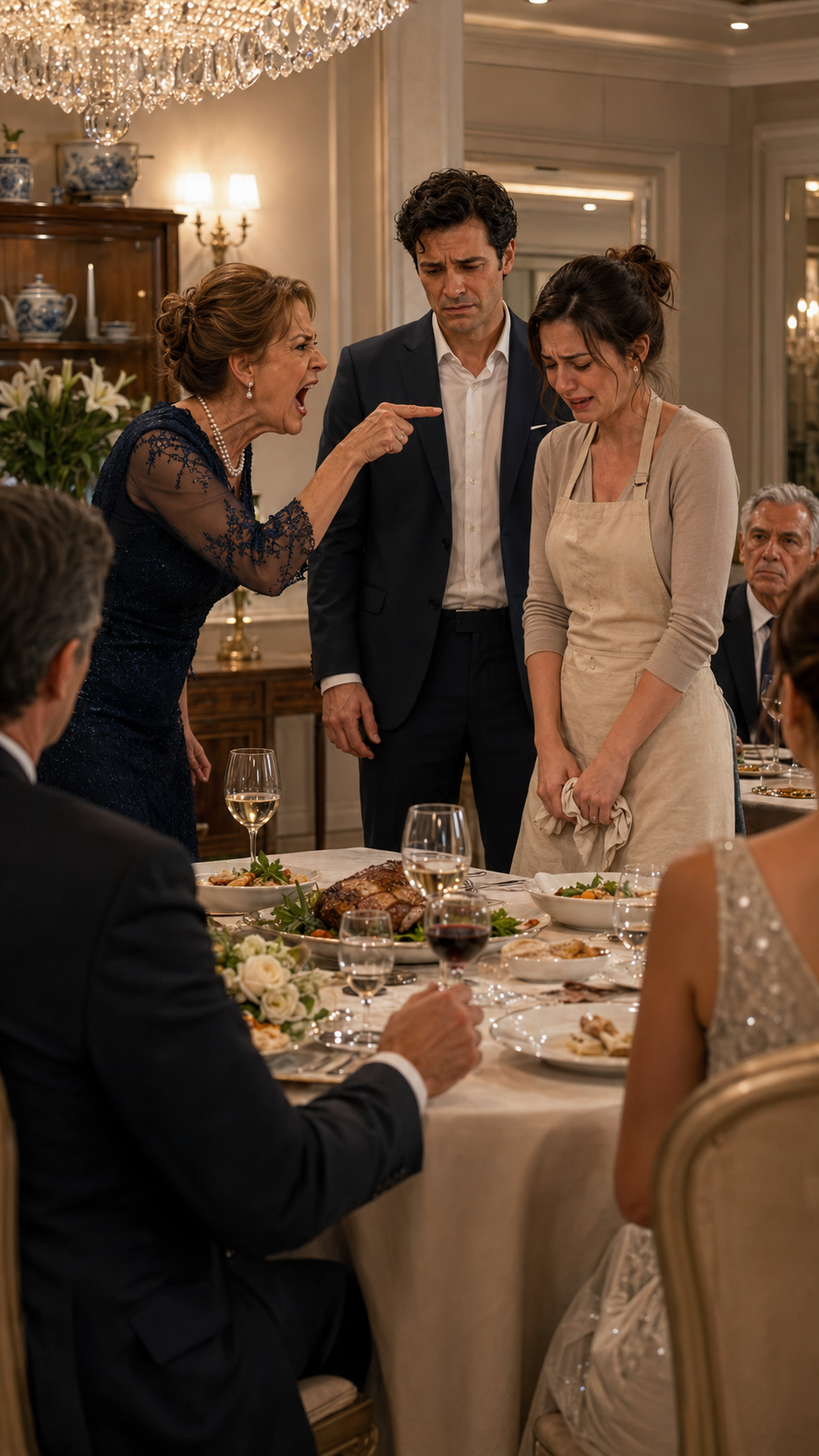
When she emerged with the freshly baked bread, Doña Graciela eyed her from head to toe.
—As you are, let her eat in the kitchen.
Diego froze.
—Mom...
—Neither Mom nor anything. Do you want your boss to think your wife looks like the help? A man’s wife must represent. And she, right now, represents nothing.
Mariana heard it all.
She didn’t lower her gaze.
She just looked at Diego, waiting for him, for once in seven years, to say something.
The doorbell rang.
Diego swallowed hard. He adjusted his watch, wiped his hands on his pants, and forced a smile.
—Honey, please… stay here tonight. You’re tired. Eat calmly in the kitchen, and we avoid problems.
Mariana set the tray on the counter.
—Am I the problem?
Diego didn’t answer.
Outside, Doña Graciela opened the door with a sweet voice.
—Licenciado Barrera! What a pleasure to have you at our home.
Mariana slowly removed her apron.
Her eyes were bright, but she didn’t cry.
—Seven years, Diego. Seven years of hearing I’m worthless, that I don’t know how to dress, that I don’t come from a fine family, that I should be grateful I married you. And you always say the same thing: “we’ll talk later.”
—Please don’t start.
—I’m not starting. I’m finishing.
Diego lowered his voice.
—This dinner is important.
Mariana let out a broken laugh.
—I was important too. Only you forgot.
From the dining room, the licenciado’s wife said:
—What a wonderful aroma! Your wife must cook amazingly.
Diego glanced toward the kitchen door.
Mariana stood there, waiting.
He could have called her.
He could have said, “She made all of this.”
He could have taken her hand.
But Doña Graciela cleared her throat behind him.
And Diego returned to the dining room.
The dinner was a success.
The licenciado asked for seconds twice. His wife requested the tart’s recipe. Doña Graciela accepted the praises as if she had spent the day in front of the oven.
Diego spoke of business, smiled, toasted, and pretended not to feel something breaking behind the kitchen door.
When the guests left, the house fell into a suffocating silence.
Diego went upstairs to check on Mateo.
The bed was empty.
—Mariana?
No one answered.
He rushed downstairs.
On the kitchen table lay a wedding ring.
Mariana’s.
Next to it, a folded note.
Diego opened it with trembling hands.
“When you read this, Mateo and I will have already left.”
Below it was a second page.
And the first line said something that took his breath away because nothing he believed about his wife was true.
PART 2
“I didn’t leave with your son to punish you. I left to save him from learning that a woman humbles herself in silence so a man can look good.”
Diego read the line three times.
Then he continued.
“For years, I thought the problem was your mother. Today I understood that the problem was you, because she attacked me, but you allowed it with your silence.”
His throat tightened.
Doña Graciela appeared at the kitchen entrance, still wearing her pearl necklace and that cold composure she used to command without raising her voice.
—Where’s the dramatic girl?
Diego looked up.
—She took Mateo.
His mother’s expression changed for just a second.
Then she pressed her lips together.
—I told you that woman was dangerous.
Diego looked at the note.
There was another line written with more force.
“If you want to know why I endured so much, open the wooden box under our bed. And then ask your mother who Tomás Arriaga is.”
Diego felt a blow to his chest.
—Who is Tomás Arriaga?
Doña Graciela paled.
—I don’t know.
—Mariana wrote to ask you.
—Then she’s manipulating you. That’s how those women start, son. First, they play the victim, then they separate you from your family.
Diego went up without answering.
In the room, everything seemed the same, but nothing was.
Mariana’s sweater hung from a chair. Her glasses were on the nightstand. Her lavender cream still perfumed the room.
Diego knelt and pulled out the box.
He had never opened it.
Not because he respected it so much, but because he had never cared enough.
Inside, he found diplomas, photographs, newspaper clippings, and letters.
The first read:
“Culinary School of Puebla. Mariana Ríos. Graduated with honors.”
Diego frowned.
Mariana had never told him that.
Or maybe she had.
Maybe he hadn’t listened.
There were job offers from restaurants in Mexico City, Guadalajara, and Monterrey. A letter from a famous chef said:
“Your talent is not domestic. Your cooking tells stories.”
Below it, a photograph showed a younger Mariana holding a plaque. Beside her stood Licenciado Barrera.
And next to him, a tall, gray-haired man in a black suit.
Diego felt he had seen him before.
On the back, someone had written:
“For Mari, who never allowed pain to take the flavor out of life. Never let anyone make you small. —Tomás.”
Doña Graciela stood at the door.
—Put those things down.
Diego lifted the photo.
—Who is he?
His mother averted her gaze.
—A man who should have stayed in the past.
—Is he Mariana’s father?
Doña Graciela didn’t respond.
That was her answer.
Diego kept searching.
He found returned letters, unopened envelopes, and a note in his mother’s handwriting.
“Mariana, a sensible wife doesn’t abandon her home for ambition. Diego needs a stable woman, not a cook with dreams of grandeur.”
The note bore no signature.
It didn’t need one.
Diego held it in front of her.
—You wrote this.
—She needed guidance.
—You ruined opportunities for her.
—I protected your marriage.
—No. You kept her locked up.
Doña Graciela crossed her arms.
—She chose to stay.
—Because you made her believe that if she chose her dream, she would lose me.
—And you agreed.
Diego opened his mouth but couldn’t defend himself.
Because it was true.
He remembered one afternoon, years ago, when Mariana wanted to tell him about an offer in Guadalajara. He had been so concerned about his job, about the wedding, about what his mother would say, that he told her:
—There will be more opportunities later.
There were no more.
Or he never asked.
His phone vibrated.
Unknown number.
He answered immediately.
—Mariana?
A male voice responded.
—Diego, I’m Tomás Arriaga.
His heart hammered against his ribs.
—Where is my wife?
—Safe. She and Mateo are with me.
Doña Graciela stepped forward.
—Hang up.
Diego activated the speaker.
—Why did Mariana send me to ask my mother about you?
Tomás paused for a moment.
—Because your mother spent eleven years ensuring Mariana believed I had abandoned her.
—That’s a lie —Graciela shot back.
Tomás’s voice remained calm.
—Hello, Graciela.
The way he said her name made the kitchen feel smaller.
—You have no right to speak —she said.
—I have the right to tell the truth. I wrote to my daughter for years. The letters returned marked as rejected. Someone changed addresses, hid messages, and convinced a wounded girl that her father didn’t want to see her.
Diego looked at his mother.
—Did you do that?
—I protected my family.
—Mariana was my family.
—No —Graciela replied too quickly.
Silence fell heavily.
For the first time, Diego heard all the cruelty hidden behind years of elegant phrases.
“Mariana doesn’t fit in.”
“Mariana is too sensitive.”
“Mariana should be grateful.”
“Mariana doesn’t understand how we are.”
It had never been advice.
It was a sentence.
Tomás continued:
—Carter House opens tomorrow. Mariana is a partner and head chef. Tonight was a private menu tasting. Barrera knew. That’s why he insisted on having dinner with you. He wanted to see if you could recognize your wife’s talent before knowing who she was.
Diego felt his face burn.
—Did Licenciado Barrera know?
—He knew Mariana was brilliant. He knew it before you did.
The phrase shattered him.
Diego remembered brochures hidden among receipts, calls in the yard, nights when Mariana wrote menus while he watched emails.
She had tried to show him her world.
He had left her talking to herself.
—Can I see her?
Tomás took a moment to answer.
—She says you can come. Alone. Without your mother.
Doña Graciela clenched her jaw.
—If you cross that door, you will regret it.
Diego looked at her.
For the first time, he didn’t see a strong mother.
He saw a woman used to ruling with fear.
—I regret more having stayed silent.
Carter House was on an old street in the downtown area, near a square filled with jacarandas and colonial facades.
It was a restored brick building, with warm lamps and a dark green sign.
Inside, the air smelled of bread, rosemary, and cinnamon.
The tables were mismatched, the chairs didn’t match, and on each plate was a card:
“Tell us a recipe that reminds you of home.”
Diego understood instantly.
That place was Mariana.
Not the dim Mariana he had allowed his mother to reduce.
The real one.
Licenciado Barrera welcomed him without a jacket, rolling up his sleeves.
—You made it.
—She let me come.
—That doesn’t mean she has forgiven you.
—I know.
Barrera looked at him sternly.
—Today you disappointed me, Diego. At work, you are efficient, smart, ambitious. But a man can win contracts and lose his home by failing to look at those in front of him.
Diego didn’t respond.
There was nothing to say.
He climbed the stairs.
Mariana was by a window, wearing a cream sweater with her hair down. She looked tired, but not broken.
That hurt him more.
Because it meant her strength no longer needed him.
—Hello —he said.
—Hello.
There was no embrace.
There were no dramatic tears.
Just two people standing before the disaster they had allowed to grow.
—Mateo is downstairs with Tomás —she said—. He’s fine. He ate. He laughed. He asked if he could call him Grandpa.
Diego looked down.
—I’m glad he’s okay.
—Your mother told him I ruined the dinner. She found him crying in the pantry.
Anger surged within him like fire.
But this time, it wasn’t for shouting and then forgetting.
It was clarity.
—She will never approach him again to speak ill of you.
Mariana looked at him with an old sadness.
—You’ve said similar things before.
—Tomorrow, she leaves the house.
—Don’t promise. Do it.
Diego nodded.
—I will.
Mariana took a deep breath.
—I didn’t leave for you to come rescue me. I left because I finally understood that I was waiting for permission to exist.
—You never needed my permission.
—No. But I needed your support.
The difference left him speechless.
Then Tomás appeared at the door with a worn leather folder.
—There’s something you need to see.
They went downstairs to the kitchen.
Mateo was at the counter trying to fold napkins into the shape of swans. They turned out like squashed tacos, but he smiled proudly.
—Dad!
Diego hugged him tightly.
—Are you two fighting? —the boy asked.
Mariana and Diego exchanged glances.
—Not anymore —she replied.
It wasn’t reconciliation.
But it was the first brick of something less broken.
Tomás opened the folder.
There were old invoices, account statements, and handwritten pages.
—This building used to be part of a catering company I had with Diego’s father —he explained—. When it went bankrupt, everyone thought I had stolen money and fled. But I found this behind an old piece of furniture.
Diego recognized his father’s handwriting.
One sheet said that several payments had been sent to a private account linked to Graciela’s house.
—This doesn’t prove everything —Tomás said—, but it explains why your mother didn’t want Mariana and me to meet. If we spoke, the past would return.
Barrera pulled out an envelope.
—We also found this.
On the front, it was written:
“Diego.”
It was his father’s handwriting.
The envelope was already open.
Diego read:
“There are truths I should have told you earlier. Graciela believes silence protects the family, but sometimes it only protects the one keeping the secret. Tomás didn’t destroy the company. Mariana shouldn’t pay for our mistakes. When the time comes, ask your mother what she agreed with Elena Ríos in the winter of 1999. Don’t accept the first answer.”
Mariana froze.
—Elena was my mother.
Before anyone could say anything more, the restaurant door swung open.
Doña Graciela entered, soaked from the rain.
She wasn’t wearing pearls.
In one hand, she held an old photograph.
In the other, a key.
—I knew you would find that letter someday —she said.
Diego clenched the paper.
—What happened in the winter of 1999?
Graciela placed the photo on the counter.
It showed her husband, Tomás, Elena Ríos, and herself in front of the same building.
Elena held a baby.
Mariana.
On the back, there was a date.
January 14, 1999.
Graciela spoke without looking at anyone.
—Your father not only hid money. He also hid a debt. Elena discovered everything and threatened to report him. I offered to pay her to leave and stop stirring up the past.
Tomás turned pale.
—Did you pay Elena to make her disappear?
—To save my husband.
Mariana could barely speak.
—My mom died believing Tomás abandoned us out of shame.
Graciela closed her eyes.
—I told her that.
The silence was brutal.
Diego felt something inside him shatter for good.
He hadn’t just lost trust in his mother.
He had understood that his silence had been part of a rotten inheritance.
Mariana took Mateo’s hand and pulled him close.
—Thank you for telling the truth —she said, her voice trembling—. But that doesn’t fix anything.
Graciela looked at her, for the first time without arrogance.
—No.
Diego set the letter on the counter.
—Mom, tomorrow you pick up your things. You will no longer live in my house. And you will not see Mateo without Mariana’s agreement.
—Are you throwing me out for her?
Diego took a deep breath.
—No. I’m kicking you out for me. Because I no longer want to be the man you taught to stay silent.
Graciela lowered her gaze.
No one celebrated.
Justice rarely sounds like applause.
Sometimes it sounds like a woman closing a door she should have closed years ago.
Mariana didn’t go home that night.
Nor the next day.
She opened Carter House with her mother’s name on the first menu and with Mateo distributing crooked napkins among the tables.
Diego arrived alone, sat at the back, and ordered the lemon tart.
When he tasted it, he cried silently.
Not because the dessert was perfect.
But because he understood he had eaten Mariana’s love for years without appreciating it, defending it, or even savoring it.
And that’s the part many don’t want to accept:
sometimes a family doesn’t break when someone leaves.
Sometimes it breaks much earlier when everyone sees the humiliation…
and no one says a thing.





