PART 1
"Let her come. I want to see her sitting in the back, swallowing her pride."
That was what Doña Graciela Aranda said as she selected bone-colored invitations, with golden lettering and a silk ribbon that smelled like old money.
It wasn’t an invitation.
It was a mockery wrapped in expensive paper.
The intended recipient was Camila Ortega, the woman who, four years earlier, had left the Aranda mansion in Zapopan crying, with a small suitcase and a dignity quietly shattered.
Camila had loved Julián Aranda with that kind of love that one still believes is pure, even when everyone around taints it.
He was the heir to a chain of private hospitals and aesthetic clinics in Guadalajara, Monterrey, and Cancún. His last name appeared in social magazines, at business dinners, and in those photos where everyone smiles as if they owe nothing.
Camila, on the other hand, came from Tonalá.
The daughter of a seamstress and a truck driver. She studied special education, worked tutoring children in the afternoons, and dreamed of opening a center for single mothers who couldn’t afford therapy for their children.
She met Julián at a university café when he was trying to use a printer as if it were a spaceship.
"Do you also need me to explain how to breathe, dude?" she said, laughing.
Julián genuinely laughed.
From that day on, he began to seek her out. First with silly excuses. Then with simple flowers. After that, with enormous promises.
With Camila, Julián wasn’t "Mr. Aranda."
He was a nervous, sensitive man, tired of living under the shadow of a mother who turned everything into business, surname, and appearance.
He promised her a house with clay pots, Sunday breakfasts, children running barefoot, and a life where no one had to pretend to be perfect.
But when he took her to meet Doña Graciela, everything changed.
The lady received her with a fine smile and a piercing gaze.
"What a natural girl," she said during dinner. "Though to enter certain families, it’s not enough to just be a good person."
Camila understood the blow.
Julián didn’t want to understand it.
Then came the worst.
Doña Graciela demanded medical studies before discussing commitment.
"In this family, we safeguard the future," she said, stroking her pearls. "We can’t leave everything to chance."
Camila accepted because Julián swore that nothing would separate them.
But the results didn’t turn out as the lady expected.
The doctor explained that Julián had low fertility and that Camila had a hormonal issue that could complicate a pregnancy. Complicate, not prevent.
Doña Graciela heard "complicate" and turned it into a condemnation.
"A woman who may not be able to give my son children cannot be part of this family."
Camila looked at Julián, waiting for one word.
Just one.
But he lowered his gaze.
That silence broke something that no insult could have shattered.
That night Camila left.
Julián didn’t follow her. He didn’t call. He didn’t knock on her door.
Two months later, Camila discovered she was pregnant.
At eight weeks, the ultrasound showed three heartbeats.
Three babies.
Camila cried sitting in a public clinic, not from complete happiness, but from fear. She knew that if she returned, Doña Graciela would turn her children into proof, scandal, or property.
So she disappeared.
She moved to Querétaro with the help of Teresa, a retired teacher who treated her like a daughter. There, Emiliano, Santiago, and Valentina were born. Premature, tiny, stubborn to live.
Four years passed.
Julián became what his mother wanted: the CEO, cover boy, perfectly tailored suit, and a girlfriend chosen almost as an investment.
Paola Luján, heir to construction companies, elegant, obedient, impeccable.
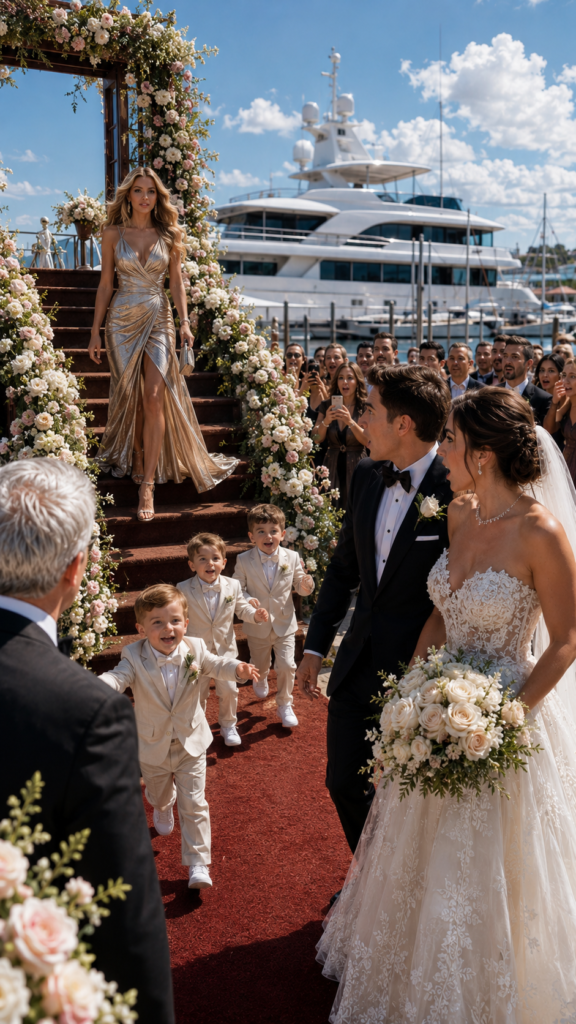
The wedding would be at a luxury estate in Tequila, Jalisco. White flowers, fine mariachi, politicians, cameras, businessmen, and 250 guests waiting to see the union of the year.
Then Doña Graciela sent an invitation to Camila.
"Let her see that my son has indeed found a woman of his level."
But Camila was no longer the broken girl she remembered.
On the afternoon of the wedding, a gray SUV slowly entered down the stone path.
Camila stepped out in a light blue dress, simple, elegant, without exaggerated jewelry. She stood tall, with a calmness that made everyone more uncomfortable than any scream.
Then three four-year-olds got out.
Two boys and a girl.
They had Julián’s eyes, Julián’s dark hair, and the same small mole next to the left eyebrow that appeared in childhood photos of the Arandas.
The mariachi stopped playing.
The guests began to murmur.
Doña Graciela turned pale.
Julián, standing at the altar, seemed to have forgotten how to breathe.
Valentina squeezed Camila's hand, looked at the groom, and asked with a voice so innocent it split the estate in two:
"Mom… is he the dad you said didn’t know us?"
PART 2
No one moved.
Not the flowers, nor the waiters, nor the photographers. Even the wind seemed stuck between the arches of the estate.
Paola, dressed as a bride, didn’t look at Camila first.
She looked at the three children.
Then she looked at Julián.
And on her face, a truth appeared that she had been trying not to see for two years.
"Did you know?" she asked.
Julián opened his mouth, but no voice came out.
His eyes bounced from Camila to the children, from the children to his mother, and from his mother to the ground.
"No," he finally said. "I swear I didn’t know."
Paola let out a sad, reluctant laugh.
"Maybe you didn’t know about them. But you knew you never loved me completely."
Julián tried to approach.
She took a step back.
"Every time we talked about children, you looked lost. Every time I asked if there was someone else in your heart, you said no. Now I understand why your eyes always wandered elsewhere."
Doña Graciela reacted as if the shame were Camila’s fault.
"This is vulgar," she said, advancing with a hard face. "How dare you come to set up this little show?"
Camila pulled the invitation from her bag and held it up in front of everyone.
"You invited me, Doña Graciela. It says right here that my presence was important."
The murmurs grew.
A businessman lowered his cellphone. An aunt of Paola crossed herself. The photographer didn’t know whether to take pictures or hide his camera.
"I invited an ex-girlfriend," Graciela spat. "Not a woman who arrives inventing children in front of all of Guadalajara."
Camila didn’t shout.
She didn’t need to.
"They aren’t inventions. They are your grandchildren."
Julián took a step towards the children.
Valentina hid behind her mother’s dress. Santiago hugged a plastic dinosaur. Emiliano, serious as a little adult, lifted his chin.
"Don’t come near," he said.
Julián stopped as if a hand had been placed on his chest.
"You’re right," he replied quietly. "They don’t know me."
Santiago looked at him with wide eyes full of questions.
"Did you know we existed?"
Julián slowly shook his head.
"No. Their mom left before knowing."
Emiliano didn’t blink.
"And did you look for her?"
Camila remained silent.
She wasn’t going to rescue him from that question.
Julián swallowed hard. In front of 250 guests, in front of his girlfriend, in front of the mother who had shaped him to her liking, he had to speak the most shameful truth of his life.
"No."
Valentina peeked out.
"Why?"
Julián closed his eyes.
"Because I was a coward. Because I let my mom decide for me. Because when I should have defended their mom, I stayed silent like an idiot."
Doña Graciela gritted her teeth.
"Don’t lower yourself! You don’t have to explain anything to those children."
Camila turned to her.
"They deserve explanations. I left because you treated me like a defect. Because you used a medical study to humiliate me. Because you said I wasn’t good enough for your family. And because he, the man who said he loved me, looked at the floor."
Julián lowered his head.
Every word was true.
Paola slowly took off her engagement ring. She placed it on a table covered with white roses.
"I deserved a man who truly chose me. Camila deserved respect. And those children deserved a father from the beginning."
Graciela tried to grab her arm.
"Paola, think of the scandal. Think of your family."
Paola looked at her with a calm that hurt.
"I'm not going to marry to save anyone’s last name."
Then she looked at Camila.
"Thank you for arriving before I signed the most expensive lie of my life."
Paola walked toward the exit.
Her veil brushed against the fallen flowers.
And the wedding ended without a wedding.
But the real fight was just beginning.
Hours later, Julián asked to speak with Camila in a private room of the estate. The children were with Teresa, the woman the triplets called Grandma Tere, even though they didn’t share blood.
Julián didn’t sit.
"Why didn’t you tell me?" he asked.
Camila let out a dry laugh.
"For what? So your mom could ask for another test? So she could say they were someone else’s? So you could go silent again?"
He didn’t defend himself.
"I deserve it."
"I didn’t come for you, Julián. I came for them. Last night Valentina asked me why at the kindergarten festival everyone had a dad except her. Santiago said maybe his dad got lost. Emiliano didn’t say anything, but he stopped drawing full families."
Julián’s face broke.
"I didn’t know."
"You didn’t know because you chose not to know."
Camila opened a green folder and placed it on the table.
There were birth certificates, ultrasounds, incubator reports, photos of the babies with tubes in their noses, and a DNA test done months earlier by a lawyer in Querétaro.
Julián read with trembling hands.
Probability of paternity: 99.9%.
He lifted his gaze, destroyed.
"They’re mine."
Camila corrected, firmly:
"They are their own. You are their biological father. Being their dad, you still have to earn it."
At that moment, the door burst open.
Doña Graciela entered with a lawyer and a warlike expression.
"Then let’s talk about custody."
Camila didn’t move.
She looked at her directly, unafraid.
"Custody?"
Graciela lifted her chin.
"They are Aranda. You can’t have three children with that blood living as if they have no future."
Camila smiled faintly.
"How strange. Four years ago, that same blood didn’t matter to you when you called me insufficient."
The lawyer tried to intervene.
"Mrs. Ortega, the family just wants to ensure the welfare of the minors."
"Lawyer," Camila replied, "if you use welfare as a synonym for money again, this conversation ends."
Julián stepped in front of his mother.
"Mom, leave."
Graciela blinked.
"Pardon?"
"Leave this room."
"Julián, you’re upset. That woman is manipulating you."
"No. The one who manipulated everything was you. Me, Paola, Camila. Today it ends."
Graciela pointed at the folder.
"Are you going to accept that without fighting for the last name?"
Julián took the DNA test.
"I’m not going to fight against the mother of my children so you can turn them into trophies."
The lawyer understood first and closed his briefcase.
"Mrs. Aranda, it’s advisable to withdraw."
Graciela left furious, but for the first time, she didn’t win.
Julián was left facing Camila, small in his expensive suit.
"I’m not going to let her attack you again."
Camila looked at him for a long time.
"The problem is, you did allow it before."
"I know."
"And that doesn’t get fixed with a pretty phrase."
"I know."
"My children don’t need last names in magazines, or gifts in SUVs, or parties with politicians. They need stability. They need adults who show up when they promise to. They need not be used to wash away guilt."
Julián nodded.
"I will do what you decide. Legal agreement, family therapy, supervised visits. I don’t want to win. I want to repair."
Camila thought about four years of fevers, diapers, debts, sleepless nights, birthdays without a father, and questions that broke her soul.
None of that would return.
"We’ll start slowly," she said. "With an agreement before the family court. Short visits. No press. No mother around until I decide it’s safe."
Julián breathed as if that small opportunity were more than he deserved.
"Thank you."
"Don’t thank me. Just comply."
And he complied.
The next day, the news exploded on social media.
"Ex-girlfriend arrives with triplets at the wedding of Jalisco heir."
"Bride cancels wedding in Tequila."
"Scandal in the Aranda family."
Doña Graciela tried to control the narrative. She called journalists, friends, entertainment hosts. She wanted to say that Camila had come for money.
Julián stopped her with a simple statement:
"Camila Ortega did not lie. My children exist because she had the courage to care for them alone. I failed by not looking for her and not defending her. I ask for respect for her, for Paola, and especially for the children."
Graciela called him in a fury.
"You just destroyed us."
"No, Mom. I just stopped lying."
The first visits were in Querétaro.
Julián quickly understood that being a dad wasn’t about posing with pretty kids. It was sitting on the floor to build blocks. It was learning that Santiago hated carrots in soup, that Valentina slept with a light on, and that Emiliano went very serious when he was scared.
He also met Daniel Robles.
Daniel was a paramedic, Teresa’s neighbor, and the man who had taken Camila to the hospital the night the babies were born prematurely. He had donated blood. He had bought medicine. He had carried all three when they weighed less than a bag of bread.
The children called him "Uncle Dani."
Julián felt jealous at first, but he swallowed it.
One afternoon, Santiago fell in the yard and scraped his knee. Julián ran first.
"It’s okay, champ. I’m here."
Santiago hugged him without thinking.
Julián froze.
It was the first time one of his children sought him out.
Camila watched from the door.
She didn’t smile.
But she didn’t look away either.
That night, Julián said to her:
"I know I arrived late."
"Yes."
"I know Daniel was there when I wasn’t."
"Yes."
"I’m not going to compete with him."
"You better not," Camila replied. "He didn’t take your place. He cared for what you abandoned before knowing it existed."
Julián lowered his head.
"Then I’m going to respect him."
Six months passed.
Julián arrived at the kindergarten festival 20 minutes early, without bodyguards, without photographers, without a show-off watch. He sat in the back, where Camila indicated.
When Valentina saw him from the stage, she raised her hand.
"Hi, Dad," she said softly.
But the microphone picked it up.
Julián cried without hiding.
Emiliano, at the end, handed him a drawing. It showed Camila, Teresa, Daniel, Santiago, Valentina, and him. Julián appeared to the side, a little separated.
"You still don’t fit close," Emiliano said.
Julián took the drawing as a just sentence.
"That’s okay. I’m going to earn my place."
Later, Graciela asked to see Camila.
She arrived at the community center that Camila had finally opened: "Casa Raíz." There, women learned to read contracts, adults finished high school, and single mothers received support for their children.
Graciela wasn’t wearing pearls.
Nor was she with a driver.
She walked among simple classrooms and walls painted by volunteers.
"I was wrong about you," she finally said.
Camila crossed her arms.
"I’m not going to forgive you today just because you finally found nice words."
"I understand."
"My children are not prizes for remorseful grandmothers. If one day they meet you, it will be slowly. And if you measure them like you measured me, you won’t see them again."
Graciela lowered her gaze.
"I accept."
Camila didn’t fully believe her.
But she understood that sometimes even the hardest pride begins to crack when it is left alone.
On the day of the official inauguration of Casa Raíz, the patio was filled with neighbors, students, teachers, and local reporters.
The children ran between the chairs.
Teresa was serving hibiscus water.
Daniel was setting up speakers.
Julián arrived with simple flowers.
Graciela appeared at the back, silent.
Camila climbed onto a small platform.
"This place is for those who once heard they weren’t enough," she said. "For those who were measured by their surname, their money, their origin, their body, or by someone else’s idea of how their life should be."
She looked at her children.
Then at Julián.
Then at Graciela.
"No one has the right to decide the value of another person just because that person doesn’t fit in their version of family."
The applause filled the patio.
Julián cried.
Graciela did too.
And Camila, the woman invited to a wedding to be humiliated, stood before everyone, taller than ever.
Not because she had destroyed those who looked down on her.
But because she built a life so full of love, work, and dignity that those who once looked down at her had to lift their gaze to see her.
Sometimes, the best response isn’t revenge.
It’s surviving without becoming cruel.
It’s protecting the children without teaching them hatred.
It’s showing that a surname can buy halls, flowers, covers, and silences, but it can never buy the courage to stay when loving costs.





