PART 1
Clara Méndez arrived home in Coyoacán with her black dress clinging to her body and her eyes swollen from crying.
She had just come from the cemetery.
She had buried Doña Inés, her grandmother, the only person who had ever asked her to be more for the sake of others’ comfort.
In the passenger seat, she carried a folder from the law firm. Inside was the news that had trembled in her hands just hours before: Doña Inés had left her accounts, investments, a ranch in Valle de Bravo, and assets worth 140 million pesos.
Clara thought of Daniel.
After 27 years of marriage, of debts, silent disputes, and sleepless nights, perhaps this inheritance would give them breath.
Maybe they could pay what was overdue.
Maybe they could talk without money being a stone in the middle of the table.
But when she got out of the car, Daniel didn’t come out to embrace her.
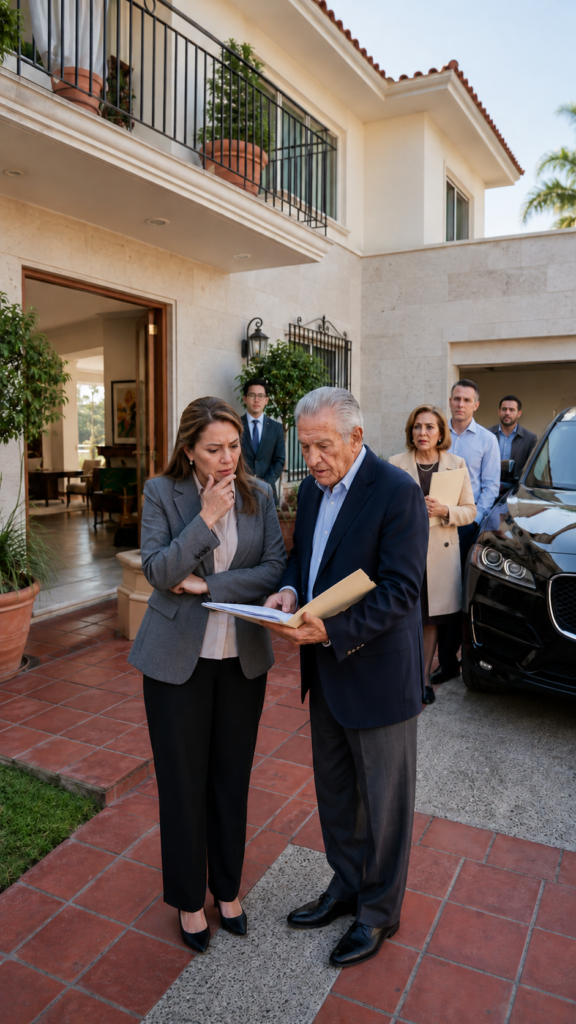
He was on the porch with his mother, Patricia Villaseñor, a woman of pearls, tight lips, and a soft voice that knew how to wound without ruffling a hair.
Between them was a thick folder.
“The house has already been sold,” Patricia said. “And Daniel has already signed the divorce. Now, Clarita, stop the drama and accept what’s due.”
Clara stood frozen.
For a moment, she thought she had misheard.
The bougainvillea on the wall had just been cut. The Talavera pot she had bought in Puebla was gone. The curtains she had sewn one Christmas, when there was no money even for decorations, had disappeared.
This wasn’t a move.
It was an erasure.
“Did you sell my house while I buried my grandmother?” Clara asked.
Daniel looked down.
That look Clara knew all too well.
It was the same look he wore when he promised to talk to his mom and never did.
The same look he had when he hid debts.
The same look he wore when he preferred to appear tired rather than guilty.
“Don’t make it harder,” he murmured. “It was already decided.”
Patricia extended the papers toward her.
“Sign. Your things are in a storage unit. The personal items, of course. The rest stays because it’s already part of the sale.”
Clara felt her throat burn.
She had spent 27 years swallowing comments disguised as good manners.
“What a brave haircut you have.”
“Daniel always dated finer women.”
“There are wives who inspire protection and others who only serve to endure.”
And Daniel always said the same thing:
“That’s how my mom talks.”
That day, Clara understood it wasn’t just how Patricia spoke.
It was how Daniel obeyed.
“The buyers are on their way,” Patricia warned, looking down the street. “Don’t embarrass us.”
Then a black truck stopped in front of the house.
Two men got out. One young, with a portfolio. The other older, with silver hair, a dark suit, and a calm that commanded more than any shout.
Daniel smiled nervously.
“Welcome. I’m Daniel Villaseñor. We can make the delivery.”
The older man didn’t respond.
He walked straight to Clara.
“You must be Clara.”
She nodded.
“I’m Álvaro Montes. I was Doña Inés’s lawyer for 32 years.”
Patricia lost her color.
Álvaro pulled out a cream envelope, sealed with wax.
“Your grandmother asked me to give you this only if someone tried to sell, transfer, or evict you from this property without your consent.”
Clara saw her name written in Doña Inés’s handwriting.
On the front, it read:
“For Clara. Open when Patricia finally dares to play dirty.”
And Daniel, for the first time all afternoon, started to tremble.
PART 2
Silence fell over the porch as if someone had turned off the world.
Patricia stepped toward the envelope, but Álvaro raised his hand.
“No, Mrs. Villaseñor. This letter is not for you. Although, from what I see, it was written with you in mind.”
Daniel tried to smile.
It came out as a grimace.
“Sir, there must be a misunderstanding. The house is in my name. I could sell it.”
The young lawyer opened his portfolio and placed a folder on the hood of the truck.
It had color-coded dividers, notary seals, certified copies, and signatures.
Too many signatures.
“It was in your name for limited administration,” Álvaro said. “Not for unilateral sale. This house is linked to a restrictive trust created by Doña Inés years ago.”
Clara felt the floor shift beneath her feet.
“Did my grandmother do that?”
“Your grandmother was a very calm woman,” Álvaro replied. “But she was not naive.”
Patricia let out a dry laugh.
“Inés was always a nosy old woman.”
Clara looked at her.
She didn’t scream.
She didn’t cry.
She just looked at her with a calm that scared more than any insult.
“My grandmother is dead, Patricia. And even so, she prepared better for you than you did for me.”
Daniel closed his eyes.
Álvaro pulled out a sheet.
“Mr. Villaseñor, read clause 4. Out loud.”
“I’m not going to do that here.”
“Then I will read it. But it’s in your best interest to understand that your signature is at the end of the acknowledgment.”
Patricia turned sharply toward her son.
“What signature?”
Daniel didn’t answer.
The young lawyer showed the document.
“8:17 a.m. Three days ago. Before the supposed sale.”
Clara remembered that morning.
She was at the Santa Fe hospital, holding her grandmother’s cold hand.
Daniel had told her over the phone that he had an urgent meeting.
It wasn’t a meeting.
It was the signing of his betrayal.
Álvaro read:
“The designated administrator may not sell, encumber, evict, transfer, or compromise the property without written authorization from Clara Inés Méndez. Any attempt made through deceit, pressure, intentional omission, or during an induced separation will activate the immediate reversion of fiduciary control.”
The word reversion hit Patricia in the face.
“That can’t be legal,” she said.
“It is,” Álvaro replied. “And very well done, by the way.”
The older buyer, who had been observing with crossed arms, looked at Daniel with rage.
“You assured us there were no impediments.”
Daniel swallowed hard.
“It was a misunderstanding.”
Clara spoke for the first time with firmness.
“It wasn’t a misunderstanding. It was a decision.”
No one replied.
Clara broke the seal on the envelope.
Inside was a letter and an old photograph.
The photo fell face up.
Patricia appeared younger, sitting in the living room of that same house. She didn’t smile. Her eyes were tearful, and she held a pen in her hand.
Daniel frowned.
“What is that?”
Clara turned the photograph over.
On the back, in Doña Inés’s elegant handwriting, it read:
“When Patricia denies knowing this house, ask her about the signature she left here before Daniel was born.”
Patricia brought a hand to her pearls.
For the first time, they seemed to tighten around her neck.
Álvaro took a deep breath.
“Doña Inés bought this property decades ago when Patricia was going through legal problems due to a family debt. She allowed the Villaseñor family to live here under specific conditions. Patricia signed a domain acknowledgment and waived any right to disposition.”
Daniel looked at his mother.
“You knew?”
Patricia pressed her lips together.
“I did what I had to do to protect you.”
Clara let out a brief, bitter laugh.
“Protect him? You taught him to sell what wasn’t his and to throw his wife away like she was trash.”
Daniel stepped toward her.
“Clara, I didn’t know it was that serious.”
There it was.
He didn’t apologize for abandoning her.
He didn’t apologize for the storage unit.
He didn’t apologize for the divorce.
He only complained about the consequences.
Clara read her grandmother’s letter.
“Little one, if you’re reading this, it means Patricia did what I always suspected: tried to take you out of a house you didn’t understand and from a life she thought she could control.
Daniel was raised to obey her. That doesn’t make him innocent. It makes him useful.
Don’t sign if they rush you.
Don’t explain if they humiliate you.
Let the papers speak before your pain.”
Clara felt her legs give way, but she didn’t fall.
Inside, something that had been bent for years began to straighten.
“I want my things back,” she said.
Daniel nodded quickly.
“Sure, I’ll call the storage unit right now.”
“Not you.”
Clara looked at Álvaro.
“I want everything documented one by one. Photographs, inventory, condition of each item.”
Álvaro inclined his head.
“Doña Inés recommended that.”
Patricia exploded.
“This woman can’t keep everything!”
The entire porch went still.
There was the unvarnished truth.
Not “daughter-in-law.”
Not “wife of my son.”
Not “Clara.”
This woman.
As if she had been an intruder for 27 years.
Clara took only a step closer.
“I’m not going to keep everything, Patricia. I’m going to keep what’s mine. The difference hurts you because you never thought I could have something without asking your permission.”
Patricia opened her mouth, but she found no elegant phrase to save her.
The young lawyer received a message.
He showed it to Álvaro.
“There is a record of the move-in at 9:32 a.m. There are also photographs of the inventory. Several pieces were not part of the sale.”
Clara breathed slowly.
Her curtains.
Her notebooks.
The photos of her grandmother.
The Talavera pot.
Everything treated as surplus.
Álvaro closed the folder.
“From this moment on, Clara resumes provisional fiduciary control of the property. No one enters, no one takes anything out, no one destroys documents, no one hands over keys.”
The older buyer looked at Daniel with disdain.
“I’m going to cancel the operation and demand damages.”
Daniel paled.
Patricia tried to take his arm, but he pulled away.
That gesture was small.
Late.
Almost useless.
But Patricia felt it like a slap.
Clara opened the door to the house.
The living room was almost empty.
They had removed pictures, lamps, and small furniture. On the hallway wall, there was a rectangular mark where a photo of her with Doña Inés used to hang.
The house smelled of dust, lemon, and goodbye.
Daniel entered behind her.
“I thought it was the best thing to do.”
Clara didn’t turn around.
“No. You thought it was the easiest.”
He remained silent.
The next day, Álvaro sent the preliminary inventory.
At 10:05 a.m., the list of removed items appeared.
At 12:40 p.m., the moving company acknowledged that there were three boxes without registration.
At 4:18 p.m., the buyer formally canceled the sale.
At 6:30 p.m., the first message from Daniel arrived:
“Forgive me. My mom pressured me.”
Clara read it hours later.
She didn’t cry.
She just turned off her phone.
Because she understood that a man nearing 50 who blames his mother for signing a betrayal is still not repentant.
He’s just scared.
A week later, the things returned.
She didn’t let Daniel touch a single box.
Álvaro’s assistants photographed everything. The pot came back with a crack. The curtains arrived filled with dust. Doña Inés’s album appeared beneath cooking utensils, as if memory had also been packed away without respect.
Clara opened it in the middle of the living room.
On the first page was a photo of her at 10 years old, sitting next to her grandmother under a jacaranda tree.
On the back, it said:
“Clara observes before speaking. That will save her.”
Then she cried.
Not as a victim.
She cried as someone who discovers she was loved even in silence.
The divorce wasn’t quick.
Daniel wanted to negotiate.
Patricia tried to play sick.
She sent crying audios, saying Clara was destroying the family.
But Clara had already understood something: sometimes family isn’t destroyed when a woman sets boundaries, but when others confuse love with enduring humiliation.
The trust halted the sale.
The signatures were reviewed.
The move was documented.
Daniel had to answer for damages, omissions, and marital pressure.
Patricia had to testify about that old signature, the one Doña Inés kept for decades like someone keeps a match to ignite the truth at the exact moment.
Months later, Clara returned to the house at sunset.
The bougainvillea had grown back.
The swing was installed.
The linen curtains, washed and repaired, moved with the breeze.
The box with her name was no longer at the entrance.
And Clara was not the same either.
Sometimes you’re not tossed out of a life with screams.
You’re tossed out with folders, signatures, and well-dressed silences.
But sometimes a grandmother leaves you armor inside a cream envelope.
And when you finally open it, you understand that the war didn’t start the day they tried to erase you.
It started many years before, when someone who loved you decided that if one day they wanted to leave you on the street, the truth would already be waiting with your name written on the first page.





