PART 1
When Mauricio Ortega returned to Mexico after five years of working in Saudi Arabia, he didn’t tell anyone.
Not his mom.
Not his sister.
Not even Elena, his wife.
He had spent five years under a sun that felt like God’s punishment, hauling rebar, breathing dust, and sleeping in rooms where eight men shared the same exhaustion.
Every month he sent $1,800 to Mexico.
The money went straight to his mother’s account, Doña Graciela, because when he left, Elena didn’t have an account of her own and their son, Santito, was just a baby.
Mauricio trusted his mom blindly.
“Make sure Elena has everything she needs, Mom.”
“Make sure my son eats well.”
“Let them live peacefully in the house.”
And Doña Graciela always replied the same.
“Yes, son, don’t worry.”
“Elena is at the plaza.”
“Santito is asleep.”
“Your wife went to the salon; she’ll call you later.”
But Elena hardly ever called.
When Mauricio asked, his mother sighed like a martyr.
“It’s just that your wife has become very strange, son. Very high-maintenance. You know how some women are when they get a little money.”
It hurt Mauricio to hear it, but he thought maybe Elena was resentful of his absence.
So he endured.
He endured the heat, the loneliness, and the nostalgia.
He endured birthdays over video calls that never came.
He endured Christmases eating dry rice while imagining his wife and son sitting in the spacious living room of the mansion he had paid for brick by brick on the outskirts of Metepec.
When his contract ended early, he decided to surprise them.
He brought fine chocolates, a gold bracelet for Elena, and an enormous box of toys for Santito, who was now six.
In the taxi, Mauricio smiled like a fool.
He imagined his son running through the garden.
He imagined Elena crying tears of joy.
But upon arriving in front of the mansion, something squeezed his chest.
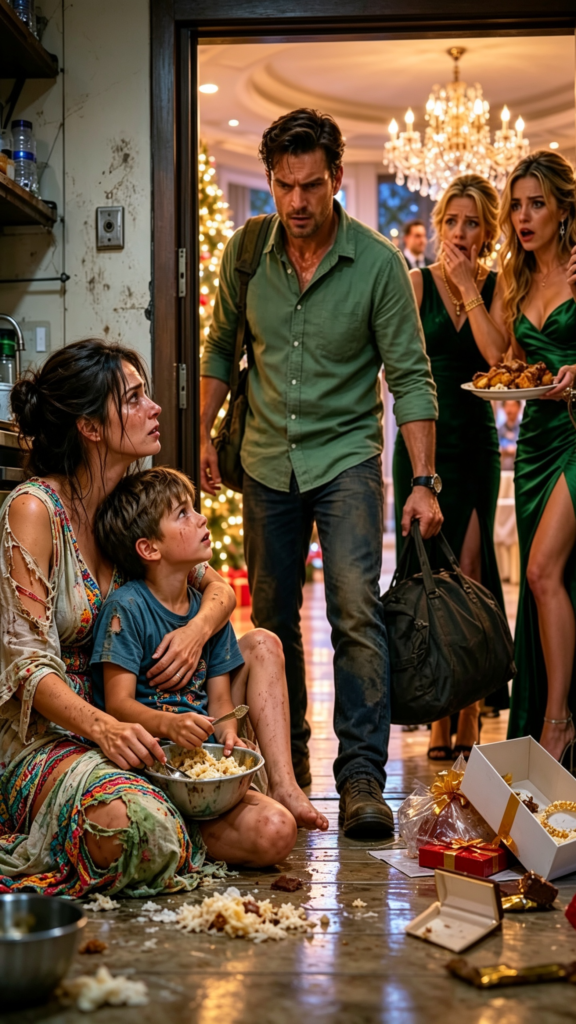
The house was lit up like a party hall.
There was banda music, laughter, luxury trucks, and women entering in shiny dresses.
From the gate, he saw Doña Graciela, adorned in jewels, raising a glass as if she owned an empire.
His sister, Priscila, danced in the window wearing a red dress and a necklace that Mauricio recognized instantly.
It was the necklace he had bought for Elena on their anniversary.
Mauricio didn’t enter through the front door.
He circled the house through the service hallway, the same one used by gardeners and delivery men.
Then he heard a soft cry.
He stopped.
From the small room behind the kitchen came the voice of a child.
“Mom… I’m hungry. Can I have some chicken from the party?”
Then he heard Elena, tired, almost without strength.
“No, my love. If your grandmother hears us, she’ll get mad. Eat this. I took the bad parts out of the rice; it doesn’t taste so sour now.”
Mauricio felt his soul drop to the ground.
He pushed open the rusty door.
There was Elena.
Thin, pale, dressed in an old, torn dress from the shoulder, sitting on a plastic stool.
In front of her was Santito, his son, eating washed rice from a chipped plate.
Behind them were two changes of clothes, a thin blanket, a bucket, and a black pot.
They didn’t live in the mansion.
They lived hidden behind it.
Like an inconvenience.
Like servants.
Like trash.
At that moment, the door connecting to the main kitchen opened.
Priscila entered carrying a tray of roasted chicken.
She wrinkled her nose upon seeing them.
“Don’t you dare touch the guests’ food. If there’s anything left, we’ll see.”
Elena lowered her gaze.
Santito hugged his plate.
Mauricio dropped the suitcase.
The toys hit the floor with a dull thud.
Priscila turned.
The tray trembled in her hands.
Doña Graciela appeared behind her, still holding her glass aloft.
When she saw Mauricio, she turned pale.
And he, looking at his mother, his sister, his broken wife, and his hungry son, understood that the five years of sacrifice hadn’t built a home… they had fed a betrayal that was impossible to forgive.
PART 2
For a few seconds, no one spoke.
The music kept playing inside.
The guests laughed, toasted, shouted “cheers!” without imagining that behind the main kitchen was about to explode the true story of that mansion.
Mauricio walked slowly toward Santito.
The boy didn’t recognize him at first.
He looked at him with fear, as if any adult entering through that door were a threat.
That broke his heart more than the plate of rotten rice.
“It’s me, champ,” Mauricio said, his voice breaking. “I’m your dad.”
Santito blinked.
He looked at Elena.
She began to cry silently.
Then the boy dropped the plate and ran to Mauricio.
He hugged him around the legs with desperate strength.
“Dad… are you going to get us out of here?”
Mauricio closed his eyes.
He didn’t ask, “What happened?” because the answer was right in front of him.
It was in the bony frame of Elena.
In the torn shoes of his son.
In the necklace of his wife hanging from Priscila’s neck.
In Doña Graciela’s wine glass.
Doña Graciela reacted first.
“Son, it’s not what it looks like.”
Mauricio raised his hand.
“Shut up.”
It was a single word.
But it fell like a stone.
Priscila tried to adjust her dress, feigning indignation.
“How rude you are, Mauricio. You show up after five years and don’t even say hello. Your wife has always been useless. We had to manage everything.”
Elena lifted her face.
For the first time, she didn’t stay silent.
“Manage?” she murmured. “They took away my phone. They took away my documents. They told me Mauricio asked that I not touch his money.”
Mauricio turned to his mother.
Doña Graciela clenched the glass.
“I did it for you, son. That woman wanted to spend everything. I protected your assets.”
Santito, glued to his dad’s pants, whispered:
“My grandma said you didn’t love us anymore.”
Mauricio felt something dark rise in his chest.
He didn’t shout.
That was what scared the two women the most.
He pulled out his cell phone.
He dialed.
“Lawyer Vargas, this is Mauricio Ortega. I just arrived in Mexico. I need you to come to my house with the police. Yes, now. Also bring the notary.”
Doña Graciela’s eyes widened.
“Police? Why police, Mauricio? Don’t make a scene. There are important guests.”
Mauricio let out a bitter laugh.
“Oh, are you worried about the scene? How odd. You weren’t worried about my son eating garbage behind my house.”
Priscila set the tray down on the table.
“You’re exaggerating, dude. Don’t be dramatic. They’ve never lacked a roof.”
Elena struggled to stand.
“A roof isn’t living locked away.”
And then she told everything.
At first, Doña Graciela told her that Mauricio had ordered them to save.
That they couldn’t spend much.
Then she took away the master bedroom and sent her to the service room “only while guests were arriving.”
Then the guests never left.
Priscila started wearing Elena’s clothes.
The jewelry.
The perfumes.
Even the truck that Mauricio had bought “for his family.”
Every time Elena asked to speak to Mauricio, Doña Graciela told her he was busy.
When Elena insisted, they broke her phone.
When she wanted to leave with Santito, they hid the child’s birth certificate.
“They told me that if I left, they would say I abandoned the house and that I was crazy,” Elena said. “And because you sent the money in your mother’s name, no one would believe me.”
Mauricio looked into the small room.
In one corner, he saw an old notebook.
He picked it up.
It was Elena’s.
There were notes, with dates, of every day she asked for help.
“March 15: Santito had a fever. They wouldn’t let me take him to the doctor.”
“June 2: Priscila sold my bracelet.”
“September 9: Graciela said Mauricio asked that I not call.”
“December 24: we were given cold leftovers after dinner.”
Mauricio swallowed hard.
Each line was a stab.
Doña Graciela changed her tone.
“Son, understand me. I suffered too. You left me alone. Your sister had debts. The house needed maintenance. What did you want me to do?”
“Feed my son?” he replied.
The phrase left her speechless.
At that moment, the music stopped.
Someone from the party had seen the argument from the hallway.
The guests began to peek in.
Ladies with glasses.
Men in expensive suits.
Nosy neighbors recording with their phones.
Doña Graciela composed herself and raised her voice.
“This woman is manipulating my son! She’s always been self-serving! Mauricio sent money for everyone, not just for her!”
Elena lowered her gaze, as if it still hurt her to defend herself.
But Mauricio wasn’t going to allow it.
He opened his backpack.
He pulled out a thick folder.
Doña Graciela paled again.
“Before coming back, I stopped by the bank in Mexico City,” Mauricio said. “They gave me all the transactions.”
Priscila swallowed hard.
Mauricio began to read.
“$1,800 every month for 5 years. A total of over $108,000.”
The guests murmured.
“Restaurants in Polanco. Designer bags. Trips to Cancun. Rental of the hall. Cosmetic surgeries. A gold necklace sold in Toluca.”
Priscila touched her neck.
Mauricio glared at her.
“That necklace belonged to Elena.”
Priscila removed the chain as if it burned her.
“I didn’t know.”
“Yes, you did,” said a voice from the entrance.
Everyone turned.
It was Don Ramiro, the guard of the neighborhood, an older man who had been working there for years.
He entered with a serious face.
“Sorry, young Mauricio, but I saw many things. Mrs. Elena asked me to lend her the phone to call. Her mother forbade me from letting her out. She said it was her orders.”
Doña Graciela lunged at him.
“Lying old man!”
But Don Ramiro pulled out a USB drive.
“I have videos from the booth. Also audios. I saved them because I was afraid something worse would happen one day.”
Mauricio looked at him with tear-filled eyes.
“Thank you.”
The first video was played on the living room screen, in front of everyone.
Elena was seen trying to leave with Santito’s hand in hers.
Doña Graciela was pulling her arm.
Priscila was snatching a backpack from her.
In the audio, it was clear:
“If you leave here, I’ll tell Mauricio you left with another man. And you’ll never see the boy again.”
The room turned cold.
Then another video appeared.
Priscila handing a box of jewelry to a woman outside the house.
“They were from my brother’s wife, but she won’t even find out. She’s so dumb.”
The guests stopped recording out of morbid curiosity and began recording out of rage.
A woman murmured:
“What a piece of work.”
Doña Graciela had no defense left.
But the hardest blow was still to come.
Lawyer Vargas arrived with two police officers and a notary.
He wasn’t alone.
He brought a woman in a blue suit, serious, with a folder under her arm.
“She’s Laura Méndez,” the lawyer explained. “A forensic accountant. She reviewed the transfers from three months ago, when Mauricio suspected something was off.”
Doña Graciela looked at Mauricio, terrified.
“Did you suspect?”
Mauricio clenched his jaw.
“Three months ago, Santito answered a call by mistake. He only said: ‘Mom is hungry.’ Then it cut off. You said he was playing. But that night I stopped believing you.”
Elena covered her mouth.
He had heard.
He had felt something.
Laura opened the folder.
“The money sent by Mr. Mauricio was not only used for personal expenses. Elena Ortega’s signature was also forged to waive rights to the property.”
Elena lifted her head.
“What?”
The notary intervened.
“The house is in the name of Mauricio and Elena as community property. But two years ago, an attempt was made to register a document where supposedly Elena ceded her share to Doña Graciela.”
Doña Graciela stepped back.
Priscila began to cry.
“No, Mom, you said that was legal.”
Mauricio turned to his sister.
There was the twist no one expected.
Priscila hadn’t just spent.
She had also helped fabricate the theft.
The lawyer placed a sheet on the table.
“The signature is false. And we have an expert report.”
Elena stood frozen.
For five years, they hadn’t just humiliated her.
They had tried to erase her from her own life.
Santito hugged his mother.
“Mommy, are they not going to hide us anymore?”
Elena broke down.
She hugged him so tightly they both ended up crying.
Mauricio walked over to them and wrapped his arms around them.
He didn’t promise revenge.
He promised something harder.
“They will never go hungry again.”
The police asked Doña Graciela and Priscila to accompany them.
Doña Graciela resisted.
“Mauricio, I’m your mother. You can’t do this to me.”
He looked at her as if he were seeing a stranger.
“You did something worse to me. You robbed me of years, you stole my trust, and you almost took away my family.”
Priscila fell to her knees.
“Forgive me, brother. I just wanted to live well.”
Mauricio shook his head.
“My son wanted to eat.”
The phrase destroyed her.
The guests parted as the two women were escorted out.
Outside, several trucks turned on their lights.
Inside, the mansion fell silent.
It no longer felt like a party.
It felt like a crime scene.
That very night, Mauricio took Elena and Santito to the master bedroom.
Elena stood at the door.
She couldn’t enter.
That room had been hers, but for years she had seen it as a forbidden place.
Mauricio opened the closet.
Priscila’s clothes were hanging there.
Expensive dresses.
New shoes.
Designer bags.
Elena looked at it all without hatred.
Only with tiredness.
“I don’t want any of that,” she said.
Mauricio asked for black bags.
He took out each dress.
Each shoe.
Each perfume.
He didn’t throw them away.
He handed them over as evidence.
Then he searched through the boxes until he found an old bag with Elena’s name on it.
Inside were three blouses, a wedding photo, and the silver bracelet he had given her when they were just dating.
Elena held it like it was a piece of her former life.
“I thought you were never coming back,” she whispered.
Mauricio knelt in front of her.
“I came back late. That will also hurt me for the rest of my life.”
Elena didn’t respond with reproaches.
She placed a hand on his head.
Sometimes pain doesn’t need screams.
Sometimes it just needs someone to see it.
Over the following weeks, everything came to light.
The story went viral on Facebook because a guest uploaded the video where Mauricio said:
“My son wanted to eat.”
The phrase spread across Mexico.
Some defended Doña Graciela, saying “there’s only one mother.”
Others responded:
“A mother isn’t the one who steals a child’s bread.”
The case reached local media.
The investigation revealed that Doña Graciela had opened four accounts using Mauricio’s documents.
Priscila had sold Elena’s jewelry, pawned appliances, and hosted parties to pretend the Ortega family was of noble birth.
Meanwhile, Elena had survived washing dishes in the same mansion where she was also legally a owner.
The judge ordered protection measures.
Doña Graciela couldn’t come near Elena or Santito.
Priscila was forced to testify for forgery, abuse of trust, and domestic violence.
The mansion remained under the direct control of Mauricio and Elena.
But the hardest part wasn’t recovering the house.
It was teaching Santito that he could ask for food without fear.
In the first few days, the boy hid bread under his pillow.
He stashed fruit in drawers.
He asked before opening the fridge.
“Can I, Dad?”
Each time, Mauricio felt his heart break.
So he filled the kitchen.
Not to show off.
He filled it to heal.
Fruit, chicken, milk, sweet bread, cereal, soup, everything a child should never be afraid to ask for.
One afternoon, Santito opened the fridge by himself.
He took out an apple.
He bit into it.
And then he smiled.
Elena cried silently from the doorway.
Mauricio took her hand.
That little bite was more powerful than any verdict.
Months later, Doña Graciela requested to see him from the preventive prison.
Mauricio went alone.
She entered with her hair tied up, without jewelry, without makeup, without that patronizing voice she used to crush everyone.
“Son,” she said, crying, “I was wrong. But I raised you.”
Mauricio listened without interrupting.
Doña Graciela continued:
“I felt like Elena took my place. You sent money, and I thought it was for me too. Priscila pressured me. It got out of hand.”
Mauricio took a deep breath.
“It didn’t get out of hand. You grabbed it with both hands.”
She lowered her head.
“Will you forgive me?”
Mauricio took time to respond.
“Not today.”
Doña Graciela cried harder.
“And someday?”
He stood up.
“When Santito stops hiding bread, maybe I’ll start to think about it.”
He left her there.
Not out of cruelty.
But because for the first time he chose his wife and son over guilt.
Elena, with psychological support, began to reclaim her life.
She opened her own account.
She returned to studying baking.
She never wanted to depend on anyone again.
In the yard where they had once hidden her, she placed a large table with pots, warm lights, and a wooden sign that said:
“Here, no one eats leftovers.”
Every Sunday, they invited neighbors, workers from the neighborhood, and single mothers from the area.
It wasn’t charity for the rich.
It was memory.
It was a way of saying that hunger doesn’t always come from poverty.
Sometimes it comes from the cruelty of people who have a full table.
A year later, Mauricio received an offer to return abroad.
The salary was better.
The company wanted to send him again.
That night he left the contract on the table.
Elena looked at him with fear, though she tried to hide it.
Santito said nothing.
He just took his dad’s hand.
Mauricio understood.
He ripped the contract into four pieces.
“I’m not leaving without you again.”
Elena cried.
Santito asked:
“Then are we a real family now?”
Mauricio picked him up.
“We’ve always been, champ. It’s just that now no one can separate us again.”
The mansion changed since then.
There were no more parties of appearances.
No more glasses raised over lies.
At the main entrance, Mauricio placed a large photo of Elena and Santito.
Not as decoration.
As a declaration.
The true owner of that house was the woman who resisted without becoming cruel.
And the true heir wasn’t the one carrying the Ortega surname, but the boy who survived five years believing asking for chicken was a sin.
Many said Mauricio was harsh with his mother.
Others said he was just.
But every time someone asked him if it didn’t hurt to report his own blood, he answered the same:
“Blood means nothing when it’s used to justify a child’s hunger.”
And that phrase, to this day, continues to make half of Mexico ask the same:
How far should one forgive a family that betrayed you precisely where they should have protected you?





