PART 1
It was Friday afternoon in Mexico City, one of those Fridays when traffic seems to swallow everyone whole, and patience gets stuck at some red light.
Valeria left the office with her head on fire.
She had unanswered messages, a meeting pending for Monday, and that horrible feeling that life was moving too fast, yet she was always late.
All she wanted was to pop into the neighborhood supermarket, grab four things, and get home.
Tortillas, milk, rice, tomatoes, and something for dinner.
Nothing more.
The place was packed.
Women combing through sales, children begging for candy, carts stuck in the aisles, and people with faces that screamed, "Move, please."
Valeria had that same face.
In the cookie aisle, she saw her.
An elderly woman, very thin, with white hair pulled back, wearing a brown sweater, comfortable shoes, and trembling hands that held a package as if it weighed too much.
Beside her stood a man in his thirties.
He didn’t seem rich or important.
He wore a worn jacket, plain jeans, and tired sneakers.
But there was something strange in his gaze.
He wasn't desperate.
He wasn’t looking at his phone.
He wasn’t rushing the woman.
He was just there.
Next to her.
The elderly woman picked up some cookies.
She looked at them.
She put them back.
She picked up another pack.
She glanced back at the first.
Valeria, standing behind them with her basket, let out a sigh.
Not loud.
But enough for the man to hear.
He turned slightly.
He didn’t reprimand her.
He just smiled a bit, as if apologizing for taking up space in a world where everyone believes their hurry matters more than someone else's slowness.
Then he said to the elderly woman:
—Mom, those are too hard. You like the butter ones, remember?
She looked at him, confused.
—Ah… yes, son. Those.
He carefully took the right package and placed it in the cart.
Without snatching anything away.
Without saying, "I already told you."
Valeria passed by them and thought something ugly.
She thought: if he knows his mom takes so long, he should have brought the list from home.
Yes.
She thought it.
And later that thought would weigh on her like a stone.
A few minutes later, she found them again in the fruit section.
The elderly woman was holding a small apple between her fingers.
She looked at it as if that apple had opened a door to the past.
—Your dad always picked the smallest ones —she said.
The man smiled.
—I know, Mom.
—He said the big ones were all show and little flavor.
He let out a soft laugh.
Not mocking.
Not forced.
It was a son’s laugh who had heard the same story a hundred times but still received it as a gift.
—Then let’s take the small ones —he replied.
Valeria pretended to check tomatoes.
But she was really watching them.
There was something uncomfortable about that scene.
Not because it was sad.
But because it was too patient.
Too calm.
Too different from how she treated her own mother when she called just to ask if she had eaten.
In dairy, the elderly woman asked three times which yogurt they always bought.
And three times he answered the same:
—The plain one, Mom. The one that doesn’t upset your stomach.
The lady lowered her gaze.
—I repeat things too much, don’t I, Julián?
That’s when Valeria heard his name.
Julián.
He leaned a hand on the cart.
—You don’t repeat, Mom. You just make sure.
Valeria froze.
That phrase hit her right where she didn’t want to feel.
Because she remembered how many times she had told her mom:
“You already told me.”
“Yes, Mom, I know.”
“I can’t right now.”
In the bakery, the elderly woman wanted to grab a bag by herself.
Her fingers trembled.
The bag fell to the floor.
Valeria thought Julián would finally get tired.
But he bent down, picked it up, and said:
—It happens to me all the time too.
The elderly woman let out a fragile laugh.
—That’s not true.
—It is true. You just don’t see me when I’m alone.
She smiled.
Then murmured:
—I give you too much trouble, son.
Julián looked at her with a tenderness that made Valeria lower her eyes.
—Mom, you tied my shoes for years. And I couldn’t sit still for a second. This isn’t work.
Valeria felt a lump in her throat.
Suddenly, she no longer saw a slow old woman.
She saw a mother.
A woman who surely once walked quickly, carried bags, cooked, washed clothes, bandaged scraped knees, and stayed awake when her son had a fever.
A woman who once waited for the stumbling steps of a child.
And now needed someone to wait for hers.
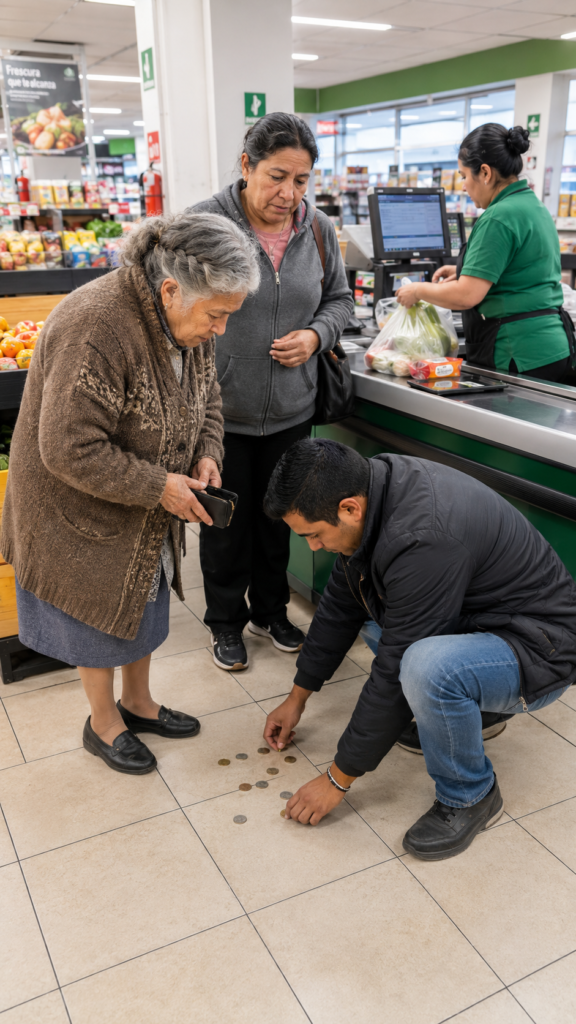
When they reached the checkout, they stood right in front of Valeria.
And of course, they took their time.
The elderly woman searched for her wallet.
Then her glasses.
Then forgot that the glasses were in the sweater pocket.
Behind them, a man huffed loudly.
The elderly woman became nervous.
—People are waiting —she whispered.
Julián didn’t turn around.
He didn’t apologize for her.
He didn’t rush her.
He just said:
—Then they’ll wait a little.
At that moment, several coins fell from the elderly woman’s hand to the ground.
Valeria bent down to pick them up.
But when she looked up, she heard something that left her frozen.
The elderly woman looked at Julián, confused, and asked:
—Excuse me, young man… are you my son?
PART 2
The silence that fell over the checkout was strange.
It wasn’t a supermarket silence.
It was as if for a second the noise of bags, the cash register, children asking for chocolates, and the murmur of the line had been silenced.
Valeria was left with two coins in her hand.
The cashier stopped scanning items.
The man behind, the same one who had huffed, swallowed his impatience.
Julián didn’t break.
He didn’t look embarrassed.
He wasn’t upset.
He just leaned a little closer to his mother, like one would approach a scared child, and smiled at her.
—Yes, Mom. I’m Julián.
The elderly woman blinked.
Her eyes filled with tears, but she didn’t cry.
—Sorry, son.
He shook his head.
—You don’t have to apologize.
—It’s just that sometimes I lose my mind.
—You don’t lose it, Mom. It just gets tired for a bit.
Valeria felt something inside her slowly breaking.
Until that moment, she had thought the elderly woman was slow.
That she was indecisive.
That she took her time for no reason.
But she understood then that there was something deeper.
Something crueler.
Something not visible from the outside when one only looks with haste.
The lady wasn’t picking cookies out of whim.
She didn’t repeat questions to annoy.
She wasn’t looking for her wallet to waste time.
She was fighting against a fog that stole bits of her memory.
And Julián was walking with her through that fog.
Without letting go.
The elderly woman looked back at Valeria.
Valeria handed her the coins.
—Here you go, ma’am.
The woman barely smiled.
—Thank you, daughter.
Daughter.
That word slapped Valeria like a sweet sting.
Because her own mother called her that too.
Daughter.
Even though Valeria responded quickly.
Even though she cut off calls.
Even though she got impatient when her mother asked the same thing twice.
Julián paid for the remainder without making it obvious.
He didn’t say, “You’re short on money.”
He didn’t say, “I’ll pay so we can finish here.”
He just slid his card and covered the difference effortlessly.
Then he packed the items into reusable bags.
He separated the tomatoes so they wouldn’t get squished.
He placed the cookies on top.
Arranged the bread.
He closed his mother’s coat.
Fixed the wine-colored shawl around her neck.
And kissed her forehead.
Right there.
In the middle of the checkout.
In front of everyone.
Without shame.
Without rushing.
As if loving a mother was the most normal thing in the world.
And it should be.
But many forget.
The elderly woman touched Julián’s face with trembling fingers.
—You look like my son.
He smiled, although his eyes glistened.
—That’s what they say.
Valeria had to look away.
Because that answer held more pain than any accusation.
Julián wasn’t waiting for his mother to always remember him.
He wasn’t demanding gratitude.
He wasn’t collecting on sacrifices.
He was loving her even when she couldn’t recognize it.
That was another level of love.
The kind that isn’t posted on social media.
The kind that doesn’t flaunt flowers or fancy dinners.
The kind that shows in the way of saying the same thing four times without humiliating anyone.
Julián began to push the cart toward the exit.
The elderly woman walked slowly, occasionally holding onto his arm.
As if she didn’t want to weigh too much.
That’s what hurt Valeria the most.
That way many mothers have of asking for little even when they need a lot.
Valeria followed them a few steps without thinking.
—Excuse me —she said.
Julián turned.
—Yes?
She swallowed hard.
She didn’t know how to say it without sounding ridiculous.
—I think you forgot something at the checkout.
He looked at the cart, worried.
—Really? What was it?
Valeria shook her head.
—No… you left us a lesson.
Julián fell silent.
The elderly woman looked at him.
Then looked at Valeria.
And smiled with a weary tenderness.
—My son is very good —she suddenly said.
Julián lowered his gaze.
—Mom…
—I don’t always remember everything —she continued—, but I know that.
Julián’s face broke.
He didn’t cry.
But it was clear in his eyes that those words had just restored something.
As if among so much lost memory, his mother had rescued just the most important thing.
Valeria pressed her lips together to hold back tears there, in front of the supermarket’s automatic door.
—Sorry —she murmured.
Julián looked at her, confused.
—Why?
Valeria took a deep breath.
—For getting impatient. For thinking badly. For… I don’t know. For being how we sometimes are.
Julián didn’t judge her.
That hurt too.
Because sometimes one expects a scolding to feel less guilty.
But he just said:
—We’re all running, right? Until life forces us to slow down.
The elderly woman squeezed his arm.
—Are we going home now?
—Yes, Mom. We’re going.
—Did we buy cookies?
—Yes. The butter ones.
She smiled as if that were the best news of the day.
—Good. Those are my son's favorites.
Julián closed his eyes for a moment.
Then replied:
—Yes, Mom. He likes them a lot.
Valeria watched them leave the parking lot.
The afternoon was turning orange.
There were cars honking, tamale vendors on the corner, a woman fighting with a bag that had torn, and a child pulling his dad toward a ball machine.
The world went on as usual.
But Valeria was different now.
She walked home with her bags, feeling every step weigh heavily.
She placed the milk on the table.
The rice too.
The tomatoes as well.
But she didn’t put anything away.
She sat down in front of her phone.
And thought about her mom.
Doña Elena lived in Toluca, in a small house with pots at the entrance and a chair where she always left a folded blanket.
She used to call nearly every day.
To ask if Valeria had eaten.
If she had brought a sweater.
If her head hurt.
If she had paid the electricity bill.
Simple questions.
Repeated questions.
Motherly questions.
Valeria often responded hastily.
—Yes, Mom, everything’s fine.
—I’ll call you back.
—I’m busy.
—Don’t start again.
And that “I’ll call you back” had become a habit.
Then it was tomorrow.
Tomorrow was next week.
Next week was a month.
And one day, without Valeria realizing it, her mother started to call less.
Not because she wanted to bother less.
But because she learned not to.
That idea embarrassed her.
No mother should learn not to bother her own children.
Valeria searched for her contact.
“Mom.”
She stared at the screen.
Her finger trembled before hitting call.
It rang once.
Twice.
Three times.
When she finally answered, Doña Elena’s voice sounded worried.
—Valeria? Did something happen?
Valeria closed her eyes.
There she understood how far she had gone.
Her call was no longer joy first.
It was fear.
Because she had called so little that her mother thought it could only be an emergency.
—Nothing’s wrong, Mom —she said, her voice breaking—. I just wanted to hear you.
On the other end, there was a long silence.
Not uncomfortable.
Full.
As if Doña Elena was arranging those words in a very delicate place in her heart.
Then she replied softly:
—Oh, daughter… what joy you bring me.
Valeria cried silently.
Her mother got scared.
—Are you crying?
—No, Mom. Well… a little.
—Did someone hurt you?
—No. On the contrary. I think today I learned something.
Doña Elena didn’t press.
She just stayed.
As always.
As mothers do even when their children don’t quite deserve it.
Valeria asked her to tell about her day.
And Doña Elena talked.
She told her about a neighbor who had bought a tiny dog.
About a zucchini recipe she wanted to try.
About a geranium pot that was finally blooming.
About a blue blouse she found stored and that, according to her, still looked “decent.”
Small things.
Things Valeria would have cut off quickly before.
But that night she heard them differently.
Without rushing.
Without correcting.
Without waiting for “the point.”
Because maybe the point was that.
To be.
The next day, Valeria took a bus to Toluca.
She didn’t give much notice.
She just showed up with sweet bread, coffee, and some butter cookies.
When Doña Elena opened the door, she was surprised.
—And you?
Valeria smiled.
—I came to walk slowly with you.
Her mother didn’t understand at first.
But she hugged her.
And Valeria felt that hug held years of being stored away.
Later they went to the market.
Doña Elena walked slowly.
She stopped in front of the stalls.
Asked prices she had already asked.
Forgot where she had put her wallet.
Compared apples as if each had a story.
Valeria felt the impulse to hurry her.
She felt it.
Because change doesn’t happen overnight.
But she breathed.
And remembered Julián.
Remembered his calm voice.
“Then they’ll wait a little.”
When Doña Elena asked for the second time if they had bought tomatoes, Valeria smiled.
—Yes, Mom. We already bought them. But let’s check again if you want.
Her mother looked at her oddly.
Then smiled.
—You’re very patient today.
Valeria squeezed her hand.
—I’m learning.
At the fruit stall, Doña Elena picked up a small apple.
—Your dad said these were the good ones —she commented.
Valeria felt a gentle pang in her chest.
The same phrase.
The same memory.
Another mother.
Another son who was no longer there.
Another opportunity to listen.
—Then let’s take those —Valeria said.
Doña Elena looked at her with bright eyes.
—I’m so glad you came, daughter.
Valeria didn’t answer right away.
Because she understood that sometimes a simple visit can repair something that was silently breaking.
Since that Friday, Valeria never looked at an elderly person in line the same way again.
She no longer saw obstacles.
She saw stories.
She saw hands that once carried children.
She saw feet that walked for years to support homes.
She saw voices that repeated questions not to annoy, but to feel secure.
And every time someone huffed behind an elderly woman in the supermarket, Valeria thought of Julián.
Of his mother.
Of those butter cookies.
Of that phrase that seemed simple but was immense:
“You don’t repeat. You just make sure.”
Because the people who once walked slowly behind us, making sure we didn’t fall, deserve more than our hurry.
They deserve our patience.
They deserve our arm.
They deserve that we stop treating them as burdens when they start needing help.
And above all, they deserve that, when life changes their pace, we have enough love to change ours.
Even if the world huffs.
Even if the line waits.
Even if everything seems urgent.
Because one day, when they’re no longer here, no one will cry for having lost 10 minutes at a checkout.
But many will cry for all the times they said:
“I’ll call you later.”
And never called.





