PART 1
Valeria Mendoza lay abandoned next to the stove, her blouse torn, her lip split, and her breath cut short by fear.
Blood stained her chin, dripping onto the white kitchen floor, drop by drop, as if the entire house were counting down the seconds before something worse happened.
Adrián Cárdenas, her husband, crouched in front of her without a rush. He didn’t look like a scared man. He looked like someone inspecting a defect in his property.
He tucked her hair behind her ear and whispered:
—Remember well, my love. You fell. Nobody believes a nervous woman.
Valeria wanted to respond, but her throat wouldn’t obey. Purple marks marred her neck, her ribs burned, and a horrible pressure throbbed in her head.
It took Adrián 18 minutes to call an ambulance.
By the time the paramedics entered their home in Jardines del Pedregal, he had already changed his shirt. His face was clean, his eyes glistening, and that soft voice he used when he wanted to convince everyone was ready.
—She slipped on some water —he said—. My wife is very careless. See, one tells her to be careful, and she doesn’t listen.
Valeria opened her eyes on the stretcher. She tried to lift her hand, but Adrián gripped it tightly.
—Don’t talk, Vale. You could hurt yourself more.
To society, Adrián was an example. Owner of Grupo Cárdenas Urbana, donor of food supplies in Ecatepec, scholarship sponsor, and friend of politicians who greeted him as if he were a saint.
In private, he was a different man.
First came jealousy. Then shouting. After that, the changed keys, the driver watching her, the phone constantly checked, the cards blocked, and cameras installed “for security.”
What Adrián never understood was that Valeria was not a decorative wife.
Before marrying, she had been a financial auditor. She knew how to find ghost companies, inflated invoices, and hidden transfers behind perfect contracts.
For 7 months, she gathered evidence: photos of bruises, audio recordings, account statements, messages, contracts, and an encrypted folder. Only 1 person could open it: her brother Mateo Mendoza, head of emergencies at San Ángel Sur Hospital.
Mateo had pleaded with her to report it.
—That guy is going to kill you.
—I need proof he can’t buy —she replied.
That night, Adrián found an external audit request. He demanded the password. Valeria refused.
Then he dragged her through the kitchen.
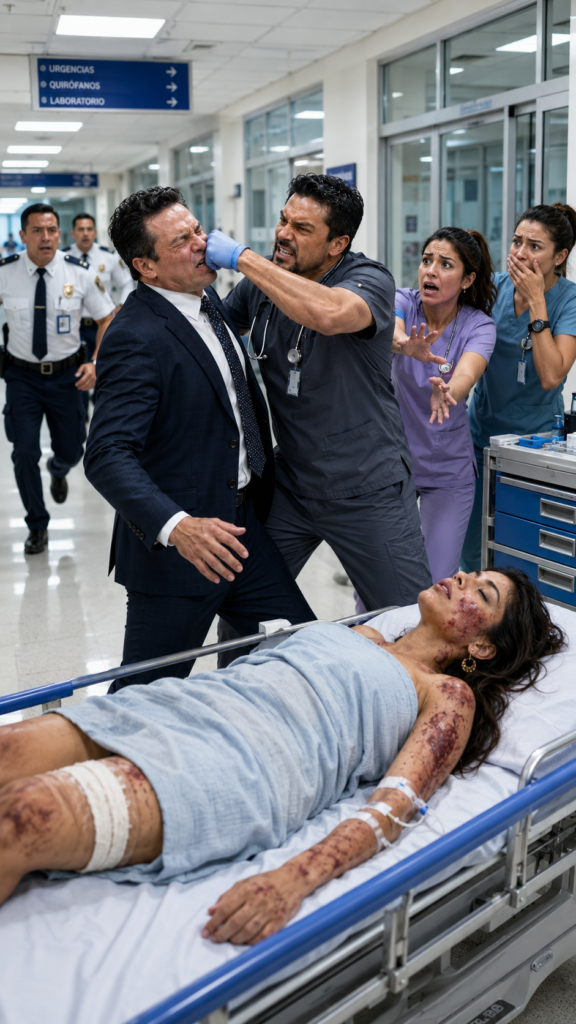
Hours later, the emergency doors burst open. A doctor in blue scrubs approached the stretcher.
Adrián said:
—Doctor, it was an accident.
The doctor looked up.
It was Mateo.
He saw the purple bruises on his sister’s neck, the dried blood in her mouth, and the old bruises peeking from under her sleeve.
Valeria barely moved her lips.
—The speaker… is still recording.
Mateo grabbed the phone off the wall and said:
—Close this area. Call the police.
Adrián turned pale, and nobody could believe what was about to happen.
PART 2
The hospital security arrived before the patrol. For the first time in years, Adrián Cárdenas could not decide who spoke, who was silent, or who obeyed.
He tried to laugh, as if it were all a misunderstanding.
—My wife is confused —he said—. She has anxiety attacks. Sometimes she makes things up when she gets upset.
Mateo didn’t shout at him. That would have given the spectacle Adrián wanted. He stood between him and the stretcher, with a calm so cold that even the nurse stopped moving.
—You will not get any closer to her.
—I am her husband.
—And I am the doctor who is seeing signs of aggression, not of an accident.
The public prosecutor’s agent arrived with a medical expert. They examined Valeria carefully. The diagnosis was worse than Adrián expected: 2 fractured ribs, a concussion, a lip injury, recent marks around her neck, and bruises in various stages of healing.
It was not a fall.
It was a complete story written on her skin.
Adrián changed tactics in seconds.
—She takes medication. She’s unstable. Ask anyone in my family.
Valeria opened her eyes.
—My phone —she whispered.
Mateo approached. She gave him a 6-digit code. The screen unlocked an encrypted folder with date, time, and name for each file.
The first video was from that night.
The camera was hidden inside a gray smart speaker, on a kitchen shelf. Adrián had never suspected it because he had bought it himself to show off his “modern house” to guests.
In the recording, Valeria was seen backing away near the stove. Adrián demanded the password for the files. She said no. He grabbed her by the neck and pushed her against the cupboard.
Then a line froze the agent:
—If you talk, I’ll bury you in a construction site, and nobody will ask about you.
Adrián lunged for the phone.
2 guards stopped him against the wall. The agent cuffed him while he screamed that everyone was making a huge mistake.
—You don’t know who you’re messing with.
Mateo stared at him without blinking.
—Now we do.
But violence wasn’t the only secret.
At 12:24 AM, Renata Salgado, Valeria’s lawyer, arrived. She carried a black folder, a USB drive, and the face of someone who had been waiting for that call for months.
In an empty office, she placed 3 documents on the table: the trust of Valeria’s father, the statutes of Grupo Cárdenas Urbana, and an immediate removal clause for violence, fraud, or serious reputational harm.
Adrián, still handcuffed, let out a dry laugh.
—That doesn’t mean anything. The company is mine.
Renata looked at him as one looks at someone who has just dug their own grave.
—The company carries your last name, Mr. Cárdenas. But 51% of the votes belong to Mrs. Mendoza’s trust.
Adrián blinked.
Before the wedding, he had signed everything without reading. He was too busy organizing a party in San Miguel de Allende, inviting businessmen, photographers, and politicians. He thought the trust was an old formality from Valeria’s father.
It wasn’t.
It was the key he could never control.
Renata plugged the USB drive into a hospital computer. The folder opened dozens of files: invoices, emails, transfers, supplier names, and fake contracts.
Valeria wasn’t just preparing her exit. She was uncovering Adrián’s true business.
For 3 years, Grupo Cárdenas Urbana had sent money to ghost companies in the name of Teresa Cárdenas, Adrián’s mother, and Julián, his favorite cousin.
The invoices spoke of “material advisory,” “construction supervision,” and “administrative services.” But there were no materials, no works, no real offices.
The sum tracked by Valeria reached 92,600,000 pesos.
The agent stopped writing for a moment.
—Did she gather all this?
Renata nodded.
—While he thought he had her locked up.
Adrián started to sweat.
He no longer shouted. He no longer smiled. He no longer looked like the confident businessman who appeared in magazines speaking of “family, effort, and values.”
He looked like a man discovering that his victim had been counting each blow, every peso, and every lie.
At 1:08 AM, Renata sent the files to the external council of the company.
At 1:21, the council suspended Adrián as CEO.
At 1:36, the bank froze 4 corporate accounts.
At 2:02, agents obtained authorization to secure his laptop, his cellphone, and a safe in his Santa Fe office.
Then Teresa Cárdenas appeared.
She entered the hospital wearing dark glasses, an expensive coat, and a perfume that seemed to want to mask her shame. She was accompanied by Julián and a gray-suited lawyer.
—Where is my son? —she shouted—. That woman is destroying him out of spite.
Everyone turned.
Teresa pointed at Valeria’s stretcher as if she were looking at trash.
—A decent wife protects her husband. Domestic disputes are settled at home.
Mateo opened the office door and walked toward her.
—Because of women like you, men like your son think silence is love.
Teresa fell silent for 2 seconds. Then she saw Adrián handcuffed and changed her tone.
—Son, tell me that woman is lying.
Adrián didn’t answer.
Renata looked at Teresa’s diamond earrings.
—Those show up on an invoice paid by a ghost company. The same one that received 14,800,000 pesos for a consultancy that never existed.
Teresa instinctively touched her earrings.
That gesture betrayed her more than any word.
The lawyer tried to intervene, but the agent ordered that Teresa not leave the hospital. Julián stepped back as if suddenly the floor was burning.
Then came the twist nobody expected.
Valeria requested another file.
Mateo opened it.
It was an audio of Teresa talking to Adrián 5 days prior.
Her voice was clear:
—Scare her well. Women obey when they feel they could lose everything. But don’t hit her where it shows, son. Remember that.
The room fell silent.
Adrián looked down.
Teresa started saying that voice wasn’t hers, that it was edited, that it was all a trap. But Renata had full backing, the metadata, the date, and the call records.
Valeria hadn’t recorded out of vengeance.
She had recorded to survive.
At dawn, Adrián asked to see her. The agent agreed only with police inside the room.
He entered without a watch, without a belt, without a cellphone, and without power. His shirt was still stained. His wrists were marked by the handcuffs, and his eyes were red with rage.
Yet he tried to use the same look that had served him for years: half tenderness, half threat.
—Vale, my love, say it was an accident. I lost control. I swear, I’ll change.
Valeria was pale, connected to an IV, with a bandage on her forehead. It hurt to breathe. It hurt to swallow. It even hurt to exist.
But she no longer felt pain in obeying.
—You didn’t lose control, Adrián —she said—. You lost your mask.
He stepped closer.
Mateo raised his hand.
—Not 1 centimeter more.
Renata opened another folder.
—Divorce petition, protection measures, complaint for aggravated domestic violence, injuries, threats, fraudulent management, and operations with illicit funds.
Adrián let out a bitter laugh.
—The house is mine. You’re going to leave there with a bag of clothes.
Valeria breathed slowly, although pain pierced her ribs.
—The house belongs to my father’s trust. You only signed an occupancy agreement before the wedding.
Adrián looked at her in confusion.
For years, that house had been Valeria’s prison: the cameras, the codes, the heavy doors, the fake dinners, the perfect photos, the silences after every blow.
And it wasn’t even his.
For the first time, Adrián couldn’t find a door to escape through.
The process was long and dirty.
The Cárdenas family hired lawyers, leaked rumors, and paid for anonymous publications to say Valeria was ambitious, cold, and calculating. Some acquaintances repeated the same old story: that nobody knows what happens in a marriage, that maybe she also had a temper, that reporting the husband was exaggerated.
But the videos destroyed the accident lie.
The medical reports demonstrated a pattern of violence.
The audios revealed threats.
The emails and invoices confirmed the fraud.
In addition, 11 employees testified. An assistant recounted how Adrián ordered emails deleted every time Valeria asked to review payments. An accountant confessed that Julián signed services that were never carried out. A driver delivered messages where Adrián ordered him to follow Valeria to the supermarket, to the bank, and to Mateo’s house.
Teresa tried to cry in front of the press. She said she was just a mother defending her son. But her accounts showed inexplicable deposits, luxury purchases, and trips paid for by nonexistent companies.
6 months later, Adrián accepted to plead guilty in exchange for delivering names of front men, hidden accounts, and properties bought with stolen money.
He received 13 years in prison and a million-dollar order for damages.
Teresa received 5 years. She lost the house in Valle de Bravo, the diamonds, the trucks, and the apartments she flaunted as blessings.
Julián fell too. When he testified, he said he was just following orders. But the documents proved he had signed false contracts for 21,300,000 pesos.
Valeria regained the company but changed its name. She didn’t want the Cárdenas surname associated with any work, invoice, or memory.
She also created a fund for women needing to escape homes where everyone smiled in photos, but no one slept peacefully.
The first time she returned to the house in Jardines del Pedregal, she was with an agent, her lawyer, and Mateo. In the kitchen, there was still a crack in the marble, right where her head had hit that night.
Valeria stared at the stove.
Mateo asked her if she wanted to leave.
She shook her head.
—No. I want to see it one last time without fear.
Months later, the house was sold. With part of the money, Valeria bought a small apartment in La Condesa. It had large windows, plants on the balcony, and a door that only she could open.
1 year after that night, she opened the window at dawn. The city smelled of coffee, sweet bread, and fresh rain. Below, trucks, vendors, and hurried people passed by like every day.
The scars were still there. Some on her skin. Others deeper inside.
But fear no longer had any keys.
Mateo arrived with 2 cups of coffee and left one on the table.
—You look different, Vale.
She looked at the clear sky over the buildings.
—No. I look like I was before him.
Mateo said nothing. He just squeezed her hand.
Far away, behind a metal door, Adrián still repeated that Valeria had betrayed him.
But the truth was different.
Valeria didn’t destroy him out of revenge. She simply stopped protecting the man who was killing her.
And there lies the question many families prefer not to hear: how many times do they call “marital problems” what is really a woman asking for help?





