PART 1
When Valeria arrived at her parents’ house in a quiet neighborhood of Morelia, the first thing she noticed was the smell of old grease wafting from the kitchen window.
The second thing was worse.
Her mom, Doña Teresa, wasn’t sitting on the terrace sipping coffee as she had imagined. She was in the service room, folding someone else's clothes on a single bed.
Her dad, Don Julián, was sleeping right there, under a thin blanket, while in the main bedroom, music, laughter, and a blaring television filled the air.
Valeria stood frozen in the hallway, her bag still slung over her shoulder.
She had built that house after 11 years of working in Querétaro, pulling double shifts at a private clinic. It wasn’t a mansion, but it was the dream she had promised her parents when they were still selling tamales outside the market.
A house with a garden, a spacious kitchen, a private bathroom, and a bright bedroom for them to rest.
But now the backyard looked like a storage room. Clothes hung between the trees, soda bottles littered the ground, broken toys scattered around, an improvised chicken coop stood in the corner, and sauce stains marred the freshly painted walls.
—Mom… why are they sleeping here? —Valeria asked, trying not to raise her voice.
Doña Teresa lowered her gaze.
—Your Uncle Óscar said it was just for a few days, daughter. That he was kicked out of his house and had nowhere to take the kids.
Valeria felt a hit to her chest.
—And they got his room?
Don Julián appeared behind her, thinner than she remembered.
—We didn’t want to cause a scene, mija. You know how your uncle is.
Valeria did know.
Óscar had always been the “needy” brother. The one who borrowed money, the one who promised to change, the one who made their mother cry and then showed up with a repentant face.
But this time was different.
In the living room, Óscar’s wife, Miriam, lay on the white couch, eating corn from a cup. Their two kids were scribbling on the wall with a black marker.
Óscar was sitting on the big couch, his feet on the wooden table Valeria had made for her parents.
—Pack your things —she said—. You’re leaving today.
Miriam let out a laugh.
—Oh, look who’s here. The lawyer has come to order us around.
Óscar turned off the television and stood up slowly.
—Is this how you treat your family, Valeria? Your mother’s blood?
—My family is my parents. And you’re living like squatters in your own home.
Miriam stood up, offended.
—We take care of them. You never come. You send money and think that makes you a good daughter.
The words fell like a slap.
Doña Teresa started to cry.
—Please don’t fight…
Valeria took a deep breath. She pulled out her phone and called her husband, Martín, who was waiting outside.
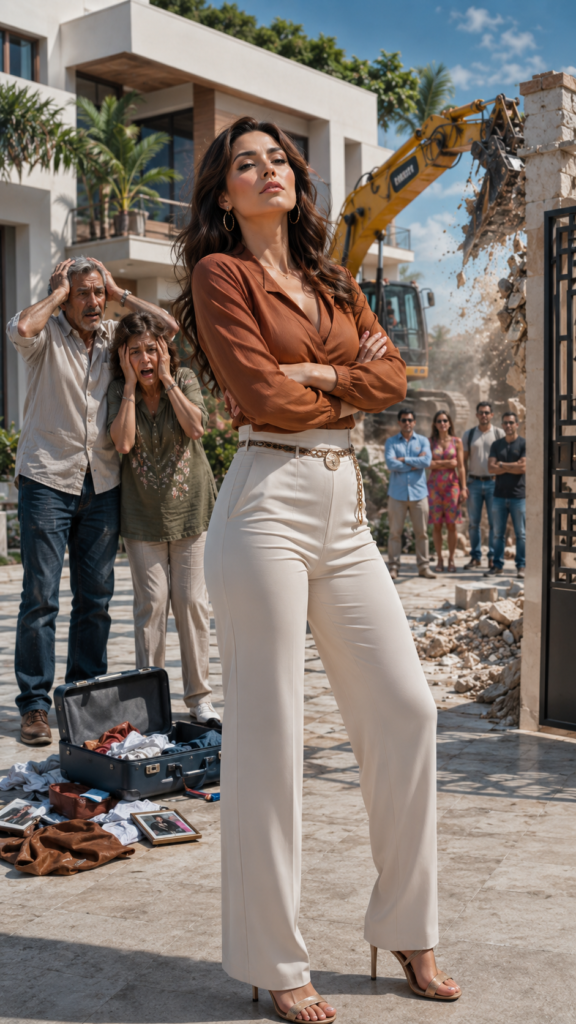
—Honey, call the police. And tell Don Efraín to bring the backhoe.
Óscar froze.
—What did you say?
Valeria looked at him without blinking.
—If you think you’re going to stay because the house is standing, I’d rather tear down every wall than watch you humiliate my parents.
In less than 25 minutes, the yellow machine appeared in front of the gate. The neighbors came out as if it were a party.
Then Miriam ran to the street and yelled:
—This woman wants to put two kids and two sick old folks on the street just because she thinks she’s rich!
And everyone turned to look at Valeria as if she were a monster, unaware that something much more rotten was hidden inside that house.
PART 2
The crowd gathered in front of the gate, cell phones in hand.
Doña Meche, the nosiest neighbor in the neighborhood, was the first to speak.
—Valeria, what a shame. You don’t kick family out like that. Look at your poor mother, all crying.
Valeria tightened her fingers around her phone.
—Doña Meche, with all due respect, you don’t know what’s going on.
—I know your uncle has two kids. And I know your parents are old. That’s not how you do things.
Óscar seized the moment as if he had been waiting for it his entire life. He stepped into the yard with red eyes, arms raised to the sky, and his shirt half-open.
—Neighbors, you know me. I’m a hard worker. I lost my house due to debts, not by choice. My sister opened her door for me because she has a heart. And now my niece shows up, with money and a new car, to kick us out like dogs?
Miriam began to cry without tears.
—We feed the old folks. We keep them company. Valeria shows up once in a blue moon and thinks she can decide everything.
The murmurs grew louder.
Don Julián lowered his head. Doña Teresa trembled, as if every word weighed on her bones.
Then Martín walked in with his phone in hand.
—You feed them? —he asked—. Then why did I find this in the old folks’ room?
He showed a picture.
In the image, a tray with dry rice, hard tortillas, and a half-full glass of water was visible. Next to it, Don Julián’s single bed and Doña Teresa’s clothes piled in black bags.
The neighbors stopped murmuring.
Valeria spoke slowly.
—My parents didn’t say anything because they were embarrassed. Because they were taught that family endures. But this isn’t help. This is abuse.
Óscar’s expression changed.
—Don’t exaggerate, girl. Your mom asked us to stay.
—Staying a few days doesn’t mean taking away their room, using their things, and treating them like servants.
Miriam crossed her arms.
—What did you want? For us to sleep on the floor?
Valeria looked her up and down.
Miriam wore new earrings, long nails, an expensive phone, and a gold chain Valeria didn’t recognize.
—If you had nothing, where did all that come from?
—It’s none of your business.
—Yes, it is when you’re living in the house I built for my parents.
At that moment, Miriam’s youngest child ran out with a ball. Behind him was the girl, Lucero, 9 years old, holding something shiny.
Valeria recognized it instantly.
It was Don Julián’s watch.
The same one he bought after 30 years of selling tamales, the only luxury he had ever allowed himself in his entire life.
—Lucero —Valeria said, her voice icy—. Where did you get that watch?
The girl froze.
Miriam ran towards her.
—Give it to me, you foolish child.
But it was too late.
Don Julián looked up and his eyes filled with tears.
—That watch was in my drawer.
The silence grew heavy.
Óscar tried to laugh.
—Oh, they’re just kids. They take things to play.
But Miriam looked pale.
Valeria didn’t ask for permission. She stormed up the stairs directly to the main bedroom. Miriam followed behind, screaming.
—You can’t check my things!
Valeria opened the door.
—In my parents’ house, yes I can.
Martín stood in the middle of the hallway, not touching anyone but blocking Miriam from getting past.
Valeria opened a closet. Then another. Then a black suitcase hidden under the bed.
The first thing she found was a velvet box with her mother’s earrings. Then a baptism bracelet, four rings, a gold chain, her grandmother’s silver rosary, and a small notebook with a brown cover.
When she opened it, nausea washed over her.
“Refrigerator: 14,000”
“Dining table: 10,500”
“Living room TV: 9,000”
“Jewels Tere: check weight”
“Tools Julián: sell in bulk”
Valeria came down with the notebook in hand.
Doña Teresa covered her mouth.
—It can’t be...
Óscar stopped pretending.
Miriam did too.
Valeria held the notebook up in front of everyone.
—You didn’t come because you had nowhere to go. You came to empty the house little by little.
Doña Meche, the same one who had judged her moments before, was left speechless.
But Valeria still hadn’t seen the worst.
Among Miriam’s clothes, she found a blue folder. Inside were rental receipts.
Not for a lost house.
For Óscar’s house.
The house he claimed to have sold was still his. He had rented it to a family from Uruapan for a full year. While collecting rent every month, he lived for free in his sister’s house and treated the true owners like bothersome intruders.
Don Julián closed his eyes.
Doña Teresa let out a small sob, one of those that don’t come out in a rush because they’ve been stuck for years.
Óscar fell to his knees.
—Tere, listen to me. I was going to explain...
—When? —Valeria asked—. When you had sold all their memories?
At that moment, the police arrived.
Two municipal officers got out: a young female officer and a gray-mustached commander who had known Don Julián since the market.
Miriam changed tactics in seconds.
She threw herself on the floor, clutching her head.
—I feel sick. My children, my poor children. This woman is attacking us.
The officer looked at her without moving.
—Ma’am, get up. We’re going to take a statement.
Óscar approached Doña Teresa with a trembling voice.
—Sister, tell them the truth. You told me this house was also my house. You gave me those things. Remember.
The word “remember” made Doña Teresa turn pale.
For months, she had been having small forgetful moments. She would leave her keys in strange places, repeat stories, confuse dates. The doctor had said it was stress and fatigue. Nothing serious.
But Óscar and Miriam had found their perfect defense there.
—My sister isn’t well —Miriam said from the floor—. Sometimes she says things and then doesn’t remember. She promised us the jewels because we took care of her.
Valeria felt rage, but also fear.
Because that lie was more dangerous than the theft.
Don Julián stepped forward.
—My wife didn’t give you anything.
Óscar looked at him with disdain.
—You don’t know, Julián. You’ve always been a henpecked husband.
Don Julián clenched his fists.
—I can count, Óscar. I count the times my daughter stopped buying herself clothes to pay for this house. I count the times my wife cried because you yelled at her. I count the years we fed you when you gambled away the money from the lottery pool. And I also count that we never, ever, gave you permission to steal.
No one spoke.
The officer took pictures of the notebook, the jewels, the rental folder, the damage to the walls and furniture. Martín showed transfers, invoices, receipts for construction, and property documents in the name of Don Julián and Doña Teresa.
—The house legally belongs to the elderly couple —the officer said—. You have no right to occupy it or any authorization over personal belongings.
Óscar began to sweat.
—Commander, we’re family. This can be resolved by talking.
Valeria looked at him with a calmness that hurt.
—That was the problem. Everything was “resolved in the family” while you were abusing.
Miriam tried to stuff a blender into a black bag.
—That stays —the officer said.
Then another suitcase appeared. Inside were two of Valeria’s perfumes, a jacket of Martín’s, Doña Teresa’s new dishes, and a bag with Don Julián’s tools.
Óscar’s face was no longer one of remorse. It was one of anger for being discovered.
—One day you’re going to need your family —he spat at Valeria.
She responded without raising her voice:
—No. One day I’m going to need good people. And that doesn’t always carry the same last name.
The commander ordered them to only take their verifiable belongings. The rest stayed in the house. Óscar had to sign a document acknowledging that he had no rights over the property.
Miriam signed trembling, shooting Valeria hateful glares.
The kids came out behind them with bags of clothes and toys. For the first time, Valeria felt sadness for them. Not for her parents. The kids weren’t to blame for being used as shields.
When the gate closed, the backhoe was still outside.
Don Efraín got down from the machine and asked:
—So, should I tear something down, miss?
Valeria looked at the backyard, where Óscar had built a rusty tin structure to keep chickens and other people’s boxes.
—Yes, Don Efraín. Tear that down.
The machine moved forward. The sound of the metal hitting the tin was sharp, loud, liberating.
Doña Teresa cried.
Don Julián took her hand.
—It’s over now, old woman.
But it wasn’t quite over.
That night, while they were cleaning the main bedroom, Doña Teresa found behind the bedside table a bag with more papers. They were betting slips, rental receipts, and printed messages where Miriam told Óscar:
“Your sister is getting forgetful. If she claims anything, we say she gave us everything.”
Valeria froze.
The lie hadn’t been improvised.
They had planned to use Doña Teresa’s memory to take everything.
The next day, Valeria filed a complaint for theft, abuse of trust, and whatever else was necessary. She didn’t do it out of revenge. She did it because when no one sets boundaries, abuse is inherited as if it were a tradition.
For four days, they fixed up the house.
They painted the walls. Changed the locks. Installed cameras. Removed damaged furniture. Washed curtains. Threw out trash. And little by little, the house began to breathe again.
Doña Teresa returned to her bedroom.
She put her earrings in the jewelry box, but this time she locked the drawer.
Don Julián put on his watch. Not to show off, but as someone who recovers a piece of dignity.
Before returning to Querétaro, Valeria saw her mother at the gate.
Doña Meche approached, uncomfortable.
—Tere… I spoke without knowing.
Doña Teresa took a deep breath.
—Yes, Meche. And speaking without knowing also hurts. My daughter isn’t bad. My daughter defended me when I couldn’t. And in this house, no one will come in to take away our peace again.
The neighbor didn’t know how to respond.
Valeria hugged her mother.
—I’m proud of you.
Doña Teresa stroked her hair.
—I’m proud of you too, daughter. I’m sorry for letting them make me feel less in my own house.
Don Julián put up a small sign by the gate:
“This house has owners. And it also has memory.”
Months later, Óscar and Miriam had to return to their own house when the tenants found out about the scandal and left. The town no longer looked at them the same way. He stopped playing the victim in the square. She stopped flaunting jewels that weren’t hers.
Valeria understood something that many families don’t want to accept.
Sometimes one doesn’t break the family by setting boundaries.
Sometimes the family was already broken the day everyone confused abuse with love.
She built a house for her parents.
But that day, she discovered that walls don’t protect anyone if the people inside are still afraid to close the door.
And finally, her parents learned to close it.





