PART 1
When Mariana got home from work at 6 PM, her apartment no longer felt like hers.
The first thing she heard was the crying of Sofia, her three-year-old daughter, sitting in the living room with swollen eyes, clutching her doll as if someone had ripped her world away.
The second thing she saw was Camilo, her husband, sitting in the armchair with his phone in hand, saying nothing.
And the third was the smell.
Naphthalene.
An old, dry scent, embedded in the curtains, in the cushions, in the little girl's bedroom.
Mariana dropped her bag on the table and felt something tighten in her chest.
That morning, Camilo had called her at work with a strange voice. He told her that his mother, Doña Esperanza, had arrived unexpectedly from Puebla because she had argued with Brenda, his brother's wife.
—It'll just be a few days, Mari —he said—. Don’t make a fuss. It's my mom.
Mariana had taken a deep breath.
She was 38 years old, exhausted from her job at a dental clinic, with a small daughter and a tiny apartment in Iztapalapa that she and Camilo had paid for penny by penny.
It wasn't luxurious, but it was theirs.
Every drawer made sense. Every shelf had its place. Everything was arranged to survive real life: leaving early, coming back tired, bathing Sofia, making dinner, and still washing uniforms.
But that afternoon, as she walked into the kitchen, she understood that someone had invaded her life without asking.
The pots were rearranged in the drawers.
The glasses were on another shelf.
The rags were folded differently.
Even the coffee was in an old can that wasn’t hers.
Mariana opened one drawer, then another, like a visitor in her own home.
Then she entered her bedroom.
Her underwear was on the bed.
All of it.
Panties, bras, t-shirts, neatly piled, out in the open, as if her intimacy meant nothing.
She opened the closet.
Doña Esperanza’s clothes were hanging there. Not two blouses for the weekend. Not a change of emergency.
All her clothes.
Dresses, sweaters, skirts, shawls. As if the woman hadn’t come for a visit, but to move in.
Mariana felt heat in her face.
She walked toward Sofia’s room.
On the girl’s bed was a thick, hand-woven blanket, cream-colored, smelling of an old wardrobe. Sofia looked at it from the door as if it were a strange animal.
—I don’t want that, Mommy —she sobbed—. It smells bad.
Then Doña Esperanza came out of the kitchen with a calm smile, as if she had just done an enormous favor.
—Oh, dear, I've tidied up a bit. Frankly, you had everything a mess.
Mariana didn’t respond.
—I also changed the soap for the girl’s clothes —added the mother-in-law—. The one you use irritates her skin. After years, one learns.
Mariana turned to look at Camilo.
She hoped he would say something. An apology. An explanation. Anything.
But he remained seated, staring at his phone, swallowing hard like a coward.
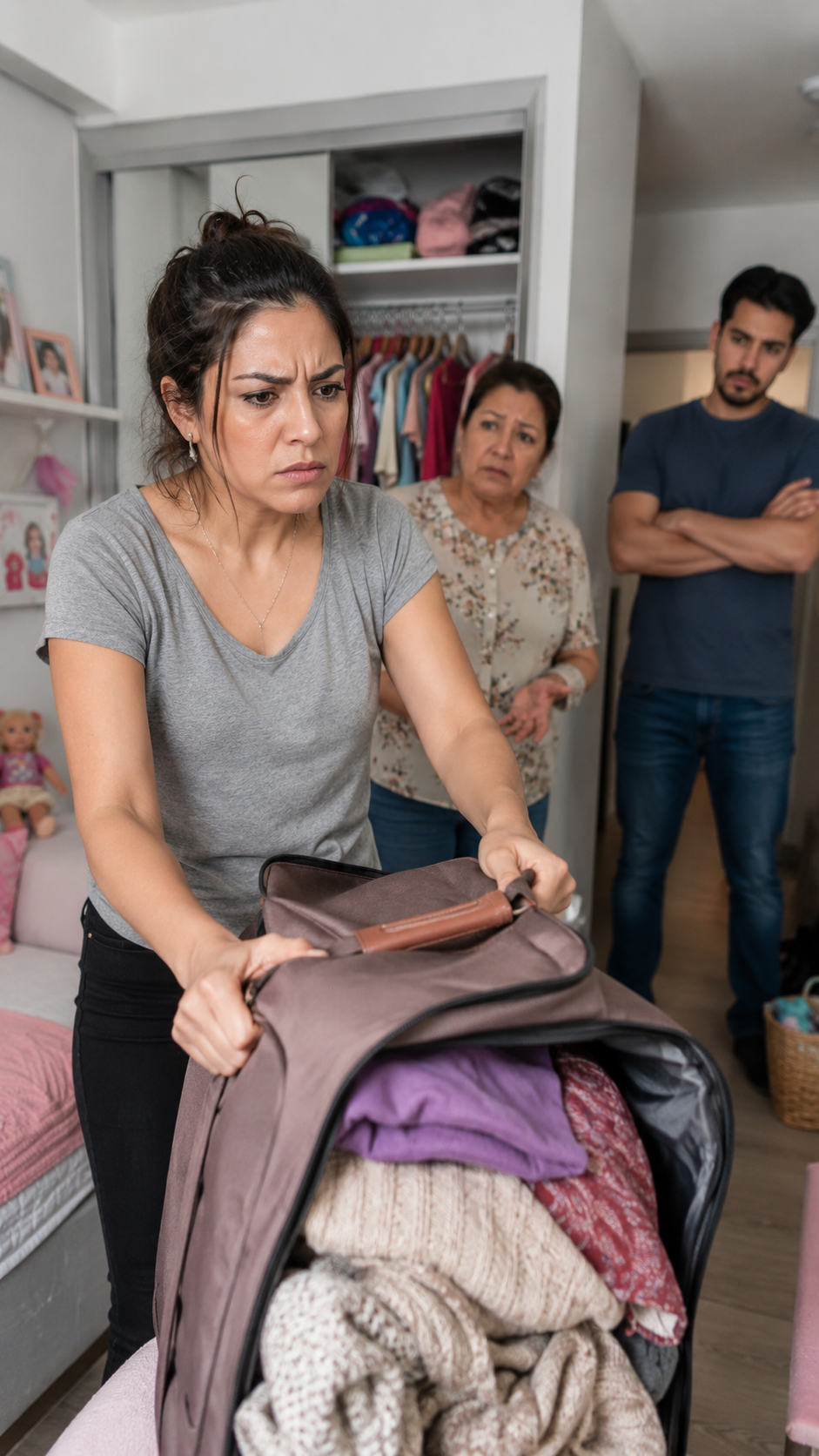
Then Mariana picked up Sofia, calmed her down, took her to the living room, and put on cartoons. Then she went back to the bedroom, grabbed Doña Esperanza’s medium suitcase, placed it on the bed, and began packing the clothes.
One blouse.
Another.
A sweater.
A dress.
Calmly.
Without shouting.
That was what scared Camilo the most: Mariana didn’t shout.
When she finished, she closed the suitcase, took it to the door, and ordered a taxi through an app.
8 minutes.
Doña Esperanza stopped smiling.
—What are you doing, dear?
Mariana looked up.
—Please don’t call me dear right now.
The silence grew heavy.
—You entered my house without my permission. You touched my clothes. You moved my things. You went into my daughter’s room and scared her.
—I just wanted to help...
—No. Helping is something you ask for. Invading is done like this.
Camilo got up.
—Mariana, chill out, seriously...
She looked at him with a coldness that froze him in place.
—You gave her the key without asking me. We’ll talk about you later.
The phone rang. The taxi had arrived.
Mariana pointed to the door.
—Doña Esperanza, your taxi is downstairs. If Camilo wants to accompany you to find somewhere to stay, he can do that. But nobody stays here who enters as if they own the place without actually being it.
The mother-in-law looked at her son.
For one second, it seemed she was about to cry. But she didn’t.
She just took the suitcase with both hands and said softly:
—I thought I could fit in here.
Mariana felt that phrase like blackmail.
Like mother-in-law drama.
Like a stab meant to make her look bad.
Camilo went downstairs with his mother. Mariana closed the door and began to return her kitchen to its place, drawer by drawer, pot by pot.
That night, when Camilo returned, he told her that she had humiliated his mother.
—A real family doesn’t kick out an old lady like that.
Mariana asked him one thing:
—Does a real family give out keys without telling?
Camilo didn’t answer.
For three days, Mariana believed she had won.
Until she called the cousin where Doña Esperanza supposedly was… and an unfamiliar woman told her that they didn’t know anyone by that name.
PART 2
Mariana hung up with a frozen hand.
She called back, thinking maybe she had dialed the wrong number. She heard again the same tired voice of a woman who had no idea who Doña Esperanza was.
Then she looked at Camilo.
He was standing next to the table, pale, as if someone had just drained his blood.
—There was no cousin —Mariana said slowly—. There was no fight with Brenda, right?
Camilo closed his eyes.
—Mari...
—Where is your mom?
He sat down, covered his face with his hands, and started to cry.
Not like an adult.
He cried like a child who has nowhere left to hide.
Mariana felt rage, fear, and a horrible nausea mixing in her stomach.
—Camilo, tell me where your mom is.
He took several seconds to respond.
—At the North Bus Terminal.
Mariana didn’t understand.
—What do you mean at the terminal?
—That’s where she slept.
—What night?
Camilo hung his head.
—For three nights.
The apartment fell silent.
Even Sofia, who was playing on the rug, seemed to sense that something had broken.
Mariana remembered the suitcase at the door, the taxi, Doña Esperanza’s red face, the phrase: “I thought I could fit in here.”
And for the first time, that phrase no longer sounded like manipulation.
It sounded like goodbye.
—Why, Camilo? —she whispered—. Why didn’t you tell me the truth?
He wiped his face with his sleeve.
—Because she made me promise not to say anything.
—Not say anything about what?
Camilo looked at her with swollen eyes.
—She has cancer. Pancreatic. It’s already metastasized. The doctor said she has months… maybe weeks left.
Mariana felt the floor drop from under her.
She grabbed the chair.
Doña Esperanza hadn’t come for fun. She hadn’t come to meddle. She hadn’t come because she wanted to take over her kitchen.
She came because she was dying.
And because she had nowhere to go without feeling like a burden.
Camilo told everything through sobs.
His mom lived with his other son, but one night she left without telling anyone. She left a note saying she didn’t want to fade away in front of them, that she didn’t want her daughters-in-law to end up taking care of her out of obligation.
She asked Camilo to stay “just a few days.”
Not for them to take care of her.
But to get to know Sofia better.
—She said that she was the only granddaughter that she needed to hold close to her heart —confessed Camilo.
Mariana covered her mouth.
For five years, she had endured Doña Esperanza. She respected her, yes, but she never truly loved her.
It bothered her that she had an opinion about everything.
That she said “dear” in that voice.
That she arrived with her suitcase as if the apartment were an extension of her home.
But now every gesture held a different weight.
The arranged kitchen.
The changed soap.
The blanket on the bed.
Everything Mariana had read as invasion could have actually been a clumsy and desperate way of leaving love.
—Take me to her —she said suddenly.
—It’s late.
—I don’t care, Camilo. Now.
It was nearly 2 AM when they left. Mariana was in her pajamas, with a sweater on and her hair tied up any old way. Sofia stayed with a trusted neighbor, still asleep.
On the way, Mariana called many times.
Nobody answered.
They arrived at the terminal. They searched the benches, the bathrooms, the waiting rooms, next to the stands for watery coffee and cold sandwiches.
Nothing.
A guard recognized them when Camilo showed a photo.
—They took the lady away in an ambulance in the afternoon —he said—. She collapsed by where the buses leave for Pachuca. A cleaning girl called for help.
Camilo turned pale.
Mariana almost screamed at him, but she couldn’t. There was no time for reproaches.
They went to the IMSS.
The hallway smelled of bleach, medicine, and fear.
They found Doña Esperanza in a bed at the back, small, with yellowing skin and the suitcase underneath, as if even sick she was afraid of losing the only thing that belonged to her.
When she opened her eyes and saw Mariana, she tried to comb her hair with her fingers.
That gesture destroyed her.
A dying woman still wanted to look presentable in front of the daughter-in-law who had kicked her out.
—Dear —she said in a thin voice—. I’m sorry.
Mariana approached, trembling.
—Don’t apologize to me.
—I shouldn’t have moved your things. It’s your house. You’re right.
Mariana swallowed hard.
—Doña Esperanza...
—The soap wasn’t to criticize you —the lady continued, struggling—. Camilo had the same rashes on his cheeks when he was a baby. I saw the girl scratching and thought… I thought I could help.
Mariana felt a blow to her chest.
—I arranged the kitchen like my mom had it —said the mother-in-law—. So that when you came home tired, you’d find everything at hand. One isn’t good for much anymore, but one still knows how to take care of a house.
Camilo was crying in a corner.
Mariana couldn’t even move.
Then Doña Esperanza looked toward her suitcase.
—Did you throw away the blanket?
—No —Mariana lied, even though she had left it folded in anger at the bottom of the suitcase—. It’s at home.
The mother-in-law barely smiled.
—I knitted it when I found out Sofia was coming. I stored it with naphthalene so it wouldn’t get damaged. I wanted to give it to you myself, but I got embarrassed. I thought if I put it on your bed, maybe you’d sleep with something of mine when I’m no longer around.
Mariana broke down.
She knelt beside the bed and took the lady’s hand.
—Forgive me.
Doña Esperanza barely squeezed her fingers.
—No, dear. You did well.
Mariana looked up, confused.
—What do you mean I did well?
The mother-in-law took a deep breath.
—When you kicked me out, I saw how you defended your home and your daughter. I said: this girl is fierce. My granddaughter will be safe. That left me at peace.
Mariana cried silently.
The woman she had thrown out had turned that humiliation into comfort.
She didn’t think twice.
She spoke with the doctor, signed papers, argued with whoever she had to argue with, and that very night took Doña Esperanza back to the apartment.
But this time, she didn’t enter as an invader.
She entered as someone expected.
Mariana gave her the room of Sofia, put clean sheets, arranged medicines on a tray, and took out the blanket from the suitcase.
The same blanket that had once disgusted her.
She stretched it over Doña Esperanza’s chest with almost religious care.
—Here, you fit in —she whispered in her ear.
The lady closed her eyes and cried.
She lived five more weeks.
They were hard weeks, filled with pain, vomiting, sleepless nights, and uncomfortable silences. But they were also weeks of truth.
Sofia would sneak into the room with her dolls and tell her nonsensical stories. Doña Esperanza listened to her as if they were important news from the president.
Mariana learned to give her medicine, to change her pillow, to detect when she pretended to be okay to avoid bothering anyone.
Camilo learned, too late, that hiding a truth out of fear could also hurt like a betrayal.
One afternoon, Doña Esperanza asked Mariana not to change the kitchen.
—This way it’s easier, right?
Mariana let out a tearful laugh.
—Yes, you stubborn lady. It was better this way.
Doña Esperanza died on a Tuesday, at 5:40 AM, with Sofia asleep beside her and the knitted blanket over her legs.
After the funeral, Brenda, the other daughter-in-law, sought out Mariana outside the cemetery.
She told her that Doña Esperanza had spoken of her in the hospital.
—She told me you were tough —said Brenda—. But she said it with a smile. She said: “That girl doesn’t let anyone move the world from her daughter. Blessed be God, my Sofia is with a lioness.”
Mariana put a hand to her chest.
She didn’t know what hurt more: having judged her wrong or having loved her too late.
Today, the blanket remains on Sofia’s bed.
It hardly smells of naphthalene anymore. Sometimes Mariana brings her face close to the fabric, searching for that last trace of old wardrobe she once wanted to remove from her home at all costs.
She doesn’t wash it.
Sofia drags it down the hallway and says it’s “Grandma’s blanket,” even though she barely remembers her face.
Camilo still carries his guilt. So does Mariana.
Because there are limits that need to be set, yes.
But there are also truths that, if they come too late, turn a closed door into a wound for a lifetime.