PART 1
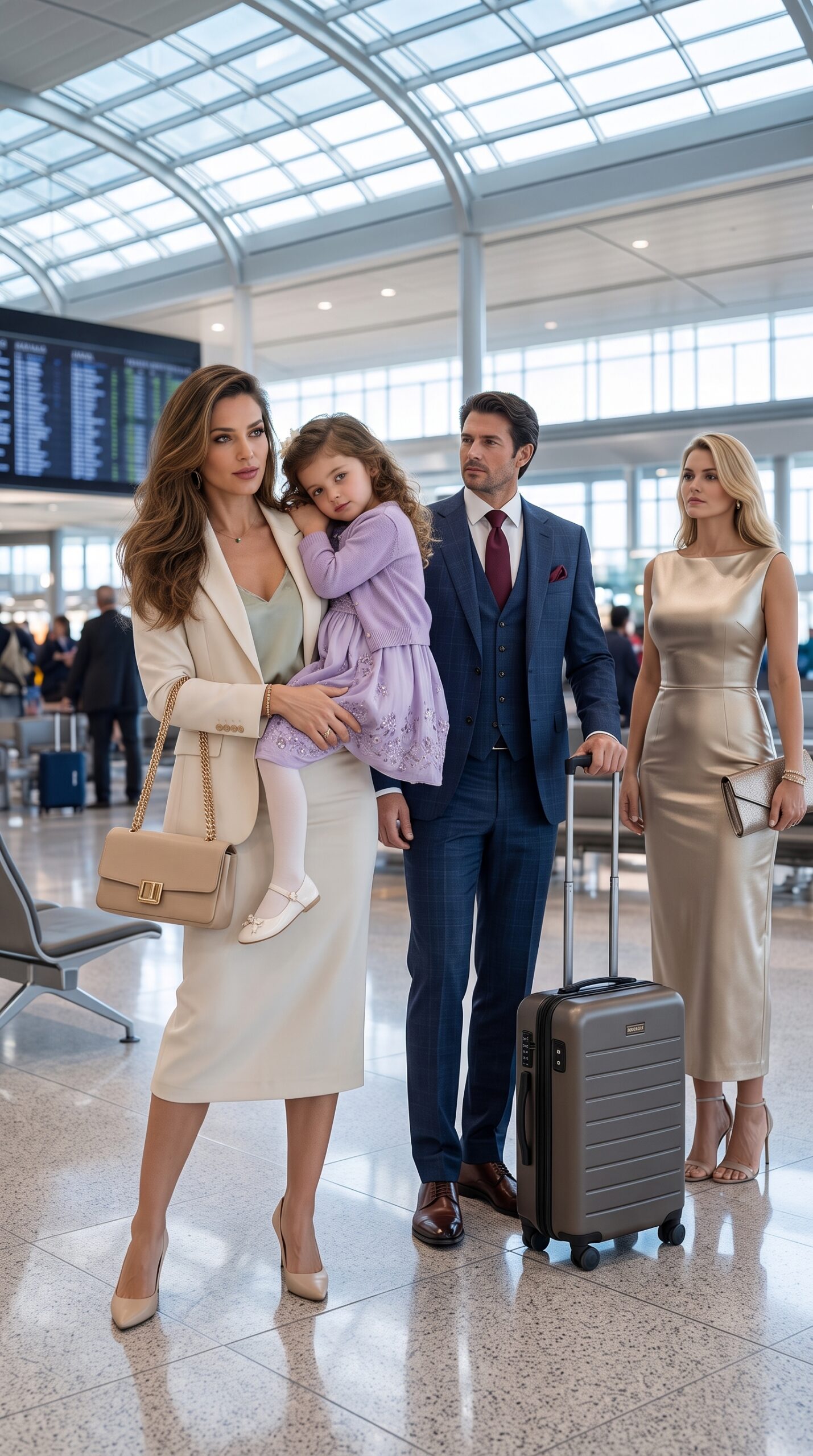
Diego Landa's honeymoon had barely taken off when he spotted, in the waiting area of Mexico City Airport, a girl with his very own eyes sitting on the lap of the woman his family had forbidden him to love.
The night before, he had married Sofía Cárdenas in an elegant estate in Querétaro. There had been orchid arrangements, fine mariachi, businessmen from Monterrey, dark-suited politicians, and a main table where his father smiled as if he had not handed over his son but signed a multimillion-dollar contract.
Maybe that was it.
Sofía was the perfect wife for someone with the Landa surname. Educated, beautiful, discreet, from a powerful family. She wore a white linen dress, expensive sunglasses perched on her head, and a ring that sparkled as if she were still showing off the wedding.
They were headed to Los Cabos. A villa by the sea, champagne, breakfasts overlooking the Pacific, and pretty pictures to prove that two wealthy families could unite without a single crack.
Then Diego saw Ana Belén Cruz.
She stood by the window, in light denim pants, a blue blouse, and white sneakers. She was holding a girl about two and a half years old who clutched a gray stuffed rabbit.
The little one watched the planes with a rare seriousness, as if she understood too much.
She had Diego's eyes.
Not similar. Not coincidental. They were the same gray-green eyes his mother called "storm eyes." She also had that stubborn way of furrowing her brows when something displeased her.
"Diego," Sofía said behind him.
He didn’t answer.
Three years earlier, Ana Belén had left his apartment in Del Valle with her dignity shattered and a phrase lodged in her throat:
"You’re not leaving me. You’re letting your dad decide for you."
Diego hadn’t followed her.
His father, Joaquín Landa, told him Ana Belén was after money, a name, and an easy life. His mother cried, saying he couldn’t destroy everyone’s future for a kindergarten teacher without connections.
Diego had been a coward.
He stopped calling. He stopped answering. He convinced himself that silence was a clean way to end things.
And now that woman was there, with a girl who looked like she came from his own blood.
"I’m going to the bathroom," he lied.
Sofía looked at him as if she already knew that lie had a name.
Diego walked towards Ana Belén. She saw him and tightened her hold on the girl, not in fear but with that protective strength a mother learns to wield alone.
"Diego," she said.
Hearing his name in her voice hurt more than any accusation.
"Ana."
The girl lifted the rabbit.
"He’s going to travel too."
Diego crouched slightly.
"That’s cool. What’s his name?"
The girl frowned.
"It’s not a he. It’s Nube."
Ana swallowed hard.
"Her name is Lucía."
Lucía.
The name fell on his chest like a bell.
"She’s beautiful," Diego said, although the real question was burning in his mouth.
Ana looked him straight in the eye.
"She’s two years and seven months old."
Diego felt his hands freeze.
Two years and seven months.
Three years since the last time he saw her. Three years since he believed all his father's words. Three years since he chose not to know.
Lucía reached out her tiny hand and grabbed a finger.
It was a minimal, innocent gesture, but Diego felt something inside him break silently.
Then the sound of Sofía's heels echoed.
"Diego," she said in a quiet voice. "They’re about to board."
Ana saw the ring before looking at Sofía.
"Congratulations."
There was no venom. That was worse.
Sofía smiled with icy politeness.
"Thank you. We’re on our honeymoon."
Lucía tugged on Diego's finger.
"Are you going on the plane too?"
Sofía answered for him.
"Yes, sweetheart. He has to go now."
Diego couldn’t move.
"Can I call you?" he asked Ana.
She held his gaze.
"Do you still remember my number?"
"I never forgot."
"Then try it."
Diego boarded the plane, but he left a piece of himself behind in that waiting area.
During takeoff, Sofía didn’t speak. She just watched him while he stared out the window, not seeing the sky.
As the plane flew over the Pacific, his phone vibrated.
Unknown number.
He opened the message.
It was a photo of Ana Belén in a hospital bed, pale, exhausted, cradling a newborn baby wrapped in a pink blanket.
Beside her stood Joaquín Landa, his father.
And next to the curtain appeared Efraín Robles, the family lawyer.
Beneath the image was a single phrase:
"Ask your dad how much he paid for you not to know she was born."
Sofía took the phone, saw the photo, and lost all color from her face.
Diego could only think that his honeymoon had just turned into an open grave.
PART 2
Sofía closed the message and returned the phone with a calm that was frightening.
"That girl could be your daughter," she said.
It didn’t sound like a question. It sounded like a sentence.
Diego looked at the photo again. Ana Belén with a newborn baby. His father standing by the bed. The family lawyer watching as if it were all just paperwork.
"I didn’t know," he murmured.
Sofía let out a small, joyless laugh.
"For your sake, I hope that’s true. Because if you knew and still married me, there’s really nothing left to discuss."
Diego tried to call the unknown number. It didn’t go through. He wrote several messages. None delivered.
The plane was too clean, too expensive, too fake. A flight attendant offered champagne, and Sofía shook her head. Diego felt the ring on his finger weigh like a chain.
"Tell me about her," Sofía asked.
"About Ana Belén?"
"About the woman you looked at as if your soul had been ripped away."
Diego lacked the strength to lie.
"I loved her."
Sofía lowered her gaze.
"I already figured that out. What I didn’t know was that maybe you had a daughter with her."
They landed in Los Cabos at noon. There was a driver holding a sign that said "Mr. and Mrs. Landa." There were flowers, a luxury SUV, and a reservation at a villa by the sea.
Sofía took off her sunglasses and looked at the airport exit.
"I’m not going to start my marriage on a lie."
"I’m going back to Mexico City," Diego said.
"So am I."
They bought two return tickets for that same afternoon. No one understood why a newlywed couple was leaving without touching the beach. But Diego was no longer thinking about the villa, or the wedding, or the photos.
He was thinking about Lucía.
When they landed in Mexico City, his father’s driver was waiting for them at arrivals.
That confirmed everything.
"Mr. Joaquín asked me to take you home," the man said.
Sofía pressed her lips together.
"Of course. How considerate."
The Landa mansion in Lomas de Chapultepec had always seemed untouchable: perfect gardens, expensive paintings, a silence of wealth, and employees who walked like shadows.
Joaquín was in his study, wearing a white shirt and dark blazer, as if he had been interrupted in a meeting, not in a three-year-old lie.
Diego threw the phone onto the desk.
"Why were you at the hospital when Ana Belén had her baby?"
Joaquín didn’t look at the photo.
That was the worst part.
He wasn’t surprised.
"You’re upset."
"Answer me."
Sofía stood rigid by the door.
Joaquín slowly took off his glasses.
"That girl came to my office saying she was pregnant."
Diego felt the floor open beneath him.
"And you didn’t tell me?"
"I protected you."
"Protected me or the business with the Cárdenas?"
Joaquín's jaw tightened.
"That relationship had no future."
"My daughter did have a future."
Joaquín slammed his hand on the table.
"You don’t know if she’s your daughter."
"But you knew she could be."
The silence answered for him.
Sofía stepped forward.
"Did my family know?"
Joaquín looked at her with annoyance.
"Your family knew what was necessary."
Sofía paled.
"What was necessary?"
Joaquín sighed, as if they were all foolish children.
"There were hotels, land, credits, a huge alliance. A pregnant woman in the middle would have destroyed years of negotiation."
He said it like that.
A pregnant woman.
As if Ana Belén had no name. As if Lucía were not a girl but a stain on a contract.
"Did you tell her I didn’t want to see her?" Diego asked.
Joaquín averted his gaze.
That silence said it all.
Sofía slowly took off her ring. She didn’t scream. She didn’t cry. That’s why her voice hurt more.
"I was used too."
Joaquín scoffed.
"Don’t dramatize, Sofía."
She looked at him in disgust.
"My marriage lasted less than 24 hours because you all think a family is a business."
Diego left the house. Sofía caught up with him by the car.
"Go to her," she said.
"Sofía…"
"Don’t ask me to accompany you to find the woman you never stopped loving. But don’t be a coward again."
She placed the ring in his hand.
"Find out who that girl is. And for the first time in your life, decide for yourself."
Hours later, Diego arrived at Ana Belén's apartment in Coyoacán. It was a small building, with bougainvillea at the entrance, pots on the windows, and a child’s bicycle by the door.
Ana opened the door with Lucía in her arms.
"It's the man from the plane," the girl said.
Ana didn’t smile.
"What are you doing here?"
"I saw the photo."
Her expression changed.
She let him in.
The apartment smelled of soup, lavender soap, and crayons. On the table were children's drawings, a cup with chewed pencils, and a plate with cut-up strawberries.
It was a simple, warm, real life.
Ana took an envelope from a drawer.
"Your father showed me this."
It was a printout of a supposed conversation from Diego.
"Ana says the baby could be yours. Do you want to know?"
Below appeared a response:
"No. Fix it. I don’t want that to touch my life."
Diego felt nauseous.
"I didn’t write that."
Ana looked at him tiredly.
"I want to believe you now. But at that moment, it sounded just like the man who left me alone."
Lucía placed a yellow block on Diego's knee.
"Keep it."
He took it, not knowing what to say.
Ana opened a white box. There was a hospital bracelet, papers, a pink cap, and an unopened DNA test.
"I bought it when Lucía was six months old," she said. "But I was scared."
"Scared of what?"
"Of confirming that I had to keep waiting for you."
Then Diego’s phone rang.
It was Sofía.
Ana hesitated, but Diego answered on speaker.
Sofía's voice trembled.
"My mom just asked me if Ana still has the hospital bracelet."
Ana lifted the plastic bracelet.
"Why would she ask that?" Diego asked.
"Because she says there might have been an error with the baby's name."
Ana turned the bracelet over.
The label read: Lucía Cruz.
But underneath, stuck to the plastic as if someone had tried to hide it, was another label.
Baby girl Cárdenas.
Sofía let out a sob on the other end of the line.
And Ana Belén understood that the secret did not only belong to Diego.
It belonged to everyone.
For several seconds, no one spoke. Lucía was on the floor arranging blocks, unaware that her story had just trembled in an old bracelet.
"This doesn’t make sense," Ana said.
But it did.
In a horrible way, it did.
Sofía arrived 40 minutes later. She no longer looked like the elegant bride from the wedding. She came without makeup, her eyes swollen, and a folder pressed against her chest.
"My mom gave me this before locking herself in her room," she said.
She placed on the table receipts from Santa Elena Hospital, fee statements, a letter from Efraín Robles, and a copy of a birth certificate that was never used.
Provisional name: Baby girl Cárdenas.
Mother: Mariana Cárdenas.
Father: Not declared.
Ana covered her mouth with her hand.
Sofía spoke slowly.
"My sister Mariana had a baby that same morning. The girl was born premature and died a few hours later. My family didn’t want it known because the father was a married man, my dad’s partner."
Diego looked at the second label.
Sofía continued, her voice breaking.
"When Ana’s labor appeared, the lawyers mixed up files to erase two problems with one lie: Mariana's pregnancy and the daughter you weren't supposed to know about."
"Are you telling me they tried to pass my daughter off as your sister's?" Ana asked.
Sofía cried without covering her face.
"It seems so."
Ana hugged Lucía tightly.
"My daughter is not a correctable document."
That very afternoon, they did the DNA test. Diego paid for a private lab with urgent results and, for the first time in his life, didn’t call his father for permission.
They also looked for Marisol, the nurse whose name appeared in a note kept by Ana. They found her in Puebla, retired, living with her daughter.
At first, she didn’t want to talk. But when she heard Lucía Cruz’s name, she began to cry.
"I knew one day you would come looking for her," she said.
Marisol told everything.
Joaquín Landa had arrived at the hospital with Efraín Robles and Ricardo Cárdenas, Sofía’s father. They had requested to move files, erase calls, alter records, and convince Ana that Diego had rejected her.
They wanted the Landa family not to carry a granddaughter they wouldn’t recognize.
They wanted the Cárdenas to hide Mariana’s pregnancy.
They wanted the business to remain clean.
"I didn’t change babies," Marisol clarified. "The Cárdenas baby had already died. But I saw how they stuck that label under the other one to create a legal exit if they ever needed to deny the origin of Ana’s girl."
"Did you send the photo?" Diego asked.
"Yes. I saw your wedding on social media. Then I saw the girl in a photo from the airport. And I thought: that’s enough."
The next day, the results arrived.
Probability of paternity: 99.9998%.
Lucía was Diego’s daughter.
There was no perfect hug. No music. No clean ending.
Ana cried sitting on the hallway floor, with Lucía in her arms. The little girl touched her face with her tiny hands.
"Mommy, don’t cry."
Diego knelt in front of them, daring not to touch what he hadn’t cared for.
"I’m sorry."
Ana shook her head.
"Don’t ask me today for what can’t be fixed in an afternoon."
"I know."
"I don’t want your last name as a prize. I don’t want your money as an apology. And I don’t want you to show up thinking being a dad means getting excited about a test."
Each word was just.
"I want Lucía to have the truth," Ana said. "And I want no one to use her again to protect a business."
That night, they faced both families at the Cárdenas' house in Polanco.
There were Joaquín Landa, Ricardo Cárdenas, Sofía’s mother, Efraín Robles, and two advisors who looked like they wanted to disappear.
Ana entered with Lucía by the hand. Diego walked beside her, but not in front. Sofía followed behind, holding the copies.
Joaquín stood up.
"This can be discussed privately."
Diego looked at him without lowering his head.
"No. The private part was the lie. The truth will be heard in full."
Ricardo slammed the table.
"Watch what you’re insinuating."
Sofía threw the folder in front of him.
"It’s not an insinuation, Dad. It’s receipts, altered files, false messages, and the testimony of a nurse."
Sofía’s mother began to cry.
"We did it to protect Mariana."
Ana looked at her with devastating calm.
"No. You used your daughter’s pain to rob my daughter of the truth."
Efraín tried to stand up.
"This has no legal validity."
Sofía took out her cellphone.
"My lawyer already has it. So does the foundation’s counsel. If anyone touches Ana or Lucía, this goes public tomorrow."
Joaquín looked at Diego as if he were the traitor.
"You’re going to destroy your family."
For the first time, Diego felt no fear.
"No, Dad. You destroyed it when you decided a girl was worth less than a deal."
Then came the fall.
Efraín lost clients before losing his license. Ricardo Cárdenas resigned from his company’s board while an investigation for document forgery opened. Joaquín had to leave the direction of the Landa group when his partners understood that a man capable of hiding a granddaughter could also bury any contract.
Sofía requested the annulment of the marriage.
There was no scandal between her and Diego. Just a sad farewell in a café in Roma.
"I wasn’t your wife," she said. "I was part of someone else’s plan."
"I’m sorry."
"Me too. But at least we’re no longer acting out a life written by cowards."
Ana didn’t go back to Diego.
Not like that. Not immediately.
Diego wanted to repair three years in a week, but he understood that love wasn’t a house he could enter with an old key.
He started with the only thing he had the right to do: to be there.
He signed the paternity acknowledgment. He went to therapy. He opened an account for Lucía that Ana would manage. He learned her favorite songs, how she liked strawberries, what time she took her nap, and that Nube, the rabbit, couldn’t be washed without asking for permission.
One Sunday, in the Viveros of Coyoacán, Lucía ran towards him with a dry leaf in hand.
"Look, Diego, it looks like a heart."
She still didn’t call him Dad.
Ana looked at him with pain and something like hope.
"Give it time."
Diego nodded.
For years, he let others decide who he should be: obedient son, convenient husband, perfect heir.
But a girl with his eyes taught him that the truth doesn’t disappear because a wealthy family hides it in a folder.
Sometimes it grows in silence.
Sometimes it learns to walk.
And sometimes it appears in an airport, with a stuffed rabbit in hand, to return names to all the cowards.





