PART 1
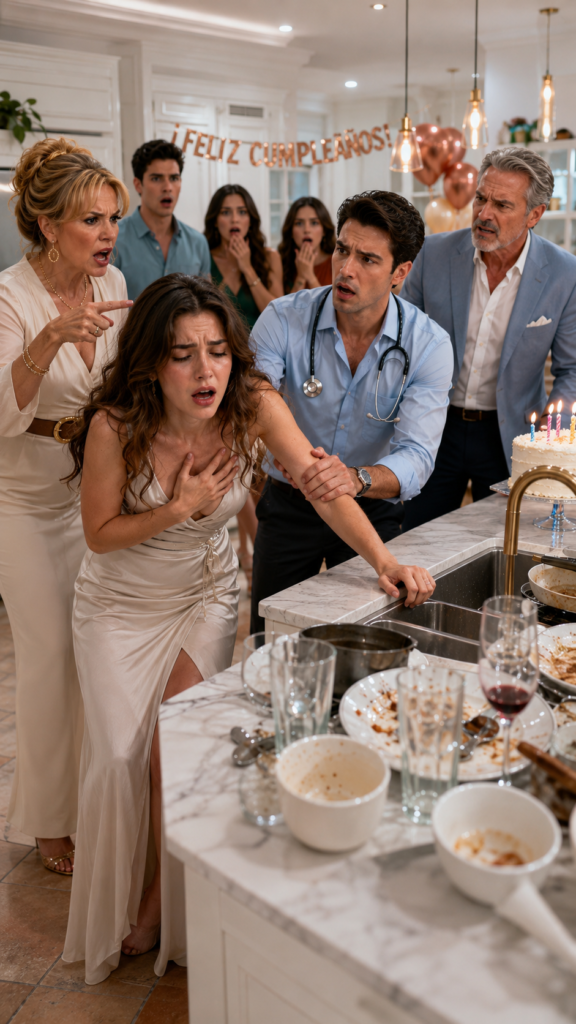
—Stop playing the victim and finish washing that —Patricia snapped, not even bothering to look at her daughter.
Mariana Rivas stood at the sink, hands soaked, back sweating, and her chest so tight that each breath felt like it was squeezing through a crack.
In the living room, the party continued as if nothing were wrong.
There was music by José José mixed with laughter, plates of carnitas on the table, children running with soda in hand, and an aunt shouting about missing tortillas. The house, in a quiet neighborhood in Zapopan, was packed because Patricia was celebrating her 55th birthday, and according to her, “a mother like her deserved to be celebrated big.”
Mariana was 25.
To everyone, she was the sensitive daughter, the one who complained, the one who ruined the atmosphere, the one who always “had a face.” In this family, Daniel, her older brother, was the charming one; Ernesto, her father, was the respected man; Patricia was the queen of the house.
And Mariana was the one who served.
From early on, she had set up chairs, washed glasses, arranged snacks, collected napkins, and carried bags of ice. No one asked if she was tired. No one noticed she had been touching her chest for a while.
—Mom... I can’t breathe —she barely managed to say.
Patricia set down a tray on the counter and looked at her with annoyance.
—Not today, Mariana. Not today with your dramas.
The girl swallowed hard. She tried to take in air, but it wouldn’t fill her lungs. The edges of the kitchen began to sway, as if everything were submerged underwater.
—I’m serious… I feel bad.
Her father appeared at the entrance with a beer in hand. He was laughing about something with his buddies, but upon seeing her hunched over, he replaced laughter with a grimace.
—Again? —he said—. You can’t stand to see your mother be the center of attention, can you?
Daniel approached behind him, with a piece of cake on a plate.
—Let her be, Dad. She probably wants everyone to ask her what’s wrong.
Someone from the dining room caught wind and laughed.
Mariana wanted to defend herself, but only a gasp escaped. She held onto the edge of the sink. Her fingers tingled. Her heart pounded so hard she was afraid she might collapse right there, among greasy plates and dirty glasses.
A glass slipped from her hand.
The glass shattered on the floor.
—Mariana! —Patricia yelled—. Do you see what you’ve done? On my birthday!
The music lowered slightly. Several guests turned to look.
Mariana took a step back, searching for the wall. Her legs trembled. Her face had lost its color, but her family continued to stare at her as if she were putting on a cheap show.
—I can’t… —she managed to say.
Then Julián walked in.
He was Daniel’s friend from college. He had arrived late to the party because he was coming off a shift at a civil hospital. Patricia always boasted that Julián was a resident doctor, almost as if he were part of the family.
But that afternoon, Julián didn’t smile.
He saw Mariana, set his cup on the table, and crossed the kitchen in a hurry.
—Mariana, look at me —he ordered in a serious voice—. How long have you been like this?
She tried to respond, but her chest tightened further.
Julián grabbed her wrist. Then he felt her neck. He looked at her lips, her eyes, her rapid breathing, her numb hands.
His face changed.
He paled.
—Call 911. Now.
Silence fell over the house like a bucket of ice water.
Patricia's eyes widened.
—Oh, Julián, don’t exaggerate. She does this when she wants attention.
Julián looked at her with a hardness no one expected.
—She’s not acting. She’s in crisis, she has pressure in her chest and hasn’t been able to breathe for a while. How long have you left her like this?
No one answered.
Ernesto muttered that it wasn’t a reason to make a scene. Daniel said it was probably anxiety. Patricia put a hand to her chest and started saying that something had to happen on her birthday.
Mariana, sitting on the kitchen floor, listened to it all from afar.
And then she understood the cruelest thing.
Yes, they had heard her.
They just didn’t care.
When the paramedics arrived, Patricia’s face changed. She cried, asked for space, said her little girl had always been delicate. Ernesto assured everyone it had all happened “suddenly.” Daniel avoided looking at Julián.
But Julián spoke the truth in front of everyone:
—She asked for help multiple times and you ignored her.
As they lifted Mariana into the ambulance, Patricia came close and squeezed her shoulder. It wasn’t tenderness. It was a warning.
—We’ll talk about this later —she whispered.
The door closed.
And Mariana didn’t know that this threat would be the last time her mother would speak to her as if she could still command her.
PART 2
In the emergency room, Mariana encountered a kind of silence that was nothing like the one at home.
Here, the silence didn’t punish.
It just let her breathe.
The hospital’s bright lights hurt her eyes. A nurse placed oxygen on her. A doctor asked quick questions: chest pain, dizziness, history, medications, recent stress.
Mariana almost let out a bitter laugh.
How do you explain a lifetime of stress on a gurney?
Stress was being 8 years old and learning not to cry because her dad said whiny girls were pathetic. Stress was hearing Daniel mock her voice every time she tried to defend herself. Stress was watching her mother smile in front of visitors and then treat her like a servant as soon as the door closed.
Julián arrived shortly after.
He didn’t intrude too much. He didn’t ask awkward questions. He just stayed close, as if he wanted to ensure that this time no one would leave her alone.
A doctor explained that the tests showed no heart damage, but that the episode had been serious. A severe anxiety attack could feel like a heart attack, and that didn’t make it a lie.
—Your body has reached its limit —the doctor said—. You need rest, psychological follow-up, and to avoid high-conflict environments.
Mariana listened to those words as if they were both a sentence and a key.
Her cellphone vibrated.
It was Patricia.
“Are you feeling calmer? Everyone here is asking what happened.”
Mariana read the message twice.
It didn’t say “How are you?” It didn’t say “I’m sorry.” It didn’t say “I’m on my way.”
It said “Everyone is asking.”
As if her emergency had been a matter of image.
Julián noticed her expression.
—Do you want me to notify anyone else?
Mariana shook her head.
—There’s no one else.
He didn’t respond. He just pulled up a chair and sat down.
Hours later, when Mariana could breathe better, Lupita, a nurse with a firm voice and attentive eyes, came in. She asked if Mariana wanted to receive visitors.
Before Mariana could answer, the door opened.
Patricia entered first, with her makeup intact and a look of a suffering mother. Ernesto followed with a judge's face. Daniel brought a container of cake, as if that could turn the night into a family anecdote.
—My girl —Patricia said loudly—. You gave us a horrible scare.
Mariana stared at her.
—I gave you a scare?
Patricia blinked.
—Of course. You collapsed in the middle of the party.
—I told you first that I couldn’t breathe.
Ernesto clenched his jaw.
—Don’t start. Your mother was busy. There were guests.
—I was out of breath.
Daniel let out an awkward laugh.
—You also picked the worst time, come on.
The monitor next to the bed began to beep faster.
Julián got up.
—It wasn’t a choice.
Ernesto looked at him with disdain.
—Thanks for your help, doctor, but this is a family matter.
Lupita stepped forward.
—While she’s in this hospital, it’s also a medical matter.
Patricia brought a handkerchief to her eyes.
—I can’t believe you’re treating me like I’m a bad mother.
There it was, the truth.
It didn’t hurt her that Mariana was in crisis. It didn’t hurt her to see her in an ambulance. It hurt her to look bad in front of others.
Lupita moved closer to the bed.
—Mariana, do you feel safe with this visit?
Patricia stopped crying instantly.
—How can she not feel safe? I’m her mother.
The nurse didn’t answer her. She looked at Mariana.
And for the first time in many years, someone gave her permission to speak the truth.
Mariana felt something open in her chest. It wasn’t just air. It was dignity.
—No —she said.
One word.
Small.
But enough.
Ernesto turned red.
—Mariana.
—I don’t feel safe —she repeated.
Patricia recoiled as if she had been struck.
—Are you kicking us out?
Mariana swallowed.
—I’m choosing to breathe.
Lupita opened the door.
—The patient needs peace. The visit is over.
Patricia cried louder now, with an audience. Ernesto murmured threats. Daniel looked at Mariana as if she had betrayed an old rule.
They left.
They weren’t pushed out. There were no shouts. It was worse: they had to walk out on their own, while a nurse held the door and Julián watched everything.
When the door closed, Mariana broke down.
She cried like a child. She cried for the daughter who still wanted her mother to come back repentant. She cried for the times she had asked for help and received ridicule. She cried because setting a boundary also hurt.
Lupita returned later to check her signs.
Before leaving, she said:
—Sometimes the body screams what the mouth is tired of asking.
Mariana didn’t sleep.
The next morning, a psychologist from the hospital sat with her. She asked what phrases popped into her head when she needed support.
Mariana didn’t have to think.
“Don’t exaggerate.”
“Don’t ruin this.”
“Don’t be a burden.”
The psychologist nodded.
—Those phrases didn’t originate with you. Someone put them there.
That was the first truth blow.
The second came with her cellphone.
She had 42 missed calls and over 80 messages. One from Ernesto said:
“Fix this. Your mother doesn’t deserve to be humiliated like this.”
Daniel wrote:
“You went too far. Everyone thinks we’re monsters because of your stunt.”
Patricia sent crying voice notes, but none of them asked how she was doing.
Julián advised her to save everything.
—For what? —Mariana asked.
—So when they try to convince you that it didn’t happen the way you remember, you have proof.
The word proof pierced her.
Because that had been her life: a family erasing her reality and then calling her dramatic for bleeding where they had hurt her.
Later, as Mariana walked slowly through the hospital common area, she heard Daniel’s voice in the hallway.
—That’s enough. Now we’re criminals because she got nervous.
Mariana’s body reacted. Her hands went cold.
Patricia appeared with dark glasses, even though they were inside the hospital. Ernesto followed behind, stiff, as if he were heading to a meeting and not toward his daughter.
—Mariana —Patricia said, softening her voice—. We need to talk.
Lupita looked up from the nursing station.
Ernesto noticed and lowered his tone.
—We’re not here to fight. We’re here for you to be reasonable.
Reasonable.
In this family, reasonable had always meant obedient.
Daniel crossed his arms.
—Mom didn’t sleep because of you.
Something inside Mariana froze. Not calm. Frozen, like the sea before releasing the wave.
Julián murmured:
—You don’t have to do this.
—I know —she replied.
And that’s why she did it.
She looked at Daniel.
—Yesterday you said I wanted attention. Today you say Mom didn’t sleep because of me. When I was 16 and fainted in school, you told everyone I was playing the martyr. When I cried at Grandma’s funeral, you said I wanted to be the saddest in the room.
Daniel looked around. People were listening.
—Don’t start with old stuff.
—It’s not old if you still use it to hurt me.
Then she looked at Ernesto.
—You called me lazy while I was trying to breathe. You texted me to fix this because Mom was humiliated. You didn’t ask if I was scared. You didn’t ask if I thought I was dying.
Ernesto gritted his teeth.
—Watch your tone.
For the first time, Mariana didn’t shrink back.
—That tone was taught to me by you.
Patricia let out a calculated sob.
—It was my birthday. There were a lot of people. I didn’t know it was real.
—You didn’t care to find out —Mariana said.
The phrase fell like another glass breaking in the kitchen.
Lupita approached.
—Do you want me to ask them to leave?
Patricia took off her glasses.
—Please don’t do this here.
Mariana felt a deep sadness, but she no longer felt guilt.
—You humiliated me in front of 30 people while I asked for help. This is not humiliation. It’s consequence.
Ernesto pointed to Julián.
—He’s putting ideas in your head.
—No —Mariana said—. You instilled fear in me for years. He just believed me.
Daniel murmured:
—We’re your family.
Before, that phrase would have broken her.
Family was the word they used to ask her to wash, smile, forgive, be silent, and come back. Family was the clean tablecloth over a table full of dirt.
But not anymore.
—Family is not permission to destroy someone and then ask them to smile for the photo.
Ernesto took a step toward her.
A guard approached.
And there Mariana saw the clearest twist of her life: her father, the man who filled the walls with his voice at home, stopped because there were witnesses.
His power depended on everything happening in private.
—I want you to leave —Mariana said.
Patricia shook her head.
—Don’t be cruel.
—Cruel was hearing me say I couldn’t breathe and sending me to wash dishes.
The guard indicated the exit. Ernesto tried to protest, but found no stage to win. Patricia cried without anyone rushing to console her. Daniel looked at the floor.
When they disappeared down the hallway, Mariana trembled.
Julián touched her elbow.
—Are you okay?
She looked at the door.
—No. But I’m no longer alone in the lie.
The next day she was discharged.
The doctor handed her instructions: therapy, rest, breathing exercises, and avoiding conflictual environments. Mariana kept those papers as if they were tickets to freedom.
When she exited, her family was in the lobby.
Patricia had an envelope in hand.
—I wrote you a letter —she said.
For a second, Mariana wanted to take it. A tired part of her still hungered for a mother.
Then Patricia added:
—I don’t want the family to think I’m a bad mom.
There it was again.
She didn’t want to repair the damage.
She wanted to repair her image.
Mariana didn’t take the envelope.
—That’s the difference between you and me. I’m trying to heal. You’re trying to look good.
Ernesto scoffed.
—Enough.
—Yes —Mariana replied—. Enough.
She pulled out her medical instructions.
—I’m not going to the Sunday lunch. I’m not going to respond to the family group. I’m not going to attend birthdays, parties, or gatherings where you expect me to be useful instead of loved.
Patricia paled.
—Are you going to cut off your own mother?
Mariana felt sadness, but it was a clean sadness.
—You cut me off first. Every time I asked for care and you gave me criticism. I’m just making the distance visible.
Daniel rubbed his face.
—I said foolish things. I didn’t think it was that serious.
—You didn’t need to know it was serious to be kind.
He fell silent.
Ernesto delivered the final blow:
—You’ll come back when it blows over.
Mariana breathed.
The air filled her lungs completely.
—No. I’ll come back only if you change. And I’m not going to wait in the damage while you decide to do it.
She walked toward the exit.
Outside, Guadalajara was still alive: cars, vendors, sun on the pavement, a lady crossing with flowers. Everything was ordinary. Everything was immense.
In the car, her cellphone started vibrating. Messages from the family group. Voice notes from Patricia. A text from Ernesto: “You’re destroying this family.” Another from Daniel: “Come on, back off.”
Mariana didn’t feel victory.
She felt pain, fear, exhaustion.
But also peace.
She silenced Patricia. Blocked Daniel for 30 days. Saved Ernesto’s messages in a folder called “Proofs.” Left the family group.
Then she turned her cellphone face down.
Weeks later, she began therapy. Bought plants for her apartment. Left dishes unwashed for an entire night, and no one called her lazy. Slept in on a Sunday while her family ate without her.
At first, it hurt to imagine her empty chair.
Then she understood that chair had never been hers.
It was a service position.
One day, Patricia wrote from an unknown number:
“I miss my daughter.”
Mariana read the message many times.
Then she replied:
“I miss the mother I needed.”
And blocked the number.
Not because it didn’t hurt. It hurt so much she had to sit on the kitchen floor and breathe slowly.
But this time, no one ordered her to clean while she was struggling to breathe.
This time, Mariana stayed with herself.
Months later, a cousin told her that Patricia said her daughter had changed, that someone had filled her head, that young people today couldn’t endure anything. Ernesto avoided talking about the hospital. Daniel no longer made jokes about her because an aunt told him:
—After what happened, it’s not funny anymore.
There was no loud revenge.
No final shouts or slammed doors.
Her family lost something much quieter.
They lost the Mariana who always came back. The one who washed dishes. The one who asked for forgiveness for breathing too loud. The one who smiled so no one noticed the cracks.
And Mariana gained something she should never have had to defend: y her right to live in peace.





