PART 1
At 6:00 AM on December 24th, Doña Rosario read her daughter-in-law's message while steam still rose from the coffee on the kitchen table.
"We need space. Don’t call."
It didn’t come from her son Julián.
It came from Mariana.
Doña Rosario, 61 years old and widowed for 5, stared at the screen without blinking. Outside, the cold of Querétaro fogged the windows, and the Christmas lights in the garden flickered on and off, as if the house had just received a silent slap.
She didn’t cry.
She didn’t scream.
She didn’t call back.
She simply laid the cellphone face down and looked toward the garage.
Julián’s car was gone.
The night before, Mariana had loaded suitcases, beach bags, sandals, a cooler, and even a huge hat she had bought for her photos. Doña Rosario thought they might be spending Christmas Eve with Mariana’s family in Celaya.
But no.
They had gone to Cancun.
Without notice.
Without saying goodbye.
Without inviting her.
And with that cold message, written as if she were an annoyance in her own home.
Julián and Mariana had been living in the upstairs apartment for 2 years. When they arrived, they said it would be temporary, "just a few months," while they saved money to buy something of their own.
Doña Rosario accepted because Julián was her only son.
Also because, after Don Ernesto's death, the house felt too silent.
At first, everything seemed to work. Julián paid a part of the electricity bill. Mariana sometimes came down with sweet bread. They had family meals on Sundays. They even talked about decorating the patio for Christmas.
But little by little, Mariana began to act as if she were in charge more than the owner.
She took down family portraits from the hallway because, according to her, "they looked outdated."
She moved Doña Rosario’s flowerpots because "they were in the way for visitors."
She asked her not to use the washing machine after 5:00 PM because the noise bothered them upstairs.
And one evening, while they were having dinner, she dropped a phrase that pierced Doña Rosario deeply.
—A woman alone doesn’t need such a big house. A small apartment would be more practical for you.
Julián said nothing.
He just lowered his gaze.
That Christmas Eve morning, Doña Rosario understood that the message was not an accident.
It was a declaration.
They wanted her to feel alone.
They wanted her to understand that she was no longer part of the decisions.
They wanted her to accept her place as an old, quiet, grateful guest.
But they were wrong.
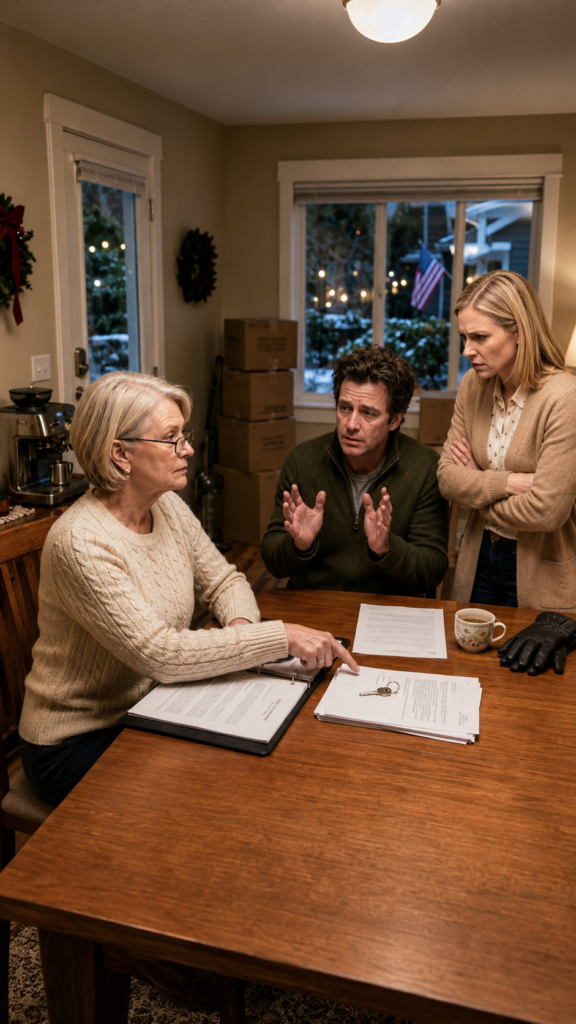
Doña Rosario slowly climbed to the room where she kept her documents. She opened the closet, took down a black folder, and placed it on the bed.
Inside were the deeds, property tax receipts, maintenance payments, insurance documents, and the updated will.
The house was in her name.
Only in her name.
Don Ernesto and she had paid for it for 30 years, peso by peso, sacrificing vacations, new cars, and many comforts.
It was not Julián’s house.
It was not Mariana’s house.
It was hers.
Doña Rosario took the master key that hung by the door, gripped it tightly, and took a deep breath.
They would be gone for 4 days.
4 days of resort, buffet, and beach photos.
4 days in which they would think she would be sitting alone, crying in front of the Christmas tree.
But those 4 days were going to change everything.
Because Mariana thought she had left a defenseless old woman alone, not realizing that Doña Rosario was about to reclaim her house, her dignity, and her peace in a way that no one in the family could believe.
PART 2
The first thing Doña Rosario did was walk to the basement.
The house was silent. That silence that once pained her now felt like a blessing.
She descended the stairs calmly, turned on the light, and approached the heating panel. The upstairs apartment had its own thermostat connected to the house’s general system.
For months, Mariana had left the heating on high, even when they weren’t home. Then she complained that Doña Rosario should pay more because "you spend more time here."
Doña Rosario adjusted the temperature to the minimum necessary to prevent the pipes from suffering.
It wasn’t cruelty.
It was common sense.
If they needed space from her, they could also need space from her resources.
Then she went upstairs and locked the interior door that connected her house to the apartment stairs. The click of the lock sounded dry, firm, almost elegant.
For the first time in months, Doña Rosario felt air filling her lungs completely.
She went to the living room, opened her laptop, and logged into online banking. The joint emergency account she once shared with Julián was still active. She had created it for house expenses, medicine, or urgent repairs.
But Julián hadn’t deposited anything for months.
Mariana, on the other hand, used it to pay for streaming services, takeout food, and even a gym membership.
Doña Rosario reviewed the transactions one by one.
She wasn’t surprised.
She only confirmed what she already knew.
At 7:18 AM, she transferred the remaining balance to her personal account.
At 7:24, she closed the account.
Then she printed the receipt and placed it in the black folder.
By mid-morning, she prepared a simple breakfast: eggs with nopal, warm tortillas, and coffee. She ate slowly, without television, without music, without her cellphone.
As she chewed, she remembered the last family gathering.
Mariana had invited her friends without asking her. She had occupied the kitchen early, changed the dining room decorations, and asked Doña Rosario to stay "a little while in her room" so the photos would look more modern.
—It’s not bad, Mother-in-law —Mariana had said, laughing—. It’s just that you look too serious and ruin the vibe.
Julián heard it all.
And once again said nothing.
Doña Rosario finished her coffee.
Then she took her phone and called Don Toño, a trusted locksmith with a shop near the La Cruz market.
Don Toño had known the family since Don Ernesto's time. He had changed locks, repaired gates, and even helped install locks when Julián was a child.
—Good morning, Doña Chayo —he greeted—. Everything okay?
—I need to change the main lock and 3 interior cylinders —she replied—. I want a new security system, one of those that doesn’t allow key copying without a card.
There was a brief silence on the other end.
—Family problems?
Doña Rosario looked at the Christmas tree, adorned with red ornaments she had placed alone.
—No, Don Toño. Family solutions.
The locksmith arrived that same afternoon. The job cost 22,000 pesos, but Doña Rosario paid without haggling. Every sound of the drill felt like a small victory.
The main lock changed.
The basement door changed.
The interior door changed.
The side entrance was also reinforced.
When Don Toño finished, he handed her 5 new keys and a security card.
—Without this card, no one can make copies —he explained.
Doña Rosario tucked the card in her purse.
—Perfect.
That night, she had chicken soup for dinner, watched an old movie, and turned off her cellphone. No new messages. No calls. Neither Julián nor Mariana asked if she was okay.
That solidified something inside her.
The next day, Doña Rosario put on work gloves and went down to the basement. For months, Mariana and Julián had invaded that space as if it were theirs.
There were boxes of clothes, shoes, decorations, a treadmill no one used, suitcases, tools, tires, modern paintings, and even bags of things Mariana bought on sale and then forgot.
The washing machine was almost blocked.
The shelves where Doña Rosario kept jars, candles, gardening tools, and memories of Don Ernesto were crammed in a corner.
She started to organize.
She threw nothing away.
She broke nothing.
She hid nothing.
But she moved every object that didn’t belong to her to the designated storage area for them. She labeled everything with a black marker.
“Mariana’s Clothes.”
“Mariana’s Shoes.”
“Julián’s Tools.”
“Decorations.”
“Papers.”
“Kitchen.”
While sorting through an old box, she found drawings Julián had made when he was 7. One said: “Mom, when I grow up, I will take care of you.”
Doña Rosario sat on a wooden bench.
She caressed the yellowed page.
For a moment, pain rose in her throat.
That boy had been sweet, cheerful, glued to her. That boy ran to hug her when Don Ernesto came home late from work. That boy asked for noodle soup when he was sad.
But that boy was no longer there.
In his place was an adult man who allowed his wife to humiliate his mother in the hallways of the house she had built.
Doña Rosario tucked the drawing in a separate box.
Not for Julián.
For herself.
Because her memories deserved respect.
On the third day, she checked the upstairs apartment using the master key she legally held as the owner. She didn’t enter to spy. She entered to verify there were no leaks, lit candles, or any risks.
She found dirty dishes, garbage bags, scattered clothes, and a full sink.
On the counter were brochures for the resort in Cancun, printouts of reservations, and a list of expenses.
4 nights.
Ocean view.
Special Christmas dinner.
Spa for 2.
Doña Rosario observed the papers and understood something that gave her more calm than anger.
It wasn’t that they didn’t have money.
It was that they preferred to spend it on themselves and live cheaply in her house.
In the upstairs living room, she saw a fine coffee maker she had lent them a year ago. Also, an expensive vacuum cleaner Don Ernesto had given her before he died.
She brought both things down to her part of the house.
She wasn’t going to keep lending comfort tools to those who denied her respect.
Then she closed the apartment and went down without looking back.
On the fourth day, as the sky began to turn purple, Doña Rosario sat at the dining table with a clean sheet of paper.
She didn’t write with anger.
She wrote as one who signs a new beginning.
Starting from the 1st of the next month, Julián and Mariana would pay 15,000 pesos monthly for the upstairs apartment. Additionally, they would need to cover their share of electricity, water, gas, and internet.
The use of the laundry room would be limited to established hours.
The basement would not be common space.
The patio would only be used with prior permission.
Visits would have to be announced.
Any disrespect would be grounds for terminating the agreement.
Finally, she printed 2 copies of the contract.
She placed one single new key on the kitchen counter above it.
1.
She left it right on top of the paper.
It wasn’t an accident.
It was a message.
If they wanted to live as adults, they would have to coordinate as adults. Mariana would no longer have her own key to enter and exit like the queen of someone else's house.
Next to the contract, she left the receipt for the closure of the joint account and a simple copy of the deed.
Then she turned off the lights, went down to her living room, and made chamomile tea.
At 8:13 PM, she heard the tires on the gravel.
They had returned.
First came Mariana's laughter, loud, carefree, still in a vacation tone. Then some bags hitting the floor. Then the sound of a key trying to enter the lock.
Nothing.
Again.
Nothing.
A third time.
Nothing.
—What’s going on? —Julián said.
—Let me see —Mariana replied.
The old key scraped the lock but wouldn’t turn.
Then came the doorbell.
Once.
Twice.
Five times.
Then banging.
—Doña Rosario! Open the door! —Mariana shouted—. We just got back!
Doña Rosario waited exactly 2 minutes.
She stood up, adjusted her sweater, and opened just enough, with the new chain in place.
Julián was tanned and nervous. Mariana wore sunglasses on her head, freshly painted nails, and a face of fury she couldn’t hide.
—Mom, the key doesn’t work —Julián said.
—It works —Doña Rosario replied—. It just doesn’t open this lock anymore.
Mariana stepped in front.
—Did you change the lock? Are you crazy or what? You left us outside with suitcases in the middle of the night.
Doña Rosario looked at her calmly.
—You left me alone on Christmas Eve with a 4-word message. I simply updated the security of my property.
—Property! —Mariana repeated with disdain—. What a nasty way to talk about family.
—Family is something else, Mariana. Don’t confuse family with abuse.
Julián took a deep breath.
—Mom, open. We’re tired. We’ll talk inside.
—You can enter through the side door to your apartment. The internal connection is closed. Everything you need to know is on the counter.
—What do you mean the internal connection is closed? —Mariana asked.
—As it sounds. Good night.
Doña Rosario closed the door.
Above, the footsteps sounded heavy. She heard a suitcase dragging, then a door, then silence.
The silence didn’t last long.
—Julián! —Mariana shouted—. Come see this!
Doña Rosario took her cup.
They had found the contract.
First came the cellphone.
Julián.
Then another call.
Then another.
Then messages.
"Mom, answer."
"We need to talk."
"This isn’t right."
Mariana also wrote:
"This is abuse. We are family. You can’t treat us like tenants."
Doña Rosario read the message and left it unanswered.
At 9:02, Julián knocked on the interior door.
—Mom, open. What’s this about 15,000 pesos? And where are our things from the basement?
Doña Rosario approached the door, but didn’t remove the lock.
—Your things are complete, labeled, and stored in your storage.
—You can’t lock our things away.
—they’re not locked away. You have 1 key for your storage along with the entrance key.
Mariana shouted from the back:
—This is outrageous! You’re punishing us because we went on vacation!
Doña Rosario pressed her hand against the wood.
—No. I’m treating you like adults.
—We are your family! —Mariana insisted.
—Then start behaving like one. Tomorrow at 5:00 we’ll talk. Not today.
That night, for the first time in a long time, Doña Rosario slept without feeling anyone invading her life.
The next day, Julián left early for work. Mariana stayed upstairs. She didn’t come down. She didn’t greet. She didn’t go out either, perhaps because she didn’t want to depend on the only key.
At exactly 5:00, Doña Rosario was sitting at the dining table with the black folder in front of her. She had set out 2 chairs on the other side.
Julián and Mariana entered through the interior door when she opened it.
He came with dark circles under his eyes.
She came with anger.
—Sit down —said Doña Rosario.
Julián sat down.
Mariana did not.
—This is blackmail —she spat—. Changing locks, taking away access, charging us rent out of nowhere. Seriously, aren’t you ashamed?
Doña Rosario didn’t raise her voice.
—You should be ashamed to go to Cancun on Christmas Eve and leave me a message as if I were trash.
Julián looked at the ground.
—Mom, Mariana was stressed. She didn’t think the message through.
—You thought it through, Julián. You saw it. You got in the car. You left.
He opened his mouth but found no words.
Mariana let out a dry laugh.
—Oh, please. Don’t dramatize. We needed a vacation. You have your house, your TV, your friends. You’re not a child.
Doña Rosario fixed her gaze on her.
—Exactly. I’m not a child. That’s why I’m not going to allow you to speak to me as if I didn’t understand what you’re doing.
Then she opened the folder and pulled out the account statements.
—For 8 months, you paid less than half of what we agreed upon. You used my emergency account for personal expenses. You invaded the basement. You gave orders about my patio, my kitchen, and my schedule. And now you want me to feel guilty for setting boundaries.
Mariana paled slightly.
Julián reviewed the papers and ran his hand over his face.
—Mom, we can work this out.
—That’s why there’s a contract.
—But 15,000 pesos is a lot —he said.
—It’s less than what a similar rental costs in this area.
Mariana hit the table with her hand.
—And what if we don’t sign?
Doña Rosario took a deep breath.
She had been waiting for that question.
She pulled out a card from a real estate agency and placed it on the table.
—Then I sell the house.
Julián’s head shot up.
—What?
—I’ve already spoken to an advisor. This property is worth a lot. I can sell it, buy a comfortable apartment in the city center, and use the rest to travel, live peacefully, and pay for help if I need it.
—You can’t do that —Julián said, almost in panic—. This was Dad’s house.
Doña Rosario’s voice became softer, yet harder.
—Your father and I paid for it together so that I would be secure when he was gone. Not so you and your wife could turn it into a free hotel.
Mariana clenched her jaw.
—Sooner or later, it was going to be Julián’s.
Then Doña Rosario revealed the secret she had kept for months.
She pulled out a copy of her updated will.
—Not anymore.
Julián stood frozen.
—What does that mean?
—It means that three months ago, I changed my will. I used to think I would leave you the house. After seeing how you allowed Mariana to treat me, I decided otherwise.
Mariana lost her color.
—She did it out of spite.
—I did it out of clarity.
Doña Rosario slid the document toward Julián.
—When I die, the house will be sold. A part will go to a foundation that helps widowed women without family, and another part to my nephews, the ones who do visit me without asking for anything.
Julián’s eyes filled with tears.
—Mom, I’m your son.
—And I’m your mother. But I’m not your ATM, your servant, or your retirement plan.
That blow was worse than any shout.
Mariana opened her mouth, but for the first time, she had no ready phrase.
Doña Rosario stood up.
—You have until tomorrow at 6:00 to sign. If not, the realtor comes on Saturday to take pictures. As long as you are here, you will respect my rules.
Julián remained seated.
Mariana pulled him by the arm.
—Let’s go, Julián.
But he didn’t move immediately.
He looked at his mother as if he had just seen her for the first time in years.
Not as a sentimental old lady.
Not as a lonely woman.
But as the owner.
The next afternoon, at 5:47, the signed contract appeared in the mailbox.
At 6:02, Doña Rosario received the transfer of 15,000 pesos.
There were no apologies.
No flowers.
No hugs.
But there was silence.
And that silence, for the first time, was not contempt.
It was respect.
The following days changed the house. Mariana no longer came down giving orders. Julián greeted quietly when he crossed paths with his mother. The washing machine was used during established hours. The patio was kept clean. The boxes didn’t reappear in the hallway.
They didn’t become a perfect family.
That only happens in cheap novels.
But Doña Rosario stopped living in fear of disturbing her own home.
On New Year’s Eve, she prepared fish, apple salad, and a glass of white wine she had been saving for months. She didn’t invite anyone. She didn’t need to fill the table to feel complete.
At midnight, the fireworks lit up the Querétaro sky.
Doña Rosario approached the window and saw her reflection.
An older woman, yes.
A widow, yes.
A mother, yes.
But not weak.
She raised her glass and toasted to Don Ernesto, to the house they built, and to the version of herself that had taken too long to awaken.
Because sometimes family doesn’t understand with tears.
Sometimes they understand when the lock changes, the key is reduced to 1, and the woman everyone thought easy to manipulate remembers that her peace is not negotiable.
And in that house, since that New Year, the rules were no longer set by those who yelled the loudest.
They were set by the one who had the deed, the dignity, and the courage to say: "Enough."





