PART 1
At 4 PM, Lupita's cake sat untouched on the patio table.
It was huge and pink, adorned with sugar towers and a golden door that looked like it belonged to a castle. But around it, there were no laughs, no children running, no cups of soda strewn across the grass.
Only six folding chairs sat beneath the bougainvillea.
And four of them were empty.
Raquel Castañeda watched her seven-year-old daughter perched in her wheelchair, dressed in a light blue princess gown with a plastic crown askew on her thin brown hair, thinned from countless treatments.
Lupita didn’t cry.
That was the worst.
She simply stared at the empty chairs as if each one had promised her something and then betrayed her.
Her illness wasn’t visible from afar, but it ruled the entire house. A rare immune disorder. A simple cold could send her to the hospital. A fever could turn into an emergency. A hug from someone newly sick could become a nightmare.
That’s why the party had rules.
Only outside.
Masks near Lupita.
Hand sanitizer on every table.
No hugs without permission.
No one with symptoms.
No one exposed to infections.
Raquel had invited just two girls, daughters of responsible moms who understood the situation well. One woke up with a fever. The other had a brother with a throat infection.
Both moms called crying to cancel.
Raquel told them it was fine.
And yes, it was fine.
But it also shattered her daughter’s soul.
Máximo Rivera, her husband, stood by the workshop gate in their garage. Everyone in the Azcapotzalco neighborhood knew him as 'The Bear.'
He was almost six and a half feet tall, with a black beard flecked with gray, tattooed arms that reached his wrists, and motorcycle boots that thudded loudly against the concrete. He was president of the Iron Lanterns, a motorcycle club that commanded respect just by parking outside.
But in his home, that massive man let Lupita paint his nails with purple polish.
He even wore tiaras.
And once, he accepted an invitation to have imaginary tea with three dolls and a dinosaur.
Lupita lifted her gaze to Raquel.
“Mommy… princesses always have people at their ball, right?”
Raquel swallowed hard.
“Yes, my love.”
“Then I’m not a real princess.”
Máximo closed his eyes as if he’d been struck in the chest.
Raquel knelt beside the chair.
“Of course, you’re a princess.”
Lupita pointed at the empty chairs.
“But no one came.”
The silence grew heavy.
From across the street, Mrs. Irma, a nosy neighbor who recorded everything, peered through her gate. She had already made two comments about “such an exaggeration” with the sanitizer and masks.
Máximo approached his daughter, adjusting her crown.
“Your friends wanted to come, little one. But they had to take care of you.”
Lupita nodded, trying to be brave.
But she was seven.
And being seven hurts a lot when you have to understand things that even adults can’t bear.
So she asked very softly:
“Dad… if my friends can’t come, can real princesses come?”
Raquel felt the world come to a standstill.
Máximo looked at the cake. Then at the chairs. Then at his daughter.
He said nothing.
He just walked toward the garage, pulled out his phone, and started dialing.
Raquel followed him.
“Máximo, what are you doing?”
“I’m going to call the club.”
“She’s sick. There can’t be that many people.”
“I know.”
“We can’t risk her for a surprise.”
“I know that too.”
“Then why are you calling?”
Máximo looked at her with red-rimmed eyes.
“Because my daughter asked for princesses.”
Raquel froze.
He spoke on the phone for less than a minute.
He didn’t shout. He didn’t explain much.
He just said:
“Code Corona. Patio. Distance. Masks. Now.”
Then he hung up.
Raquel didn’t understand what that meant, but she felt fear.
Forty minutes later, the first motorcycle roared down the street.
Then another one.
Then another.
The sidewalk began to vibrate.
Lupita lifted her head.
Neighbors emerged in droves. Mrs. Irma already had her phone raised, recording with a look of scandal.
Sixteen motorcycles cruised slowly down the street, sparkling in the clean afternoon light, as if thunder had learned to behave to avoid startling a girl.
They parked in a row.
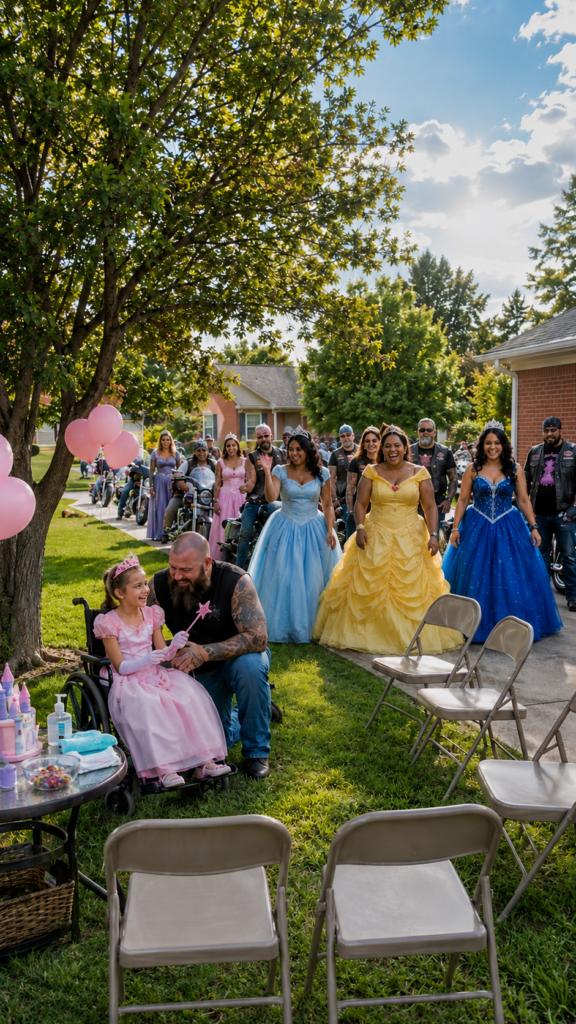
And one by one, the toughest bikers Raquel had ever seen dismounted their bikes dressed as princesses.
Glittered beards.
Black boots under huge skirts.
Tattoos peeking out from shiny sleeves.
Cockeyed crowns.
Badly placed wigs.
The first was 'Preacher,' a dark-skinned, bald man with a temple voice and wrestler’s arms, dressed as Elsa, with a silver braid falling over one eye.
Next came 'Mammoth,' huge, in a Belle-style yellow dress, holding a plastic rose in hand.
Ruth Delgado, a 62-year-old biker with silver hair and flower tattoos on her arms, arrived dressed as Cinderella and looked like the only one who could demand reverence.
Even 'Tank,' who never smiled, showed up dressed as Ariel, with a red wig and a funeral face.
They all lined up in front of the gate.
They applied gel.
They adjusted their masks.
And they entered the patio, keeping their distance, like a royal guard in front of a palace.
Preacher bowed until he almost touched the ground.
“Your Majesty Lupita, the royal court has arrived.”
Lupita’s eyes widened.
And for the first time all day, she let out a laugh so pure that Raquel began to cry.
But just when Máximo knelt beside his daughter to say, “I brought you an entire kingdom,” Raquel’s phone began to vibrate incessantly.
It was her sister.
Then her sister-in-law.
Then a neighbor.
Raquel glanced at the screen and felt the blood drain from her face.
Mrs. Irma had already uploaded the video to Facebook with a horrible caption:
“Bikers invade sick girl’s party. Fatherly love or criminal irresponsibility?”
And the video had already garnered thousands of shares.
PART 2
Raquel wanted to run to the gate and snatch Mrs. Irma’s phone, but Lupita kept laughing.
That laughter was so rare in the house that no one dared to break it.
Máximo saw the screen, clenched his jaw, and then looked at his daughter.
“Not today,” he said quietly. “They’re not taking this from us.”
The Iron Lanterns understood without needing explanation.
They didn’t get too close.
They didn’t touch Lupita.
They didn’t remove their masks.
Each wore their own gel hanging from their belts or vests. Ruth even carried a bag of colorful masks, in case one broke.
They had come ridiculous, yes.
But not careless.
Preacher lifted his blue skirt to avoid tripping and announced with solemnity:
“First royal decree: no one breathes over the queen.”
Lupita laughed again.
Mammoth placed a hand over his chest.
“Second decree: if anyone makes fun of my dress, I demand double slices of cake.”
“You look nice,” Lupita said.
Mammoth stood still.
That huge man, capable of lifting a motorcycle like it was a jug of water, lowered his gaze and adjusted the plastic rose.
“Thank you, my queen.”
Raquel saw something in that moment she would never forget.
They weren’t men in costumes trying to be funny.
They were adults laying down their pride on the sidewalk so a girl wouldn’t feel that her illness had stolen her birthday.
They paraded around the patio, keeping their distance.
They sang Las Mañanitas out of tune.
Ruth taught Lupita to wave like a queen.
Tank, with his red wig all crooked, made a bow so serious that two bikers choked on their laughter.
Lupita asked:
“Don’t you feel embarrassed?”
Máximo looked at his friends, all tattooed, sweating under borrowed dresses, holding cheap crowns with absurd dignity.
“No, little one.”
Preacher heard and pointed at his dress.
“Embarrassment would be leaving a princess alone on her birthday.”
The phrase landed like a soft punch.
Raquel looked toward the street.
Mrs. Irma kept recording.
The video continued to grow.
Comments began to arrive like knives.
“How irresponsible.”
“Poor girl, those men are going to make her sick.”
“Surely they are criminals.”
“What kind of father brings bikers into a house with a sick minor?”
But others appeared too.
“My son is in chemo and this made me cry.”
“That’s love.”
“They took more precautions than many family members.”
“Bearded princesses do exist.”
The party ended before the sun set.
Lupita blew out her candles from a distance, with Máximo holding the cake away and everyone singing behind their masks.
There were no hugs.
No kisses.
But there was something Raquel didn’t know how to name.
A secure joy.
A joy carefully invented.
A joy that didn’t deny the illness but also wouldn’t let it crush them.
Before leaving, Ruth knelt two meters away from Lupita.
“Your Majesty, do you authorize us to keep the dresses in case another princess needs a court?”
Lupita thought very seriously.
“Yes. But also for princes.”
“Of course,” Ruth replied. “Royalty does not discriminate.”
Everyone laughed.
Máximo asked permission to take a photo.
Raquel hesitated. After what happened with Mrs. Irma, she feared the world would use her daughter as a spectacle.
But Lupita raised her hand.
“Yes, mommy. Let other sick kids see it. So they know they can have a party too.”
Raquel took the photo.
Lupita in the center, pale and thin, but with shining eyes.
Around her, 16 tattooed bikers in princess dresses, bowing to her as if she were the most important person in Mexico.
That night, Máximo posted the image with a single phrase:
“My daughter asked for princesses. I brought her 16 with tattoos.”
The next morning, Facebook exploded.
But not as Mrs. Irma expected.
Her venom-filled video began receiving responses from doctors, nurses, and parents of immunocompromised children.
A doctor from the Children’s Hospital commented:
“As long as they maintain distance, masks, and are outside, this is more responsible than many family gatherings.”
A mom from Monterrey wrote:
“My daughter has been isolated for 3 months. She just saw this and asked if the princesses also visit hospitals.”
A dad from Mérida sent a private message:
“My son turns 8 in two weeks. No one can come. Do you think a princess on a motorcycle could greet him from the street?”
Máximo read that message five times.
Then he sat in the kitchen, phone in hand, with glitter still stuck in his beard.
Raquel found him crying silently.
“What happened?”
He showed her the screen.
“It wasn’t just Lupita.”
That was the twist no one saw coming.
The photo didn’t just clear the slander.
It also opened a door.
For two days, messages flooded in from Guadalajara, Toluca, Puebla, Querétaro, and even families from abroad.
Children with cancer.
Children who were transplanted.
Children with rare diseases.
Children who had spent months watching other birthdays via video call.
All asking the same thing:
“Can princesses come too?”
The Iron Lanterns called an urgent meeting at their club, an old place near an auto parts store, where before there had only been helmets, tools, domino tables, and the smell of burnt coffee.
That day, alongside the leather jackets, they hung dresses.
Blue.
Pink.
Yellow.
Green.
Some donated by families. Others bought with contributions. Others sewn by Ruth, who had hands of a queen and the character of a sergeant.
Lupita arrived in a purple mask and declared from the entrance:
“It’s going to be called The Court of Lupita.”
No one argued.
Not Máximo.
Not Preacher.
Not Mammoth.
Not Tank, who was already resigning himself to the fact that Ariel would be part of his public identity.
Lupita set the main rule:
“No sick child should feel forgotten on their birthday.”
Raquel set the second rule:
“Safety first, then surprise.”
And that’s how it all began.
Not as an elegant foundation.
Not with expensive logos.
But with tattooed bikers washing dresses, checking masks, filling out permission forms, and asking every family what was safe.
Sometimes they arrived dressed as princesses.
Sometimes as superheroes.
Once, for a six-year-old in Neza, nine bikers dressed as dinosaurs and almost stopped the avenue.
Mrs. Irma tried to delete her post.
But it was too late.
People had taken screenshots.
Some neighbors confronted her for using a girl’s illness to gain likes.
She went to apologize to Raquel, with a gelatin in hand and a fallen face.
Raquel didn’t humiliate her.
She just said:
“Before judging, ask. The illness takes enough from us without stripping away our dignity.”
Mrs. Irma cried.
And for the first time, she recorded nothing.
Lupita’s health didn’t magically improve.
Real life doesn’t work like a fairy tale.
The tests, emergencies, days with low defenses, sleepless nights, and times Raquel slept sitting beside a hospital bed continued.
But something changed.
Lupita stopped feeling only like a patient.
Now she saw photos of other children smiling with tattooed princesses, pirates in boots, bearded fairies, and superheroes arriving on motorcycles while respecting distance.
“I started this,” she proudly said.
Máximo always replied the same way:
“Yes, Your Majesty.”
Months later, they hung the original photo in the living room.
Lupita in her blue dress.
Sixteen bikers bent over.
Máximo behind, with the eyes of a father who had understood something immense.
That love doesn’t always arrive softly.
Sometimes it comes roaring down the street.
Sometimes it wears black boots beneath a yellow dress.
Sometimes it has scars, tattoos, rough hands, and glitter stuck in its beard.
Sometimes the world mocks first because it doesn’t understand.
And then it cries because it finally gets it.
When a reporter asked Lupita what she remembered most about that birthday, everyone expected her to mention the cake or the motorcycles.
But she smiled.
“That princesses can be brave even if they look silly.”
Máximo wiped his eyes with the back of his hand.
Raquel pressed the photo against her chest.
And thousands of people commented the same:
Maybe true bravery isn’t about looking strong.
Maybe it’s loving someone so much that you don’t care about looking ridiculous just to bring back their laughter.