PART 1
Mariana's baby was only 3 days old when his lips began to turn purple.
It wasn’t a light shade. It wasn’t cold. It was that deep color that makes a mother’s heart stop before her mind can process what she’s seeing.
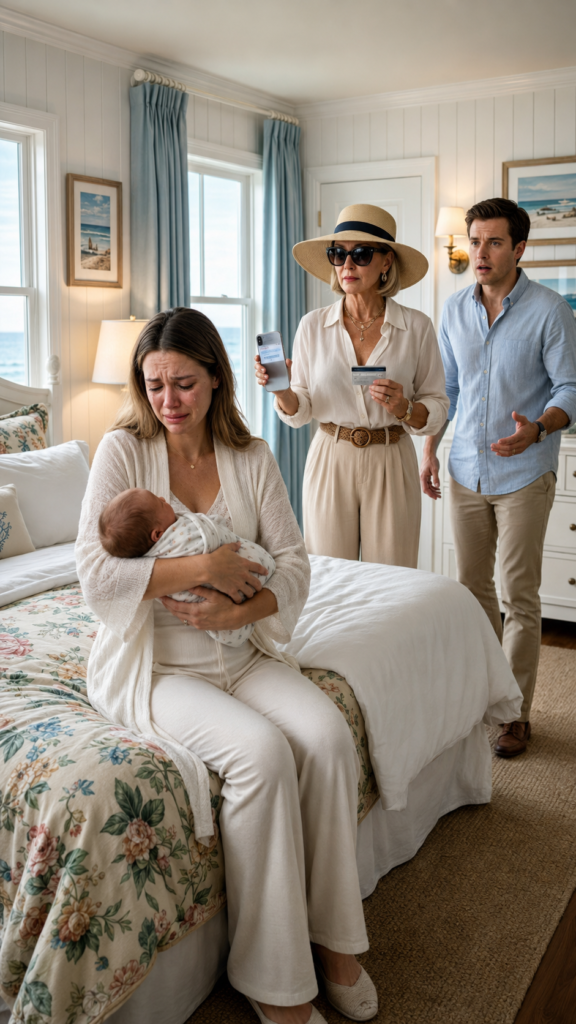
Mariana sat in the living room of her home in Naucalpan, her stitches burning, her robe stained with milk, and her eyes swollen from three sleepless nights.
In her arms, Mateo struggled to breathe as if each gasp was a battle for life.
—Diego, please call 911 —she pleaded, her voice shattered—. Something is happening to the baby.
Diego didn’t even bother to look up from his phone.
He was checking flights to Cancun, his suitcase sprawled open on the sofa, expensive shirts half-folded.
Beside him, Doña Leonor, his mother, sipped her coffee as if watching a dull soap opera.
—Oh, Mariana, come on, really —said the mother-in-law—. First-time moms always exaggerate. The baby is just cold.
Mariana turned to her husband, hoping he would at least react.
—Look at him, Diego. His lips are blue. His little hands are going limp.
Diego approached, glanced at the baby for less than two seconds, then sighed in annoyance.
—My mom raised four kids. You’ve been a mom for three days. Don’t start with your dramas.
That sentence cut her deeper than any labor pain.
Mariana reached for her phone on the table to call emergency services herself, but Doña Leonor was quicker. She snatched it and stuffed it into her sweater pocket.
—You need to clear your head —she said with false sweetness—. It’s not good to be searching for illnesses online.
—Give it back —Mariana demanded, trying to stand up.
Diego grabbed his bag, pulled out his credit card, and tucked it into his wallet.
—We’re leaving. This trip was already paid for, and I won’t let you ruin it like you ruin everything.
—With my card? —Mariana asked, unable to believe it.
Doña Leonor smiled.
—After everything my son has put up with from you, the least you owe him is a vacation.
Mariana stood there, barefoot, still bleeding, with Mateo fighting for air, as they headed toward the airport.
Before shutting the door, Diego said:
—When I get back, we’ll talk about your anxiety.
The slam left the house in silence.
And then Mateo stopped breathing completely in his mother’s arms.
PART 2
For a moment, Mariana didn’t scream.
Her body froze. Her hands clutched the baby against her chest as if love alone could bring him back to life.
Then she let out a scream so loud that the neighbor across the street, Doña Lupita, burst through her door.
Mariana stumbled into the hallway, her legs shaking, Mateo limp in her arms.
—Help me! My baby isn’t breathing!
Doña Lupita saw the child's face and didn’t ask questions. She called 911 with a speed that she would later recount in tears.
—Send an ambulance now. It’s a newborn. He’s purple.
As they waited, Mariana searched for her phone throughout the house. She found it fifteen minutes later in the dirty laundry basket, dead and out of battery.
The charger was hidden behind a box in Diego’s closet.
It hadn’t been negligence.
It had been a decision.
In the hospital, the world transformed into white lights, nurses rushing, and doctors speaking in words Mariana could barely comprehend.
A pediatrician asked how long the baby had been blue.
—Since before my husband left —she replied—. I wanted to call, but they took my phone away.
A social worker stopped writing.
—Who took it away?
Mariana looked at the intensive care door behind which her son was connected to tubes larger than his arms.
—My husband Diego and his mom, Leonor.
The diagnosis came four hours later.
Mateo was born with a critical congenital heart defect. If they had taken him to the hospital when Mariana asked for help, there was a real chance to stabilize him for surgery.
But the delay had left him too weak.
That night, while Mariana signed medical authorizations with trembling hands, Diego uploaded a photo from Cancun.
He and Doña Leonor appeared at a hotel by the sea, wearing sunglasses and holding drinks.
The caption read:
“Finally escaping the drama. A well-deserved break.”
Mariana saved it.
The next day, Doña Leonor posted another photo with designer bags.
“Some people are born to complain, while others know how to enjoy life.”
Mariana saved that one too.
She didn’t comment. She didn’t call. She didn’t beg.
She just saved every screenshot, every hour, every location, every charge on the card.
Because before marrying Diego, before becoming that exhausted woman everyone called dramatic, Mariana had worked for seven years as a hospital risk investigator.
She knew how to read files. She knew how to request logs. She knew how to preserve digital evidence. She knew when a lie left traces.
And Diego, overly confident, had forgotten that.
Mateo survived the first night.
The second, his heart began to fail.
The third, the doctors told Mariana they were doing everything possible.
On the fourth dawn, her baby died.
Mariana didn’t collapse to the floor. She didn’t scream like in the movies. She didn’t break anything.
She simply sat next to the empty incubator and touched the little blue blanket she had bought with such hope.
Then she requested complete copies of the medical record.
She requested the ambulance report.
She requested Doña Lupita’s testimony.
She insisted that it be noted that she had been prevented from calling for help.
Then she called Valeria Robles, a lawyer who had been her colleague in clinical research.
—I need a preservation of evidence letter today —Mariana said, with a calm that was frightening.
—Against whom?
—Against my husband, his mother, the airline, the hotel, the bank, and any platform where they used my card.
Valeria fell silent for a few seconds.
—They messed with the wrong woman.
When Diego finally responded to one of Mariana’s messages, Mateo had been dead for eleven hours.
His reply was:
“Stop punishing me with your attacks. You probably freaked out for nothing.”
That message was also saved.
Mariana returned home alone. The baby’s room still smelled of talcum powder and cream. The crib was still ready. The mobile of little animals turned slowly in the air from the window.
At the dining table, Mariana opened Diego’s laptop.
He never set a password because he was convinced his wife was too emotional to check anything intelligently.
He was wrong.
She found messages from Doña Leonor sent before the trip.
“Take away her phone or she’ll call 911 for anything silly.”
Diego had replied:
“I already took it away. I’m also going to use her card. Let her pay for ruining our week.”
Then she found the hotel reservations, restaurant charges, boutique purchases, and a worse message.
Doña Leonor had written:
“If the baby were really sick, he would have gotten worse by now. She just wants to manipulate you.”
Mariana printed everything.
She created three folders.
One red for the hospital.
One black for the theft.
One blue for the messages.
When Diego and Doña Leonor returned five days later, they came back tanned, laughing, and dragging suitcases full of new clothes.
Doña Leonor entered first.
—See? The house is still standing. All that fuss for nothing.
Diego dropped the keys on the table.
—Mariana, we’re back. I hope you’ve thought about your attitude.
Then he saw his wife.
Mariana was dressed in black, sitting at the dining table with her hair pulled back and her eyes dry.
There was no stroller in the living room.
No bottles in the kitchen.
No lullabies playing.
Diego frowned.
—Where is Mateo?
Mariana didn’t answer immediately.
Doña Leonor rolled her eyes.
—Don’t start with your theatrics, girl.
Diego raised his voice.
—Where is my son?
Mariana looked at him with a coldness he had never seen before.
—He died on Thursday at 4:18 AM.
The suitcase fell from his hand.
Doña Leonor opened her mouth, but couldn’t say anything.
Diego shook his head, stepping back as if the news physically pushed him away.
—No. No, no, no. That can’t be. You’re lying.
Mariana pushed the red folder toward him.
—Medical record. Diagnosis. Time of admission. Time of death. And the note stating that I tried to ask for help before you left.
Diego started to cry.
Mariana pushed the black folder.
—Charges made with my card while your son was in intensive care. Hotel, flights, seafood, sunglasses, bags, and two bottles of champagne.
Then she pushed the blue folder.
—Messages where your mother orders you to take away my phone. Messages where you agree. Messages where you both decide to leave even though I told you Mateo was blue.
Doña Leonor regained some voice.
—This woman is crazy. She’s making all this up to get money from us.
At that moment, the doorbell rang.
Valeria entered with two police officers.
Doña Leonor went pale.
Valeria placed an order on the table.
—Diego Rivas and Leonor Andrade, you are being investigated for neglect, interference in a medical emergency, domestic violence, and unauthorized use of a bank card.
Diego fell to his knees.
—I didn’t know it was that serious.
Mariana slowly stood up.
—You didn’t want to know. That’s the difference.
—I loved my son —he sobbed.
—No —Mariana replied—. You loved your comfort. You loved having your mom decide for you. You loved not taking responsibility for anything.
Doña Leonor pointed at Mariana with a trembling finger.
—She’s always been a manipulator.
Valeria barely smiled.
—Then she’s going to love knowing that the bank has already submitted the transactions, the hospital released the record, the neighbor testified, and your posts in Cancun are already notarized.
The case became public when someone leaked the vacation photos along with the dates of Mateo’s hospital admission.
People couldn’t believe it.
While a newborn fought for his life, his father and grandmother posed by the sea using the money from the mother they had locked away without a phone.
Diego lost his job at an insurance company when the charges came out in local media.
Doña Leonor had to sell her apartment to pay lawyers.
At first, both insisted that Mariana was unstable from the birth.
But the evidence was overwhelming.
The messages didn’t cry. The receipts didn’t lie. The posts had time, location, and an arrogance impossible to erase.
Months later, Diego accepted his guilt in a hearing to avoid a longer trial.
Doña Leonor also accepted lesser charges, although she never truly apologized.
She only cried when the judge told her she couldn’t come near Mariana or publicly mention Mateo’s name.
Mariana signed the divorce papers without looking Diego in the eye.
He begged her for one minute.
She granted him ten seconds.
—I’m sorry —he said.
Mariana took a deep breath.
—Your apology came five days late.
A year later, Mariana returned to the hospital where Mateo had died.
In the entrance garden, there was a young tree with a small plaque.
“Mateo. 3 days of life. A voice that changed many lives.”
With the recovered money, the settlement, and help from several organizations, Mariana founded a program for postpartum mothers.
Every woman leaving the hospital with a newborn received emergency information, legal support, and a basic phone with active credit if they were in a vulnerable situation.
The first baby saved by that program also had purple lips when his mother called.
He arrived in time.
He survived.
When a nurse handed Mariana the photo of that child, she touched Mateo’s plaque and closed her eyes.
Justice didn’t bring her son back.
Nothing could.
But it turned the silence they tried to impose on her into an alarm that now sounded for other mothers.
And that was the part Diego and Doña Leonor would never understand:
A mother might be called dramatic, crazy, or exaggerated.
But when they take from her what is most sacred, her pain can become the most powerful evidence of all.





