PART 1
The first real contraction hit Mariana Salgado in the middle of her kitchen in Interlomas. At 38 weeks pregnant, she held a glass of water when a brutal pain shot through her back, tightening around her belly like a vice.
The glass smashed on the white porcelain floor, shattering into dozens of pieces.
—Rodrigo... something's wrong —she managed to say, leaning against the marble island.
Her husband stood by the entrance mirror, adjusting his tie. He wore a gray suit because that night, his mother, Beatriz Montiel, would celebrate her 65th birthday at an exclusive club in Bosques de las Lomas.
There were 200 guests, live music, and photographers.
Rodrigo glanced at Mariana but didn’t move closer.
—Not this again, love. The doctor said the discomforts were normal.
A second pain doubled her over. Then she felt a warm wetness running down her legs. It wasn’t clear fluid.
It was blood.
Three days earlier, the gynecologist had warned them that Mariana’s blood pressure was unstable and that the placenta showed concerning signs. Continuous pain, dizziness, or bleeding meant an immediate emergency.
Rodrigo had half-listened while responding to his mother’s messages.
Then his phone rang.
Beatriz called to complain that the toast was about to start.
—Don’t tell me Mariana is making up another tragedy to ruin my night —the woman said through the speaker—. Seriously, son, you need to set some boundaries.
Mariana fell to her knees among the shards of glass.
—I need an ambulance! The baby isn’t well!
Rodrigo grabbed the car keys.
—My mom only turns 65 once. You’ve been pregnant for nine months; you can wait a few hours.
Mariana watched him leave, unable to believe it. She tried to crawl toward the door, but she heard the click of the security gate lock.
Rodrigo had locked it from the outside with the only key.
He also lowered the garage’s electric curtain from his app and activated the alarm. He had left her trapped to prevent her from following him and “causing a scene” at the party.
Mariana fell to her side. Blood began to spread across the white floor.
With her hands cut from the glass, she crawled to the landline and dialed 911. She barely managed to give the address before her strength faded.
Paramedics arrived minutes later, but the gate wouldn’t budge.
From a window, they saw the red trail crossing the house and Mariana’s motionless body.
Firefighters broke the side glass, forced the lock, and rushed inside. One paramedic searched for a pulse while another shouted that there was massive bleeding and a possible placental abruption.
When they loaded her into the ambulance, Mariana could barely breathe.
Meanwhile, Rodrigo raised a champagne glass in front of his cellphone camera.
And his mother, smiling before 200 guests, began to publicly mock the woman who was dying, locked in her own home.
PART 2
Beatriz lifted her glass with a proud smile as Rodrigo live-streamed from the club's main hall.
—Thank you for joining me —he said in front of the cameras—. And especially thanks to my son, who finally understood that a dramatic wife cannot control the whole family with false emergencies.
Some guests laughed out of obligation.
Rodrigo laughed too.
—Cheers to the real family! —Beatriz shouted.
At that very moment, the ambulance crossed Periférico with sirens blaring. Mariana had lost so much blood that her pressure began to plummet. The baby’s heartbeat was slowing down.
In the emergency room, the doctor confirmed a total placental abruption.
—The fetal heart rate is at 60 and dropping. OR now. Emergency C-section.
Mariana heard someone call for more blood units. Then a mask covered her face, and everything went black.
During the surgery, her heart stopped for a few seconds.
The doctors managed to revive her.
The baby was born without crying, her skin bluish and weighing barely 1,900 grams. The neonatal team worked for several minutes until her tiny chest finally responded.
When Mariana woke up, she felt her abdomen empty and covered in bandages. The first thing she did was ask about her daughter.
Lucía, her older sister, was at the bedside. Her eyes were swollen, and she still wore the clothes she had on when she left her accounting office.
—She’s alive —she said, squeezing Mariana’s hand—. She’s in neonatal intensive care. They registered her as Emilia, just like you wanted. She’s fighting, sister.
Mariana cried with relief.
Then she glanced at the empty chair by the window.
—Where is Rodrigo?
Lucía's expression changed.
The hospital had called more than 20 times. When a nurse finally reached Beatriz’s phone, Rodrigo answered that Mariana was throwing a tantrum to ruin the party and asked them to stop bothering him.
He didn’t come to the hospital.
Not even to ask if the baby had been born.
Lucía pulled out her phone and opened the recording of the stream. Mariana watched her husband toasting, laughing, and focusing on Beatriz as she said that “false emergencies” were a form of manipulation.
The time of the video matched the exact moment the doctors were trying to revive her.
—While they were cutting the cake, you were dying —Lucía said—. And Emilia was born without breathing.
Mariana stopped crying.
For four years, she had endured Rodrigo minimizing her emotions. She had accepted Beatriz coming into her house unannounced, deciding vacations, criticizing her clothes, and even having an opinion about the baby’s name.
Every time Mariana protested, Rodrigo responded the same way:
—That’s just how my mom is. Don’t make a scene.
But one thing was to tolerate a controlling mother-in-law.
Another very different thing was knowing that her husband had seen the blood on her legs, had heard her pleas, and still locked her in to attend a party.
—Call Esteban —Mariana requested.
Esteban, Lucía’s husband, worked as a commander in the municipal police. He had arrived at the house after the hospital notified the family and saw the shattered glass, the forced gate, and the large pool of blood.
He also spoke with the paramedics and obtained the recording of the 911 call.
In it, Mariana could be heard clearly saying:
—My husband locked it from the outside. I don’t have the key. I can’t get out.
The Prosecutor's Office opened an investigation file for omission of assistance, domestic violence, and the possible commission of other crimes related to preventing her from leaving the home during an emergency.
Additionally, a family judge authorized urgent protective measures. Rodrigo could not approach Mariana or the baby while the facts were investigated.
—It’s done —Lucía explained—. Hospital security has his photo. If he tries to enter, he’ll be stopped.
Mariana breathed slowly.
—Open the house cameras.
Two hours later, a movement notification appeared on the screen.
Rodrigo’s car entered the parking lot. He got out wearing dark glasses and carrying a box of leftover cake. Beatriz stepped out of the passenger seat, upset to have had to interrupt her rest.
—I’m not staying long —she said as they walked toward the door—. We’re going to bring her cake, pick up clothes, and tell her to stop punishing everyone with her little act.
—I’ll take care of it —Rodrigo replied—. She’s probably calmed down and wants us to apologize for not chasing after her.
Upon reaching the entrance, they both stopped.
The side glass was broken. The metal gate had marks from the firefighters' tools, and the door remained secured with Prosecutor’s Office tape.
Rodrigo paled.
—What happened here?
They entered accompanied by a police officer who was guarding the property. In the hallway, the cake box slipped from his hands.
The floor was still covered in dark stains. There were bloody handprints on the wall, opened gauzes, medical supplies, and shards mixed with dried blood.
The place looked like a scene from a nightmare.
Beatriz covered her mouth.
—Oh my God...
—Mariana! —Rodrigo shouted—. Mariana!
Esteban emerged from the living room in uniform, body camera, and a folder of documents.
—She’s not here.
Rodrigo stepped closer in desperation.
—Where is my wife? Where is my daughter? Was there a robbery?
Esteban looked at him with disdain, forcing him to lower his voice.
—There was no robbery. There was a coward who locked his wife in while she bled out.
Rodrigo stepped back.
Esteban explained that Mariana had suffered a placental abruption, that her heart had stopped, and that Emilia was connected to a ventilator.
Beatriz tried to interrupt.
—We didn’t know. Mariana always exaggerates. She’s had many false alarms and...
—Shut up, ma'am —Esteban ordered—. Everything is being recorded. And after the video where you mock her while she was being operated on, you’d better think very carefully about every word.
Rodrigo began to tremble.
Until that moment, he had still wanted to believe that Mariana had only gone to the hospital for precaution. The trail of blood revealed a truth that was impossible to cover up.
—I need to see her —he said—. I need to meet my daughter.
Esteban handed him the protective measures.
—You cannot come within 500 meters of either of them. You also cannot communicate with them directly. You have 15 minutes to take basic clothing and leave the house.
—This is my house! —Rodrigo shouted.
Then came the first twist he hadn’t expected.
The house wasn’t his.
It had been purchased with the money Mariana received from selling a piece of land inherited from her father. Rodrigo appeared as a spouse on some documents, but the property was within a trust created before the marriage to protect Mariana’s assets.
For years, Beatriz had boasted to her friends that her son had bought that residence.
In reality, Rodrigo hadn’t paid a dime as a down payment.
—Your right to live here depended on the marriage cohabitation —Mariana’s lawyer explained over the phone—. And that cohabitation ended last night.
Rodrigo sat on the lower step, surrounded by the bloodstains he had chosen to ignore. For the first time, Beatriz found no cruel phrase to defend him.
The next day, the story began to circulate.
One of the guests had downloaded the stream before Beatriz tried to erase it. The video showed the time, the mockery, and Rodrigo raising his glass.
Another recording, obtained from the home security system, contained something even worse.
The entrance camera captured the exact moment when Mariana, crying, asked for help. It also recorded Rodrigo looking at the blood on her dress before locking the gate from the outside.
—You’re not going to ruin my mom’s night —he could be heard telling her.
That video destroyed his version that he didn’t understand the gravity of the situation.
The financial company where Rodrigo held a managerial position suspended him from his duties. Several clients demanded never to work with him again, and the board initiated an internal review.
Beatriz also paid a social price. The same people who had applauded her speech stopped responding to her. The club canceled her membership after receiving dozens of complaints.
She issued a statement saying it had all been “a terrible family misunderstanding.”
No one believed her.
A week later, she sent a huge arrangement of white lilies to the hospital with a card asking to put aside “the misunderstandings for the baby’s sake.”
Mariana asked the nurse to return the flowers.
—An apology that avoids naming the harm is not an apology —she said.
Emilia spent five weeks in neonatal intensive care.
Mariana spent hours by the incubator, watching each breath. Lucía accompanied her, bringing food and helping her get up when the cesarean wound made it hard to walk.
Rodrigo sent messages through his lawyers. First, he demanded to see her. Then he blamed Beatriz for pressuring him. Later, he claimed he had panicked and didn’t know how to react.
Finally, he begged for forgiveness.
Mariana did not respond.
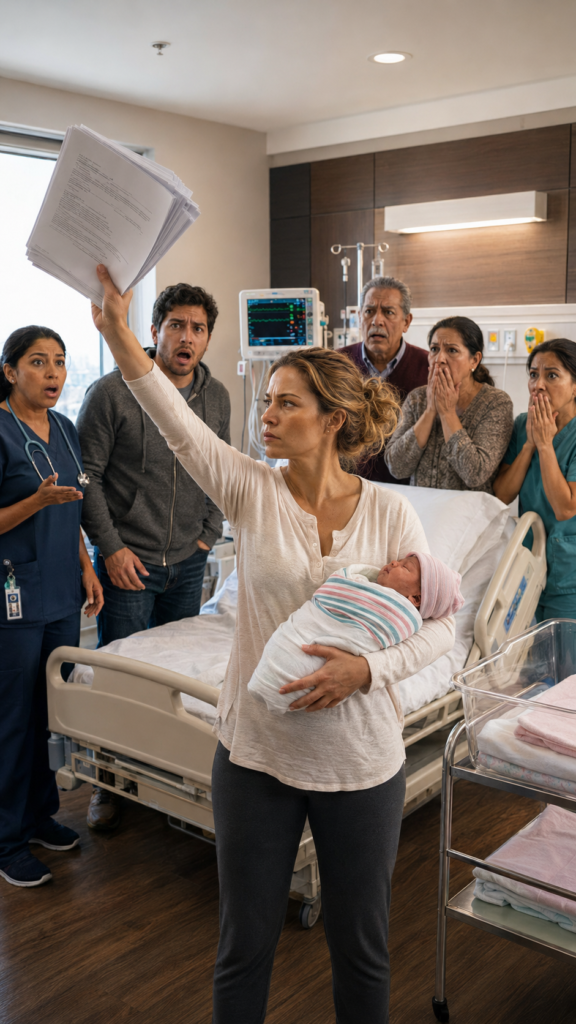
In the family hearing, the lawyer placed two screens in front of the judge.
On one, she projected the party stream: Rodrigo and Beatriz laughing, the five-tier cake, the glasses, and the speech about the “real family.”
On the other, she showed the medical records from the same hour: massive hemorrhage, maternal cardiac arrest, emergency C-section, neonatal resuscitation, and mechanical ventilation.
The room fell silent.
Then the entrance video played.
Rodrigo appeared closing the gate while Mariana screamed that she was bleeding.
His own lawyer stopped taking notes.
The protective measures were maintained. Rodrigo temporarily lost any chance of unsupervised visitation and was required to start psychological therapy, parenting courses, and risk assessment before requesting contact with Emilia.
The criminal process continued separately.
During the divorce negotiations, he tried to fight for the house, but the trust left him with no arguments. He also had to account for money movements he had made from a joint account to cover his mother’s expenses.
That was the second secret.
For almost two years, Rodrigo had paid Beatriz’s driver, her trips, cosmetic treatments, and club dues with marital funds. In total, he had diverted over 1,300,000 pesos without Mariana’s authorization.
Beatriz didn’t just control her son.
She lived at the cost of the assets of the daughter-in-law she called selfish.
The judge ordered that those amounts be considered when dividing the assets and setting financial obligations. Rodrigo left the courtroom without a wife, without a house, without prestige, and with an investigation threatening his professional future.
Beatriz waited for him outside.
—This is all that woman’s fault —she murmured.
Rodrigo looked at her for several seconds.
He finally understood that he had spent his life obeying his mother, but he also realized something more painful: no one had forced him to close that gate.
The decision had been his.
—No, mom —he replied—. This time it was my fault.
It was the first honest truth he had said in a long time.
Months later, Mariana moved with Emilia to a bright apartment near Lucía’s house. She didn’t want to return to the place where she had to crawl over her own blood to ask for help.
The baby grew slowly but without serious consequences. Every morning, Mariana held her by the window and listened to her breathing as if it were the most beautiful song in the world.
Rodrigo received permission for supervised visits after completing part of the mandated treatment. The first time he saw Emilia, he cried throughout the session.
He didn’t ask for Mariana to come back.
He knew some decisions cannot be repaired.
Beatriz never met the girl. She refused to acknowledge her responsibility and continued to say they had turned her into a villain for a phrase taken out of context.
But it hadn’t been a phrase.
It had been a chain of contempt, manipulation, and cruelty that ended when a woman almost died so another could feel important for one night.
Mariana did not live consumed by hate. She simply stopped giving energy to those who had proven they didn’t deserve it.
Forgiveness, she understood, does not always mean reopening the door.
Sometimes it means closing forever the one someone shut first, saving oneself, and teaching a daughter that true love never demands bleeding in silence to keep a family together.





