PART 1
The first pain doubled Mariana over the kitchen table.
It wasn't a normal discomfort.
It wasn’t that pain the neighbors talked about with a nervous smile, saying, "This is how babies start."
It was a fierce, deep stab, as if something inside her body was breaking apart.
She was eight months pregnant.
And she wasn’t expecting one baby.
She was expecting twins.
Mariana reached with one hand for the back of a chair. With the other, she held her enormous belly, hard and shifting beneath her light blue dress.
—Raúl… —she called, her voice breaking—. Raúl, please.
Her husband appeared from the living room with his cell phone in hand. Tall, well-dressed, with that look of a man who always seemed to be in a hurry, even though he never moved without his mother’s permission.
—Again? —he asked, frowning—. The doctor said they could be false contractions.
Mariana lifted her gaze.
Her face was sweaty.
Her lips pale.
—They're not false. It feels different. Take me to the hospital, now.
On the table, a sheet from the gynecologist was stuck with a magnet.
"HIGH-RISK PREGNANCY. DO NOT DELAY TRANSPORT."
Raúl had read it.
He had signed it.
He had promised to have the bag ready, the car fueled up.
But in that house, promises made to Mariana always weighed less than an order from Doña Graciela.
And just as Raúl grabbed the car keys, the hallway door opened.
Doña Graciela came out, styled, made up, with dark glasses perched on her head and a shiny handbag in hand.
Behind her was her younger daughter, Camila, checking her nails.
—Where do you think you're going? —the mother-in-law asked.
Raúl stood frozen.
Mariana felt another pain and let out a groan.
—To the hospital —he said, lacking strength—. Mariana is in pain.
Doña Graciela looked at Mariana as if she were throwing a tantrum for breaking a plate.
—Oh, please. Women always exaggerate. First, take us to Plaza Andares. Your sister needs her dress for her friend's wedding. Then you can take her.
Mariana couldn’t believe what she was hearing.
—Ma'am, I'm bleeding out… I think something is wrong.
Camila rolled her eyes.
—Seriously, Mariana, how opportunistic. You always want attention when my mom has something planned.
Raúl tightened his grip on the keys.
Mariana looked him straight in the eye.
—Raúl, for our daughters… please.
He swallowed hard.
For a second, it seemed like he was going to choose her.
But then Doña Graciela clicked her tongue.
—Don’t make me embarrassed. We're waiting for you.
Raúl lowered his gaze.
And Mariana understood.
Before he spoke, she already knew.
—Hold on a little —Raúl said, cold, uncomfortable—. Don’t move. I’ll be back quickly.
—Raúl! —she shouted, falling to her knees.
He opened the door.
Her father, Don Ernesto, sitting in the armchair, barely lifted his eyes from the newspaper.
—You can wait two hours —he muttered—. Women used to give birth at home, and nobody made such a fuss.
Mariana reached out her hand towards her husband.
—Don’t leave me alone.
Raúl didn’t turn his head.
—Don’t do anything foolish before I come back.
And he left.
The door closed.
The sound of the car driving away was crueler than any scream.
Mariana was left on the floor, clutching her belly, feeling fear rise up her throat.
She tried to reach her cell phone, but another pain shook her completely.
When she finally managed to drag herself to the kitchen counter, she saw blood on the floor.
A lot.
Too much.
With trembling fingers, she dialed emergency services.
—Please… I'm pregnant with twins… my husband left… I can’t get up…
The operator told her to breathe.
That the ambulance was on the way.
Not to hang up.
But Mariana was no longer sure she could wait.
Minutes later, when they knocked on the door, she didn’t walk.
She crawled.
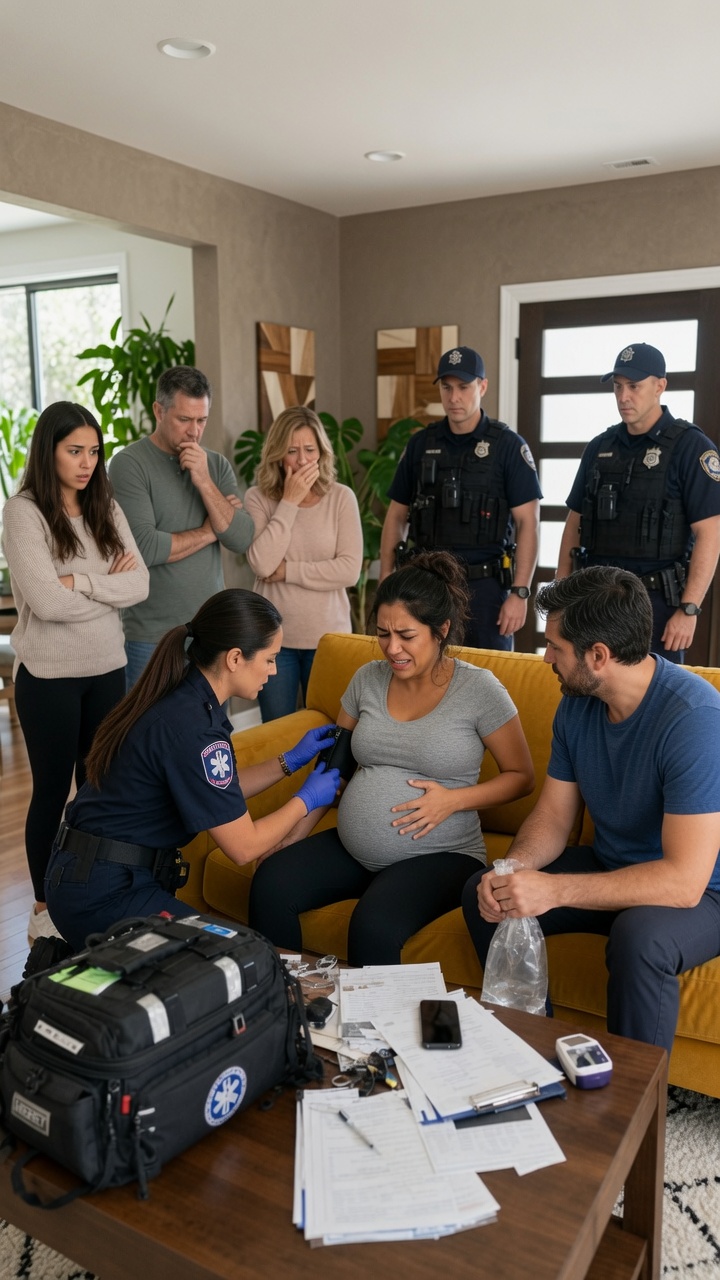
When she opened it, a paramedic found her pale, drenched in sweat, with blood on her dress and terror-filled eyes.
—Are you alone, ma’am?
Mariana could barely nod.
—My husband… he went with his mom…
The paramedic looked at the floor.
Then he looked at his partner.
—Code red. High-risk twin pregnancy. Possible hemorrhage.
As they lifted her onto the stretcher, Mariana managed to see the messy house, the unclosed hospital bag, and the doctor’s sheet lying next to a blood stain.
In the ambulance, she took the paramedic’s hand with the little strength she had left.
—Save my girls… please.
And as the sirens shattered the afternoon in Guadalajara, Mariana closed her eyes, believing she might never open them again.
PART 2
Raúl returned at 9:38 PM.
He had four shopping bags hanging from his arms.
Camila was laughing because, according to her, they had found the perfect dress on sale.
Doña Graciela carried a box of new shoes and was complaining that the parking at the mall was ridiculously expensive.
Don Ernesto came in behind, tired but satisfied.
None of them expected to find the house in absolute silence.
The living room was dark.
A lamp lay on the floor.
The kitchen chair was overturned.
Medical papers were scattered across the floor.
And a dark, dry stain stretched from the kitchen to the entrance.
Raúl dropped the bags.
—Mariana?
No one answered.
—Mariana!
He ran to the bedroom.
Empty.
To the bathroom.
Empty.
To the babies' room.
The cribs were still set up, clean, intact.
But there were no babies.
No wife.
No crying.
No life.
Camila stopped smiling.
Doña Graciela put a hand to her chest.
—She must’ve thrown a fit and gone to her mom’s.
Raúl returned to the kitchen with a white face.
On the table was an envelope.
His name was written in shaky handwriting.
He opened it.
Inside were two documents.
The first was a short letter.
"The doctors told me that 30 more minutes could have killed me and our daughters."
Raúl felt his legs give out.
He kept reading.
"When I begged you, you chose your mother. When I bled out on the floor, you were buying shoes. When our daughters were fighting for their lives, you ordered me not to move."
The second paper was a report from the Fray Antonio Alcalde Civil Hospital.
One line was underlined in red.
"PATIENT ADMITTED IN CRITICAL CONDITION. COMPLICATIONS AGGRAVATED BY DELAY IN EMERGENCY TRANSPORT."
Raúl fell to his knees.
Not like in the novels.
Not gracefully.
He fell like a man who finally understands that he destroyed his own home.
—No… no… —he murmured.
Doña Graciela approached and tried to take the paper from him.
—Don’t read that. It's manipulating you.
But Raúl's cell phone rang.
He answered with trembling hands.
—Is this Mr. Raúl Mendoza? —a serious voice asked.
—Yes.
—This is attorney Patricia Salazar. I represent your wife. From this moment on, all communication will be through legal channels. You are also informed that hospital security has been instructed to prevent you and your family from accessing the neonatal area.
Raúl stopped breathing for a moment.
—Do my daughters… live?
There was a pause.
—Your daughters were born via emergency cesarean. They are alive. Your wife is also alive. And that, Mr. Mendoza, was not thanks to you.
Camila let out an “oh, how exaggerated,” but no one paid attention.
The lawyer continued.
—The hospital notified the Public Ministry and the DIF for possible abandonment during a medical emergency. The paramedics gave statements. The call to 911 was recorded. And there is visual evidence of the condition in which your wife was found.
Raúl looked at his mother.
Doña Graciela opened her mouth, but nothing came out.
—Get ready —the lawyer said—. This is just the beginning.
The call ended.
That night, no one slept.
At 7:12 AM, there was a knock at the door.
Raúl opened it to find two police officers, a social worker from the DIF, and a ministerial agent.
—We’re here to take statements about what happened yesterday —the agent said—. No one who was present can leave.
Doña Graciela tried to act dignified.
—This is a misunderstanding. My daughter-in-law has always been very dramatic.
The agent looked at her without blinking.
—Ma’am, your daughter-in-law arrived at the hospital with severe hemorrhaging. Your granddaughters were born prematurely via emergency cesarean. The gynecologist had left clear instructions not to delay transport.
Raúl closed his eyes.
—I knew about that sheet —he said quietly.
The agent turned to him.
—And you still left?
Raúl couldn’t lie.
—Yes.
Doña Graciela quickly jumped in.
—I told him to take us. He just listened to me.
The social worker responded with a calm that cut more than a scream.
—But he wasn’t married to you. He was married to her.
Silence fell heavily.
Then came the blow no one expected.
The agent pulled out a folder.
—We also reviewed the body camera footage of one of the paramedics. You can clearly hear when Mrs. Mariana says: "My husband went with his mom. Please, save my babies."
Raúl covered his face with both hands.
And cried.
Not out of shame.
Not out of fear of jail.
He cried because for the first time he heard the scene without excuses, without his mother's voice on top, without the lie that "it wasn’t that serious."
Meanwhile, in the hospital, Mariana watched her twins inside incubators.
They were tiny.
Too tiny.
Their hands looked like petals.
Their breaths, miracles.
A nurse adjusted the blanket over her shoulders.
—You saved them —she said.
Mariana shook her head, tears streaming down her face.
—I barely made it.
—You called. You endured. You made it here alive. That is also protection.
Attorney Patricia arrived shortly after with documents.
Divorce petition.
Provisional custody.
Restraining order against Doña Graciela.
Request for possession of the marital home.
Mariana signed each sheet without trembling.
Not because it didn’t hurt.
It hurt like having another part of her body ripped away.
But looking at her daughters, she understood something no one in that family had wanted to understand:
A mother does not negotiate the safety of her children to avoid upsetting a mother-in-law.
Six months later, the trial was brief.
Raúl arrived thinner, with deep bags under his eyes and a wrinkled suit. He no longer lived with his parents. He had started therapy. He had sent eight letters that Mariana never read.
Doña Graciela wanted to declare that it had all been "a family accident."
But the 911 recording, the medical report, the photos of the house, and the paramedic's video left no room for her tales.
The judge was clear.
—This was not a common marital dispute. It was the abandonment of a pregnant woman during a high-risk emergency.
Raúl asked to speak.
He stood up, looking at the floor.
—I loved her —he said with a broken voice—. I loved my daughters before I even met them. But I was a coward. My mom spoke, and I obeyed, as always. The day they needed me most, I chose poorly. I don’t ask for forgiveness because I know I don’t deserve it. I just want them to know someday that I regret it every day.
Mariana listened without hatred.
That was what surprised her the most.
She no longer needed to hate him to leave.
She just needed to remember.
Remember the cold floor.
The blood.
The door closing.
The sirens.
And her daughters fighting to breathe.
—They will know you loved them —she finally replied—. But they will also know that love means nothing if it disappears just when someone needs you the most.
Raúl lowered his head.
The judge signed.
Divorce granted.
Full custody for Mariana.
Supervised visits for Raúl.
Permanent order for Doña Graciela to stay away from Mariana and the girls.
As they left the courtroom, there were relatives from both sides waiting.
Some said Mariana had been “too harsh.”
Others murmured that a family shouldn’t break up over “a mistake.”
Mariana stopped with her twins in her arms.
She looked at everyone.
—A mistake is forgetting the keys —she said—. Leaving a woman giving birth on the floor to go shopping is not a mistake. It’s a choice.
No one responded.
A year later, Mariana lived in a small house in Zapopan, with bougainvilleas at the entrance and toys scattered all over the living room.
Her daughters were already crawling.
Laughing loudly.
Sleeping poorly.
Crying when they wanted mango.
And every time Mariana saw them wake up, she thought that was her justice.
Not seeing Raúl fall.
Not humiliating Doña Graciela.
Not winning a family war just to have Facebook comment “how strong.”
Her justice was hearing her girls laugh in a house where no one had to beg to be chosen.
One day a letter arrived with no sender.
Inside was a picture of Raúl in front of the Basilica of Zapopan.
On the back, it said:
“Every birthday of the girls, I thank God because they had a mother stronger than their father.”
Mariana put the photo in a box.
Not out of love.
Not out of nostalgia.
She saved it because someday her daughters would ask about him.
And she would tell them the whole truth.
That their father loved them.
That he failed in an unforgivable way.
That he regretted it.
And that sometimes a person can feel real love and still not be safe to stay.
That afternoon, Mariana held her two daughters by the window.
The girls laughed because a butterfly landed on the bougainvillea.
Mariana kissed their little heads and whispered:
—You will never have to beg anyone to choose you.
They didn’t understand yet.
But there was time.
And this time, time was on her side.





