PART 1
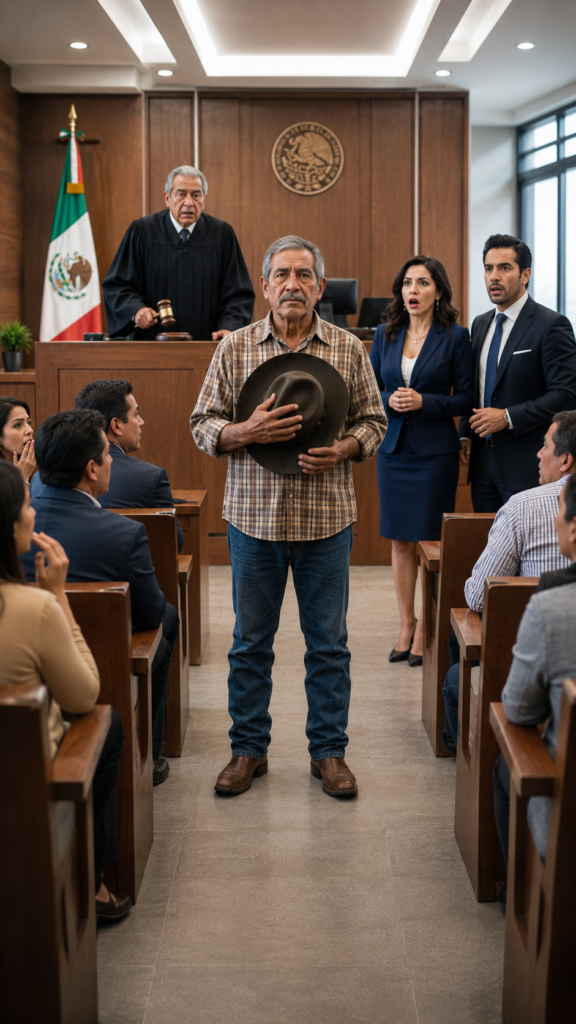
When Don Aurelio Mendoza entered the civil court in San Juan del Río, many thought he was just another old man from the countryside dragged there against his will by his family.
He wore dusty boots, a neatly pressed cotton shirt, and a palm hat pressed against his chest.
His daughter, Mariana, sat at the front with her lips painted red and a look that no longer resembled that of a daughter.
Next to her, her husband, Tomás, scrolled through his phone as if this were just a boring administrative task.
—Today, this novel comes to an end —he murmured—. The ranch is almost ours.
Mariana elbowed him to silence him, but she couldn’t hide her smile.
Their lawyer assured the clerk that Don Aurelio could no longer distinguish reality, that he spoke to himself, that he forgot to pay bills, and that he had tried to sell animals that didn’t even exist.
He also said the old man posed a risk to himself.
They wanted to declare him incompetent.
They wanted Mariana to become his legal guardian.
They wanted to manage Rancho Los Mezquites, the accounts, the old house, the pastures, the deeds, and even the truck that still smelled of Doña Clara’s perfume, Aurelio’s deceased wife.
For everyone, it was just another case.
For Mariana, it was the final step.
For Tomás, it was the way out of a debt that was suffocating him.
But when Judge Álvaro Robles entered the courtroom and asked for the details of the supposed incompetent, the atmosphere shifted.
The clerk read:
—Aurelio Mendoza Barragán, 72 years old, rural property owner.
The judge looked up.
First, he frowned.
Then he froze.
The gavel slipped slightly between his fingers.
—Don Aurelio Mendoza Barragán? —he asked, his voice trembling.
Mariana turned, confused.
Tomás stopped looking at his phone.
Aurelio didn’t respond immediately. He simply raised his head, calm, like someone who had been waiting a long time for this moment.
—That’s my name, Your Honor.
Álvaro Robles stood up.
Not out of protocol.
Not out of courtesy.
He stood as if he had just seen a ghost who owed him his life.
—It can’t be… —he whispered—. You were the one who saved my father from the fraud at La Cañada.
A heavy silence fell over the courtroom.
Mariana swallowed hard.
Tomás clenched his jaw.
No one understood why a respected judge looked at that old rancher with such a mix of respect and fear.
Aurelio had lived almost 25 years as a simple man.
He grew chiles, raised skinny cows, fixed fences, and talked to the rose bushes his wife left by the well.
But before that, he had been a financial investigator for the federal government.
One of the good ones.
The type that didn’t appear in photos but took down entire networks of lenders, corrupt notaries, and businessmen who stole land from farmers.
Mariana never wanted to remember that part.
To her, her father had become a burden since her mother passed away.
It all began four months earlier when a notice from the municipality arrived at the ranch.
The paper stated that Aurelio owed 480,000 pesos in back property taxes and that if he didn’t pay, they would initiate foreclosure.
Aurelio stared at the official seal with a cold chest.
He had given Tomás 500,000 pesos to resolve this issue.
Mariana convinced him.
—Dad, you’re not up for this. Tomás knows people. Let us help you.
That night they arrived at the ranch in a white truck, smelling of expensive perfume and city urgency.
Aurelio placed the notice on the table.
—Explain this to me.
Tomás didn’t even sit down.
—It’s probably a mistake from the municipality, Don Aurelio. You know how they are. Just a mess.
—Then show me the proof.
Mariana sighed, tired.
—Dad, with your ideas again. Lately, you’ve been acting strange. Yesterday you said Mom spoke to you from the kitchen.
Aurelio felt a blow to his stomach.
He had never said that.
Of course, he missed Clara.
Of course, sometimes he looked at her empty cup.
But he wasn’t crazy.
Tomás approached with a gentle voice, like someone speaking to a child.
—Don’t worry. We’re going to take care of you.
The next day, Mariana brought a jar without a label.
—These are natural memory pills. They’ll do you good, Dad.
Aurelio stared at her for a long time.
He wanted to ask her since when could a daughter lie without looking away.
But he took a capsule in front of her.
Not out of naivety.
Out of pain.
Because he still wanted to believe that his daughter was not capable of sinking him.
For three weeks, Aurelio started to walk as if he carried stones in his legs.
He slept too much.
His words got tangled.
One day he forgot the name of a worker who had been with him for 18 years.
Mariana recorded him in secret.
Tomás smiled.
—Look at this —he said—. With this, the judge will sign off on us quickly.
The night everything shattered, Aurelio heard them from the hallway.
Tomás was talking on the phone in the patio.
—It’s almost done. When Mariana is the guardian, we’ll sell Los Mezquites and pay off the ones from Querétaro. If the old man dies first, even better.
Aurelio felt the world open beneath his feet.
But he didn’t scream.
He didn’t cry.
He just returned to his room, flushed the pills down the toilet, and opened a wooden box hidden under the floor.
Inside was an old ID, a notebook with old names, and a phone that no one knew.
He dialed a number.
—I need help, compadre —he said in the firmest voice he had used in months—. My daughter wants to take my life on paper.
And now, facing the judge who had just recognized him, Mariana understood something terrible: his father hadn’t been losing his memory.
He had been gathering evidence.
PART 2
Judge Robles took a few seconds to regain control of the courtroom.
He sat down slowly, but he no longer looked at the file as just another routine task.
He looked at it as if he could smell a trap.
—Before we continue —he said—, I want to hear from Mr. Aurelio Mendoza directly.
Mariana’s lawyer shot up.
—Your Honor, my client requests that the supposed incompetent not be allowed to testify. There are medical reports indicating disorientation, paranoia, and cognitive decline.
Aurelio turned to him.
Not with rage.
With a calmness that unsettled everyone.
—Counselor, if I’m going to be as lost as you say, let me speak. Maybe I’ll sink myself, right?
A low murmur swept through the courtroom.
Even the clerk looked down to avoid smiling.
The judge nodded.
—Go ahead, Don Aurelio.
Aurelio pulled out a sealed transparent bag from his pocket.
Inside were six white capsules.
Then he took out an old yellow folder, worn on the outside but impeccable inside.
—For weeks they gave me this saying it was vitamins. I had the contents analyzed at a private clinic in Amealco. They were not vitamins. They were strong psychiatric medications, mixed with sedatives.
Mariana turned pale.
Tomás leaned toward his lawyer.
—That doesn’t prove anything —he whispered.
Aurelio continued.
—I also have videos from my study, audio from the patio, bank statements, printed messages, and documents with my forged signature.
Mariana’s lawyer tried to interrupt, but the judge raised his hand.
—I want to see that evidence.
Then a woman stood up from the second row.
It was Licenciada Rebeca Salinas, an old colleague of Aurelio’s, famous for never losing cases of asset abuse.
She wore a dark blue suit and had a gaze capable of splitting stone.
—Your Honor, I represent Mr. Mendoza. We request that this material be admitted as urgent evidence, as it concerns a possible simulation of incapacity for the purpose of dispossessing assets.
Mariana turned to her father with eyes filled with fury.
—Did you do all this against me?
Aurelio didn’t answer.
That question hurt more than she understood.
The courtroom screen lit up.
First, Tomás appeared entering the study of the ranch at 2:13 a.m.
He wore black gloves.
He opened a panel behind a bookshelf using a small key.
He pulled out deeds, insurance policies, and an old will.
Then his voice was heard on a call.
—Yeah, dude, I have the papers. The old lady is going to sign as guardian, and we sell before the bank comes down on us. We’ll keep the father well-medicated. He won’t know what day it is.
Mariana covered her mouth.
Not because she didn’t know.
But because she never imagined it was recorded.
The second video was worse.
Mariana appeared in the kitchen, holding the jar of pills.
Tomás said to her:
—Give him 2 in the morning and 2 at night.
—The doctor said 1 —she replied.
—And do you trust the doctor or do you trust me? We need him to look bad for the hearing.
Mariana lowered her head.
—He’s my dad, Tomás.
He let out a dry laugh.
—Your dad is 72 years old and has a ranch that saves our lives. Don’t be stupid.
In the courtroom, no one breathed the same.
The judge clenched his jaw.
Aurelio looked at the floor.
Because, even though the evidence defended him, every image was killing him inside.
Then Rebeca presented the bank statements.
Tomás had used forged documents to put up 3 parcels as collateral with illegal lenders.
He had also transferred 500,000 pesos from the supposed payment of property taxes to an account linked to shady betting and businesses.
The municipal debt did exist.
But not due to Aurelio’s negligence.
Due to theft.
The lawyer then showed 11 messages between Mariana and Tomás.
In one, she wrote:
“My dad is suspecting. We need to say he sees things about my mom.”
In another:
“What if we miss the dosage?”
Tomás replied:
“Better. That way it’s clearer that he’s lost.”
Mariana began to cry.
But it wasn’t that clean cry of someone who regrets.
It was a desperate cry, from someone who no longer has an escape.
—Dad, I didn’t want it to go this far —she said, standing—. Tomás threatened me. He owed money. He said if I didn’t help him, they would come for Diego.
That name changed Aurelio’s face.
Diego, his 9-year-old grandson, was the only thing still connecting his heart to Mariana.
The judge called for order.
Tomás slammed the table.
—Don’t put it all on me! You were the one who said your dad never loved you like he loved his ranch. You said that land was your inheritance and that the old man was taking too long to die.
The phrase fell like a stone.
Mariana closed her eyes.
Aurelio slowly lifted his gaze.
There lay the real poison.
Not just the capsules.
Not just the signatures.
It was that resentment kept for years.
—Is that what you thought of me? —Aurelio asked.
Mariana didn’t answer.
Tomás, now out of control, spilled the whole truth.
He said that Mariana hated the ranch because, as a child, Aurelio spent too much time working.
He said Clara, her mother, always asked her to be patient, but Mariana grew up believing her dad loved the land more than his own daughter.
He said that when Clara died, Mariana expected Aurelio to sell everything and leave with her to the city.
But he stayed.
With the cows.
With the mezquites.
With the memories.
And Mariana felt like he was choosing the ranch over her again.
Aurelio listened without moving.
Each word opened an old guilt.
Because it was true that he worked too much.
It was true that he often arrived late to school festivals, birthdays, and meals.
It was true that Clara would say:
—Aurelio, one day that girl is going to need you, and you won’t know how to talk to her.
But none of that justified what Mariana had done.
The judge called for a 15-minute recess.
No one stood up at first.
Mariana slowly approached Aurelio.
—Dad, please, say something.
He looked at her as if he had two people in front of him.
The girl who fell asleep in his truck after the village fairs.
And the woman who allowed him to be drugged to steal his house.
—I failed as a father many times —he said—. But you chose to fail as a daughter when you saw me shaking from those pills and didn’t stop.
Mariana broke.
Tomás tried to leave the courtroom, but two officers were already at the door.
When the judge returned, his voice sounded harsh.
—The request for interdiction is denied. An investigation is ordered for fraud, forgery of signatures, asset abuse, criminal association, and administering substances without consent.
Tomás was arrested right there.
He screamed that everyone would regret it.
That he had heavy friends.
That the old man wouldn’t last much longer.
But as they handcuffed him, his arrogance melted away like mud in the rain.
Mariana was also taken into custody, although her situation changed when she agreed to testify and turn over conversations, contacts, and receipts.
She didn’t come out unscathed.
No one comes out clean from such a betrayal.
The judge ordered immediate protection for Rancho Los Mezquites.
He annulled the documents signed under deception.
He requested independent assessments.
And before closing the hearing, he looked at Aurelio with respect.
—Don Aurelio, 25 years ago you prevented them from taking your house from my father. Today this court will do what is necessary to ensure that no one takes yours.
Aurelio simply inclined his head.
He didn’t feel victorious.
Justice doesn’t always taste like triumph.
Sometimes it tastes like cold coffee and an empty chair at the family table.
Five months passed.
Tomás remained imprisoned as the process advanced.
The lenders disappeared when they learned that the forged signatures were under federal investigation.
Mariana received court orders, mandatory therapy, and a prohibition on approaching the ranch without authorization.
Aurelio returned to his slow life.
He watered Clara’s rose bushes.
He fixed the fence in the northern pasture.
He paid the property taxes with his own hands, at the window, even though the young man at the municipality told him he could do it online.
—I like to see the seal —he replied.
One Sunday afternoon, a truck stopped in front of the gate.
It wasn’t luxurious.
It wasn’t Tomás.
Mariana got out, thinner, with a washed face and tired eyes.
Holding Diego’s hand.
The boy ran ahead before asking for permission.
—Grandpa!
Aurelio felt something crack and heal at the same time.
He crouched down with difficulty and hugged his grandson.
Diego smelled of sun, school, and childhood.
—My mom says she made you cry —the boy whispered—. But I don’t want you to be alone.
Aurelio closed his eyes.
Behind them, Mariana didn’t cross the gate.
She stayed outside, as if she knew a house could also have wounds.
—Dad —she said, her voice trembling—. I’m not here to ask you to forgive me today. I’m here to tell you that I’ve already declared everything. Even what sinks me.
Aurelio looked at the mezquites swaying in the wind.
Then he looked at the kitchen window, where Clara’s apron still hung.
—Your mom always said that the truth doesn’t fix everything, but it does stop it from rotting.
Mariana cried in silence.
—I’m going to spend years trying to deserve to come in again.
Aurelio took time to respond.
—Then start by not using Diego as a bridge. He is not to blame for our mistakes.
She nodded.
—I know.
From that day on, Diego began to spend some weekends at the ranch, with permission from the court.
He learned to plant tomatoes.
To distinguish a sick cow.
Not to mock old hands because those hands carried more history than one imagines.
Mariana didn’t return immediately.
For months she stayed at the gate, dropping off the boy, picking him up, barely saying good afternoons.
Aurelio also didn’t pretend everything was fine.
Because forgiving doesn’t mean opening the door as if nothing had happened.
And being a father doesn’t oblige one to allow oneself to be destroyed by one’s children.
One day, while sorting Clara’s books, Aurelio found a letter hidden among recipes.
It read:
“Aurelio, when I am gone, do not turn into pure silence. Our daughter has wounds we failed to see. But do not allow anyone to confuse love with abuse.”
Aurelio read that line three times.
Then he stepped out onto the porch.
Diego was running among the rows with a hat too big for him.
Mariana waited by the gate, not demanding, not crying to convince him.
Just waiting.
Aurelio raised his hand.
It wasn’t an absolution.
It wasn’t forgetting.
It was just a signal for her to take three steps closer.
And sometimes, in a broken family, three honest steps are worth more than a hundred false apologies.
That afternoon, the sun fell over Rancho Los Mezquites as if cleansing the earth.
Aurelio understood they wanted to take his house, his name, and his memory away from him.
But they couldn’t take away the truth.
And he also understood something harder:
Justice can save a property, but only daily truth decides whether a family deserves to be called a family again.





