PART 1
The Family Courtroom in Mexico City was so cold it felt designed for people to break down in silence.
Ana Sofía clutched a blue folder against her chest. Inside were supermarket receipts, school records, IMSS pediatrician appointments, and proof of the overdue payments her ex-husband, Rodrigo, had sworn to cover "as a responsible man."
Next to her sat Mateo, her 7-year-old son.
He wore a gray shirt with a little rocket embroidered on the sleeve. It wasn't new. The collar was slightly stretched, and near the hem, there was a faint stain, one of those that doesn't come out no matter how hard a mom scrubs with Zote soap.
But Mateo was clean. His hair was combed. His old sneakers, yes, but washed the night before and placed by the fan to wake up dry.
Ana Sofía had no lawyer.
Rodrigo did.
He sat across the room, immaculate, in a navy suit, expensive watch, and that calm face of someone who always thinks money can buy reason. Beside him, lawyer Saldaña organized documents as if he were about to present an irrefutable truth.
"Your Honor," the lawyer said, "this case is not about feelings. It’s about stability."
Judge Méndez, a serious man with thin glasses and a dry voice, listened without showing much.
For almost two hours, the lawyer painted Ana Sofía as a woman overwhelmed. Living in a small apartment in Iztapalapa. Working double shifts at a diner and a pharmacy. Sometimes leaving Mateo with his grandmother Carmen. Unable to offer him a nice bedroom, private English classes, or a sports club like Rodrigo promised.
Ana Sofía swallowed hard.
She wanted to say that Rodrigo had failed to pay child support for five months. That the apartment was small, but there, Mateo had hot dinners. That his grandmother cared for him with love, not neglect. That she broke her back so her son wouldn’t feel poverty as shame.
But the words got stuck in her throat.
Then lawyer Saldaña lifted a photograph.
"This image was taken three days ago, when the minor left school."
Mateo looked down.
It was him. Wearing the same gray shirt.
"The garment is worn out," the lawyer continued. "It has visible stains. This is not a minor detail. It reflects a pattern. If a mother cannot guarantee decent clothing, how can she ensure emotional stability?"
Ana Sofía felt her face burn.
Rodrigo didn’t look at her. He simply adjusted his watch.
Judge Méndez barely nodded, as if he were taking notes.
That gesture hit Ana Sofía like a door slamming shut.
Mateo stopped swinging his feet.
At first, he seemed scared. Then he stood up.
No one asked him to.
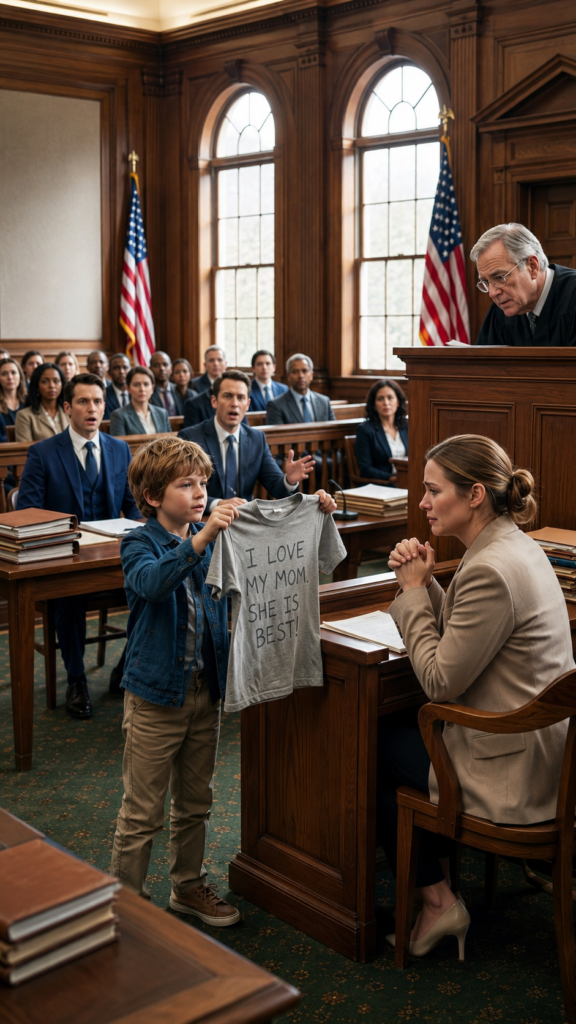
The boy held the bottom of his shirt with his tiny hands and said, in a trembling but clear voice:
"It’s this shirt they’re talking about."
Everyone turned.
Ana Sofía wanted to stop him, but Mateo stepped forward.
"My mom doesn’t know what’s written inside."
And then the room became so still that even Rodrigo stopped breathing for a second.
No one could believe what was about to happen.
PART 2
"Mateo, my love…" Ana Sofía whispered, trying to take his hand.
But the boy didn’t sit down.
Lawyer Saldaña quickly stood, uneasy.
"Your Honor, with all due respect, the minor has not been called to testify and could be emotionally influenced…"
Judge Méndez raised a hand.
"Let him speak."
Those three words changed the air in the room.
Mateo swallowed. His ears were red, and his eyes shone, but he didn’t back down.
"My mom bought this shirt after working," he said. "She got home when it was still dark. I was awake, but I pretended to be asleep."
Ana Sofía felt something inside her chest break.
She remembered that night.
She had left the pharmacy at 11:40, then agreed to clean tables at Doña Lupita’s diner because a waitress was absent. After finishing, she stopped by a night market near Metro Constitución. She had 120 pesos left. She needed to save them for tortillas, eggs, and fare.
But she saw the gray shirt with the little rocket.
Mateo had been talking for weeks about planets. He checked out the same solar system book from the school library because he said Saturn looked like "a top with a belt."
Ana Sofía bought it.
She arrived home close to 1:30 in the morning, her feet swollen and hair smelling of oil. She folded the shirt and placed it on the chair next to Mateo’s bed.
She thought he was sleeping.
"She smiled when she left it there," Mateo said. "But she was crying too."
A woman in the back covered her mouth.
Rodrigo clenched his jaw.
Mateo looked at the judge.
"My mom puts the pretty apple in my lunch box, and she eats the bruised one. She says she’s not hungry, but she is. I’ve seen her."
Ana Sofía lowered her head.
She didn’t want to cry in front of Rodrigo. She had already shed too many tears.
"She helps me with my homework," Mateo continued. "Even with division, although she always says math is treacherous. And when I have nightmares, she comes even when she’s tired."
Lawyer Saldaña shuffled his papers, nervous.
"And this shirt isn’t dirty because my mom doesn’t take care of me," Mateo said. "The stain is from cajeta. It spilled on me when we had pancakes on Sunday. I told her I liked it that way because we were happy that day."
The judge took a deep breath.
"You said the shirt has something written inside. What is it?"
Mateo lifted the hem.
"I wrote it so I wouldn’t forget."
A court clerk approached with the judge’s permission. He helped the boy show the inner seam without having to take off the garment.
Ana Sofía leaned in, confused.
She had washed that shirt several times. She had hung it in the common patio. She had even sewn a stitch on the side with white thread. How did she not see anything?
Then she remembered the blue marker she found under Mateo’s bed.
The judge adjusted his glasses.
There, in crooked, small but clear letters, it was written:
My mom is my hero. She makes me feel rich even though we don’t have money.
Nobody spoke.
Not the lawyer.
Not Rodrigo.
Not Ana Sofía, who felt those words touch every wound at once.
Judge Méndez didn’t read the phrase aloud immediately. He looked at it as if that old shirt had just become the most important document in the trial.
Then he raised his gaze towards Rodrigo.
"Mr. Valdés, did you know your son felt this way?"
Rodrigo opened his mouth.
For the first time all morning, he didn’t have a ready answer.
"I’m glad my son loves his mother," he finally said. "That’s not up for discussion."
His voice sounded kind, but Ana Sofía knew him. Beneath that calm lay anger. He wasn’t moved. He was upset because Mateo had disrupted his strategy.
Lawyer Saldaña intervened:
"Your Honor, children tend to be loyal to their primary caregiver. They can even repeat ideas implanted without understanding them."
Mateo frowned.
Ana Sofía felt her blood boil.
"My son is not lying," she said.
"Ma’am, no one said that," Saldaña replied with a fake smile. "We’re just saying it could have been coached."
The word landed like a slap.
Coached.
As if Mateo’s love were a trick. As if a secretly written phrase could be part of a cheap manipulation.
The judge looked at the boy.
"Mateo, did someone tell you to write that?"
"No, sir."
"Did your mom know?"
"No."
"Did your dad know?"
Mateo hesitated.
It was barely one second.
But everyone noticed.
Rodrigo turned his head toward him with a harsh look.
Mateo lowered his eyes.
"I showed it to him on Sunday," he confessed. "At his house. I changed because I spilled juice, and he saw it."
The judge leaned in.
"And what did your dad say?"
Mateo clutched the shirt.
"He said it was embarrassing."
Ana Sofía closed her eyes.
"Did he say anything else?"
The boy looked at Rodrigo one last time.
"He said that if I wanted to live with rich people for real, I had to stop acting poor."
The room filled with a heavy silence.
Rodrigo tried to smile.
"That’s taken out of context."
The judge didn’t blink.
"Explain the context in which that phrase is appropriate for a 7-year-old."
Rodrigo adjusted his tie.
"I just wanted to motivate him to have self-pride."
Mateo slowly shook his head.
The judge made a note.
Saldaña, realizing he was cornered, pulled out another sheet.
"Your Honor, respectfully, an unfortunate phrase doesn’t eliminate material concerns. We have four overdue rent notices, requests for assistance with bills, and evidence of unstable work hours."
Ana Sofía felt herself sinking again.
Yes, there were rent notices. Yes, she had asked for help to pay the electricity. Yes, she had worked overtime because life in the city doesn’t forgive.
But Rodrigo had stopped paying child support.
The judge looked at Rodrigo.
"Are you current on child support?"
Rodrigo looked at his lawyer.
"There was a disputed period."
"I didn’t ask that."
Rodrigo swallowed hard.
"Not always."
"How long did you stop paying?"
"Five months, but then I caught up."
Ana Sofía raised her face.
"You didn’t catch up entirely. You paid when I filed for enforcement. Before that, I covered rent, school, food, medicine, and transportation on my own."
"Do you have proof?" the judge asked.
She opened her folder with trembling hands. The papers slipped from her grip.
Mateo crouched down, picked up two sheets, and put them on her lap.
"Breathe, Mommy," he whispered softly.
That almost undid her.
She handed over bank statements, printed messages, and court notices. In several texts, Rodrigo replied with cruel phrases:
"Learn to manage yourself."
"If you can’t, let me know, and I’ll take Mateo."
"It’s not my fault you live day to day."
The judge read in silence.
Then Saldaña attempted one last play.
"There’s also an email where the lady rejected help from the father."
He showed a printout.
It only displayed Ana Sofía’s response:
"We don’t need anything from you."
Saldaña smiled.
"As you can see, the gentleman did offer support."
Ana Sofía felt cold.
She remembered that email. But the printout was cut off.
"It’s incomplete," she said.
The judge looked at her.
"Do you have the complete email?"
She searched for her cell phone in her bag.
It wasn’t there.
She paled.
She had left it in the security tray when entering the courtroom, alongside the folder, keys, and Mateo’s lunch box.
Rodrigo smiled ever so slightly.
So little that almost no one would have noticed.
But Ana Sofía did.
The judge ordered a clerk to retrieve the phone.
During those minutes, Mateo huddled close to his mother.
"Did my dad trick you?" he whispered.
Ana Sofía didn’t know how to answer.
When they brought the cell phone, she opened the complete email.
Rodrigo’s message read:
"I saw Mateo in that ridiculous hoodie. I can buy him decent clothes if you accept in writing that you can’t cover his basic needs. That would facilitate custody."
And Ana Sofía’s complete response was:
"We don’t need anything from you if it comes with humiliation. Pay the child support you owe."
The judge placed the phone on the desk.
"Lawyer Saldaña, you presented an incomplete communication before this court."
The lawyer lost color.
"Your Honor, it was what my client provided me."
The judge turned to Rodrigo.
"That concerns me even more."
Rodrigo no longer looked elegant. He looked exposed.
Then the judge announced a brief recess and said he would speak with Mateo under appropriate conditions.
As he stood up, Rodrigo walked close to the boy and mouthed silent words.
Mateo turned pale.
Ana Sofía immediately crouched down.
"What did he say?"
Mateo shook his head.
"Tell me, love. You didn’t do anything wrong."
The boy started to cry.
"He said: remember the dog."
Ana Sofía didn’t understand at first.
Then she remembered Jasper, the brown dog from Rodrigo’s neighbor. Mateo adored him. Every visit, he talked about him. He said Jasper listened to him.
"Dad told me that if I made him look bad, he wouldn’t take me to see him anymore," Mateo sobbed. "And that you could never give me a dog because we don’t even have a yard."
Ana Sofía felt rage, but she didn’t shout.
This time, she didn’t stay silent.
She notified the clerk that there might be emotional pressure on a minor.
The judge returned earlier than expected. Rodrigo was called again.
"Did you use the neighbor’s dog to condition what your son could say?" the judge asked.
"It was a joke," Rodrigo replied. "Mateo is sensitive."
The boy raised his voice through tears:
"It wasn’t a joke. You told me that if I made you lose, it would be my fault."
The judge gently tapped the table with his pen.
"Enough."
The word sounded louder than a scream.
He looked at Rodrigo with a hardness that finally couldn’t be bought.
"Love is not used as leverage. A child is not a prize nor an extension of their parents’ ego."
Rodrigo tried to speak, but the judge interrupted him.
"I’m ready to decide."
Ana Sofía took Mateo’s hand. She felt her heart pounding against her ribs.
"This court recognizes that Mr. Valdés has better financial resources," the judge said. "He has a spacious home, higher income, and access to private services. But custody is not granted to the father who dresses better or who can pay for more activities."
Rodrigo stared at the floor.
"I also acknowledge that Ms. Ana Sofía faces real difficulties. She works many hours. Her housing is modest. Her support network is limited. However, the evidence shows a constant presence, effective care, and a secure emotional bond."
The judge lifted the shirt, now protected in a transparent bag.
"The garment used to indicate negligence ended up showing something very different: attachment, gratitude, and emotional security."
Ana Sofía could no longer hold back her tears.
"Furthermore," the judge continued, "there are serious indications of document manipulation, failure to provide support, and emotional pressure on the minor by the father."
Rodrigo stood up.
"Your Honor…"
"Sit down."
And he sat down.
"Primary custody is awarded to the mother. The father's visits will be supervised until further psychological evaluation and responsible parenting courses are completed. The overdue child support will be reviewed immediately."
Mateo let out a small sound, as if the air returned to his body.
Ana Sofía hugged him to her chest.
It wasn’t a pretty victory. There were no applause. No music. Just a trembling mother and a child tired of being brave.
Before leaving, Rodrigo murmured:
"You’re going to regret this."
The judge, who had not yet left, heard him.
"That threat will also be noted."
For the first time, Rodrigo found no way to disguise his cruelty.
Weeks later, visits began at a family center run by the DIF. Mateo went serious, but returned knowing he no longer had to please anyone to be loved.
Ana Sofía framed the shirt in a simple frame, bought on sale at a neighborhood stationery store. She hung it in the hallway of the new apartment she got months later, smaller than Rodrigo’s house, but with a window where sunlight streamed in.
Carmen, the grandmother, placed a pot of basil by the door. Mateo put a handmade sign underneath it:
"Here, it smells nice."
Over time, Rodrigo canceled visits. He no longer had a trial to show off in nor an audience to pretend to be the perfect father. Mateo noticed, of course. It hurt him. But he stopped believing that abandonment was his fault.
One day, returning from school, he looked at the framed shirt and asked his mom:
"Did I save you that day?"
Ana Sofía knelt in front of him.
"No, my love. It wasn’t your job to save me. The adults should have protected you first."
Mateo thought for a moment.
"But I told the truth."
She smiled with tears in her eyes.
"Yes. And the truth protects too."
Years later, when someone visited the house and asked about that gray shirt, Mateo no longer spoke of the courtroom with fear.
He would just say:
"That was the day they tried to make fun of what we had… and my mom proved that love leaves evidence too."
And maybe that’s why the story stayed in everyone’s memory.
Because in a country where many believe that poverty is a lack of effort, a 7-year-old boy had to remind adults something they should have known all along:
a humble home doesn’t destroy a child.
What destroys them is feeling used.
What saves them is feeling loved.





