PART 1
When Camila Robles saw her 8-year-old daughter connected to tubes in a bed at the Civil Hospital of Guadalajara, she understood that a mother doesn’t break all at once.
She breaks piece by piece.
First with the diagnosis.
Then with the sleepless nights.
After that, with the bills that come even when the heart is stopped.
Her daughter, Valeria, had been hospitalized for 12 days due to an infection that worsened after surgery. The doctors spoke softly in the hallways, as if their words would hurt less if they came out slowly.
Camila worked nights at a warehouse, loading boxes until her hands trembled. Since her divorce, she had been living with her parents in a house in the Oblatos neighborhood.
She paid $4,800 a month for a room.
It wasn’t free.
It never was.
Her mother, Doña Teresa, said it every chance she got:
—Nobody lives here for free.
Camila endured it because Valeria needed a roof, school, and peace. But that month, between medicines, taxis, tests, and hospital food, she couldn’t make the rent.
It wasn’t three months overdue.
Not six.
It was one payment.
One afternoon, from the hospital stairs, Camila called her mom. Her eyes were swollen, her voice broken.
—Mom, I need two weeks. Valeria got worse. I can give you half now and the rest when I get paid.
On the other end, silence.
Then her dad, Don Ernesto, spoke.
—You should have planned better, Camila.
She thought she had heard wrong.
—Dad… Valeria almost died last night.
—That’s exactly why you should have saved up —he replied, cold—. Life doesn’t forgive those who are careless.
Camila pressed the phone against her ear.
She didn’t know what to say.
Two days later, Valeria left the hospital. She looked pale and thin, with a medical bracelet still on her wrist. In the taxi, she rested her head on her mom's arm.
—Did my grandpa fix my purple lamp? —she asked.
Camila swallowed hard.
She didn’t answer.
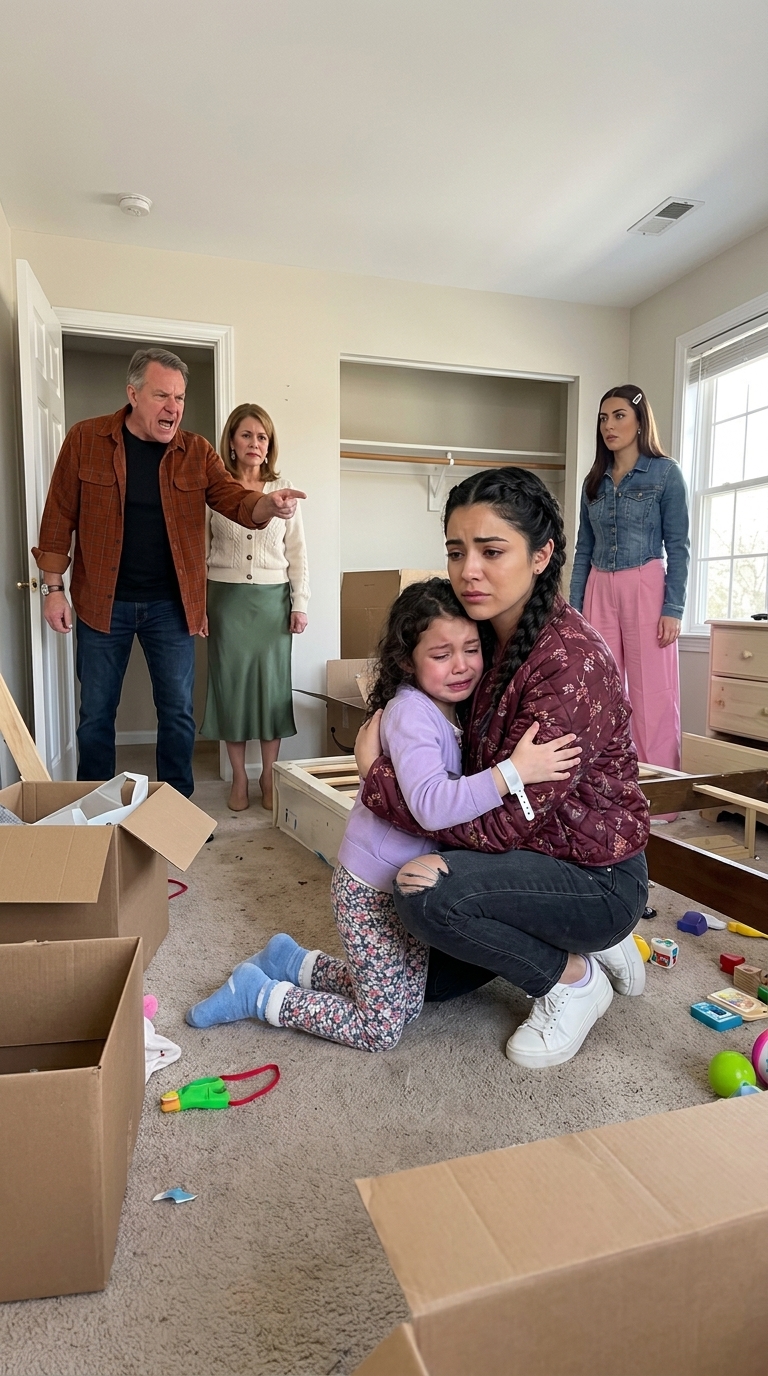
When they got home, the door to the room was open.
And the room was empty.
The bed was gone.
Valeria’s stuffed animals were gone.
The backpack wasn’t there, nor the drawings stuck to the wall, nor the purple blanket with stars that Valeria used when she was scared.
Camila’s work shoes were gone, her old laptop, a small box with her grandmother’s earrings, and the folder where she kept her documents.
Her younger sister, Brenda, was sitting on the new bed, painting her nails.
—Mom and Dad told me I could use the room now —she said, not bothering to look up—. Honestly, I needed space too.
Camila felt the floor move beneath her.
Doña Teresa came out of the kitchen, drying her hands with a rag.
—We sold what we could. It barely covered part of what you owed.
—What I owed? —Camila whispered.
Don Ernesto appeared from the living room.
—You failed to pay the rent. This house isn’t a shelter.
Valeria hid behind her mom.
—She just got out of the hospital —Camila said, her voice trembling.
Her mother stared at her without blinking.
—Then be grateful we kept her things for so long.
Camila looked at her parents.
She looked at her sister.
She looked at the empty room where her daughter had prayed for so many nights to not die.
And something inside her switched off.
She didn’t scream.
She didn’t beg.
She didn’t ask where the purple blanket was.
She carried Valeria in her arms, stepped out onto the street, and sat with her on the sidewalk until a coworker from the warehouse answered the phone.
Valeria, tears in her eyes, asked softly:
—Mommy… do we no longer have a house?
Camila hugged her tight.
And just when she thought they couldn’t take anything else from her, she saw her dad locking the door from the inside.
PART 2
That night, Camila and Valeria slept on the couch of Marisol, a coworker who lived in Tonalá with her two children.
The couch was small.
Valeria could hardly stretch her legs.
Camila spent the night sitting on the floor, holding her daughter's hand every time she complained of pain.
Marisol offered her coffee at 5 a.m.
—Stay a few days, comadre. You’re not alone.
Camila wanted to say thank you, but the words stuck in her throat.
For years, she had thought that family was the last place one could return to when everything fell apart.
That night, she understood that sometimes family also shoves you away.
The next day, she went to retrieve her things.
They wouldn’t let her in.
Don Ernesto stepped out to the gate with his arms crossed.
—You have nothing here anymore.
—I need Valeria’s papers. Her birth certificate, her prescriptions, her tests.
—You should have thought about that before defaulting.
Camila looked towards the window of the room.
Brenda was there, wearing Valeria’s sweatshirt. A pink sweatshirt with a bunny embroidered on it, that still looked big on the little girl.
—That clothes belongs to my daughter —Camila said.
Brenda shrugged.
—Oh, don’t exaggerate. If you needed it so badly, you shouldn’t have left it behind.
Camila felt a rage so great it burned her eyes.
But Valeria was beside her, gripping her hand.
And Camila didn’t want her daughter to remember her mom begging on a sidewalk.
So she breathed.
Pulled out her phone.
Took a picture of the sweatshirt, of the closed gate, of her dad denying her the documents.
Then she left.
The first few days were a nightmare.
Camila worked nights, cared for Valeria during the day, and slept whenever she could in a plastic chair. The girl needed check-ups, medicines, and a special diet.
Marisol organized a collection among several coworkers at the warehouse. One brought adult diapers that had been leftover from her grandma, since Valeria still couldn’t get up alone some nights. Another brought used clothes. Another managed to get a school backpack.
It wasn’t much.
But it was love.
And love, when one comes from humiliation, feels like a clean blanket.
One afternoon, at the hospital, Camila met the social worker, Licenciada Abril Mendoza. The woman noticed Camila filling out forms precisely, organizing receipts by date and explaining every expense without missing a detail.
—Did you study something administrative? —she asked.
Camila looked down.
—I did four semesters of accounting, but I dropped out when I got married.
Abril observed her for a few seconds.
—There’s a temporary position at a bank, in recovery and customer service. They don’t pay a fortune, but it’s during the day. And they need someone organized, honest, who isn’t afraid of difficult paperwork.
Camila let out a sad laugh.
—Difficult paperwork is the only thing I have plenty of.
Abril gave her the contact.
Camila went to the interview wearing a borrowed blouse, black shoes bought at the flea market, and her hair tied back because she didn’t have money to fix it nicely.
She thought they would reject her.
But the manager, Mr. Medina, read her resume and asked why she wanted the job.
Camila didn’t make anything up.
—Because my daughter is alive and I need to build her a life where no one can kick us out for one mistake.
The manager remained silent.
Three days later, she was hired.
Not as an important executive.
Not with her own office.
She started as an assistant in customer service and the filing of overdue credits.
But for the first time in months, Camila had daytime hours, health insurance, and a stable salary.
She rented a little room near the light rail station. The paint was peeling, the bathroom leaked, and at night, barking dogs could be heard.
But it was hers.
Valeria chose a new blanket at the market.
It wasn’t purple.
It was blue with moons.
—This one works for having nice dreams too —the little girl said.
Camila cried in silence that night, while her daughter slept.
For three months, she didn’t call her parents.
They didn’t call either.
Doña Teresa never asked about the medical check-ups.
Don Ernesto never asked if Valeria was still taking antibiotics.
Brenda posted pictures on Facebook from the room that used to be Camila’s, showing off “new space, new vibes.”
A cousin commented:
“Where’s Camila?”
Brenda replied:
“Everyone chooses their own path.”
Camila saw the post just once.
Then she blocked everyone.
But life, as the ladies in Mexico say, turns in very cruel ways.
One Monday morning, Camila was at her desk at the bank, reviewing files of overdue mortgage credits. She liked that job because everything was orderly: dates, signatures, amounts, responsibilities.
At 10:17, the receptionist approached.
—Camila, there’s a man asking for you. He says he’s your dad.
Her body froze.
Camila looked up.
At the entrance was Don Ernesto.
He no longer seemed like the firm man who locked the door.
He had wrinkled clothes, disheveled hair, and a yellow folder pressed against his chest. Doña Teresa came in behind him, pale, with a bag hanging from her arm.
Camila walked over to the service area.
—What do you need? —she asked.
Don Ernesto tried to smile, but his mouth trembled.
—Honey…
Camila didn’t respond.
He swallowed hard.
—We were told that you work here. That you deal with credit matters. We have a problem with the house.
Camila looked at the folder.
—What kind of problem?
Doña Teresa interjected.
—They want to take the house from us. It’s a mistake, surely. Your dad needs you to check it out.
Camila took the papers.
She read them slowly.
It wasn’t a mistake.
The house was mortgaged.
There were seven missed payments.
There was also an additional loan, taken out a year before, using the property as collateral.
Camila raised her gaze.
—Who took out this loan?
Don Ernesto cleared his throat.
—It was to help your sister.
Camila felt a punch to the stomach.
—For Brenda?
Doña Teresa hurried to explain.
—She wanted to start a nails and eyelashes business. She said it would go very well. Then she needed more to rent a place. Then for advertising. Then to pay a friend who helped her get furniture.
Camila turned the page.
—Here are large cash withdrawals.
Don Ernesto looked down.
—Brenda said it was an investment.
Camila understood before they said it.
—And where is Brenda?
Doña Teresa tightened her bag.
—She went to Cancun with her boyfriend. She doesn’t answer.
Silence fell heavily.
Camila thought about Valeria’s pink sweatshirt.
About the new bed.
About Brenda’s painted nails while her daughter could hardly walk.
Don Ernesto left the folder on the table and spoke with a humility he had never used with her.
—We need you to help us. You know about these things. Talk to someone. Tell them we are your parents.
Camila felt the past settle between the three of them.
Her father, the very man who told her “this house isn’t a shelter,” was begging for compassion for a house he had put at risk himself.
—There are procedures —she said—. I can’t erase delays. I can’t lie. I can’t jump over rules.
Doña Teresa was offended.
—So you’re going to leave us on the street?
Camila looked at her fixedly.
—Like you left Valeria?
The look on her mother’s face changed.
Don Ernesto pressed his lips together.
—That was different.
—No —Camila replied—. It was worse. Because Valeria was 8 years old and just got out of the hospital.
Doña Teresa began to cry, but it wasn’t a soft cry. It was one of anger, shame, fear.
—I didn’t know she was so sick.
Camila opened her phone.
She showed a picture of Valeria in the hospital bed, with yellow skin, dry lips, and closed eyes.
—You did know.
Then she showed the call log, the messages where she pleaded for two weeks, the pictures of the empty room, Brenda wearing the sweatshirt, the closed gate.
Don Ernesto lost all color.
—Did you keep everything?
—I learned to plan better —Camila said.
The phrase was like a slap without a hand.
Manager Medina walked by and noticed the tension.
—Is everything okay, Camila?
She nodded.
—Yes, sir. I’m just explaining the process.
Don Ernesto, desperate, lowered his voice.
—Honey, please. We have nowhere to go.
Camila felt a knot in her throat.
Despite everything, they were her parents.
Despite the cruelty, a part of her still remembered her mom braiding her hair for elementary school and her dad teaching her to ride a bike.
But then she recalled Valeria asking on the sidewalk if they no longer had a house.
And she knew that forgiving didn’t mean handing over her neck again.
—I can give you the correct information —Camila said—. You can request a restructuring if you make an initial payment. You can also sell the house before the auction to avoid losing everything.
Doña Teresa looked at her with rage.
—Is that all?
—That’s more than what you did for my daughter.
Don Ernesto covered his face with one hand.
For the first time, he looked old.
Not authoritative.
Not tough.
Old.
—We sold your things for almost nothing —he confessed suddenly.
Camila stood still.
—What?
He took a deep breath.
—Your laptop, the bed, the little box, the clothes… Brenda called a buyer. She said you would learn this way. We… we let her do it.
Doña Teresa glared at him in fury.
—Ernesto, shut up.
But he couldn’t stop.
—The purple blanket wasn’t sold. Brenda threw it away because she said it smelled like the hospital.
Camila felt the air leave her.
Not because of the blanket.
But because of the cruelty.
Imagining her daughter searching for something soft after almost dying, while her own aunt tossed it away like trash.
—Valeria asked for that blanket for two weeks —Camila said.
Doña Teresa cried even louder.
—It was Brenda. She put ideas in our heads. She told us you were taking advantage of us, that you would never get ahead, that the house would be for her because you had already failed.
Camila let out a dry laugh.
—How easy it is to blame the daughter who isn’t here.
Don Ernesto raised his gaze.
—No. The fault was ours.
That phrase changed something.
It didn’t fix anything.
It didn’t return the stuffed animals.
It didn’t erase the night on the couch.
But it was the first truth Camila had heard from them in years.
Camila closed the folder and handed it back.
—Submit the restructuring request at the window. Bring proof of income and account statements. If you don’t qualify, seek legal advice before the auction.
—Aren’t you going to do it? —Doña Teresa asked.
—No. It would be a conflict of interest. And even if I could, I wouldn’t.
Her mother looked at her as if she didn’t recognize her.
—You’re seeking revenge.
Camila shook her head.
—No, Mom. I’m respecting myself.
At that moment, a small voice sounded from the entrance.
—Mommy?
Camila turned.
Marisol had brought Valeria to the bank after a nearby medical check-up. The little girl was fuller, with her hair tied in two pigtails and her blue blanket folded between her arms.
Don Ernesto broke down at the sight of her.
—Valerita…
The girl hid behind Marisol.
She didn’t run to her grandparents.
She didn’t smile.
She didn’t ask about her lamp.
She just looked at Camila and said:
—Are we going to our house now?
Our house.
Not “grandparents’ house.”
Not “the room.”
Our house.
Camila felt her chest fill with something like peace.
She crouched down and hugged her daughter.
—Yes, my love. We’re going now.
Don Ernesto took a step forward.
—Valeria, forgive us.
The girl looked at him with a seriousness that didn’t correspond to her 8 years.
—My purple blanket took care of me when I was in pain. You threw it away.
No one said anything.
Doña Teresa covered her mouth with one hand.
Valeria took her mother’s hand.
—Let’s go, Mommy.
Camila stood up.
Before leaving, she looked at her parents one last time.
—I hope you find somewhere to live. Really. But don’t seek refuge in the same daughter you closed the door on.
She exited the bank with Valeria and Marisol.
Outside, the Guadalajara sun beat down hard. Buses passed full, people walked hurriedly, life went on as if nothing had happened.
But for Camila, something enormous had just ended.
That afternoon, in her small room, Valeria pinned a new drawing on the wall. It was a blue house, with two windows, a mom and a little girl holding hands.
Above, she wrote with crayon:
“Here, we are wanted.”
Camila saw it and understood that justice doesn’t always come with shouts, lawsuits, or spectacular punishments.
Sometimes it arrives in silence.
It arrives when the humiliated no longer ask for permission to exist.
It arrives when a little girl stops missing a closed door.
Weeks later, her parents’ house was put up for sale before the auction. Brenda returned when the money ran out but found suitcases in the living room and Doña Teresa crying in front of unfamiliar buyers.
The entire family had an opinion.
Some said Camila was cruel for not saving them.
Others said her parents reaped what they sowed.
Camila didn’t argue with anyone.
She just kept working, taking Valeria to her medical appointments, and paying the rent punctually for a small, imperfect place, full of calm.
Because there are families that give you life.
And there are moments when, to save that life, you have to walk away from them forever.





