PART 1
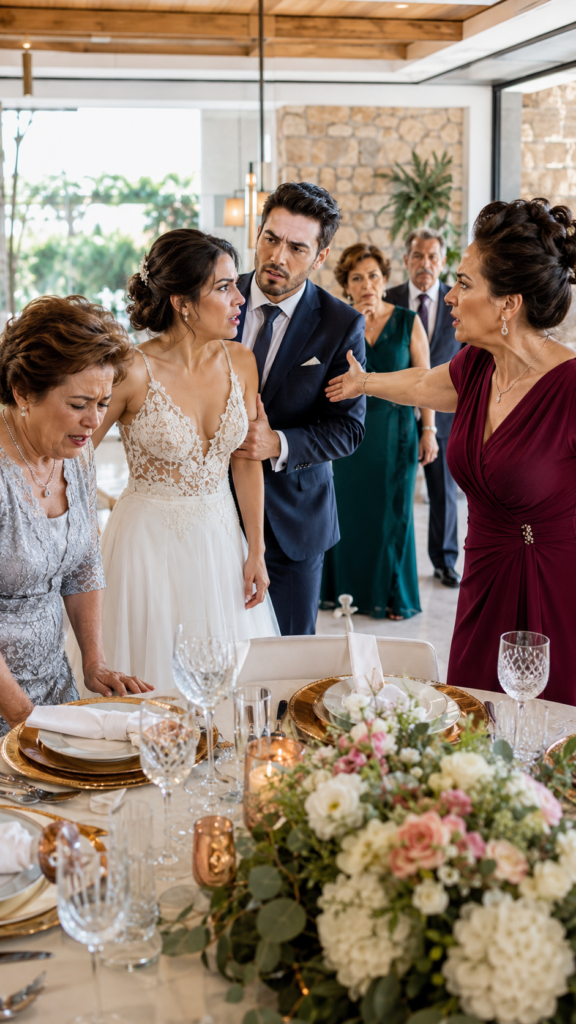
—If your mom is done eating, she should head to the kitchen and wash the dishes. She should get used to it, because in a decent family, everyone serves.
Doña Rebeca's words hit the living room like a slap.
Mariana froze, holding her coffee cup tightly. Beside her, doña Teresa lowered her gaze, gripping her navy blue dress, the one she had bought in installments for her only daughter's engagement.
The gathering was at a modest house in Iztapalapa. There were paper flowers, cold sodas, red rice, mole with chicken, sweet bread, and chairs borrowed from neighbors.
Doña Teresa had been cooking since 5 AM. She wanted Julián's family to feel welcomed, but from the moment they arrived, it was clear they did not come to socialize; they came to judge.
Doña Rebeca entered adorned with large jewelry, expensive perfume, and a sharp smile.
—Oh, what a tiny patio —she remarked as soon as she crossed the threshold—. But well, for a family gathering, it’s passable.
Then she tasted the mole and added:
—It's good. Very homemade. You can tell it's not from a banquet, but it has its charm.
Doña Teresa smiled as if she hadn’t understood the insult.
Mariana understood it all too well.
She also understood Julián's silence.
He sat beside her, elegant, groomed, with an impeccable shirt. Each time his mother made a hurtful comment, he would only touch her knee beneath the table.
—Don't mind her, love —he whispered—. You know how my mom is.
But Mariana didn’t know a person could humiliate so much in just one afternoon.
Doña Rebeca criticized the house, the food, the tablecloth, the chairs, and even Mariana's job.
—When you get married, ideally you should leave that accounting job —she stated—. A husband needs a present wife, not a woman who’s out all day thinking she’s an executive.
Mariana pressed her lips together.
She had worked for years to pay for her education. Her mother sold food outside a high school, cleaned houses, and washed other people's clothes so that she could study. No one had given her anything.
Then doña Rebeca looked at Teresa as if she were part of the help.
—And if your mom is done, she should wash the dishes. She's just sitting here getting in the way.
The room fell silent.
Mariana stood up slowly.
—My mom is the hostess and the mother of the bride. She is not your servant.
Doña Rebeca let out a dry laugh.
—Oh, dear, don’t exaggerate. In my family, no one feels too posh to serve.
Julián grabbed Mariana's arm.
—Come on, love. Don’t ruin the engagement over something silly.
Mariana looked at him, and something inside her broke.
She pulled out her phone, placed it on the table, and said:
—Fine. Since we're talking about how things are done in your family, I’m going to reveal why Julián needs to marry me before the end of the month.
Julián paled.
—Mariana, don’t you dare.
She unlocked the screen.
And when she pressed “play,” no one imagined that this engagement was about to turn into the biggest scandal that family had ever seen.
PART 2
Julián's voice came from the phone, low, nervous, almost pleading.
—Marry me first, Mariana. With the money from the envelopes, the wedding coins, and the gifts, I can pay those who are pressuring me. I’ll explain everything later, but don’t tell your mom anything.
No one breathed.
Doña Teresa slowly lifted her face.
Doña Rebeca slammed her hand on the table.
—That’s manipulated! My son would never say something like that.
Mariana didn’t scream. She didn’t cry. She just opened a folder on her phone and began to show screenshots.
Messages.
Transfers.
IOUs.
Threats.
Julián owed more than 850,000 pesos.
He had lost money betting on sports, on a supposed investment platform, and on loans he took out to cover other loans. First, he asked friends. Then coworkers. After that, he used other people's credit cards and convinced an ex-girlfriend to lend him her savings.
—I found out ten days ago —Mariana said—. I got a notification while he was using my computer. He swore he was sorry, that he would fix it, and that he didn’t want to involve me.
Julián stood up.
—I was going to pay it off! I just needed time.
—With what? —Mariana asked—. With my savings? With the wedding gifts? With the house my dad left my mom?
Doña Teresa put a hand over her chest.
—The house?
Mariana took a deep breath.
—Your mom knew everything. That’s why they insisted on rushing the wedding. That’s why they wanted me to agree to use my house as collateral for a loan after we got married.
Aunt of Julián looked at Rebeca.
—Did you know, Rebeca?
The woman took too long to respond.
That silence was another confession.
—A wife supports her husband —Rebeca said, trying to regain her authority—. If you truly loved him, you wouldn’t be humiliating him in front of everyone.
—Supporting doesn’t mean allowing deceit —Mariana replied—. And loving doesn’t mean letting them treat my mom like a servant while they plan to use our assets.
Julián stepped closer, desperate.
—Mariana, please. We can work this out. My mom will apologize, I’ll get help, and we’ll sell your car to buy some time.
That phrase finally opened her eyes.
There was no remorse. Only calculation.
Mariana took off her engagement ring and placed it on a silver tray.
Doña Rebeca stood up furiously.
—If you cancel the wedding, I’ll say your mother asked us for money to hand you over. Let’s see who comes out worse.
Doña Teresa broke down in tears.
Several guests stood up.
Mariana closed her eyes for a second. Then opened another audio.
—Then listen to what you yourself said last night.
The recording started with the sound of a door, and then Rebeca's voice came through, clear, calm, confident in her own wickedness.
—The girl has a steady job, a paid-off car, and a house in her name. Once married, Julián can convince her to mortgage it. If she gets difficult, we’ll make her understand that a good wife doesn’t abandon her husband.
Then Julián’s voice was heard.
—Mariana won’t accept if she knows how much I owe.
—That’s why she shouldn’t know yet —Rebeca replied—. First the wedding. With the envelopes and the gifts, we recover something. Your mom is a simple woman; with a little pressure, she’ll stay quiet.
The audio lasted less than 2 minutes.
But it destroyed three years of relationship.
Doña Teresa cried silently. Not because of the humiliation of the dishes, but because she had just heard they wanted to use her daughter as a financial lifeline.
Julián tried to take Mariana's hand.
—I would never have let it get this far.
She pulled her hand away.
—But you were going to let it start.
Don Ernesto, Julián’s father, stood up with a twisted face.
—Since when did you know this, Rebeca?
—I just wanted to help our son —she murmured.
—Help him? —he said—. By dragging another family into his debts?
Julián lowered his gaze.
Then Don Ernesto dropped another bomb.
—The bank called me yesterday. They received a loan application for 300,000 pesos with my signature.
The entire room froze.
—I didn’t forge anything —Julián stammered—. I just sent documents to explore options.
—The bank said the application was formal.
Doña Rebeca slumped into the chair.
For the first time, she no longer seemed like an elegant woman. She looked like a scared mother faced with the monster she had fed.
Mariana understood everything.
Julián not only had debts. He had a way of living: lying, hiding, manipulating, and waiting for someone else to pay the consequences.
She took the ring and held it in front of him.
—It’s over.
He shook his head.
—You can’t decide this out of anger. Give me a week. I’ll sell my car, find another job, postpone the wedding, and we’ll be fine.
—I’m not postponing a wedding —she said—. I’m canceling a life with you.
Julián fell to his knees.
—I love you, Mariana. I did everything because I was afraid of losing you.
Her eyes filled with tears.
She still loved him. And that’s why it hurt so much.
But love doesn’t turn betrayal into sacrifice.
—You weren’t afraid of losing me —she said—. You were afraid of losing what you could get from me.
—I’m not a bad person.
—Maybe not. But you chose to lie. You chose to remain silent while your mom humiliated mine. You chose to accept a plan to use my job, my house, and my future. We are also what we do when we’re afraid.
Doña Rebeca approached Teresa.
—Comadre, talk to your daughter. There were already expenses. Everyone was notified. What will people say?
Teresa wiped her tears.
All afternoon, she had kept her head down to avoid upsetting anyone.
This time, she stood up.
—People can say whatever they want. I sold tamales, cleaned floors, and wore the same shoes for years so my daughter could study. I didn’t raise her to deliver her to a family that wants to settle their debts with her life.
Rebeca swallowed hard.
—I didn’t mean to offend her with the dishes.
—You did mean to —Teresa replied—. You just thought I wouldn’t respond.
Then she took Mariana’s hand.
—My daughter can lose a wedding. What she won’t lose is her dignity.
A cousin of Mariana started to clap. Then an uncle. Then another neighbor who was helping in the kitchen.
Rebeca’s face filled with shame.
Don Ernesto approached Teresa.
—I apologize. I didn’t know the whole plan, but my silence also helped.
Mariana pointed to the baskets, bottles, and gifts.
—Take everything.
Julián's guests began to leave. The boxes returned to the trucks. Outside, some neighbors watched from their doors, whispering softly, as always happens in Mexico when a party turns into a drama.
Before leaving, Julián stopped by the gate.
—Mariana, don’t make it final.
She looked at her mother.
Tired.
Hurt.
But standing tall.
Going back to Julián would mean teaching him that he could betray her without losing her.
—It’s final.
When the last truck disappeared, the house was filled with dirty dishes, wilted flowers, and disordered chairs. On the wall hung a golden sign with their names.
Mariana sat down and cried like she hadn’t in years.
She cried for the wedding.
For the imagined children.
For the version of Julián that had only existed in her head.
—I’m sorry, mom —she said—. I should have ended it when I discovered the debt.
Teresa sat down beside her.
—When someone cares, it takes time to accept what hurts. The important thing is that you opened your eyes before marrying.
That night, they washed the dishes together.
Not because someone ordered them to.
But because it was their home, their table, and their way of regaining calm.
The next day, the messages began.
Some congratulated Mariana. Others told her not to exaggerate, that everyone makes mistakes, that at 30 years old, canceling a wedding was “very delicate.”
Teresa took the phone away from her.
—A door that leads to a fire isn’t useful, even if it has flowers at the entrance.
In the following weeks, the truth kept coming out.
Three coworkers reported that Julián had asked them for money with different stories. His ex-girlfriend showed transfers he never paid back. The company discovered he had used customer data to attempt to apply for loans and fired him.
Don Ernesto confirmed that his signature had been forged. He separated his accounts from Rebeca’s and forced Julián to return the car. Rebeca had to sell a plot of land to cover part of the debts, but it wasn’t enough.
Mariana didn’t celebrate his downfall.
She just wanted peace.
She changed passwords, checked her credit report, and consulted a lawyer. Then she discovered something that froze her blood: Julián had photographed her documents months earlier.
He hadn’t managed to use them.
But that was enough to erase any doubt.
Two months later, he showed up outside her house with a folder in hand.
—I came to show you that I’m changing —he said.
Mariana didn’t open the gate.
He showed proof of therapy and a payment plan.
—I got a job in a warehouse. I don’t gamble anymore. I just want another chance.
—I’m glad you’re doing something —she replied—. But I’m not going back.
—Not even when I finish paying?
—Changing isn’t a currency to buy back the people you hurt. Do it for yourself.
Julián lowered his gaze.
—I did love you.
—Maybe you loved me as you knew how. But that way, you would have destroyed me.
He took a deep breath.
—I’m sorry for not defending your mom.
Mariana felt a knot in her throat.
—That day, I didn’t need a hero. I just needed you to say: “Don’t talk to her that way.” You couldn’t even do that.
Julián left without insisting.
And for the first time, Mariana closed the door without crying.
Over time, she sold the wedding dress and used that money to take Teresa to Veracruz. They walked along the boardwalk, ate by the sea, and laughed at simple things, as if life were giving them air back.
One afternoon, Teresa asked her:
—Are you still afraid of being alone?
Mariana looked at the waves.
—Sometimes. But I was more afraid of getting married and feeling alone every day.
A year later, Mariana received a promotion and started remodeling the house.
When someone asked her why she canceled the wedding, she replied:
—Because I discovered they wanted a financial solution, not a wife or a daughter.
Some people called her exaggerated.
Others confessed that they had also endured humiliations for fear of what others would say.
Mariana understood that that afternoon, she hadn’t just saved a house and some savings. She had broken a chain.
Doña Rebeca thought sending Teresa to wash dishes was putting a humble woman in her place.
But all she managed to reveal was the place she wanted to assign the entire family: down, silent, and grateful.
Mariana didn’t cancel the wedding for some dirty dishes.
Nor just for 850,000 pesos.
She canceled it because she understood that a marriage built on lies, contempt, and fear of scandal doesn’t become a home just because there are flowers, rings, and pretty pictures.
Sometimes losing a wedding is the bravest way to save a life.
And no woman should feel guilty for closing a door when behind it, they demand she enter on her knees.





