PART 1
For six years, Mariana Ríos believed that a good wife should endure in silence to maintain family peace.
That’s what everyone had told her: don’t argue, don’t respond, don’t embarrass your husband, and above all, respect your mother-in-law because "there’s only one mother."
But no one had explained that respect didn’t mean allowing herself to be trampled.
Mariana lived in a spacious house in the Jardines del Pedregal neighborhood, in the south of Mexico City. From the outside, it looked like a perfect life: electric gate, bougainvillea at the entrance, a gourmet kitchen, an elegant living room, and a husband named Rodrigo, an engineer, always well-dressed and always too busy to notice his wife’s pain.
Living with them was Doña Graciela, Rodrigo’s mother.
She had come “for two weeks” while they fixed a leak in her apartment in Satélite. Now, ten months later, she was still there, running the kitchen, criticizing Mariana’s clothes, checking what she bought at the supermarket, and calling “my things” the furniture that Mariana had paid for with years of work as an accountant.
Mariana swallowed hard and smiled.
Until that Sunday.
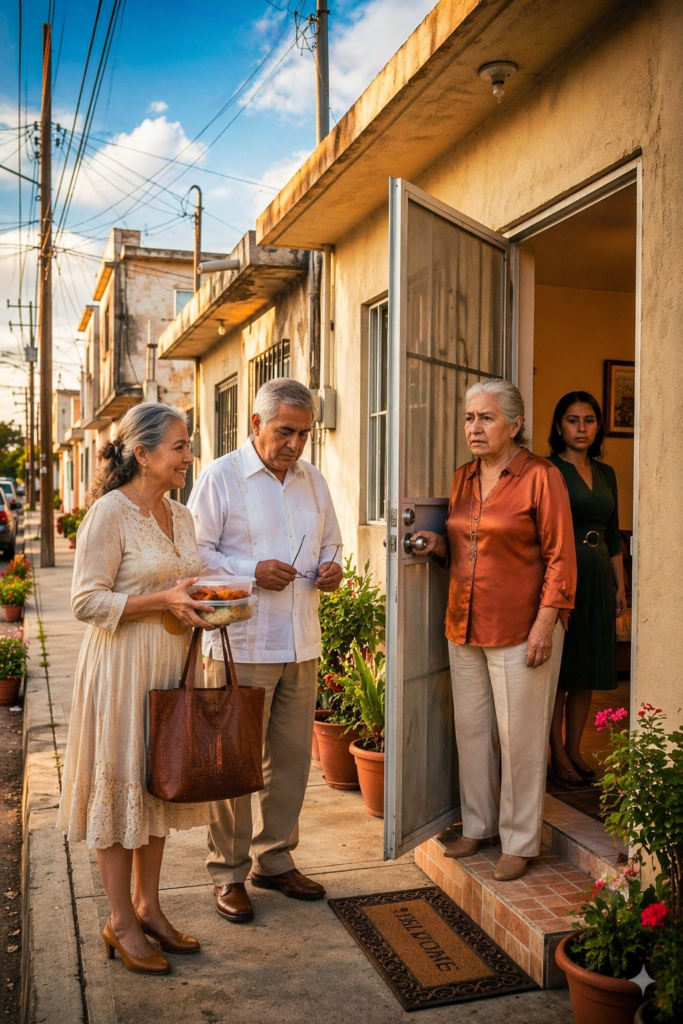
Her parents, Don Aurelio and Doña Meche, arrived from a small town in Hidalgo after a nearly four-hour bus ride. They came tired but happy. Doña Meche brought a clay pot filled with barbacoa wrapped in leaves, handmade tortillas, and a jar of spicy salsa.
Don Aurelio carried a bag of oranges from their garden and an old hat in his hands.
They just wanted to see their daughter.
When they rang the doorbell, Mariana was upstairs folding clothes. Hearing her mother’s voice lit up her face. She hurried down the stairs, but stopped when she saw Doña Graciela standing at the entrance, arms crossed and the gate closed.
—What do you want? —the mother-in-law asked, looking them up and down.
Doña Meche smiled shyly.
—Good afternoon, ma’am. We came to greet Marianita. We brought her some barbacoa because we know she loves it.
Doña Graciela let out a dry laugh.
—Mariana is busy. And we don’t receive visitors without notice, especially not with food smelling like a market.
Don Aurelio lowered his gaze.
—I’m sorry, ma’am. We came from far away. We just want to give our daughter a hug.
The mother-in-law’s face hardened.
—Well, your daughter has another life now. She doesn’t live in the ranch. This is a decent house, not a bus stop for people from the town to come and dirty the entrance.
Mariana felt the air clogging in her throat.
She wanted to move.
She wanted to open.
She wanted to scream.
But fear, habit, and all those years of “don’t cause trouble” left her frozen in the middle of the living room.
Doña Meche pressed the pot against her chest. Her eyes were filled with tears, but she said nothing. Don Aurelio placed a hand on her back, and they both began to walk slowly towards the corner, as if every step weighed a hundred kilos.
Then Doña Graciela closed the gate and murmured with disdain:
—What a shame, really. One works hard to move up in the world, and then the uncouth come to remind you where you got the girl from.
Mariana didn’t cry.
She just went up to her bedroom, pulled out a blue folder from the closet, and read a document she had kept for years.
That very night, while Rodrigo slept, Mariana made three calls that would destroy everything.
PART 2
The next morning, Mariana prepared coffee as usual.
Doña Graciela was sitting at the dining table, scrolling through her phone and complaining that the cleaning lady hadn’t arranged the cushions properly. Rodrigo was having breakfast, staring at emails on his laptop, without looking up.
Everything seemed normal.
But Mariana was no longer the same.
There was something different in her eyes. A strange calm. Cold. As if she had stopped asking for permission to exist.
—Rodrigo —she said, pouring coffee into her cup—, my parents came yesterday.
He didn’t even lift his gaze.
—Yeah, my mom told me. They came without notice. Lety, I mean, Mariana, you have to understand, there are rules here.
Doña Graciela smiled, satisfied.
—Exactly. Besides, one can’t let just anyone in. Then they don’t want to leave.
Mariana set the coffee pot down on the table.
—They weren’t just anyone. They were my parents.
Rodrigo sighed, irritated, as if she were exaggerating over a neighborhood gossip.
—My love, let’s not start. You know how my mom is. She’s just direct. Don’t take it personally.
That phrase was the last thread that snapped.
For years, Mariana had heard the same thing. When Doña Graciela criticized her accent because sometimes her Hidalgo roots slipped out, Rodrigo said not to take it personally. When she called her “useful girl” in front of her friends, Rodrigo said it was a joke. When she moved her parents to the kitchen table at Christmas so they wouldn’t “uncomfortable” the guests, Rodrigo said it was to avoid tensions.
It was always her who had to understand.
It was always her who had to stay silent.
But this time, no.
Mariana stood up without arguing and headed to work. She didn’t go to the office. Driving on the Periférico, her hands firm on the wheel, she arrived at a notary’s office in the Del Valle neighborhood.
There, Licenciada Barragán, a sharp-eyed lawyer with a no-nonsense demeanor, was waiting for her.
On the table were four folders.
The first contained the title deeds of the house.
The second, the mortgage payment records.
The third, the account statements showing that every monthly payment had come from Mariana’s personal account.
The fourth was the most dangerous: it contained documents proving that Rodrigo had used money from a shared account to pay his mother’s debts without Mariana’s authorization for 18 months.
There weren’t just two or three purchases.
They were monthly transfers, credit card payments, cosmetic treatments, trips to Vallarta, and even the down payment on a truck that Doña Graciela bragged about as if she had earned it through hard work.
—Are you sure? —the lawyer asked.
Mariana looked at the signatures, the stamps, the dates.
—Yesterday, my parents were left on the street —she replied—. Today, I stop allowing it.
She didn’t sell the house immediately.
She did something more precise.
The house was solely in her name. Rodrigo had never been able to get on the mortgage because when they married, he had three overdue debts and a civil lawsuit. Mariana had put down the deposit, signed, paid, and trusted.
But there was one detail that Rodrigo and his mother were unaware of.
The marriage regime was separation of property.
Doña Graciela had no right to a single centimeter of that property.
Neither did Rodrigo.
Licenciada Barragán prepared a revocation of access, a formal eviction notice for Doña Graciela, and a divorce petition with property protection measures.
Mariana signed each page with a calmness that surprised her.
Then she went to the bank.
She canceled Rodrigo’s additional credit card.
Blocked automatic charges.
Changed the passwords.
Requested a certified statement of transactions.
When she exited, the sun hit her face, and for the first time in a long time, she felt she was breathing without asking for forgiveness.
For the next six days, she said nothing.
She returned home, cooked little, answered with short phrases, and observed. Doña Graciela continued to act like a queen. Rodrigo continued to believe that Mariana’s silence was obedience.
They didn’t understand that silence, at times, is the prelude to the hardest blow.
The following Saturday, exactly seven days after humiliating Don Aurelio and Doña Meche, Doña Graciela organized a meal at the house.
She invited five friends from her church group, two cousins, and a neighbor who always talked about “good manners.” She wanted to showcase her life as a well-off lady, her obedient daughter-in-law, and the house she claimed “her son had built with sacrifice.”
Mariana didn’t oppose.
She even set the table with nice dishes.
Prepared hibiscus water.
And waited.
At 3:40 PM, the doorbell rang.
Doña Graciela got up in her beige dress, her fake pearls, and her smile of an important hostess.
—I’ll get it —she said, as always.
Upon opening the gate, she found Licenciada Barragán accompanied by two court officers and a locksmith. The lawyer held a black folder with official documents.
—Good afternoon. Is Mrs. Graciela Mondragón here?
The mother-in-law’s smile vanished.
—Yes, that’s me. What do you want?
—We are here to notify you that you must vacate this residence. Your stay is no longer authorized by the owner.
Doña Graciela let out a nervous laugh.
—Owner? You must be mistaken, lawyer. This house belongs to my son, Rodrigo Salvatierra.
Mariana appeared behind her.
She didn’t shout.
She didn’t tremble.
She just said:
—No, Graciela. This house is mine.
The guests froze in the living room. One of the cousins dropped her spoon on the plate. Rodrigo, coming down the stairs, stopped halfway, his face pale.
—What’s happening? —he asked.
Licenciada Barragán extended the notification.
—Mrs. Mariana Ríos Álvarez is the sole owner of the property. Mrs. Graciela Mondragón does not have a contract, possessory rights, or current authorization to remain here. You have 72 hours to remove your belongings.
Doña Graciela snatched the papers from her hand.
She read quickly.
Then read again.
Her face began to contort with rage.
—This is ridiculous. Rodrigo, tell them something! Tell your wife to stop throwing a tantrum!
Rodrigo came down the stairs, trying to regain his tone as the man of the house.
—Mariana, enough. You’re not going to make a scene in front of people. Come upstairs, we’ll talk and fix this.
She looked at him with a hard sadness.
—There’s nothing to fix. Your notification is here as well.
Rodrigo opened the second folder.
There was the divorce petition.
There were the account statements.
There were the transfers to his mother’s name.
There was everything he thought Mariana would never check because “she was too good.”
—Where did you get this? —he murmured.
—from the account you thought I wasn’t watching —she replied—. For 18 months, you used my money to support your mother’s whims. While she called my parents people from the town, you paid for her luxuries with my work.
Doña Graciela’s friends started to look at each other. No one wanted to speak up. No one wanted to defend her. Because it was one thing to criticize the humble daughter-in-law in private, and another entirely to be exposed in the middle of a legal document.
Doña Graciela approached Mariana with fiery eyes.
—You’re ungrateful. I taught you how to behave like a lady.
Mariana stepped forward.
—No. You taught me what I must never allow. You taught me that there are people who confuse education with humiliation. And you taught me that no house is worth more than the dignity of my parents.
Rodrigo clenched the papers.
—Are you going to destroy our marriage over a visit? Over a tantrum from your parents?
Mariana felt a pang in her chest, but she didn’t back down.
—It wasn’t a visit. It was the final test. They traveled four hours to bring me food made with love, and your mother treated them like garbage. You knew it and justified it. That day I understood that in this house, your friends, your cousins, your mother’s whims, and your lies could fit, but my roots couldn’t.
Rodrigo tried to take her hand.
She pulled it away.
—Mariana, please. Don’t do this. My mom has nowhere to go.
The phrase fell like a stone.
Mariana smiled faintly, without joy.
—Curious. When my parents were on the curb, no one cared if they had somewhere to go.
Doña Graciela exploded.
—They have their town! I’m not like those people!
There it was.
The last nail.
The guests heard clearly. Rodrigo closed his eyes, knowing he could no longer disguise his mother’s cruelty as “strong character.”
Licenciada Barragán intervened calmly.
—Ma’am, I advise you to stop talking. All this diligence is being recorded.
Doña Graciela looked around and noticed a neighbor’s phone recording from the living room. In seconds, her respectable lady mask turned to panic.
For the next 72 hours, the house became a boiling pot.
Doña Graciela cried over the phone, saying Mariana was leaving her on the street. She called family members, the priest, a lawyer friend, and even a police cousin. Everyone asked the same thing:
—Is the house in your name?
And she had to answer no.
Rodrigo went from shouting to begging. First, he accused Mariana of being cold. Then he told her they could go to therapy. After that, he promised her mother would leave “for a while.” But it was too late.
On the last day, Doña Graciela was at the entrance with six suitcases, three black bags, and a face full of hatred. She no longer looked like the queen of the house. She looked like a woman facing the consequences of her poison for the first time.
Rodrigo helped her load her things into a rideshare taxi.
Before leaving, the mother-in-law looked at Mariana.
—You’ll regret it. One day you’ll need family.
Mariana opened the door wide.
—Family was what you left on the curb. You were just a person living in my house.
Doña Graciela was left speechless.
The taxi pulled away.
Rodrigo didn’t leave with her. He stood in front of Mariana, his eyes red.
—And me? —he asked—. Are you going to kick me out too?
Mariana took a deep breath.
—I’m not kicking you out, Rodrigo. You left my side every time you chose to defend the indefensible.
He wanted to respond, but couldn’t.
The following week, he received the formal divorce petition. He also received the claim for unauthorized expenses. His mother’s truck had to be sold to cover part of the money.
The scandal spread among relatives like wildfire. Some said Mariana was cruel. Others said someone finally put an end to Doña Graciela. Aunts argued in groups about it.
For the first time, she slept peacefully.
One month later, Mariana organized a meal at her house.
There were no expensive tablecloths or imported glasses. Just a simple table, yellow flowers in a vase, red rice, beans, and the barbacoa that Doña Meche prepared again with her hands.
Don Aurelio arrived with his clean hat and a box of oranges.
This time, when he rang the doorbell, Mariana opened before the first sound finished.
Doña Meche hesitated at the entrance.
—Sweetheart, are you sure we can come in? We don’t want to impose.
Mariana broke down.
She hugged both of them so tightly that Don Aurelio had to take off his hat to wipe away his tears.
—You will never impose here —she said—. This house is also yours because everything I am started with you.
Doña Meche entered crying.
Don Aurelio placed the oranges on the table and looked around. He didn’t say much, because he was a man of few words, but his voice came out raspy.
—Your house is nice, daughter. It feels peaceful.
Mariana understood then that that was the word she had been searching for all those years.
Peace.
Not luxury.
Not appearances.
Not approval.
Peace.
That afternoon, they ate together until nightfall. They laughed about simple things, talked about the town, the neighbors, the harvest, the tortillas that no one in the city knew how to make as well.
And though the house was the same as always, for the first time it felt different.
Because there was no longer a woman watching who deserved to enter.
There was no longer a husband minimizing wounds.
There was no longer a daughter ashamed of her origins.
There was only an open door and a table with three places filled with love.
Mariana lost a marriage, lost the false notion of a perfect family, and lost the fear of being embarrassed.
But she regained something much greater: the voice they had taught her to silence.
And from that day on, whenever someone said she had exaggerated for defending her parents, Mariana responded with the same calm:
—It’s not exaggerating to set boundaries. It’s exaggerating to think you can humiliate your loved ones and keep sitting at your table.





