PART 1
The San Ángel church smelled of expensive flowers and shame.
Valeria Cruz walked toward the altar in a dress she hadn’t chosen, her eyes dry from too much crying and a dead smile painted on her face out of obligation.
Beside her, in an immaculate wheelchair, sat Sebastián Montejo, heir to one of the most powerful construction companies in Mexico.
He had been in a coma for 9 months.
He didn’t blink.
He didn’t speak.
He couldn’t say no.
Behind him, a private nurse monitored every breath as if guarding a golden relic. The guests murmured quietly, dressed in linen, pearls, and watches that cost more than the house where Valeria grew up in Iztapalapa.
Her father, Armando, squeezed her arm.
“Say yes, daughter. Please. You’ll save us all.”
Valeria glanced at him.
That “all” always meant him.
His debts, his gambling, his loans with dangerous people, his lies wrapped in the tears of a remorseful father.
“I accept,” she whispered.
No one clapped enthusiastically.
There was no kiss.
Just a notary in the back, a grandmother with an icy stare, and a cousin smiling as if he’d just won a bet.
Doña Beatriz Montejo, Sebastián’s grandmother, looked Valeria up and down.
“She’ll do,” she said, as if speaking of a chair, not a woman.
The cousin, Diego Montejo, approached after the ceremony with a glass in hand.
“Welcome to the family, little sister-in-law. Quite the beautiful sacrifice, huh?”
Valeria felt disgust.
Three weeks earlier, her father had sat her down in the kitchen of their home. The light flickered, the refrigerator was nearly empty, and he cried with his hands clasped.
He told her the Montejos needed a wife for Sebastián before he turned 30, or control of the group would pass to Diego.
In return, they would pay off all her debts.
“It’s just a piece of paper, Vale. He won’t even know.”
But Valeria knew everything.
That her life was worth less than a signature.
That her father preferred to sell her than face the consequences.
That night, they took her to the Montejo mansion in Lomas de Chapultepec. White marble, private guards, illuminated fountains, and a silence so heavy it felt like a rich person's prison.
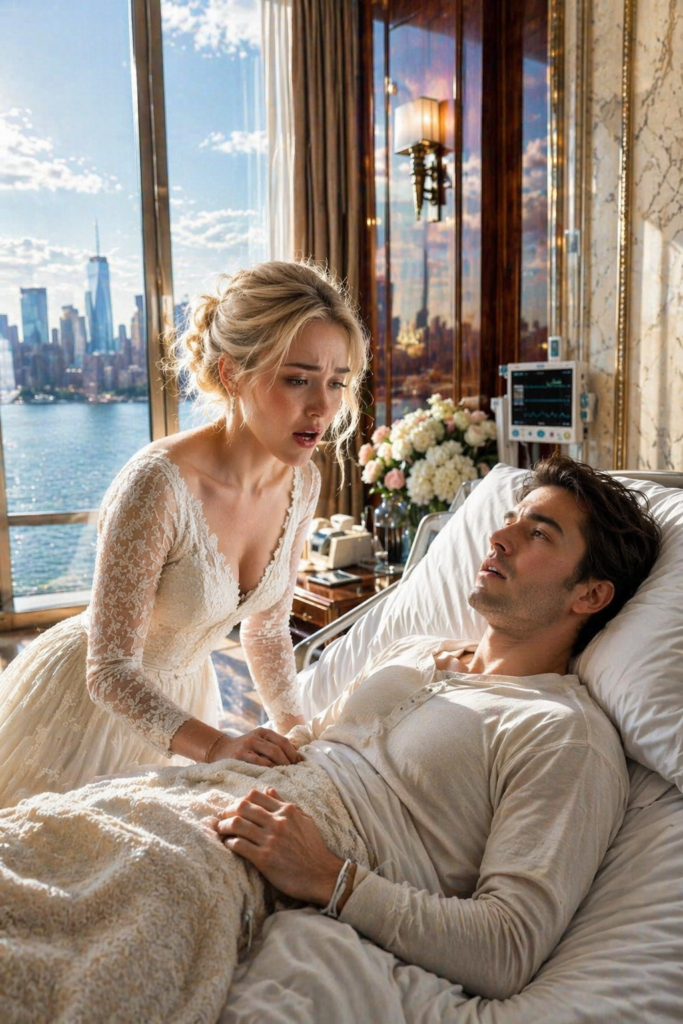
Sebastián’s room didn’t resemble a hospital.
There were light curtains, fresh flowers, soft music, and a huge bed in front of a window. He lay there, motionless, beautiful in a sad way, like someone trapped underwater.
Valeria was left alone with him.
She sat beside the bed and, for the first time in hours, let the mask fall.
“I’m sorry,” she murmured. “I didn’t want this either.”
She told him that her mother had died two years ago. That her father had changed since then. That she wasn’t a gold digger, nor self-interested, nor a crazy woman seeking a name.
“I was just the coin they used to pay a debt.”
Then something minimal happened.
A finger of Sebastián moved.
Valeria stopped breathing.
She looked at his hand, frozen in fright. Then she saw his eyelids flutter.
Sebastián Montejo’s eyes opened slowly.
And in a broken, almost impossible voice, he whispered:
“Don’t trust Diego… or your father.”
PART 2
Valeria wanted to scream.
She wanted to run down the hall, call the doctor, shake the nurse, and tell everyone that the comatose heir had just awakened.
But Sebastián barely moved his head.
No.
That gesture was so weak and so clear that she remained frozen next to the bed, her heart pounding against her ribs.
“What did you say?” she whispered, trembling.
Sebastián breathed with difficulty. His lips were dry, his voice coming out as if each word ripped years of silence from him.
“Diego… caused my accident. Your father signed with him.”
Valeria felt the marble floor opening beneath her feet.
Her father.
Again, her father.
Before she could ask more, high heels echoed in the hallway. Sebastián closed his eyes immediately and lay still again.
The door opened.
Doña Beatriz entered with the nurse and a doctor in a blue coat. She looked at Valeria coldly.
“Why are you so pale?”
“He moved,” Valeria said, measuring each word. “I think he moved a finger.”
The grandmother approached the bed. For one second, her hard face broke.
It wasn’t joy.
It was fear.
The doctor checked pupils, pulse, blood pressure. He said it could be a reflex. Doña Beatriz didn’t fully believe him, but she didn’t ask more in front of Valeria.
“From now on, you’ll sleep here,” she ordered. “You’re his wife. Watch over him.”
Valeria lowered her gaze.
“Yes, ma’am.”
Inside, she understood they had just granted her access to the eye of the storm.
That dawn, when the nurse went to the bathroom, Sebastián opened his eyes again.
“Since when have you been awake?” Valeria asked.
“Since three months ago.”
Her blood turned cold.
“And you pretended all this time?”
“If I woke up, they would kill me.”
Sebastián told her fragments. His truck went off the road en route to Valle de Bravo. Everyone said it was an accident. But he remembered the smell of chloroform, Diego’s voice in the front seat, and a call mentioning “the transfer.”
Diego didn’t just want to inherit.
He wanted to take the Montejo Group before the shareholders' meeting, using forged documents and Sebastián’s state of coma.
“And my dad?” Valeria asked, though it hurt to know.
Sebastián closed his eyes, not from sleep, but from pity.
“Armando accepted money. He signed as a witness to some contracts. Then he delivered you as a wife so Diego could use you.”
“Use me how?”
“As the legal wife who would authorize medical and estate decisions if something happened to me.”
Valeria felt nauseous.
It wasn’t a wedding.
It was a trap with flowers.
The next day, Diego found her in the hallway, in front of the family portraits.
“Have you gotten used to sleeping with the sleeping prince?” he said, smiling.
Valeria gritted her teeth.
“I didn’t know this family found misery so funny.”
Diego chuckled softly.
“Oh, Valeria. Don’t play dignified. Your dad sold you cheap. At least here you eat well.”
The blow wasn’t physical, but it shattered something inside her.
That afternoon, Valeria received a call from Armando. He didn’t ask if she was okay.
He only asked if she had signed some papers Diego was going to bring.
“Daughter, don’t throw a tantrum. It’s for everyone’s good.”
“For everyone or for you?”
There was silence.
“Don’t talk to me like that. I gave you life.”
Valeria looked at Sebastián, motionless in the bed, pretending not to listen.
“And you sold it.”
Armando hung up.
That night, Diego left a folder in the room. It said it was simple medical authorizations, “just paperwork.”
Valeria pretended to be clumsy.
“I’m bad at these things. Where do I sign?”
Diego leaned in too close, pointing with his finger.
“Here, here, and here. Don’t read too much, little sister-in-law. Don’t be intense.”
She smiled innocently.
“Can I borrow a pen?”
When Diego left to get it, Valeria quickly took photos with her phone hidden under a magazine. Sebastián opened his eyes just a bit.
“Safe box,” he whispered. “Diego’s office. Code 1-2-0-8.”
“How do you know?”
“It was my mom’s birthday. He was always a brute with codes.”
At 2 a.m., Valeria walked barefoot through the hallway. The mansion felt different at night: the portraits watched, shadows stretched, and every creak sounded like an accusation.
Diego’s office was locked.
But beneath a clay pot, she found a small key. The guy was arrogant even in hiding his secrets.
She entered.
The place smelled of expensive whiskey and tobacco. On the desk lay invoices, promissory notes, and copies of deeds.
She opened the safe with trembling hands.
1-2-0-8.
Click.
Inside was a USB drive, stock transfer contracts, receipts for payments to a doctor, and a sheet that left her breathless.
It was an agreement signed by Armando Cruz.
Her father had received 3,000,000 pesos for “family management, marital consent, and asset collaboration.”
Valeria covered her mouth to stifle a sob.
It wasn’t pressure.
It wasn’t desperation.
It was price.
Her price.
Then the light turned on.
Diego was at the door with a small gun in hand.
“I told you not to be intense.”
Valeria hid the USB in her fist.
“I just wanted to understand what I signed.”
“You haven’t signed anything yet,” he said, moving closer. “But you will. And later, when Sebastián ‘dies’ from a respiratory complication, you’ll be left as the sad widow who authorized everything.”
Valeria stepped back.
“You’re sick.”
“No, doll. I’m tired of watching everyone cry over a useless sleeping man while I run this empire.”
Diego grabbed her arm tightly.
“Give me what you took.”
“No.”
He pushed her against the desk.
“Your father cried less than you did when he accepted the money. He even told me, ‘Valeria has always been obedient.’”
That was the final blow.
Valeria stopped being afraid.
She looked at him with tears but without bowing her head.
“Well, they both made a mistake.”
Diego raised the gun.
In that instant, a secret door behind the bookshelf opened.
Sebastián appeared standing, pale, thin, leaning on a black cane, but with eyes more alive than ever.
“Let her go.”
Diego turned white.
“No… you can’t walk.”
Sebastián moved slowly.
“You couldn’t hear me, according to you. And I’ve been listening to you for three months.”
Valeria ran toward him, but Sebastián raised a hand to shield her behind his body.
Diego aimed.
“It was all mine.”
“Never was,” Sebastián said.
The front door burst open.
Investigation police and two lawyers from the Montejo Group entered. Doña Beatriz followed, her face hard, but her eyes filled with tears.
Valeria then understood the most unexpected twist.
The grandmother knew Sebastián could awaken.
But she didn’t know whom to trust.
She had kept strict surveillance because she suspected someone in her own house was still drugging him.
“I installed new cameras a week ago,” Doña Beatriz said, looking at Diego as if she had just buried him. “And you just talked too much.”
Diego tried to laugh.
“Grandma, don’t be ridiculous.”
“Don’t call me grandma,” she replied. “You tried to kill my grandson.”
The agents took the gun from him. Diego screamed, insulted, threatened to sink everyone. But when they reviewed Valeria’s USB, payments to the doctor, purchases of sedatives, transfers to Armando, and audios where Diego spoke of the accident appeared.
The truth could no longer be hidden under marble.
At dawn, Armando was brought to the mansion by the police.
He arrived with a wrinkled shirt and a face swollen with fear.
When he saw Valeria, he tried to hug her.
“Daughter, forgive me. I didn’t know how far this would go.”
Valeria stepped back.
That small step hurt more than a slap.
“You knew you were selling me.”
Armando cried.
“It was a debt, Vale. They were going to kill me.”
“And you preferred they killed me inside.”
No one spoke.
Neither Sebastián.
Nor Doña Beatriz.
Nor the lawyers.
Because sometimes the truth is so ugly it doesn’t need witnesses.
Armando fell to his knees.
“I’m your father.”
Valeria looked at him with serene sadness.
“No. My father died the day he put a price on me.”
Armando was arrested for fraud, forgery, and complicity. Diego, too. The private doctor ended up confessing that he had kept Sebastián sedated on Diego’s orders, altering reports to make it seem he remained in a deep coma.
Doña Beatriz resigned from the board’s presidency.
Not for lack of power.
But for shame.
In front of all the shareholders, Sebastián appeared walking with difficulty, Valeria by his side. The press waited outside like vultures, but he didn’t speak of revenge.
He spoke of rebuilding.
Of denouncing.
Of not allowing a powerful family to continue believing that money buys bodies, silences, and forgiveness.
When it was all over, Valeria stepped into the mansion’s garden. The sun fell on the jacarandas, and for the first time, that place didn’t seem like a prison.
Sebastián approached slowly.
“I can annul the marriage,” he said. “No one will force you to stay.”
Valeria looked at him.
That man had been her husband on paper, her quarter prisoner, her ally in darkness, and the living proof that even golden cages can be broken from within.
“I need to leave for a few days,” she replied. “I need to remember who I am away from all of you.”
Sebastián nodded.
“I understand.”
She smiled faintly.
“But I didn’t save you to become someone else’s property.”
He lowered his gaze.
“Never.”
Valeria left the mansion with a small suitcase, without a chauffeur, without guards, without a white dress. She only carried the original USB hidden as insurance and a phrase lodged in her chest:
Family isn’t always those who give you life.
Sometimes, family is those who don’t allow it to be taken from you.
Months later, Valeria opened a foundation in Mexico City for women forced to marry, sign, or silence under family pressure. She didn’t use the Montejo surname on the façade.
She used her mother’s.
Sebastián visited her on the inauguration day with a simple bouquet of bougainvillea.
He didn’t ask her to come back.
He didn’t ask her for forgiveness for a guilt that wasn’t his.
He only stood at the back, watching her speak in front of other women who cried in silence.
Valeria took the microphone and said:
“Many of us were taught that obeying family is love. But when they ask you to destroy yourself to save them, that’s not love. It’s abuse.”
The video went viral that same night.
Some defended Armando, saying a desperate father makes mistakes.
Others said that selling a daughter has no forgiveness, neither with tears, nor debts, nor blood.
Valeria didn’t respond to comments.
She just closed her phone, looked out the window, and breathed free.
Because in the end, she didn’t stay with the millionaire out of necessity.
She didn’t forgive her father under pressure.
She didn’t obey anyone out of fear.
And that was her true wedding day:
The day she stopped belonging to everyone and finally started to belong to herself.





