PART 1
—Let’s see if he still claims to love you when he sees what you’ve become —Beatriz said, her smile unwavering.
The brick struck Valeria Montes on the left side of her face before she could comprehend why her father had raised his arm.
One moment, she stood in front of the family home, in an old neighborhood of Puebla, holding a box of wedding invitations. The next, she fell to her knees on the sidewalk, vision blurred, blood streaming down her neck.
Emiliano Robles, her fiancé, managed to catch her before she hit the ground.
—Vale, look at me! Don’t close your eyes!
She tried to open her left eye, but found only darkness. With her right, she saw her mother by the gate, calm, as if this were a scene she had been waiting for weeks to unfold.
Rogelio Montes dropped the piece of brick among the bougainvilleas.
—She asked for it —he said.
Emiliano looked at him in horror.
—Are you crazy? She’s your daughter!
Mónica, Valeria’s younger sister, appeared from the door. She wore a red dress, new heels, and an expression of annoyance.
—I told you I wasn’t giving up on him —she murmured.
Beatriz crossed her arms.
—we tried talking to her nicely, but she’s always been selfish.
Valeria could barely breathe. She had come to announce that the wedding would be in four months. Yet her parents had prepared something else entirely.
Ever since Emiliano sold part of his real estate development company, Mónica had started stalking him. She “coincidentally” showed up at restaurants, meetings, the gym, and even outside his office.
He had rejected her, blocked her numbers, and made it clear he loved Valeria.
But Mónica convinced their parents that her sister had stolen the life that belonged to her.
—You’re going to marry Mónica —Rogelio ordered—. She knows how to rise to the occasion of a man like you.
—I’m not a prize you can hand out —Emiliano replied—. And I would never trade Valeria for anyone.
Rogelio kicked the cellphone Emiliano had pulled out to call 911. The device smashed against the wall.
—No calls are going out here.
Emiliano pushed him, and they both fell onto some flowerpots. Beatriz didn’t call for help. Mónica didn’t either. They just watched, cold, as if the blow wasn’t a fit of rage but the final step of a plan.
Valeria felt a chill.
She remembered her mother’s messages: “Step aside.” Her father’s threats: “Your sister deserves that wedding.” And Mónica’s phrase: “When you’re no longer pretty, he’ll open his eyes.”
A delivery truck screeched to a stop in front of the house. The driver got out, saw Valeria bleeding, and immediately called for emergency assistance.
Rogelio tried to stop him, but several neighbors had already come out with their phones.
The sirens arrived minutes later.
As the paramedics lifted Valeria, she saw a silhouette behind the living room curtain. It was an unfamiliar old man, with a cane and a yellowed envelope pressed against his chest.
The man raised his hand, desperate, as if he had waited 26 years to find her.
And what he was about to reveal would turn this family crime into an unstoppable nightmare.
PART 2
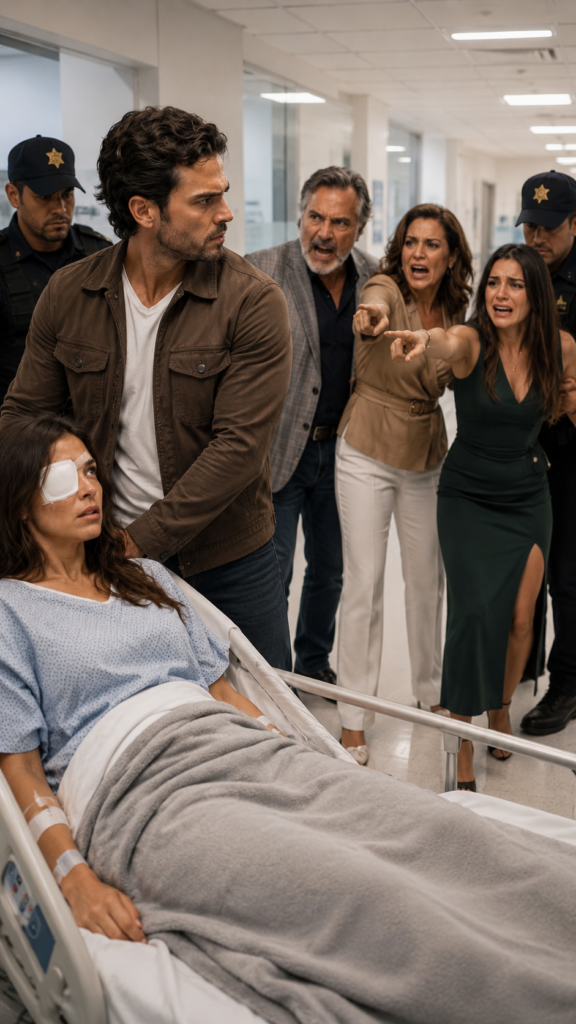
Valeria woke up in the University Hospital with her face covered in bandages and an unbearable pressure around her left eye.
Dr. Paulina Castañeda explained that she had fractured the orbital bone, sustained a deep cut on her cheek, and suffered severe damage from swelling.
—The optic nerve seems intact —she said—, but we still can’t guarantee she’ll regain full vision.
Emiliano sat by the bed, his shirt stained with blood and his knuckles bruised.
When Valeria moved her hand, he took it gently.
—I’m not going anywhere. Not today, not ever.
She didn’t cry until she heard him. She had endured 29 years feeling like the leftover daughter, but in that moment, she understood that someone could love her without comparison.
An agent from the Prosecutor’s Office, Commander Jimena Alcázar, entered to take her statement.
Valeria confirmed that her father had intentionally hit her. She then recounted years of threats, blackmail, and favoritism.
When Valeria got a scholarship, Rogelio accused her of humiliating Mónica. When she bought her first car, Beatriz tried to force her to give it to her sister.
When Mónica dropped out of two college courses, everyone blamed Valeria for “pressuring her too much.”
The commander listened without interruption.
—Did your family want to separate Emiliano from you for money?
—They wanted him to choose Mónica —Valeria replied—. They thought they could break me until they succeeded.
Emiliano added that Mónica had sent him photos, gifts, and messages for months. She even offered to keep “their relationship” a secret, although there had never been any relationship.
Then a nurse appeared in the doorway.
—Your parents and your sister demand to see you.
Emiliano immediately stood up.
—They’re not coming in.
From the hallway, Rogelio’s voice rang out.
—Valeria, stop playing the victim!
Beatriz shouted next:
—We came to forgive you for provoking your father!
Mónica chimed in:
—Because of you, everyone is looking at us like criminals!
The commander stepped out and ordered them to leave. Rogelio scoffed, claiming no one would believe the word of a resentful daughter.
Jimena replied calmly:
—We have eight witnesses, three videos, and the complete recording of the 911 call.
A sharp silence fell.
Mónica whispered:
—Dad, we need to erase the notebook.
—Shut up —Rogelio growled.
The commander turned to two officers.
—Arrest them.
The handcuffs clicked shut one after another. Beatriz began to cry. Mónica insisted it was all their parents’ idea. Rogelio threatened to sue the hospital.
At that moment, an elderly voice spoke from the end of the hallway.
—I’ve waited 26 years to see Rogelio pay for what he did.
It was the man Valeria had seen behind the curtain.
His name was Jacinto Serrano, and he had been a partner, compadre, and best friend to Don Ernesto Montes, Valeria’s grandfather.
He carried an old briefcase and the same yellowed envelope.
—Your grandfather asked me to find you when you became an adult —he explained—. Rogelio threatened me to keep me away.
Valeria had never met her grandfather. At home, they only said he had been a bitter, controlling man, obsessed with money.
Jacinto shook his head sadly.
—Your grandfather was a carpenter. When he learned you were on your way, he built a cedar cradle and carved moons on the sides. He said his first granddaughter would bring joy to the family.
—Where is that cradle? —Emiliano asked.
Jacinto looked down.
—Rogelio burned it because he was furious that his first baby was a girl.
Valeria felt the air leave her.
Jacinto opened the briefcase and took out 26 envelopes tied with a green ribbon. Each one bore Valeria’s name and a different age.
Don Ernesto had written a letter for each birthday.
—I kept them because your father said he’d destroy me if I got close to you —Jacinto confessed—. But yesterday I learned he planned to hurt you. I went to the house to try to stop him. I arrived too late.
He handed her the first envelope.
Inside was a photograph of Don Ernesto holding newborn Valeria. On the back was written: “My first granddaughter, my greatest pride.”
Valeria began to cry. Not for the wound, but for all the years she believed she had been born unworthy of love.
Jacinto also pulled out a small key.
—Open a safe that your grandfather left in your name.
Before he could explain further, the commander returned with information from the search conducted at the house.
In Rogelio’s office, they found photographs of Emiliano, schedules, license plates of his vehicles, and notes about his accounts.
They also discovered a notebook with plans written by the three.
One page read: “If Valeria loses her beauty, Emiliano will tire of her.”
Another: “After the blow, Mónica should appear as the understanding woman.”
The last had a phrase marked in red: “Do not call an ambulance until he agrees to negotiate.”
Emiliano closed his eyes, disgusted.
They hadn’t tried to scare her. They had accepted the possibility of letting her die.
The commander confirmed that the neighborhood videos showed Beatriz handing the brick to Rogelio minutes before the attack.
The twist destroyed any pretense that it had been a spontaneous argument.
But the biggest truth still awaited.
That same afternoon, a woman named Teresa Aguilar called. She was Rogelio’s sister and had lived far from Puebla for over 20 years.
—I hid because Rogelio also hit me when I discovered he was stealing from our father’s business —she explained—. When I saw his arrest, I knew I could finally speak.
Teresa revealed that Don Ernesto had discovered embezzlements within the family hardware chain.
That’s why he changed the trust.
Rogelio could manage the businesses, the stores, a house in Atlixco, and several investments, but he would lose everything if convicted of violence against a direct descendant.
Additionally, there was a specific clause: if he severely assaulted one of his daughters, the assets would pass to the victim.
The estate was valued at over 180 million pesos.
Valeria stood frozen.
Her father had tried to destroy her face to protect Mónica’s ambition, but with that same blow, he had just handed her what he had controlled for decades.
Jacinto’s key opened the safe. Inside were the original trust documents, accounting records, letters, a recording of Don Ernesto, and evidence of Rogelio’s thefts.
In the recording, the grandfather said:
—I fear my son may one day hurt his own family over money. If that happens, I wish for the victim to have the means to leave and start anew.
The evidence strengthened the criminal case and opened an investigation for fraud, illicit administration, and attempted homicide.
Rogelio, Beatriz, and Mónica changed their story several times.
First, they said Valeria had tripped. Then they blamed Emiliano. Finally, Mónica claimed she just wanted “a chance to be happy.”
No one believed them.
The messages, the notebook, the videos, and the testimonies proved the premeditation.
Months later, Rogelio received a severe sentence for the assault and financial crimes. Beatriz was convicted as an accomplice.
Mónica faced charges for conspiracy, threats, and failure to assist.
Permanent protection orders were also issued.
The doctor confirmed that Valeria would regain much of her vision, although she would retain a scar under her eye.
At first, she tried to cover it with makeup. Then she stopped.
That mark no longer meant her family had succeeded in ruining her. It meant she had survived in a place where she should have been protected.
Valeria legally received the estate, but she didn’t use it to show off or seek revenge.
She sold several properties and created a training program for underprivileged youth in carpentry, electricity, masonry, and metalworking.
She retained the original hardware store and placed a plaque:
“Ernesto Montes: honest worker and grandfather who knew how to love before meeting.”
She also restored the house in Atlixco and turned one room into an archive to store the 26 letters.
One Sunday, Jacinto handed her a charred cedar plank. It was the only recovered fragment from the cradle.
A moon was still discernible, along with a phrase:
“For the girl who will change our story.”
Valeria ran her fingers over the wood and understood she had never been the wrong daughter.
She had simply been born into a family that confused love with obedience and blood with ownership.
That night, Emiliano took her to a lookout near the volcanoes. There was no party, no photographers.
He pulled out one of the letters from his bag.
Don Ernesto had written:
“When someone makes you feel less, remember that cruelty describes the one who inflicts it, not the one who receives it. Inherit kindness and finish what we never knew how to complete.”
Emiliano took Valeria’s hand.
—Do you still want to marry me?
She touched the scar on her cheek and smiled.
—Yes. But this time the wedding will be with people who know how to rejoice in seeing me alive.





