PART 1
Dinner at the Salvatierra home began with laughter, expensive wine, and porcelain plates that no one dared to handle carelessly.
Everything seemed perfect in that enormous residence in San Ángel, with its illuminated garden, famous artwork, and a table so long it looked like a movie set.
But Valeria Montes knew she hadn’t been invited for a friendly gathering.
She had been summoned to be cornered.
At 34 years old, she was a commercial architect in Mexico City and had painstakingly purchased an apartment in the Del Valle neighborhood.
It wasn’t an inheritance.
It wasn’t a gift from her husband.
It wasn’t “family property,” as her mother-in-law liked to say.
It was hers.
She had earned it through endless hours, projects submitted at dawn, and years of saying, “I can’t, I’m saving.”
So, when Doña Victoria, her mother-in-law, set her glass down on the table and sweetly announced she would be moving into that apartment because “her home was becoming too large,” Valeria felt the air freeze.
No one was surprised.
That was the worst part.
Don Ernesto, her father-in-law, added as if discussing the weather:
—Besides, Valeria should contribute 45,000 pesos a month for your mom's expenses. It’s the least a good wife can do.
Valeria looked at her husband, Diego.
She waited for him to say something.
To laugh.
To clarify that this was madness.
But Diego just cut his meat, poured more wine, and pretended not to see her.
For nearly 20 minutes, the family discussed where they would place Victoria’s sofas, which closet she would use, which of Valeria's furniture “was in the way,” and how Diego and Valeria could rent something smaller.
—You’re still young —one aunt said—. You don’t need to live so comfortably.
Valeria set her fork down.
—No.
The word came out calm.
No shouting.
No drama.
But it landed on the table like a stone.
Doña Victoria raised an eyebrow.
—Excuse me?
—My apartment is not available, nor is it transferable or a gift —Valeria said—. And I’m not going to pay 45,000 pesos a month for a decision made without me.
Diego threw his napkin down.
The chair screeched against the floor.
—How dare you humiliate me in front of my family?
Valeria looked at him with a calmness that only enraged him further.
—You’re humiliating yourself.
Then Diego lost it.
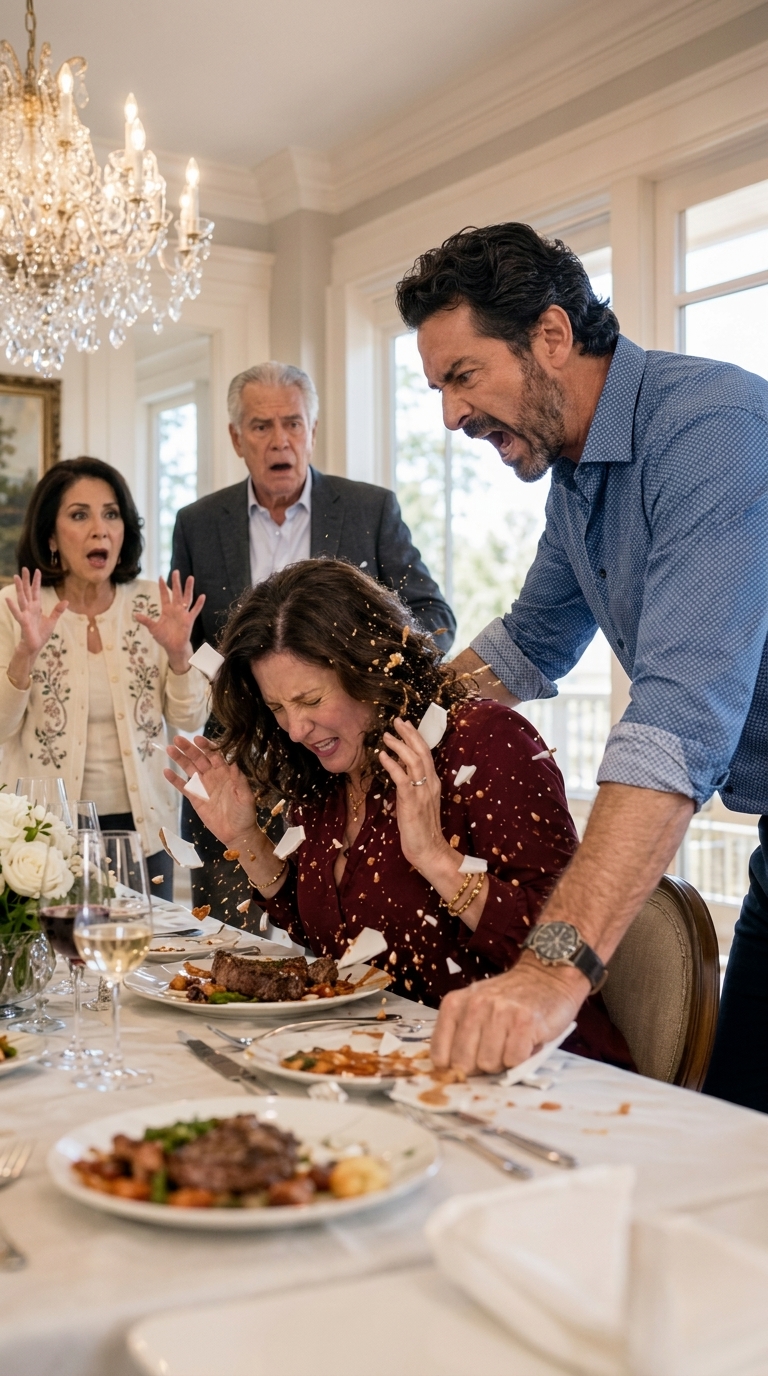
He grabbed the heavy plate in front of him and smashed it against the left side of Valeria’s head.
The impact sounded dry.
Then came the shattering of porcelain.
Blood began to trickle down her temple and stained her ivory blouse.
The table fell silent.
No one got up.
No one screamed.
No one said “enough.”
Only Mariana, Diego’s younger brother’s wife, pulled her two children away and tremblingly ushered them out of the dining room.
Valeria steadied herself with one hand on the table to avoid collapsing.
She saw Doña Victoria looking away.
She saw Don Ernesto feigning interest in his glass.
She saw Diego breathing heavily, convinced he had finally broken her.
But Valeria didn’t cry.
She slowly straightened up.
She pulled a piece of plate from her hair.
She wiped the blood with a white napkin.
She took her cell phone from her purse and dialed 911.
—My husband just assaulted me —she said in a firm voice—. He hit me in the head with a ceramic plate. There are plenty of adult witnesses. I need a patrol car and an ambulance.
Doña Victoria turned pale.
—Valeria, don’t exaggerate. It was an accident, dear.
Valeria stared at her.
—No, ma’am. It was domestic violence.
Diego took a step towards her.
—Hang up the phone.
Valeria didn’t blink.
—Take another step and I’ll tell the operator you’re coming towards me.
At that moment, the doorbell rang at the mansion.
And for the first time in years, the Salvatierra family understood that money wouldn’t save them.
PART 2
When the patrol car drove through the gate, the dining room no longer looked like an elegant dinner.
It resembled a crime scene that everyone was trying to disguise with folded napkins and crystal glasses.
Doña Victoria paced back and forth, saying it was a disgrace, that the neighbors would find out, that a decent woman solved family problems privately.
Valeria remained seated, one hand pressing against her wound and the phone in the other.
She wasn’t trembling.
That frustrated Diego even more.
Because he had expected tears.
He expected pleas.
He expected her to say “I’m sorry” like the family had taught her to do to keep the peace.
But that night, Valeria was no longer protecting anyone's peace.
Two police officers entered behind a paramedic.
The first looked at the blood, the broken plate pieces, the table full of witnesses, and then at Diego.
—Who did this?
No one spoke.
Not a single person.
The paramedic approached Valeria.
—Ma’am, I need to check the wound.
—Sure —Valeria replied—. But first, I want you to take pictures of everything. The broken plate, the blood, the table, and the witnesses present.
Diego let out a nervous laugh.
—So now you’re a lawyer?
Valeria looked at him coldly.
—No. But I spent six years designing buildings for prosecutors' offices, courthouses, and justice centers. I know exactly what evidence disappears when rich people start moving their contacts.
Don Ernesto lifted his head.
That phrase hit him.
Doña Victoria approached the officer with a soft voice, as if she were used to buying favors without saying it.
—Officer, my son got upset. It was a marital discussion. We are all good people here.
The officer glanced at the blood on Valeria's blouse.
—Good people don’t smash plates over anyone’s head, ma’am.
Mariana returned to the dining room.
She looked pale but held her phone in hand.
—I recorded part of the argument —she said.
Diego turned to her as if she had betrayed the nation.
—What did you say?
Mariana swallowed hard.
—I recorded it from when they started demanding the apartment from her. And you can also hear you yelling at her before throwing the plate.
Doña Victoria lost her composure.
—Shut up, you freeloader! You’re not even part of this family.
Mariana took a deep breath.
—Precisely for that reason, I can still tell the difference between a family and a pack of wolves.
The silence that followed was brutal.
Diego tried to approach, but the officer intervened.
—Sir, please come with me outside.
—You can’t take me out of my parents' house.
—I can if there’s a complaint of assault and risk to the victim.
Diego glared at Valeria with hatred.
—You’re going to ruin my life over a damned apartment.
Valeria slowly stood up, with the paramedic's help.
—No, Diego. You ruined your life by thinking my work belonged to you.
They took her to an ambulance.
While they cleaned the wound, Valeria received three stitches.
The paramedic told her she would need to go to the hospital to rule out a more serious injury and then file a formal complaint.
Valeria agreed.
But first, she asked for her bag.
From it, she pulled out a thin black folder with colored dividers.
Mariana, who had accompanied her outside, looked confused.
—What’s that?
Valeria closed her eyes for a second.
—What I didn’t want to use just yet.
Inside were copies of messages, bank statements, emails, and audio clips.
For months, Diego had pressured her to sell the apartment.
First with sweet words.
Then with pressure.
After that, with insults.
When Valeria began to suspect it was not just her mother-in-law's caprice, she reviewed documents, bank transactions, and conversations on a family computer that Diego had left open one night.
There, she discovered the truth.
Doña Victoria didn’t want to move because the stairs tired her.
The San Ángel house was mortgaged to the hilt.
Don Ernesto had used properties, jewelry, and even family accounts to cover gambling debts and fake businesses.
The mansion, the expensive wines, the artwork, and the elegant dinners were all a charade.
The Salvatierra family was broke.
And Valeria's apartment was the only clean property they could try to control.
Mariana covered her mouth.
—No way…
Valeria nodded.
—They wanted me to put it in Diego's name. Then they would ask for a loan using the apartment as collateral. Afterward, they would tell me it was for the good of the family.
Mariana looked down.
—My husband knew something. He told me not to get involved, that everything would be solved that night.
Valeria felt a different blow.
Not physical.
Deeper.
—Did everyone know?
Mariana cried silently.
—I don’t know if everyone, but several did.
At the hospital, Diego was presented to the Public Prosecutor's Office.
The complaint was filed for domestic violence, injuries, and threats.
Valeria requested protection measures.
She also asked to register that the assault occurred in front of witnesses who tried to cover it up.
When the Salvatierra family arrived at the Prosecutor's Office, they no longer had the elegant façade from the dining room.
Doña Victoria wore smudged makeup.
Don Ernesto spoke on the phone, searching for lawyers.
Diego kept insisting it was “a misunderstanding.”
But Mariana’s recording changed everything.
In the audio, Victoria’s voice could be heard saying:
—If she doesn’t yield today, tomorrow Diego will convince her his way.
Then Don Ernesto's voice:
—We can’t waste time. The bank has already given us a deadline.
And after that, Diego shouted:
—That apartment belongs to my wife, so it’s mine too!
Valeria listened to the recording without moving.
But inside, something broke.
It wasn’t just the blow.
It wasn’t just the blood.
It was discovering that they had sat her down for dinner like one sits a person before taking everything from them.
The investigation advanced quickly because Valeria provided complete evidence.
Messages where Diego told her that an “obedient” wife didn’t deny support to her mother-in-law.
Emails where Don Ernesto asked a manager how to put Valeria’s property into a family trust without her “understanding too much.”
Voice notes from Victoria calling her “that little architect” and saying that her son deserved a more docile woman.
But the twist came four days later.
Mariana called Valeria crying.
—You need to know something else.
They met at a small café in the Roma neighborhood.
Mariana brought a hidden USB inside a diaper bag.
She said she had taken it from her husband Rodrigo's computer, Diego’s younger brother.
Valeria plugged the drive into her laptop.
There was a folder with her name on it.
“VALERIA-APARTMENT.”
Inside were copies of her ID, pay stubs, bank statements, and a mortgage application already prepared.
But that wasn’t the worst of it.
There was also a forged signature.
Valeria’s.
They had tried to fast-track the process as if she had agreed to put her apartment up as collateral.
Valeria felt nauseous.
—This wasn’t a family dinner —she said.
Mariana shook her head.
—It was a trap.
Valeria took the USB to the Prosecutor's Office.
The case was no longer just about violence.
Now there was potential fraud, forgery of documents, and conspiracy among several family members.
When Diego’s attorney saw the file, he tried to negotiate.
They offered a public apology, to pay her medical expenses, and to “forget the matter” if Valeria withdrew the complaint and agreed to sign the divorce without asking for anything.
Valeria laughed for the first time since that night.
But it wasn’t a happy laugh.
It was a dry laugh.
—Tell them my silence is not for sale.
The divorce proceedings began two weeks later.
Diego arrived at the hearing in an expensive suit, wearing a victim's expression.
He attempted to say that Valeria was ambitious, cold, resentful.
That she had exaggerated a normal discussion.
That he had only reacted because she had disrespected his mother.
Then the judge asked to see the photographs.
The blood on the blouse.
The broken plate.
The audio.
The messages.
The folder of fraud.
Diego stopped speaking.
Doña Victoria, sitting behind, began to pray softly.
Valeria heard her.
And for the first time, she felt something akin to sadness for that woman.
Not pity.
Sadness.
Because Victoria had raised her children believing that loving family meant obeying it, covering it up, and sacrificing anyone who refused.
The judge issued clear measures.
Diego could not approach Valeria or communicate with her.
The apartment was protected as Valeria's exclusive property.
The Prosecutor's Office would continue investigating the assault and the forged documents.
Moreover, Mariana’s recording was admitted as evidence.
Upon leaving, Diego waited in the hallway, held back by his lawyer.
—Are you happy? —he said to Valeria—. You left me without a wife, without family, and without reputation.
Valeria paused.
She still had a small scar near her hairline.
She didn’t hide it.
—No, Diego. You lost everything when you confused marriage with ownership.
He lowered his gaze for a second.
It was minimal.
Almost invisible.
But Valeria saw it.
It wasn’t regret.
It was fear.
Because for the first time, someone had told him that his actions had consequences.
Months later, the San Ángel mansion was foreclosed.
The same relatives who had remained silent that night began to say they “never agreed with that.”
An aunt sought Valeria to beg her not to mention her name.
A cousin wrote to her, admiring her courage.
Don Ernesto tried to blame Victoria.
Victoria tried to blame Diego.
Diego tried to blame stress.
As always, everyone wanted to escape the broken plate.
But no one could wipe away the blood.
Mariana separated from Rodrigo after discovering he had also participated in the forgery.
Valeria helped her find a lawyer.
Not because Mariana was perfect.
But because she was the only one who stood between Diego and Valeria when everyone else looked away.
One Friday afternoon, Valeria returned to her apartment in Del Valle.
She opened the windows.
Took out the glasses Diego had chosen.
Removed the paintings that Victoria had always criticized.
She painted one wall a deep blue, even though her ex-mother-in-law said that color was “vulgar.”
Then she sat on the floor, holding a cup of coffee, watching the city move below.
That place was still hers.
But it no longer just represented effort.
It represented a boundary.
A line that no one would ever cross again.
Later, Valeria shared a photo of her renovated living room on Facebook.
She didn’t disclose all the details.
She just wrote:
“A house is not a home if to keep it you have to allow yourself to be broken. Sometimes the family that demands the most respect is the first that needs to learn boundaries.”
The post exploded.
Thousands of women commented with similar stories.
Some said they had also been asked for houses, salaries, land, inheritances.
Others defended the mothers-in-law, saying that a daughter-in-law should support her husband’s family.
And there was the debate.
How far does familial love go?
At what point does helping become allowing oneself to be used?
Valeria did not respond to everyone.
It was unnecessary.
Her answer was already in that small scar she didn’t cover, in the complaint she didn’t withdraw, and in the door of her apartment, which now had a new lock.
Because that night, Diego believed that by breaking a plate over her head, he would make her obey.
But all he shattered was the last fear she had.