PART 1
When Sergeant Julián Ríos arrived home in Guadalajara, his uniform still coated in dust and a small gift bag in his hand, his heart raced with one singular thought: to meet his newborn son and embrace Valeria, his wife.
But as soon as he crossed the threshold, the scent of wilted flowers hit him like a fist.
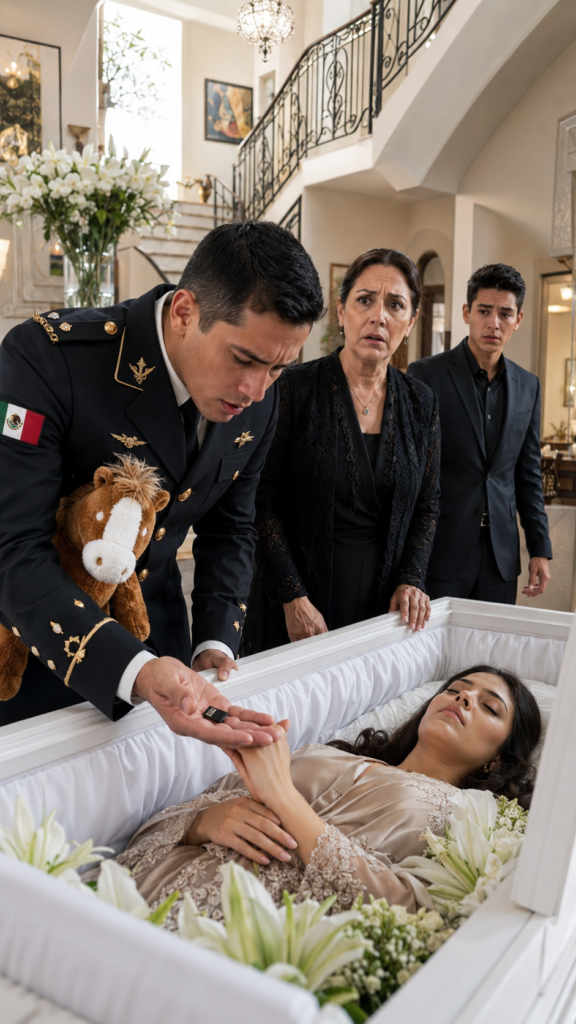
In the middle of the living room, there was a white coffin.
Julián froze.
The bag fell to the floor, and a small blue rattle rolled out, one he had bought at a roadside store.
His mother, Doña Amparo, stood by the coffin, dressed in black, her hair impeccably styled, a rosary clutched between her fingers.
She wasn’t crying.
She didn’t even look sad.
“Your wife died during childbirth,” she said with a coldness that froze the room—“And if you hadn’t run off to the Army, maybe she’d still be alive.”
Julián didn’t respond.
He gazed at the coffin, then at his younger brother, Bruno, who sat at the dining table, fixated on his cellphone, as if this were just another mundane errand.
“Where’s my son?” Julián asked, voice choked.
From upstairs, a faint cry echoed.
A cry so soft it sounded like it came from a worn-out baby.
“He’s alive,” Doña Amparo replied. “But not thanks to her. Valeria was stubborn, always making a scene.”
Julián walked toward the coffin.
Valeria lay there, dressed in a cream-colored gown, her hair neatly arranged, hands resting on her belly.
She looked too polished.
Too still.
Too prepared for a burial that nobody had informed her husband about.
Julián scrutinized every detail.
There were no hospital papers.
No medical bracelet.
No doctor, no nurse, no visible certificate.
Just haste.
So much haste.
“When are they burying her?” he asked.
“Tomorrow morning,” his mother said. “It’s all arranged.”
Julián felt something ignite within him.
He had spent years detecting lies in dangerous zones. He knew when a story was overly rehearsed.
And that whole room reeked of deceit.
Then he noticed Valeria’s right hand.
It was closed.
Tight in a fist, as if she had clutched something until her last breath.
“What’s in her hand?” he asked.
Doña Amparo stepped forward swiftly.
“Nothing. Let her rest.”
Bruno lifted his gaze sharply.
“Don’t start, Julián. You’re all worked up.”
Julián ignored them.
He carefully took his wife’s cold hand and began to pry her fingers apart.
Doña Amparo turned pale.
Bruno stood up from his chair.
And when the last finger gave way, something small fell into Julián’s palm.
A microSD memory card.
Black.
Almost invisible.
But enough for his mother to whisper, terrified:
“Don’t open that.”
From above, the baby cried again.
Weaker.
More desperate.
Julián tucked the memory card into his uniform pocket, looked at his mother as if seeing her for the first time, and climbed the stairs without asking for permission.
In the room, he found his son lying in a crib, wrapped in a gray blanket, lips chapped, a half-empty bottle resting on the dresser.
As he smelled him, Julián felt a punch in the gut.
He didn’t smell like milk.
He smelled of syrup, chemicals, something no newborn should ever taste.
Then Doña Amparo appeared in the doorway, speaking with a horrible calm:
“Come down, Julián. Before the burial, you need to sign some papers to put the child and the house in the right hands.”
Julián held his son against his chest.
And in that moment, he understood that what he was about to uncover couldn't fit into any nightmare.
PART 2
Julián locked the bedroom door.
Not because he thought a simple latch could stop his mother, but because he needed a few minutes to avoid doing something crazy.
The baby trembled against his chest.
He was small, fragile, with Valeria’s long lashes and a tiny hand clenched around the rough fabric of the uniform.
“Easy, champ,” Julián whispered. “Daddy’s home.”
On the dresser, the bottle remained.
Julián pulled a clean bag from his military backpack, stored the bottle, and sealed it. He didn’t know what they had given the boy, but something told him that this evidence could save him.
Then he glanced at the microSD memory card.
In one corner of the room was Valeria’s laptop. It had a sticker of a pink axolotl, the same one she had shown off during a video call while she was still pregnant.
Julián connected the memory with an adapter.
The screen took its time loading.
Outside, Doña Amparo knocked on the door.
“Julián, open up. Don’t make a scene. The people downstairs are waiting.”
He didn’t answer.
On the screen appeared a folder with a name that shattered his soul:
“FOR JULIÁN, IF SOMETHING HAPPENS TO ME.”
He opened it.
There were five files.
The first was a video.
Valeria appeared, sitting on the bed, her face pale and eyes swollen. She was alive, but scared.
“Julián, love... if you’re seeing this, it’s because I couldn’t explain everything to you in person.”
Julián stopped breathing.
Valeria glanced to the side, as if fearing someone would walk in.
“Your mom wants me to sign some documents. She says they’re to protect the baby while you’re away, but it’s not true. They’re papers to put the house in her name and to request temporary custody of our son.”
Julián clenched his jaw.
The house wasn’t Doña Amparo’s.
It belonged to Valeria.
Her grandmother had left it to her in Zapopan, and though it was simple, with yellow walls and a yard filled with bougainvilleas, it was the only real inheritance they had.
Valeria continued:
“Bruno owes money, Julián. A lot. I don’t know if they’re loan sharks, gambling debts, or what, but I overheard your mom say that if they sold the house, they could pay off and ‘start fresh.’”
Julián glanced at the door.
Bruno was downstairs, pretending everything was normal while his wife lay dead in the living room.
The video continued.
“I refused to sign. I told your mom that when you got back, we would decide together. Since then, she started treating me like I was crazy. She said a pregnant woman doesn’t think straight, that I was a gold digger, that the house should serve ‘the real family.’”
Valeria wiped her tears with her sleeve.
“I’m scared, Julián. I’m really scared.”
The video ended.
Julián felt the pain turn to fire.
He opened the second file.
It was an audio recording.
First, Bruno’s nervous voice came through.
“Mom, those guys gave me three days. If I don’t pay, they’re coming for me.”
Then Doña Amparo’s dry voice:
“Then stop shaking and help me. Valeria signs, we sell the house, and it’s over.”
“And if she doesn’t sign?”
There was silence.
Then Doña Amparo said:
“Everyone signs when they’re scared enough.”
Julián closed his eyes.
This wasn’t a discussion.
This was a plan.
He opened the third file.
They were photos of documents.
A custody application.
A letter stating that Julián suffered “emotional disturbances from military service” and was unfit to raise a newborn.
And at the end, a signature.
His signature.
Forged.
Not perfect, but close enough to deceive someone who didn’t know him.
There was also a private sale contract for the house, dated to be signed one day after the burial.
Julián understood the rush.
They wanted to bury Valeria quickly.
They wanted to declare him unstable.
They wanted to keep the baby.
And they wanted to sell the house before anyone asked questions.
The fourth file was another video.
Valeria was in the baby’s room, breathing heavily, a hand over her belly.
“Julián, if I don’t come back from the hospital, find Dr. Mireles. She examined me at the public clinic and said my pregnancy was going well. Your mom insists on taking me to a private doctor in Tlaquepaque, but I don’t trust him.”
The image shifted.
Valeria lowered her voice.
“Today I saw Bruno with a jar. He said it was to make the baby sleep when he was born because ‘a whiny baby ruins everything.’ It disgusted me. I told him that if he touched my child, I’d report him.”
Julián turned to the crib.
His son slept in fits, with a weary expression that wasn’t normal.
The last file was a short audio.
Valeria could be heard crying.
“Doña Amparo, please call an ambulance. I’m in so much pain. I’m bleeding.”
Then his mother’s voice:
“First, you sign.”
“I can’t even get up!”
“Of course you can. Don’t be dramatic.”
Valeria screamed in pain.
Bruno murmured:
“Mom, let’s go to the hospital.”
And Doña Amparo replied:
“If we leave without papers, this woman will leave us on the street.”
The audio ended.
Julián stood still.
He didn’t shout.
He didn’t pound the wall.
He didn’t cry.
He just took his phone, copied the files, sent them to a secure email, and called 911.
“My wife died after giving birth under suspicious circumstances,” he said firmly. “I have evidence of pressure, forged documents, and a possibly medicated newborn. I need police, an ambulance, and forensic experts. Don’t let them move the body.”
When he hung up, he opened the door.
Doña Amparo was on the other side, her face hard.
Bruno stood behind her, pale and sweating.
“What did you see?” his mother asked.
Julián stared at her without blinking.
“Enough.”
She tried to enter the room.
“Give me the baby. You’re not well.”
Julián stepped forward.
“Don’t come near my son.”
Doña Amparo let out a dry laugh.
“Your son? You weren’t even there when he was born.”
“And Valeria died because you were.”
The phrase fell like a stone.
Bruno put his hands on his head.
“I didn’t want this to happen,” he said, crying. “I just needed time.”
Doña Amparo turned furiously.
“Shut up, useless!”
But Bruno could no longer stay quiet.
“Valeria asked for help. She begged you. She was bleeding in the bathroom, and you kept pushing her papers. You told her that if she truly loved the child, she should sign before she died.”
Julián felt the world shatter.
Doña Amparo slapped Bruno.
“I did everything for you.”
“No,” Bruno replied, broken. “You did it because you always wanted that house.”
At that moment, sirens could be heard.
Doña Amparo changed color.
For the first time, she was out of control.
She tried to run downstairs, but Julián followed her with the baby in his arms.
Below, the few neighbors who had come to the supposed wake looked confused.
Some had noticed the tension.
Others just murmured.
When the police and paramedics entered, Doña Amparo began to scream that her son was traumatized by the war, that he didn’t know what he was saying, that Valeria was an unstable woman.
But Julián showed the files.
He showed the sealed bottle.
He showed the forged documents.
And he showed the memory card Valeria had hidden in her dead hand.
An officer requested that nobody touch the coffin.
The paramedics checked the baby, and upon smelling the bottle, one of them changed his expression.
“We need to transport him right away,” he said. “This doesn’t seem like formula.”
Julián climbed into the ambulance with his son.
Doña Amparo tried to follow them.
The officer stopped her.
“You stay here.”
“I’m his grandmother!”
“For now, you’re a person of interest in an investigation.”
Doña Amparo’s scream echoed into the street.
But this time, no one rushed to obey her.
In the civil hospital, the baby was examined for hours.
Julián paced back and forth, still wearing his dusty boots, his face that of a man who had come home expecting life and found a grave.
Near dawn, a pediatrician emerged.
“Your son is stable,” she said. “He had traces of a sedative in a low but dangerous amount for a newborn. If they had continued giving it to him, it could have been fatal.”
Julián covered his face.
For the first time, he cried.
Not as a soldier.
Not as a son.
He cried as a father who had just understood that he was on the verge of losing the only thing he had left.
“Is he going to be okay?” he asked.
“Yes,” the doctor replied. “He arrived just in time.”
Those three words brought him to his knees.
Just in time.
For his son, yes.
For Valeria, no.
Days later, the Prosecutor’s Office opened a formal case.
The private clinic where they had taken Valeria had expired permits and altered records. The supposed doctor was not a specialist in obstetrics.
The autopsy confirmed that Valeria had suffered a postpartum hemorrhage and could have survived if she had been transferred in time.
They also found signs that someone had wanted to hasten the burial to avoid questions.
Bruno testified.
He said his mother had pressured him to forge signatures, hide documents, and convince Valeria.
He confessed that he had brought the jar into the room, although he insisted that Doña Amparo told him it was only “to calm the baby.”
His testimony didn’t make him innocent.
But it helped to uncover the truth.
Doña Amparo was arrested two weeks later.
When Julián saw her being led away in handcuffs, she didn’t cry.
She just glared at him with rage.
“Ungrateful,” she said. “I tried to save this family.”
Julián held his son against his chest.
The baby slept peacefully, no longer trembling.
“You saved no one,” he replied. “You destroyed Valeria for a house.”
Doña Amparo pressed her lips together.
For a second, it seemed she would say something more.
But she said nothing.
Maybe because, for the first time, she didn’t have a lie prepared.
Julián never returned to live in that house.
Though legally it belonged to his son, he couldn’t sleep under the roof where Valeria had cried for help and no one listened.
He rented a small apartment near Chapalita.
It had a tiny kitchen, a window facing the street, and a crib next to his bed.
It wasn’t the home Valeria had imagined.
But it was safe.
And that was enough.
He named the baby what she had chosen: Mateo.
Every night, Julián told him about his mom.
He recounted how Valeria sang while making coffee, how she laughed when it rained, how she bought little white shoes because she dreamed of seeing him walk towards his dad.
He also told him she was brave.
That even when everyone tried to silence her, she left behind evidence.
A memory.
A truth.
A way to keep protecting him even after death.
Months later, when Julián took Mateo to the cemetery, he placed white flowers on Valeria’s grave.
The baby already held tightly onto the small blue rattle that had fallen to the ground that terrible day.
Julián knelt before the headstone.
“You did it, Vale,” he whispered. “You saved us.”
The wind stirred the flowers.
Mateo let out a soft giggle, as if responding for her.
And Julián understood something that left him trembling.
Sometimes family isn’t who shares your blood.
Sometimes family is who protects you when everyone else wants to bury you alive.
And in Mexico, where many still say “a mother is always right,” this story left a burning question in all who heard it:
How far can a mother go when she confuses love with control?





