PART 1
Rafael Montes returned to Mexico after five years working in Saudi Arabia, his skin burnt by the sun, two suitcases packed with gifts, and a hope that ached in his chest.
The taxi dropped him off in front of his house in Lomas Verdes, Naucalpan, a little after 9 PM. It was a big house, with a black gate, a spacious garden, and tall windows. Every brick had been paid for by him, sending money from a camp where he slept with other workers and dined on cheap rice to save up more.
He brought new sneakers for his two kids, chocolates, clothes for his wife Lucía, and a simple gold chain he bought at the airport.
He hadn’t mentioned he was coming back.
He wanted to see their faces when they opened the door.
But before he could ring the bell, something tightened in his stomach.
Inside the house, there was loud music, laughter, shouting, the smell of grilled meat, clinking bottles, and bright lights as if it were a wedding. Outside, two luxury SUVs were parked, and a young man was arranging cars like a valet.
Rafael frowned.
His mother, Doña Amparo, had told him over the phone for years that everything was fine.
—Don’t worry, son. I’m taking care of Lucía and the kids. Your wife is good but completely useless at managing. Leave it to me.
And Rafael believed her.
Because she was his mother.
Every month he sent money for food, tuition, medicine, clothes, bills, home repairs, and savings for emergencies. Doña Amparo always repeated that a mother could scold, but would never steal from her own child.
Then he heard a cough.
It didn’t come from the party.
It came from the backyard.
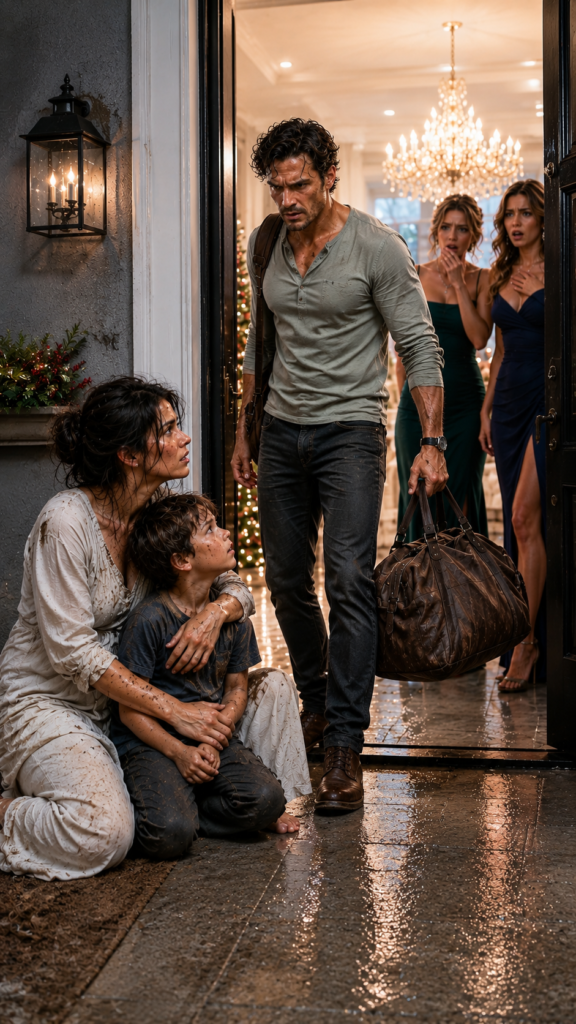
Rafael left a suitcase by the gate and walked down the side path. Upon reaching the back, he froze.
Under an old tarp, next to the trash cans, Lucía sat on a broken bench, stirring a small pot over a rusty grill. She looked gaunt, her lips dry, and her hair tied back carelessly.
Beside her, their youngest son held a cup of chard soup. Their eldest daughter stared at the pot as if she had already learned to be hungry in silence.
The girl looked up.
—Dad?
Rafael felt something break inside him.
The suitcases fell to the ground. The two kids ran towards him, barefoot, dressed in old, loose, and faded clothes. Rafael knelt down, hugging them so tightly he could hardly breathe.
He felt their small ribs.
He smelled smoke, dampness, and hunger.
—My God… what have they done to you?
Lucía tried to stand, but her legs failed her.
—Rafa…
He looked at the pot. There were only boiled chard with salt. In one corner, a nearly empty bag of rice was tied with a rubber band.
—Where’s all the money I sent?
Lucía looked down.
—Your mom said this house was hers. That I couldn’t enter through the living room. That your kids and I were a burden. That if I told you anything, you would believe her and leave us on the street.
From inside, a loud laugh echoed.
—Open another bottle! —shouted Brenda, Rafael’s sister—. While my little brother is slaving away with the Arabs, here we’re living it up!
Rafael stood frozen.
He approached the kitchen window and looked inside.
Doña Amparo sat in the main armchair, wearing a sparkly dress, new jewelry, and holding a glass. Brenda was dancing with two men in front of a table piled high with ribeye steaks, shrimp, imported bottles, designer bags, and wads of cash.
On the wall, where Rafael and Lucía’s wedding photo used to hang, now there was a huge portrait of Doña Amparo, as if that house were her palace.
Lucía squeezed his arm.
—Don’t go in like that. She’s going to cry. She’ll say I filled your head.
Rafael looked at his kids hiding behind his legs. Then he glanced at the front door of the house he had paid for while his family ate next to the garbage.
—I’m not going to shout.
He said it so calmly that Lucía felt fear.
Rafael picked up a suitcase, walked to the entrance, and rang the bell.
The music lowered.
Brenda opened the door, a glass in hand. When she saw him, her smile vanished.
—Rafael…
He stepped inside slowly.
—Surprise.
Doña Amparo jumped up so fast she spilled wine on the carpet.
—Son… why didn’t you notify me?
Behind him, Lucía and the kids appeared, skinny, barefoot, trembling.
Doña Amparo looked at them, then at the guests.
—Oh, Lucía, don’t start with your dramas. Always playing the victim.
Rafael surveyed the food, the bottles, the jewelry, the bags, the giant screen, and his mother’s portrait.
There were five years of his life turned into a party for those who had left his children hungry.
—Mom —he said quietly—, tomorrow we’re going to talk about everything.
Brenda let out a nervous laugh.
—Talk about what? You should be grateful. We took care of the house while you were away.
Rafael stared at her unblinking.
—Yes. I’ll thank you the way you deserve.
And in that instant, Doña Amparo understood that the obedient son she had sent away to work had not returned.
PART 2
That night, Rafael didn’t sleep in his house.
He took Lucía and the kids out through the front door, in front of the guests who fell silent, their plates half-served and glasses in hand. He didn’t throw anything. He didn’t insult anyone. He didn’t put on the show everyone expected.
He just carried his son, held his daughter’s hand, and told Lucía:
—Walk straight. No one is going to take you out the back again.
He took them to a simple hotel in Satélite.
When the waiter set hot soup, rice, chicken, beans, and tortillas on the table, the kids didn’t rush to eat. They looked first at their mom, then at their dad, as if they needed permission to feel hunger.
The boy quietly asked for another roll.
Rafael ordered a whole basket.
Lucía cried without touching her glass of water.
—I’m sorry. I tried to tell you many times. Your mom broke two of my phones. Then she told me that if you worried, you would stop sending money, and then the kids would starve.
Rafael clenched his jaw.
He didn’t cry, but his eyes turned red.
He pulled out an old phone from his backpack, the screen cracked, and opened a protected folder. There he had receipts, transfers, emails, screenshots, and audios. There were also blurry photos Lucía had managed to send from a neighbor’s phone.
In one photo, his daughter slept on cardboard next to the patio heater.
In another, his son had a fever, wrapped in a dirty blanket.
In another, Lucía washed clothes in buckets while in the background, the well-lit pool where Doña Amparo held parties with music and whiskey was visible.
Rafael hadn’t returned just with gifts.
He came back with a lawyer, a forensic accountant, and a prepared complaint.
For the past four months, he had begun to suspect. A transfer for medicine appeared spent at a jewelry store in Polanco. The tuition payment never reached the school. And a photo Lucía managed to send, before they took her phone, confirmed what his heart didn’t want to accept.
Before going to Saudi Arabia, Rafael had left the house deeded in his name. Doña Amparo only had limited authorization to pay bills and manage family expenses. She was never the owner. She had never had the right to take Lucía out. She had never had the right to decide if the kids could sleep under a roof.
At 7:30 AM, the lawyer arrived at the hotel with a thick folder. With him were two investigators, a municipal DIF worker, and a bank representative.
Lucía turned pale.
—Are they coming for me?
Rafael took her hand.
—No. They’re coming for what they did to you.
When they arrived at the house, the gate was still closed. There were glasses strewn in the garden, cigarette ash in the pots, and a speaker playing a party song at a low volume.
Doña Amparo opened the door in silk pajamas, dark glasses, and a face full of anger.
—What is this nonsense, Rafael?
He didn’t raise his voice.
—The last nonsense you do in my house.
The lawyer handed her the notification. Misappropriation of money intended for maintenance. Property fraud. Domestic violence. Child abuse. Illegal expulsion of the wife from the home. Misuse of credit cards and bank documents.
Doña Amparo let out a dry laugh.
—Don’t be ridiculous. I’m his mother. Everything this boy has passed through my hands. I made him a man.
The DIF worker walked to the backyard.
Upon seeing the tarp, the damp mattresses, the plastic cups, the children’s blanket next to the trash cans, and the school uniforms hanging by the sink, she covered her mouth.
Brenda came down the stairs with a designer bag hanging from her arm.
—Rafa, you’re really messed up. Are you going to expose your own family in front of the neighbors?
And yes, the neighbors were watching.
For years they had heard shouting. They had seen Lucía enter through the side hallway with borrowed groceries. They had seen the kids asking for water through the gate while inside there was meat, cake, and music.
But no one had dared to confront Doña Amparo.
Until Doña Chela, a neighbor from the corner, raised her voice from the sidewalk.
—I saw when that lady pushed Lucía with a broom to keep her from entering the kitchen.
Doña Amparo turned furious.
—Nosy old hag!
Then a gardener she had fired a year earlier spoke up.
—I was fired for giving sandwiches to the kids. She told me that if I wanted to feed animals, I should go to the zoo.
Brenda turned white.
Then a girl from the stationery store spoke.
—the girl was going to ask for paper on credit. She told me her grandmother didn’t give her money because her dad didn’t love her anymore.
Rafael closed his eyes.
Each testimony fell on him like a stone.
The lawyer opened a second folder on the living room table. There were the account statements: cash withdrawals on the same day Rafael sent money for food; purchases at jewelry stores on the day he sent for medicine; expensive dinners charged to the card meant for groceries; trips to Cancun, cosmetic surgeries, bags, watches, and bottles.
Brenda tried to snatch the papers.
An agent grabbed her wrist.
—Miss, don’t touch evidence.
Doña Amparo’s expression changed in one second. The queen of the house vanished, and the offended mother appeared, with ready tears.
—Son, please. Don’t allow this. I gave birth to you. I sacrificed for you.
Rafael looked at Lucía, who was holding the kids as if she still feared someone would shove her out.
—And you almost destroyed those I love most.
The bank representative informed them that the linked accounts would be blocked. Clarifications would also begin for unjustified withdrawals and unauthorized use of cards.
Brenda started shouting that this was abuse.
The lawyer looked at her.
—Abuse was buying a bag for 80,000 pesos with money earmarked for food for two minors.
The living room fell silent.
But the hardest blow came when Rafael pointed to a closed door at the end of the hallway.
—Open that room.
Doña Amparo stood up desperately.
—Not that room! I keep personal things there.
Rafael looked at her intently.
—You keep what you didn’t want me to see.
A locksmith opened the door in front of everyone.
Inside were stacked boxes, envelopes with cash, cards in Rafael’s name, jewelry with tags, bank documents, and a red folder with “Lucía” written in black marker.
The lawyer put on gloves and opened it.
Inside were copies of IDs, printed messages, torn sheets from a notebook, and a false declaration where Lucía supposedly accepted having abandoned the house and left her children in Doña Amparo’s care.
At the end was a forged signature.
Lucía covered her mouth.
—Was she going to say I abandoned my children?
Doña Amparo lost control.
—It was to protect the property! That woman was going to take everything from you! She had you bewitched, Rafael!
Lucía stepped forward for the first time.
Her voice was broken but firm.
—I never wanted to take anything. I just wanted a key to bathe my kids inside.
No one responded.
Neither the agents.
Nor the neighbors.
Nor Brenda.
The phrase hung in the air like a shame that couldn’t be cleaned up with all the stolen money.
The DIF worker documented the conditions of the patio, requested urgent psychological attention for the children, and recorded that Lucía had suffered property, psychological, and domestic violence.
The agents took Doña Amparo and Brenda away to testify.
At the gate, there were no applause.
No one celebrated.
There was too much guilt in the air because many had eaten fine meat and drunk whiskey in a house where two children slept next to the trash.
In the following days, Rafael didn’t allow Lucía or the kids to sleep in the patio again. He hired locksmiths, changed cameras, canceled access, and reviewed every document of the house.
He also fired employees who had obeyed cruel orders out of fear, comfort, or convenience.
The forensic accountant discovered that, in five years, Doña Amparo had embezzled enough money to pay the kids’ tuition through high school. He also found frequent deposits to Brenda’s account.
When Rafael confronted her in front of the lawyer, Brenda stopped crying.
—And what did you want? —she spat with rage—. You sent money as if you were a millionaire. Mom said Lucía was going to leave you poor. We’re family too.
Rafael felt a sadness heavier than anger.
—No. You are my blood. My family was the one eating chard behind the garbage cans.
Brenda looked down.
For the first time, she had no answer.
The house changed abruptly.
The music stopped.
The barbecues ended.
The expensive bottles disappeared.
The huge portrait of Doña Amparo in the living room was gone.
When Lucía officially returned, she stood in front of the front door. Her hands trembled.
Rafael didn’t pressure her.
—You can come in now.
She shook her head.
—My body still thinks someone is going to yell at me.
Rafael swallowed hard.
—Then we’ll wait until your body understands that no one is going to rule over you here again.
The girl took her mom’s hand.
—Can we finally sleep in the upstairs rooms now?
Lucía broke down.
That question hurt more than any insult.
Rafael knelt in front of his kids.
—You’re going to sleep in beds. You’re going to eat at the table. You’re going to bathe in the inside bathroom. You’re going to go back to school. And no one, ever again, is going to tell you that you’re a burden.
The boy touched his father’s beard with his skinny fingers.
—Are you going to leave again?
Rafael felt his throat close.
—No. Now I’m staying.
They entered slowly.
Lucía looked at the living room as if she were stepping into a forbidden place. Her eyes went straight to the wall where Doña Amparo’s portrait used to hang.
Rafael took it down without saying a word.
Behind it was a rectangular mark, lighter than the wall paint. That’s where their wedding photo had been.
The girl ran to one of the suitcases and pulled out a battered frame. In the picture, Lucía smiled in a simple dress, and Rafael looked at her as if the world began with her.
—This goes there —the girl said.
Rafael hung the photo.
Lucía sat on the sofa and cried. She didn’t cry like someone humiliated. She cried like someone who could finally collapse without asking for permission.
The following months were slow but real.
The party terrace became a space for the kids to study and play. The locked room turned into a workshop for Lucía, who started by mending clothes for neighbors and then began receiving orders for dresses for birthdays and graduations.
The room where Brenda stored bags became the siblings’ room, with two beds, new lamps, and a shelf full of stories.
The girl returned to school.
At first, she hid bread in her backpack. Her teacher notified carefully.
That night, Rafael placed fruit, milk, rice with chicken, beans, and sweet bread on the table.
—Here, food isn’t hidden —he said softly—. Here, food is shared.
The boy began to gain weight. He also started laughing louder. He ran around the garden as if each lap returned him a piece of the childhood that had been stolen from him.
After six months, the initial resolution arrived.
Doña Amparo and Brenda lost control of the accounts, their assets were blocked, and they faced prosecution for fraud, domestic violence, and child abuse. Many relatives who had previously posted photos at parties suddenly disappeared.
No one wanted to accept that they had toasted in a house where two children slept cold.
One Sunday afternoon, Rafael found Lucía in the garden. She wore the simple chain he had brought from the airport.
The kids played in clean uniforms and new shoes.
—I thought you’d never come back —she said.
Rafael looked at his hands marked by work. Then he looked at the house, now calm, without shouting, without fear, without forbidden doors.
—I thought I was building a home for you. But I was feeding those who wanted to erase you.
Lucía rested her head on his shoulder.
—Is it ours now?
Rafael nodded.
—Now it belongs to those who suffered to deserve peace.





