PART 1
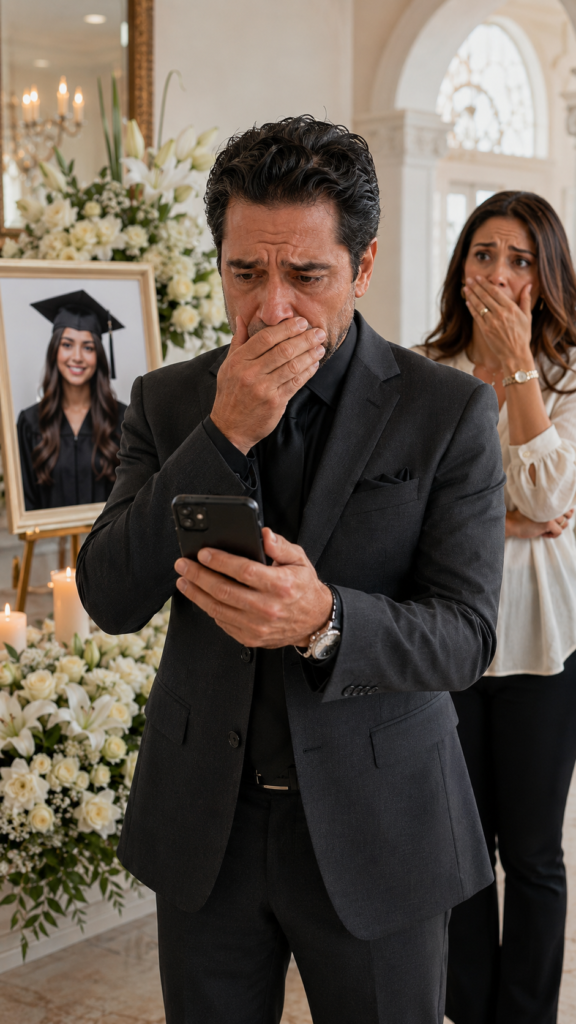
In the midst of the mass marking the second anniversary of Natalia's death, Esteban Cárdenas felt his phone vibrate inside his black jacket.
He had no intention of answering anything.
That day, in the private chapel of his home in San Pedro Garza García, everyone pretended to keep silent for his daughter. But the true pain wasn’t in the white flowers or the expensive arrangements his wife had brought from Mexico City.
It was in Esteban's chest, squeezing him like a stone.
Natalia had died at 19 in a car accident on the road to Cuernavaca.
That’s what the papers said.
That’s what the death certificate said.
That’s what the urn Mónica, his second wife, kept in a lit display case suggested, as if mourning were also a part of decoration.
But when Esteban looked at the screen, the world slipped from his grasp.
The message came from Natalia’s old number.
"Dad, if you still have a little love left for me, I graduate tomorrow. Don’t be late again."
Esteban froze.
The priest praying continued speaking, but Esteban heard nothing. He only saw those words, over and over, as if a dead girl had opened the earth to reclaim him.
Mónica leaned toward him with a tense smile.
—What happened, my love?
Esteban showed her the phone.
Mónica’s face changed in just one second. It was quick, but not quick enough.
—This is a scam —she whispered—. Someone knows you’re sensitive today and wants to take your money.
Darío, Mónica’s son, immediately stood up. Ever since Esteban had appointed him as the administrative director of Grupo Cárdenas, he walked as if the company already belonged to him.
—Give me the phone, Esteban. I’ll handle it with digital security.
But Esteban pressed the phone against his chest.
—Nobody touches this.
Darío extended his hand.
—Don’t be stubborn. Natalia is dead.
That name, said so hurriedly and with annoyance, hit him harder than a slap.
—I never saw her body —said Esteban.
Silence fell over the family like a tombstone.
Mónica turned pale.
—Because she was unrecognizable. You yourself accepted the closed coffin.
—No. You told me not to open it.
At that moment, another notification arrived.
It was a blurry photo. A young woman from behind, in a black gown, standing in front of a university building. On her left wrist was a silver bracelet with a tiny star.
The same bracelet Esteban had given to Natalia when she turned 15.
Mónica tried to take the phone from him.
Esteban stepped back.
—Don’t ever try to take my daughter from me again.
She opened her mouth but found no words.
That early morning, while the house slept, Esteban bought the first flight to Mexico City. Before leaving, he called Clara Beltrán, the lawyer who had been a friend of his first wife.
When Mónica found the empty bed, Darío was at the door, waiting for answers.
—Why are you so scared of me going? —he asked.
Mónica looked towards the chapel, where the urn continued to shine.
—Because there are dead people who need to stay dead, dude… otherwise, we all sink.
PART 2
Esteban arrived in Mexico City with a wrinkled shirt, red eyes, and a guilt heavier than his suitcase.
The graduation was at 6 PM at Ciudad Universitaria, but he was there since 4:30, walking like a man who didn't know if he was going to find a miracle or a cruel mockery.
Clara Beltrán accompanied him with a blue folder under her arm.
She had done some research that morning. On the list of law graduates, there was a young woman named Abril Montes. She was 21, had an incomplete school history before arriving at UNAM, and no family registered as an emergency contact.
But in the ID photo, there was something impossible to erase.
Natalia’s eyes.
—Don’t run towards her —Clara warned—. If she’s your daughter, she could also be a victim. And victims don’t always embrace the first one who arrives late.
Esteban didn’t reply.
Because that phrase hurt him with all its justice.
When they announced the name Abril Montes, the auditorium erupted in applause.
The young woman climbed the stage in a black gown. She had shorter hair, a fine scar near her lip, and a different way of walking, more serious, as if life had taught her not to ask for permission to survive.
Esteban stood up without realizing it.
She received her diploma.
Then she turned.
Her eyes met his.
She didn’t scream.
She didn’t run.
She didn’t cry.
She only looked at him as one looks at someone who buried your name without making sure you were dead.
Esteban felt his knees buckle.
—It’s Natalia —he murmured—. Really, it’s my daughter.
Clara took him by the arm.
—Then we have to prove it before they destroy her.
After the ceremony, Esteban tried to approach.
—Natalia…
The young woman paused for just one second but didn’t turn around.
An older professor stood beside her in a protective manner. Esteban understood the message and stayed still. For the first time in his life, his money, his last name, and his pain gave him no right to enter.
Meanwhile, in Monterrey, Mónica was locked in her bedroom.
She took an old cellphone from a shoebox and called Dr. Ignacio Rivas, the former administrator of Hospital Santa Amalia, where Natalia had been taken the night of the accident.
—Esteban saw her —Mónica said without greeting.
There was silence on the other end.
—That wasn’t part of the agreement.
—Well, someone opened their mouth.
—After 2 years, there’s nothing left to move.
Mónica let out a dry laugh.
—There’s always something to move when someone paid to bury it.
Darío listened from the hallway.
He didn’t catch everything, but enough for his stomach to churn.
His mother didn’t sound like a worried widow.
She sounded like a woman guarding a crime.
That night, Esteban stayed at a small hotel in the Roma neighborhood. He didn’t answer Mónica’s 31 calls or Darío’s furious messages.
At 11:18, Clara arrived with new documents.
—I found a significant irregularity.
Esteban stood up.
—Tell me.
—The night of the accident, two young women were admitted to Hospital Santa Amalia. One was in critical condition, nearly without signs. The other had facial injuries, mild cranial trauma, and partial memory loss, but was stable.
Esteban lost his breath.
—Which one was Natalia?
Clara left the folder on the table.
—In the first 48 hours, the stable patient had no name. Later, she was registered as Abril Montes.
—And the other?
Clara lowered her voice.
—The patient who died was registered as Natalia Cárdenas.
Esteban put both hands to his head.
Not only had they robbed him of his living daughter.
They had also buried another girl under the name of Natalia.
The next morning, Abril agreed to meet him in a small church in Coyoacán. Not in an office. Not in a restaurant. Not in a luxury home.
She wanted a place where no one could buy the walls.
Esteban entered alone.
She was sitting in the third pew, wearing a white blouse, dark pants, and the star bracelet on her wrist.
—Natalia —he said, almost voiceless.
She didn’t move.
—Don’t use that name as if you took care of it.
Esteban sat far away, as if any closeness could shatter her.
—I didn’t know.
Abril let out a bitter laugh.
—You never knew. You didn’t know that Mónica told me that my dead mom couldn’t defend me anymore. You didn’t know that Darío called me a nuisance. You didn’t know I got accepted into law because you never opened the letter. You didn’t know I called you three times before the accident.
Esteban closed his eyes.
—Did you call me?
—Yes. I wanted to come home. I wanted to ask you to listen to me. Your assistant said you were in a meeting and couldn’t attend to tantrums.
The word “tantrums” pierced through him.
That night, Mónica had entered the conference room crying. She told him Natalia was dead. He didn’t ask more. Didn’t request videos. Didn’t check calls. Didn’t open the coffin.
He preferred to believe the papers because the papers didn’t accuse him.
—I woke up not remembering my name well —she continued—. A nurse told me that if I wanted to live, I had to stay quiet. Then a social worker arrived with new documents. They told me I was Abril Montes. That I had no family. That some powerful people could harm me.
—Who paid for everything?
She finally looked at him.
—The woman who prayed next to you for my death.
Outside the church, Clara met with a former nurse named Teresa. The woman arrived trembling, with a manila envelope pressed to her chest.
—I didn’t make the switch —she said—, but I saw it.
Inside were copies of shifts, incomplete notes, and an almost erased file: “Mariana López, 23 years old, no relatives present.”
That was the name of the girl buried as Natalia.
Mariana López.
A girl from Ecatepec who had come to the city looking for work and ended up turned into someone else’s corpse because no powerful person was looking for her.
When Abril read the name, she didn’t cry immediately.
She just tightened the bracelet.
—So they didn’t just steal me.
Esteban wanted to touch her shoulder but stopped.
—I’m going to fix this.
She lifted her gaze.
—With money?
He remained silent.
—Your money came too late, Dad. And when it arrives late, it also hurts.
The word “Dad” didn’t sound like forgiveness.
It sounded like an open wound.
Hours later, Mónica called a press conference at a hotel in Polanco. She said that a young opportunist was trying to take advantage of Esteban Cárdenas’s pain to ask for money and tarnish Natalia’s memory.
She arrived dressed in white, with perfect tears and a huge photo of Natalia behind her.
—My husband is vulnerable —she said before the cameras—. This woman is not my stepdaughter. She’s an impostor.
Then the doors of the hall opened.
Abril entered first.
Clara walked beside her with the blue folder.
Esteban followed behind, without bodyguards, without arrogance, with the face of a man to whom the truth had demanded everything.
The reporters stood up.
Mónica froze.
—Esteban, you shouldn’t be here.
He didn’t look at her.
Abril took the microphone.
—For two years, I was forced to live as Abril Montes because for certain people, Natalia Cárdenas was more useful dead than alive.
The hall exploded with questions.
Mónica slammed the table.
—Lies!
Clara connected her computer to the screen.
A timeline appeared: accident, admission of two patients, identity change, death certificate, discreet discharge, payments to a medical consultancy without a contract.
Then the bracelet appeared.
—This object was registered to the stable patient —Clara explained—. Then it disappeared from the file.
Esteban spoke with a broken voice.
—I gave that bracelet to my daughter when she turned 15.
Mónica tried to smile.
—That doesn’t prove anything.
Then Darío entered.
His eyes were red, and he had a folder in his hands.
—Maybe this does.
Mónica paled.
—Darío, shut up.
But he kept walking.
—My mother told me for years that Natalia wanted to take everything from us. That I would never be worth anything next to the blood daughter. I believed her. But I’m not going to inherit a lie.
He delivered messages, transfers, and emails where Mónica spoke of “eliminating the succession risk” and “closing the original heir definitively.”
The motive became clear.
Esteban’s first wife had left shares of the group in Natalia’s name when she turned 21. If Natalia lived, Mónica and Darío lost control. If Natalia died, everything could be moved.
Mónica lost her mask.
—I just wanted to secure a place for my son!
Abril replied without shouting:
—you took mine to build his.
The silence was brutal.
Esteban took the microphone.
—I publicly recognize Natalia Cárdenas Robles as my daughter. I also acknowledge that Mariana López was buried under a name that wasn’t hers. My family must answer for both.
That phrase spread across networks in minutes.
Mónica faced investigations for document alteration, improper payments, and defamation. The hospital was intervened. Dr. Rivas tried to disappear, but the transfers caught up with him. Darío provided evidence, even if it would sink him too.
Natalia didn’t return to the mansion.
Esteban offered her security, a home, a driver, everything.
She only said:
—Do you still think caring is buying things?
He lowered his head.
—I’m learning.
And he learned to wait.
He waited for messages that wouldn’t come.
He waited for permissions he never asked for before.
He waited without demanding hugs, without buying forgiveness, without turning his guilt into a spectacle.
Months later, Mariana López had a face. Her younger sister, Alma, received the truth in a simple office, without cameras or important last names.
Natalia was there.
Esteban too, but he didn’t speak first.
Alma cried, hugging a worn photo of Mariana. Then Esteban understood something that tore him apart inside: his tragedy became news because he was rich; Mariana’s had been ignored because she was poor.
Natalia demanded to create a fund in Mariana’s name to support families searching for the disappeared and to verify identities in hospitals.
—Without your photos handing out checks —she warned.
Esteban nodded.
—As you say.
Almost a year later, Natalia presented a paper at UNAM on identity and justice for missing persons.
Esteban arrived 30 minutes early.
He didn’t sit in the front row until she looked at him and pointed to an empty chair.
Throughout the presentation, he didn’t check his phone even once.
At the end, Natalia spoke about the right to have a name, a story, and someone who doesn’t arrive late to find you.
Esteban applauded standing, crying silently.
In the hallway, she approached him.
—You arrived early.
He smiled sadly.
—I’m practicing.
Natalia looked at the white flowers he held in his hand.
—Are they for me?
—For you and for Mariana.
She took one flower and fell silent.
Then she walked towards the exit. Esteban stayed a step behind, without invading, without asking for forgiveness as if that would force healing.
Near the door, Natalia stopped.
—I still don’t know if I can forgive you for everything.
He replied:
—I still don’t deserve everything.
She looked at him with tears in her eyes.
—but you can walk with me to the outside, Dad.
And Esteban walked beside her, finally not arriving late, as the afternoon fell over Ciudad Universitaria and the world learned that there are names that can be buried with money, but cannot remain dead when the truth decides to return.





