PART 1
—Sign here, Fernanda. The house, the truck, and the accounts no longer belong to you.
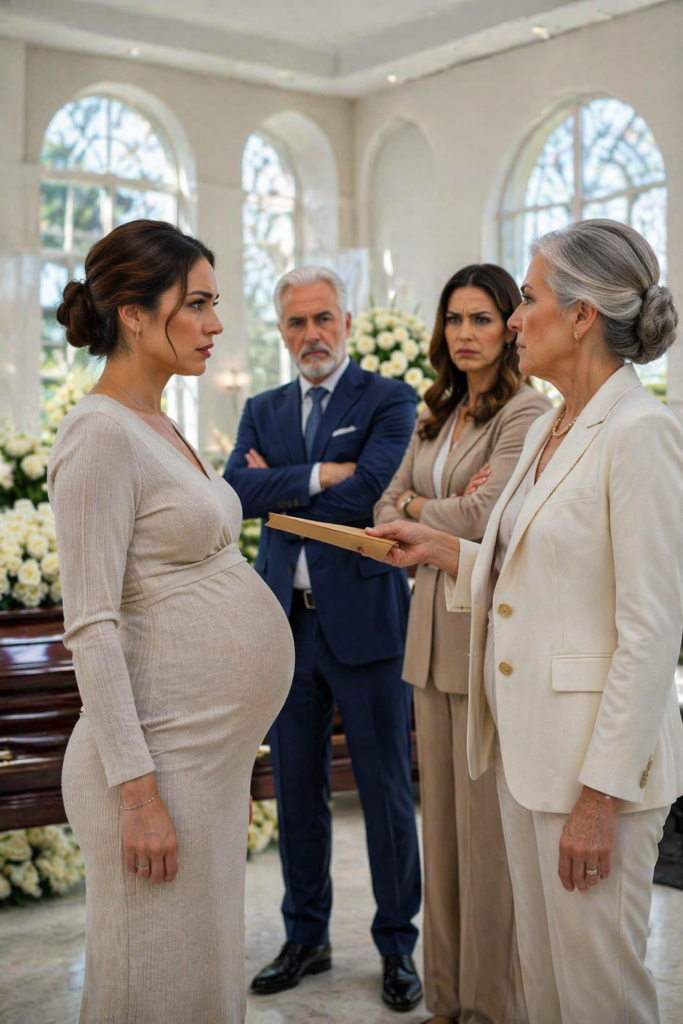
Fernanda Mendoza heard those words two steps from her husband's casket, her black dress clinging to her body, a trembling hand resting on her abdomen.
Diego Rivas had been dead for less than 24 hours.
And his family was already distributing his belongings as if the deceased were merely a formality and she a dismissed employee.
The funeral home was located on a gray avenue in the Narvarte neighborhood of Mexico City. There were white flower wreaths, cold coffee in Styrofoam cups, and murmurs of people saying, "What a tragedy" while glancing at their watches.
Fernanda hadn’t slept a wink.
Her eyes were swollen, her hair hastily tied back, and a small box hidden in her bag. Inside were tiny white shoes she had planned to give to Diego on Sunday, after lunch with his mother.
She was eight weeks pregnant.
Diego didn’t know.
Nobody knew.
He had died on the Mexico-Querétaro highway when a trailer allegedly swerved into his lane. That’s what the police said. That’s what his family repeated. That’s what everyone accepted far too quickly.
Doña Graciela, her mother-in-law, appeared before Fernanda with a brown folder. Beside her walked Paola, Diego’s younger sister, wearing dark sunglasses and a designer bag slung over her arm.
Behind them walked Don Ernesto Rivas, owner of a transportation company he always bragged about as if it were a family empire.
Doña Graciela didn’t hug Fernanda.
She didn’t say, “I’m sorry.”
She simply extended the folder.
—The house will be transferred to Paola’s name —she said—. And the truck as well. Diego was our son. You have no business here anymore.
Fernanda looked up, confused by both pain and audacity.
—The house was mine before I married Diego —she replied—. And I paid for the truck.
Paola let out a dry chuckle.
—Oh, Fer, don’t start. My dad already talked to the lawyer. Don’t make this moment any more uncomfortable.
Fernanda stared at the casket. She wanted to hear Diego’s voice telling her, “Stay calm, my love, don’t let them push you around.”
But all she heard were muffled prayers and the cold buzzing of the lights.
—I won’t sign anything —she said.
Don Ernesto’s face changed.
He stopped looking like a father shattered by grief and reverted to the man everyone obeyed out of fear.
He grabbed her arm tightly.
—Don’t act dignified —he hissed—. You’re all alone.
Fernanda tried to pull away, but he yanked her toward the side corridor, away from the room where the coffin lay.
Doña Graciela followed.
So did Paola.
—Let me go —Fernanda pleaded.
Don Ernesto shoved her against the wall.
The impact stole her breath. Her first instinct wasn’t to cover her face but to cradle her abdomen.
Doña Graciela approached with eyes full of hatred.
—Without Diego, you’re nobody.
And she slapped her.
The sound echoed in the hallway.
Someone saw. No one intervened.
Fernanda tasted blood on her lip and felt a hot sting on her cheek. Paola lowered her sunglasses, satisfied.
—Sign —the mother-in-law ordered—. Or tonight we’ll change the lock and throw your things into the street.
Fernanda reached into her bag.
She didn’t cry.
She didn’t shout.
She pulled out her phone, dialed a number, and when they answered, she looked at Don Ernesto with a calmness that made him frown.
—Do it —she said.
Paola stopped smiling.
And in that instant, while Diego’s body remained inside the coffin, the Rivas family had no idea that the USB hidden in a box was about to destroy them all.
PART 2
Don Ernesto tightened his grip on Fernanda’s arm.
—Who did you call?
Fernanda wiped the blood from her lip with the back of her hand.
—Someone who actually reads documents before threatening widows.
Doña Graciela opened her mouth to insult her, but an odd murmur came from the main room.
Licenciado Samuel Ortega, the Rivas family lawyer for years, stood by a flower wreath sent by Grupo Altavista, one of Transportes Rivas's largest clients.
He answered a call.
At first, he spoke with a firm voice.
Then he paled.
He stepped back, asked something twice, and turned to Don Ernesto with a face that no longer resembled a lawyer but a man who had just seen a hole open beneath his feet.
He walked to the corridor.
—Don Ernesto —he said quietly—. We have a problem.
—Not now, Samuel.
—It’s the bank. And the SAT. And Grupo Altavista.
Don Ernesto released Fernanda.
—What did you say?
Samuel swallowed hard.
—They froze the company’s credit line. The SAT notified an urgent review. And Altavista just suspended the distribution contract.
Paola took off her sunglasses.
—No. That can’t be.
Doña Graciela looked at Fernanda as if she had just discovered that the quiet girl had teeth.
—What did you do, you wretch?
Fernanda stepped away from the wall. Her shoulder, back, and face ached, but she forced herself to stand tall.
—I didn’t do anything. I just let out what you all hid.
Samuel looked at her anxiously.
—Fernanda, I need to know what you sent.
She took a deep breath.
Two weeks earlier, Fernanda had found something strange while reviewing papers for an external audit. She worked as a freelance accountant, and although Diego didn’t want to mix her with his father’s business, one afternoon he asked for help because some routes didn’t add up.
Transportes Rivas moved goods all over the Bajío.
In the files, there were duplicate invoices, drivers who didn’t exist, tolls charged three times, ghost routes, and forged signatures on million-dollar contracts.
Fernanda thought it was a mistake.
Then she found transfers to empty companies.
And a USB with folders Diego had saved separately.
That night, in her kitchen, she showed it to him.
Diego didn’t defend his father.
He didn’t shout.
He didn’t call her exaggerated.
He just stared at the screen with red eyes.
—Give me two days —he pleaded—. I’ll talk to my dad. If this is true, we’ll fix it before it blows up.
The next day, Diego died.
Fernanda wanted to believe it was an accident.
She wanted to believe it because loving someone also obliges you to close your eyes when the truth hurts too much.
But when her in-laws arrived at the wake with documents prepared to take her house, she understood they didn’t want inheritance.
They wanted to search for something.
Doña Graciela advanced toward her.
—You used my son’s funeral to get your revenge.
Fernanda looked up.
—You used your son’s casket to rob me.
The silence was brutal.
Paola began to cry, but not for Diego.
—And my apartment? And my cards? What will happen to me?
Fernanda looked at her with cold sadness.
—Your brother is dead, Paola.
—Don’t give me lectures! —she shouted—. You’re not even blood.
Fernanda felt a pang of fear and instinctively brought her hand to her abdomen.
Doña Graciela noticed.
Her eyes dropped to that hand.
—What does that mean?
Fernanda closed her eyes for a second.
She didn’t want to say it there.
Not in front of them.
Not next to Diego’s casket.
But they had already stripped her of the right to keep her pain silent.
—It means they didn’t just hurt me.
Don Ernesto froze.
Fernanda spoke with a broken voice.
—I’m pregnant. Eight weeks.
Doña Graciela clutched her chest.
Paola stepped back as if the news had sullied her.
Don Ernesto opened his mouth, but nothing came out.
For the first time that night, the Rivas family understood that the woman they had called an outsider carried within her the last piece of Diego.
Then Samuel’s phone vibrated.
He read the message.
His face lost the little color it had left.
—Fernanda… there’s something about the accident you need to see before someone deletes it.
She felt the ground shift beneath her.
—What thing?
Samuel glanced at Don Ernesto.
—A video from the toll booth. A contact from Altavista sent it to me. When the review was activated, they also started gathering evidence.
Don Ernesto slammed his hand against the wall.
—That doesn’t prove anything!
Fernanda looked at him.
His reaction spoke volumes.
Samuel showed her the phone. On the screen, the dark highway appeared, with date and time. Diego’s gray car was moving in the right lane. Behind it, all too closely, was a white truck with the Transportes Rivas logo.
Fernanda felt as though the air had been sucked out of her.
—Diego was going to talk to you —she said to her father-in-law—. What did you do?
—I didn’t kill my son —Don Ernesto replied, but his voice cracked.
—I didn’t ask you that.
No one breathed.
Paola began to shake her head.
—Dad, tell me no.
Don Ernesto ran a hand over his face. Suddenly, he no longer looked powerful. He looked old, cornered, and rotten from within.
—I just wanted to scare him.
Doña Graciela let out a moan.
Fernanda froze.
—What?
—Diego was going to destroy everything —he said—. He was going to deliver documents. He was going to sink the company I built over 30 years.
—Your son was going to do the right thing.
—My son didn’t understand what was at stake!
Fernanda took a step toward him.
—What was at stake was his life.
Don Ernesto lowered his gaze.
—I asked a driver to follow him. To block his way. To take the folder. Nothing more.
Samuel closed his eyes.
—Which driver?
Don Ernesto didn’t answer.
And then a voice spoke from the corridor entrance.
—I did.
Everyone turned.
It was Martín, one of the oldest drivers at Transportes Rivas. He wore a white shirt, black pants, and held his cap tightly between his hands. He had come to the wake to pay his respects to Diego, but until that moment, he had stayed away.
Don Ernesto paled.
—Martín, leave.
The man shook his head.
—Not anymore, boss.
Fernanda felt a chill run down her spine.
Martín approached with guilt-filled eyes.
—I was driving the truck.
Paola screamed.
Doña Graciela covered her mouth.
Martín looked at Fernanda, not at them.
—Ma’am, forgive me. Don Ernesto told me it was a family matter. That I just had to make sure that Licenciado Diego stopped to take a few papers. He sent me the location, messages, everything.
Fernanda couldn’t blink.
—And the trailer?
Martín swallowed hard.
—When I got close, your husband tried to dodge me. The trailer was coming behind. I slammed the brakes. He lost control. It all happened in seconds.
The pain surged up Fernanda’s chest like fire.
She wanted to scream.
She wanted to hit him.
She wanted to wake up and see Diego walking through the door in his blue jacket, telling her it had all been a nightmare.
But all she could do was cradle her abdomen.
Martín pulled out his phone.
—I have the audio. I haven’t slept since that day. If I go to jail, I’ll go with the truth.
Don Ernesto moved toward him.
—If you talk, you sink with me.
Martín looked at him with tears in his eyes.
—Then we sink together.
Samuel was already dialing 911.
No one stopped him.
The patrols arrived at the funeral home while the wake was still open. The same relatives who did nothing when Fernanda was hit were now recording from a distance, as if they were spectators of a series.
A priest called for calm.
No one paid attention.
The police took Fernanda’s and Samuel’s statements, as well as Martín’s. They also called for an ambulance to assess the injuries. When an officer saw the mark on Fernanda’s cheek, she frowned.
—Who did this to you?
Fernanda looked at Doña Graciela.
—She did.
The mother-in-law began to cry.
—It was a moment of pain.
Fernanda responded without raising her voice.
—No. It was a moment of truth.
Don Ernesto was handcuffed in front of his son’s casket.
There, where he wanted to take everything from the widow, he began to lose everything himself.
Doña Graciela tried to approach.
—Fernanda, my love, I didn’t know about the baby.
Fernanda raised her hand.
—Don’t call me your love. An hour ago, you called me a leech.
The woman froze.
Paola, sitting on a bench, stared at Diego’s casket as if she were just beginning to understand that her comfortable life had been paid for with lies.
Samuel accompanied Fernanda to the Public Prosecutor’s Office and then to the hospital. She reported the hits, the threats, the attempted dispossession, and submitted a copy of the USB.
When they did the ultrasound, Fernanda held her breath.
Then she heard the heartbeat.
Fast.
Tiny.
Strong.
She broke down.
—Here you are —she whispered—. Here we are.
The next day, the news was already in group chats.
She returned to her Narvarte home with a patrol car.
The lock had marks.
Someone had tried to break in during the night.
Inside, everything smelled like Diego: his coffee, his jacket, the soap from the bathroom, the sneakers next to the bed.
Fernanda walked to the closet and took down a metal box from the highest shelf.
Diego had left a note attached.
“If anything happens to me, don’t trust them. I’m sorry for not seeing it sooner.”
Inside were contracts, account statements, copies of routes, audio recordings, photographs, and several USB sticks.
There was also a letter for Fernanda.
It didn’t speak of money.
It spoke of guilt.
Of a son who discovered too late the kind of man his father was. Of a husband who wanted to clear his name before starting a family. Of someone who was afraid but decided not to stay silent.
In the end, Diego wrote:
“Fer, if we ever have a child, tell him that his dad tried to do the right thing.”
Fernanda fell to her knees.
It wasn’t a pretty cry.
It was a broken, ugly cry, the kind that comes when the body can no longer hold in any more pain.
Months later, the case advanced. Don Ernesto was charged with fraud, threats, and his involvement in the events that led to Diego’s death. Martín testified. The SAT froze accounts. Grupo Altavista provided evidence. Several employees, tired of years of abuse, also spoke up.
Doña Graciela sent flowers, letters, and crying audios.
Fernanda didn’t respond.
Paola sold her car, left the apartment her parents paid for, and got a job for the first time. One afternoon, she left a bag of baby clothes at Fernanda’s door.
She didn’t ring the bell.
She just left a note.
“I don’t expect forgiveness. I’m ashamed to have thought of money while my brother was dead.”
Fernanda read the note and kept it.
She didn’t forgive.
Not yet.
Because forgiveness isn’t a debt the victim has to pay so the guilty can sleep easy.
When her son was born, she named him Diego.
She didn’t invite the Rivas family to the hospital. Her mother, a college friend, and Samuel were there, who came to drop off documents and ended up crying behind the glass like an improvised uncle.
The baby squeezed Fernanda’s finger with tiny strength.
She understood then that she had not won because they fell.
She had won because she didn’t let fear decide for her son.
A year later, Fernanda took the child to the cemetery. She placed the tiny white shoes by Diego’s grave and arranged fresh flowers.
—Your dad didn’t get to know you —she said softly—, but he defended you before he even knew you existed.
The wind stirred the flowers.
Fernanda was no longer the woman cornered against a funeral home wall.
She was a mother.
She was a survivor.
She was the owner of her story.
And if the Rivas family thought a lonely widow was easy to break, they learned too late that there are women who, when everything is taken from them, don’t sink: they rise with the truth in their hands.