PART 1
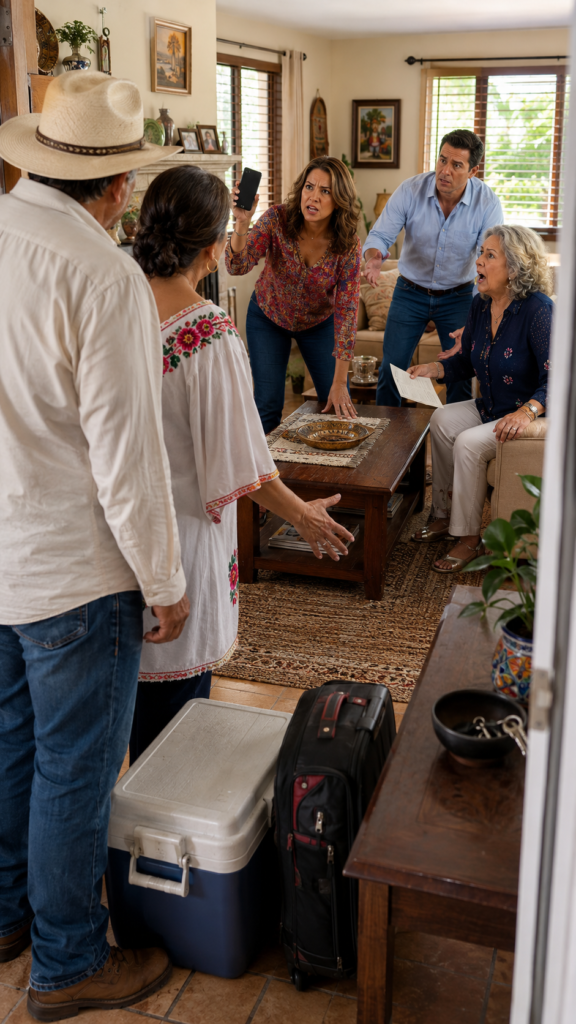
After 14 hours crammed in a passenger truck from Zacatecas to Querétaro, Mariana's parents arrived at their daughter's house with numb legs, weary eyes, and hearts brimming with hope.
Don Ernesto carried an old cooler filled with jars of homemade jam, pickled chilies, and a cut of meat he'd saved for a special occasion.
Doña Lupita brought a woven bag with homemade flour tortillas, two changes of clothes, and a rosary wrapped in a napkin.
They weren’t going to ask for anything.
They just wanted to embrace their daughter.
Mariana lived with her husband, Diego, in a spacious house within a lovely gated community in Juriquilla. White façade, well-kept garden, electric gate, and neighbors who greeted as if everyone was important.
For Mariana's parents, that house was almost a miracle.
Not because of the luxury.
But because they knew how hard it had been to see her happy there.
When they rang the doorbell, Mariana came rushing out. She hugged her mother first, then her father, and for a moment, she was once again the little girl running barefoot across the dirt yard in Zacatecas.
“Oh, my little old folks, you finally made it!” she said, her voice breaking.
Don Ernesto smiled, lifting the cooler.
“We brought a little something, sweetheart. Just for a nice dinner.”
Doña Lupita added:
“And your dad didn’t sleep watching that meat, like it was a baby.”
The three laughed.
But the laughter faded when Beatriz, Diego's mother, appeared.
Beatriz descended the stairs in an expensive blouse, sparkling bracelets, and that look that inspected rather than greeted.
She scanned Mariana's parents from head to toe. Don Ernesto's worn-out sneakers. Doña Lupita's knitted sweater. The battered cooler. The shopping bags.
Then, she smiled just a little.
“Good to see you made it,” she said. “Diego, show them the basement so they can put their things down.”
Mariana blinked.
“The basement?”
Beatriz adjusted her hair as if the question were absurd.
“Yes, of course. The guest room is prepared for my sister, who’s coming tomorrow from San Miguel. They can sleep downstairs. There’s space next to the boxes.”
Doña Lupita lowered her gaze.
Don Ernesto pressed his cap against his chest.
Mariana looked at Diego.
He was two meters away, hands in his pockets, staring at the ground.
He said nothing.
Beatriz continued, as if offering a huge favor:
“Plus, after so much time in the truck, they won’t even notice the difference. Simple folks are used to sleeping wherever, right?”
The silence fell heavily.
Mariana felt something inside her crack.
Her mother tried to smile.
“We don’t want to be a bother, dear. Really, the basement is fine.”
But Mariana wasn’t listening anymore.
She was staring at Diego.
Hoping he would lift his face, defend his parents, at least say, “Mom, no.”
Nothing.
Then Mariana walked over to the entrance furniture, opened the drawer, and pulled out a blue folder.
Beatriz frowned.
“What are you doing?”
Mariana opened the folder in front of everyone.
Inside was the deed to the house.
And what Beatriz read on the first page wiped the smile right off her face.
PART 2
Diego's name wasn’t there.
Neither was Beatriz's.
The house was in Mariana's name.
And at the end of the document, as buyers who had paid in full, were the full names of Don Ernesto Salgado and Doña Guadalupe Rivera.
Beatriz took a step back.
“That… that can’t be.”
Mariana held the deed with both hands. Her fingers trembled, but her voice remained steady.
“My parents sold their land, their truck, and 20 years of savings to help me buy this house. They did it because they wanted me to have a safe place when I got married.”
Diego looked up, pale.
“Mariana, don’t start.”
She turned toward him.
“No. You don’t start. You knew this before the wedding.”
Beatriz glared at her son with fury.
“You knew?”
Diego swallowed hard.
“Mom, it wasn’t necessary to say.”
Don Ernesto closed his eyes.
Doña Lupita clutched her hand to her chest.
In that instant, Mariana understood that Beatriz's insult stung, but Diego’s silence hurt more. Because Beatriz was arrogant. She always had been. But Diego had promised to be family.
And when the moment came, he hid behind his mother like a child.
“For three years,” Mariana said, “I endured your mom mocking my accent, my mom’s cooking, my dad’s clothes, the house where I grew up. Every Christmas she said my family ‘didn’t match’ yours. Every birthday she made comments about how ordinary my last name was. And you always said the same.”
Diego clenched his jaw.
“Don’t pay attention to her.”
“Exactly. ‘Don’t pay attention; that’s just how she is.’ As if humiliation were a personality trait.”
Beatriz let out a dry laugh.
“Oh please. How dramatic. All of this over a bed.”
Mariana stared at her.
“It’s not about a bed. It’s about the place where you think my parents deserve to be.”
Doña Lupita whispered:
“Sweetheart, we don’t want any trouble.”
Mariana turned to her with tears in her eyes.
“You didn’t cause this, Mom. You came with food, with love, with 14 hours of exhaustion in your body. The problem is that someone thought they could treat you as a burden in a house you paid for.”
Beatriz opened her mouth, but no words came out.
Diego approached Mariana and lowered his voice.
“Let’s talk privately.”
“No,” she replied. “Here was the disrespect. Here will be the truth.”
He tried to grab her wrist.
Mariana pulled away.
“Don’t touch me.”
The gesture left Diego frozen.
Beatriz, on the other hand, regained her venom.
“Look at this. So much theatrics because your parents have a complex. Nobody said anything serious. If they can’t get along with people of a different level, that’s not my problem.”
Don Ernesto stepped forward.
He didn’t shout.
He didn’t insult.
He spoke with a sadness that hurt more than any accusation.
“Ma'am, we’re not wealthy. That’s obvious. But we’ve never entered any house thinking we’re better than anyone.”
Beatriz regarded him with disdain.
“Well, you should learn to know your place.”
Mariana closed the folder.
That was the exact point when something changed forever.
“Diego,” she said, “you have ten minutes to pack what you need and leave my house with your mother.”
Diego's face crumpled.
“What?”
“What you heard.”
Beatriz burst into laughter.
“Don’t be ridiculous. Diego lives here. He’s your husband.”
“And I’m the legal owner of this house.”
“You’re crazy.”
Mariana raised her cell phone.
“I can call the security of the community, or I can call a patrol directly. You choose how humiliating you want your exit to be.”
Diego stood in front of his mother.
“Mom, let’s just go for a bit.”
“A bit?” Mariana said. “No. This isn’t temporary.”
He looked at her with that face he always used when he wanted to make her feel guilty.
“You’re emotional. Tomorrow you’ll regret it.”
Mariana felt a bitter laugh rise in her throat.
“I regret waiting three years for you to be a man and defend my family.”
The phrase hit him.
Beatriz clicked her tongue.
“Diego deserves better than a resentful woman.”
Mariana nodded slowly.
“And I deserve better than a husband who stays silent while his mother sends my parents to the basement.”
Diego rushed up the stairs.
Beatriz followed him, muttering that Mariana was ungrateful, that modern women couldn’t handle anything, that’s why marriages fell apart.
From below, drawers opened, doors slammed, and a suitcase thudded against the wall.
Don Ernesto approached Mariana.
“Sweetheart… a marriage doesn’t end just like that.”
She looked at him tenderly.
For one second, she saw the fear in her father’s eyes. Not fear of Beatriz. Not fear of Diego. Fear that his daughter might end up alone for defending them.
“Dad, you taught me that no one is worth so little to accept humiliation.”
Don Ernesto lowered his gaze.
“You also taught me that a house is worthless if those you love can’t enter with dignity.”
Doña Lupita began to cry silently.
Mariana hugged her.
“Don’t cry, Mom. We didn’t lose a family today. We discovered who the real one was.”
Eight minutes later, Diego came down with a sports backpack. Beatriz followed behind with two suitcases, outraged, as if she were being expelled from a palace that belonged to her.
“This isn’t over,” she threatened.
Mariana opened the door.
“Of course not. Tomorrow I’ll change the locks, access codes, and the utility account.”
Diego stopped at the threshold.
“Are you throwing everything away for them?”
Mariana looked at him as if she finally understood something she had avoided looking at for too long.
“I’m not choosing them over you. I’m choosing respect over your cowardice.”
He opened his mouth but found no defense.
Beatriz yanked her son by the arm.
“Let’s go, Diego. Don’t beg her.”
But Diego did want Mariana to break.
He expected to see her cry, run after him, ask for forgiveness for exaggerating. He had lived for three years trusting she would always give in to avoid fights.
This time she didn’t give in.
Beatriz’s truck roared to life in front of the house. It sped off so fast it almost crashed into a planter at the entrance.
Mariana stood in the doorway until the red lights disappeared down the community.
Then she closed the door.
The silence was enormous.
It wasn’t an empty silence.
It was as if the house breathed for the first time without insults, without poisonous comments, without that tension that forced Mariana to measure every word.
In the kitchen, the cooler remained next to the island.
Doña Lupita wiped her face with her sleeve.
“Forgive me, sweetheart. We came to see you happy.”
Mariana opened the cooler.
Inside were the jars wrapped in clean cloths, the tortillas, the chilies, and the meat that Don Ernesto had protected throughout the trip.
That wasn’t food.
It was love traveling 14 hours in a truck.
Mariana carefully took out the cut.
“Dad, will you still teach me how to season it like before?”
Don Ernesto swallowed hard.
His eyes were red, but he straightened up.
“Of course, sweetheart. First salt. Then garlic. And then patience.”
Doña Lupita let out a small laugh between tears.
That night they didn’t sleep in the basement.
They slept in the guest room, with clean sheets, fresh flowers, and the window open to let in the air.
As the meat cooked, Don Ernesto shared stories from the truck. Doña Lupita served peach jam on a small plate. Mariana set three glasses on the table, and for the first time in a long time, she ate without feeling ashamed of loving where she came from.
The next morning, Diego called 17 times.
He also sent messages.
First, he asked to talk.
Then, he asked for forgiveness.
Next, he said his mom was sick with anger.
Finally, he wrote:
“You’re destroying our marriage out of pride.”
Mariana read the message while her parents ate breakfast in silence.
She didn’t respond immediately.
She took a photo of the table: tortillas, coffee, homemade jam, and the blue deed next to the salt shaker.
Then she wrote:
“It wasn’t pride. It was dignity. And that I was taught at home.”
Diego never replied again.
The story spread among neighbors, relatives, and acquaintances. Some said Mariana exaggerated. Others said a wife should endure for her marriage. More than one aunt opined that kicking out the husband was too much.
But there were those who understood what had really happened.
It wasn’t about a rude mother-in-law.
It wasn’t about a bedroom.
It wasn’t about an awkward visit.
It was about a daughter watching her parents being treated as less within a house built with their sacrifices.
And it was about a husband who had one chance to take the right side.
He didn’t take it.
Since then, Mariana learned that family isn’t always who arrives with an elegant last name, expensive perfume, and pretty words.
Sometimes family arrives exhausted, with swollen feet, in a truck, carrying an old cooler full of food.
And when someone disrespects that love, maybe they don’t deserve even a corner of the basement.





