PART 1
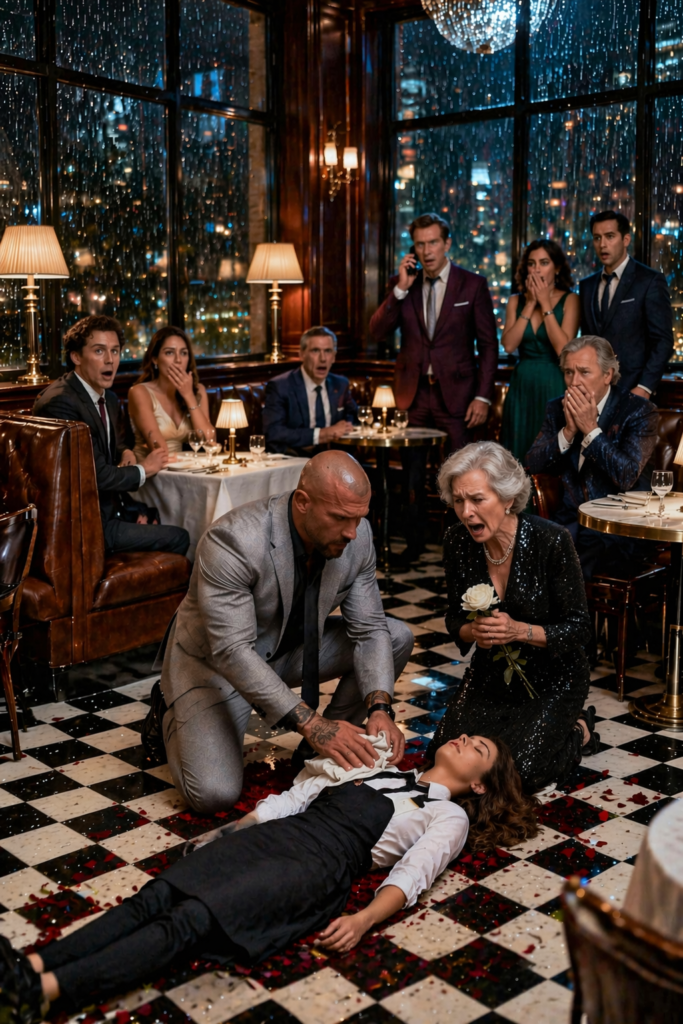
Blood ran over the tiled floor of a café in the Roma neighborhood, but it was not from any hitman.
It was from a 22-year-old waitress.
Valeria Cruz worked the night shift at La Cuchara de Plata, an old restaurant where the waitstaff knew two things: always smile and never ask too many questions.
She studied nursing in the mornings, served tables in the afternoons, and was still paying off the medical debts her father left behind before he died. She lived with her younger brother in an apartment in Iztapalapa where the water heater broke down more often than luck did.
That night, it rained heavily in Mexico City. The windows were fogged, the coffee smelled of cinnamon and toasted bread, and the customers spoke softly as if the water had doused even their urge to laugh.
At 9:00 p.m., the restaurant fell nearly silent.
Doña Isabel Santoro walked in.
She was 72 years old, impeccably dressed in black, pearls around her neck, and a gaze that made even armed men lower their voices. She was the mother of Damián Santoro, the most feared boss of a family involved in gambling, transportation, construction, and businesses no one dared to name aloud.
But Valeria didn’t treat her like a criminal legend.
She treated her like a grandmother.
“Good evening, Doña Isabel. The usual?”
“The usual, my dear. And a little lime on the side, as you like to remember.”
Valeria smiled.
“Of course I remember. You always leave a tip for the porters when I tell you about my practices.”
Doña Isabel let out a soft laugh. Her two bodyguards stood at the entrance, one watching the street under the awning and the other checking his phone as if trust could also reinforce doors.
Valeria walked toward the kitchen with the tray in her hand.
Then she saw the reflection of a black car stopping in front of the restaurant.
The door opened.
A man in a dark raincoat, low cap, and a calmness that didn’t belong in that place stepped inside.
Valeria didn’t know his name, but the bodyguards would have recognized him: El Zurdo Beltrán, a hitman from a rival family who had been looking for a way to humiliate the Santoros for months.
The man didn’t ask for a table.
He didn’t look at the bar.
He reached into his coat and pulled out a silenced pistol.
He aimed directly at the corner.
Directly at Doña Isabel.
Valeria could have thrown herself to the ground. She could have screamed and run. She owed nothing to that woman, nor her son, nor that world of men in expensive suits with dirty hands.
But in that second, she didn’t see the mother of a criminal boss.
She saw a 72-year-old woman staring death in the face.
“Get down!” Valeria shouted.
She lunged across the table and pushed Doña Isabel against the leather seat just as the man fired.
Thud.
Thud.
Thud.
Thud.
Four dry shots cut through the air.
Valeria fell to the floor with the tablecloth over her, broken glasses scattered around, and her white apron turning red in seconds.
One bullet tore through her shoulder. Another entered her abdomen. The third broke a rib. The fourth buried itself in her thigh.
Doña Isabel crawled out from under the table unscathed, trembling like she had never been seen trembling before.
She knelt beside the young woman and pressed her hands, adorned with rings, against the wound in her abdomen.
“Don’t leave me, daughter. Please, don’t leave me.”
Valeria could barely breathe.
“Are you... okay?”
“I’m alive because of you.”
Then the doors burst open.
Damián Santoro entered with a twisted face, gun in hand and his coat soaked from the rain.
“Mom!”
He ran toward Doña Isabel, checking her with desperation.
“It’s not my blood, Damián,” she sobbed, pointing at the waitress. “It’s hers. That girl took the four bullets meant for me.”
Damián looked at Valeria.
And for the first time in years, the man who feared no one stood frozen.
PART 2
Damián immediately took off his jacket and pressed it against Valeria’s abdomen.
“Listen to me,” he said in a low, harsh, almost furious voice. “You’re not going to die. Not today. Not after doing this.”
Valeria tried to focus on his face, but the restaurant's light blurred into white spots. She heard screams in the kitchen, footsteps rushing, a chair falling, Doña Isabel praying under her breath.
“My brother…” she murmured.
Damián leaned closer.
“I’ll find him. I’ll take care of him. But you breathe, you hear me?”
El Zurdo had already escaped in the black car. The bodyguards at the door, pale as ghosts, didn’t dare to look Damián in the eye.
“Block the street,” he ordered without taking his hands off the wound. “And if that girl dies, there won’t be anyone left to tell it.”
The ambulance arrived eight minutes later.
By then, Damián Santoro had already called the best private hospital in the city and cleared out half a floor with a single phrase. No one asked how. No one wanted to know.
Valeria entered surgery at 10:12 p.m.
The operation lasted eleven hours.
They reconstructed her collarbone, closed an artery in her leg, and removed the fragments that had perforated her abdomen. The doctors said that if she had arrived five minutes later, she wouldn’t have survived.
For four days, the fourth floor of the hospital became a fortress.
Men in suits guarded the elevators. No one entered without identification, inspection, and permission. Even the nurses walked in fear, because everyone knew who was paying for that room.
In the waiting room, Damián didn’t sleep.
Doña Isabel found him gazing out the window at the city, wearing the same shirt as the previous day, his eyes red from exhaustion.
“She’s waking up,” she said.
Damián clenched his fists.
“Good.”
“Good isn’t enough, son.”
He turned.
Doña Isabel walked slowly, leaning on a cane she always refused to use. Her face looked ten years older.
“That girl didn’t just save me. She humiliated the Beltráns. She ruined their plan in front of everyone. For them, as long as she breathes, she’s a mockery.”
“I’ll assign her bodyguards.”
“For how long? One month? One year? Her whole life? She’s a civilian, Damián. A waitress. When she goes home, they’ll find her. When she visits her brother, they’ll follow her. When she leaves school, they’ll kill her.”
Damián gritted his teeth.
“I’ll pay for everything. Hospital, home, schooling, whatever she wants.”
“Money doesn’t stop bullets.”
The silence weighed like a tombstone.
Doña Isabel moved closer.
“In our world, there are codes. Dirty, but they exist. If that girl remains nobody, she’s a target. If she carries your last name, touching her means war against all plaza agreements.”
Damián understood before she finished speaking.
“No.”
“Yes.”
“Mom, she’s 22 years old. She’s hurt. I’m not going to use her fear to drag her into my life.”
“I’m not asking you to use her. I’m asking you to give her back the life she gifted you.”
Damián stood still, lost in thought. He was capable of ordering fires, buying silence, and breaking enemies without blinking. But the idea of marrying an innocent young woman to protect her felt, for the first time, like a burden too heavy to bear.
Still, his mother was right.
Twenty minutes later, he entered Valeria’s room.
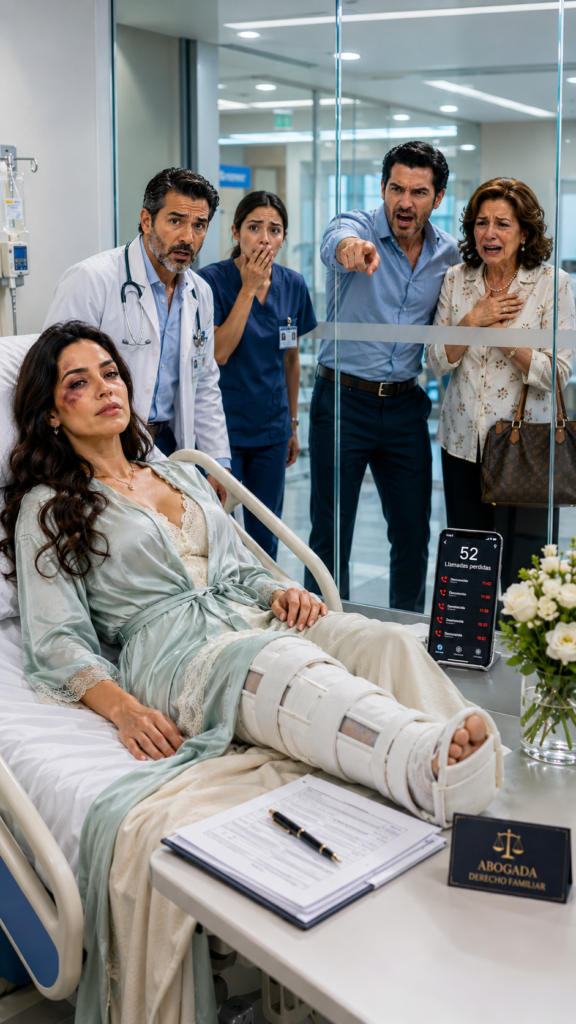
She was pale, connected to IVs, bandaged on her shoulder and leg. She opened her eyes with difficulty.
“Her mother…”
“She’s alive. Not a scratch.”
Valeria closed her eyes, relieved.
“Then it was worth it.”
Damián sat by the bed. He didn’t smile. He didn’t pretend tenderness. He looked at her like one looks at someone to whom one can no longer lie.
“Valeria, I need you to hear something horrible.”
She swallowed hard.
He told her the truth.
That the man in the raincoat hadn’t acted alone. That the Beltrán family didn’t forgive humiliations. That surviving made her a witness, a symbol, and a debt. That if she left that hospital as Valeria Cruz, waitress at La Cuchara de Plata, she would either live in hiding or die.
Valeria cried silently.
“I just pushed a lady. I didn’t want to get involved in anything.”
“I know.”
“I have a 16-year-old brother. His name is Mateo. If something happens to me, he’s alone.”
“Nothing will happen to him.”
“How can you promise that?”
Damián took a deep breath.
“Because there’s one way.”
Valeria looked at him.
“What?”
“You marry me.”
The monitor beeped faster.
“What?”
“Legally. Today. You take my last name and stop being a civilian. On the street, in business, in front of my enemies, you become my wife. No one will dare touch you without unleashing something they couldn’t handle.”
Valeria looked at him as if the anesthesia were conjuring nightmares.
“You're crazy. I don’t even know you.”
“I’m a criminal, yes. But I’m also the only real shield you have right now.”
“That’s not marriage. It’s a cage.”
Damián lowered his gaze.
“It can be a cage with separate doors. I won’t touch you. I won’t force you to love me. You’ll have your room, your money, your studies paid for, and your brother safe. When all this is over, if you want to leave, I’ll let you go with documents, protection, and a new life.”
Valeria stared at the ceiling.
She thought of Mateo heating instant soup at home. She thought of the debts. She thought of the man in the raincoat aiming at an elderly woman. She thought of the four gunshots entering her body.
“Will my brother be safe?”
“Yes.”
“And can I continue studying nursing?”
“When you heal, yes.”
“Will you not treat me like property?”
Damián looked at her with a seriousness that almost hurt.
“You saved my mother. I would never treat you as anything less than that.”
Valeria closed her eyes. A tear slipped down to her ear.
“Alright,” she whispered. “But not because I want to be your queen. I do it because I want to live.”
Less than two hours later, a judge from the Civil Registry entered the room escorted by six men.
Doña Isabel sat in a corner with a rosary in her hands. Mateo, Valeria’s brother, arrived crying, accompanied by a social worker and two trusted guards. Upon seeing her in bed, he wanted to run to her, but Damián gently held him back.
“Slow down, champ. She just had surgery.”
Mateo looked at the ring Damián took from a black box.
“What are they doing to my sister?”
Valeria, weak, raised her hand.
“They’re taking care of me, Mati. Don’t cry.”
The judge read quickly. Valeria signed with the hand she could still move. Damián signed afterward.
When it was time for the ring, he slipped an antique diamond piece onto her finger. There was no kiss on the mouth. He only bowed his head and kissed her gently, as if she could break.
“Now no one touches you,” he murmured.
But outside, by the emergency stairs, a guard named Ramiro pulled out a cheap cell phone.
“She did it,” he whispered. “She married the girl.”
On the other end of the line, a voice laughed slowly.
“Perfect. Then tonight we don’t kill a waitress. We leave the boss a widower.”
At 2:15 a.m., the hallway fell too silent.
Damián was sitting in front of Valeria’s bed, awake, with a hidden gun under his jacket. He had survived so many years because he distrusted even the air. That’s why he noticed that footsteps were no longer heard outside.
He stood up.
“Damián?” Valeria murmured.
“Don’t speak.”
The doorknob turned slowly.
Damián fired three times through the door.
A body fell on the other side.
Then hell broke loose.
Silenced bursts shattered wood, plaster, and glass. Valeria screamed as Damián flipped the bed over, using it as a barrier. The movement opened stitches and tore a groan from her that broke his heart.
“I’m sorry,” he said, covering her with his body. “But I’d rather you hurt than see you dead.”
Two men entered.
Damián shot without hesitation.
They fell before crossing halfway into the room.
A third appeared from the connecting bathroom. Damián shot him in the knee, dragged him by the vest, and pressed the gun against his forehead.
“Who let you in?”
The man spat blood.
“Ramiro…”
Damián froze.
Ramiro was one of his own. He had eaten at his table. He had carried his father’s coffin. He had sworn to protect Doña Isabel.
The final shot rang out, dry.
Ten minutes later, the hospital was filled with loyal men. Ramiro was found in the parking lot trying to escape with a backpack full of dollars. They brought him before Damián, crying, begging, saying he had children.
Damián didn’t even look at him.
He took Valeria in his arms, ignoring the doctors' protests.
“Prepare the house in Cuernavaca. I want private doctors, checked cameras, and new people. No one enters without my mother’s authorization.”
Doña Isabel understood something at that moment.
The marriage had started as a shield.
But Damián's fear was no longer political. It was personal.
For three weeks, Valeria healed in a walled residence in Cuernavaca, among jacarandas, discreet nurses, and guards who changed every six hours. Mateo lived in a nearby house, with a new school and paid therapy.
Damián hardly showed up.
He was hunting traitors.
The investigation revealed the dirtiest plot: Ramiro hadn’t sold information only to the Beltráns. The plan had originated within the Santoro family itself.
Arturo Santoro, Damián’s uncle and advisor to the organization, had orchestrated the attack against Doña Isabel to provoke a war, weaken his nephew, and take it all for himself.
But Valeria ruined the plan.
Then her marriage to Damián ruined the second.
Arturo didn’t want to kill just a witness. He wanted to emotionally break Damián in front of everyone.
When the truth came out, Doña Isabel didn’t cry. She simply took the rosary off her neck, placed it on the table, and said:
“My brother died the day he sent bullets against my family.”
The Beltráns fell first. Routes, accounts, warehouses, political protection: everything crumbled in silence and precision. Arturo disappeared one morning after a meeting in Toluca. No one ever spoke his name again in the Santoro household.
Exactly one month after the shooting at La Cuchara de Plata, Valeria stood by a window, wearing an ivory robe and the ring weighing on her finger like a question.
Damián entered the room.
He had bruises on his jaw, broken knuckles, and a tired look that no longer seemed invincible.
“It’s over,” he said. “There’s no one left who can come after you. Neither you nor Mateo.”
Valeria watched him in silence.
“Then the deal is done.”
Damián didn’t respond.
“The marriage was to protect me,” she continued. “I’m already protected. Can I leave?”
He clenched his jaw. For the first time, he didn’t seem like a boss at all. He seemed just a man scared to hear the answer.
“You can,” he finally said. “I promised you weren’t my property.”
Valeria walked slowly toward him. She still limped a bit. It still hurt to breathe deeply. But her eyes no longer held fear.
“When I married you, I thought I was stepping into a cage.”
Damián lowered his gaze.
“Maybe so.”
“No,” she said. “The cage was my life before. Debts, double shifts, fear, loneliness. This is dangerous, yes. You are dangerous. But you were also the only one who told me the truth from the start.”
He lifted his eyes.
Valeria gently touched the bruise on his jaw.
“I don’t stay because you saved me. I stay because when everyone saw me as a debt, you started to see me as a person.”
Damián exhaled as if he had been holding his breath for an entire month.
“I don’t know how to love nicely, Valeria.”
“Then learn.”
He smiled faintly, a broken and awkward smile.
This time, when he kissed her, it wasn’t to seal a pact or pretend in front of anyone. It was slow, trembling, almost incredulous.
The waitress who took four bullets for an elderly woman did not become a queen out of ambition.
She became the woman who forced a man feared throughout Mexico to remember that even monsters can owe their soul to someone.
And at the tables of La Cuchara de Plata, years later, people still debated the same:
whether Valeria was a victim caught by a powerful last name… or the only person who managed to change the heart of Damián Santoro.