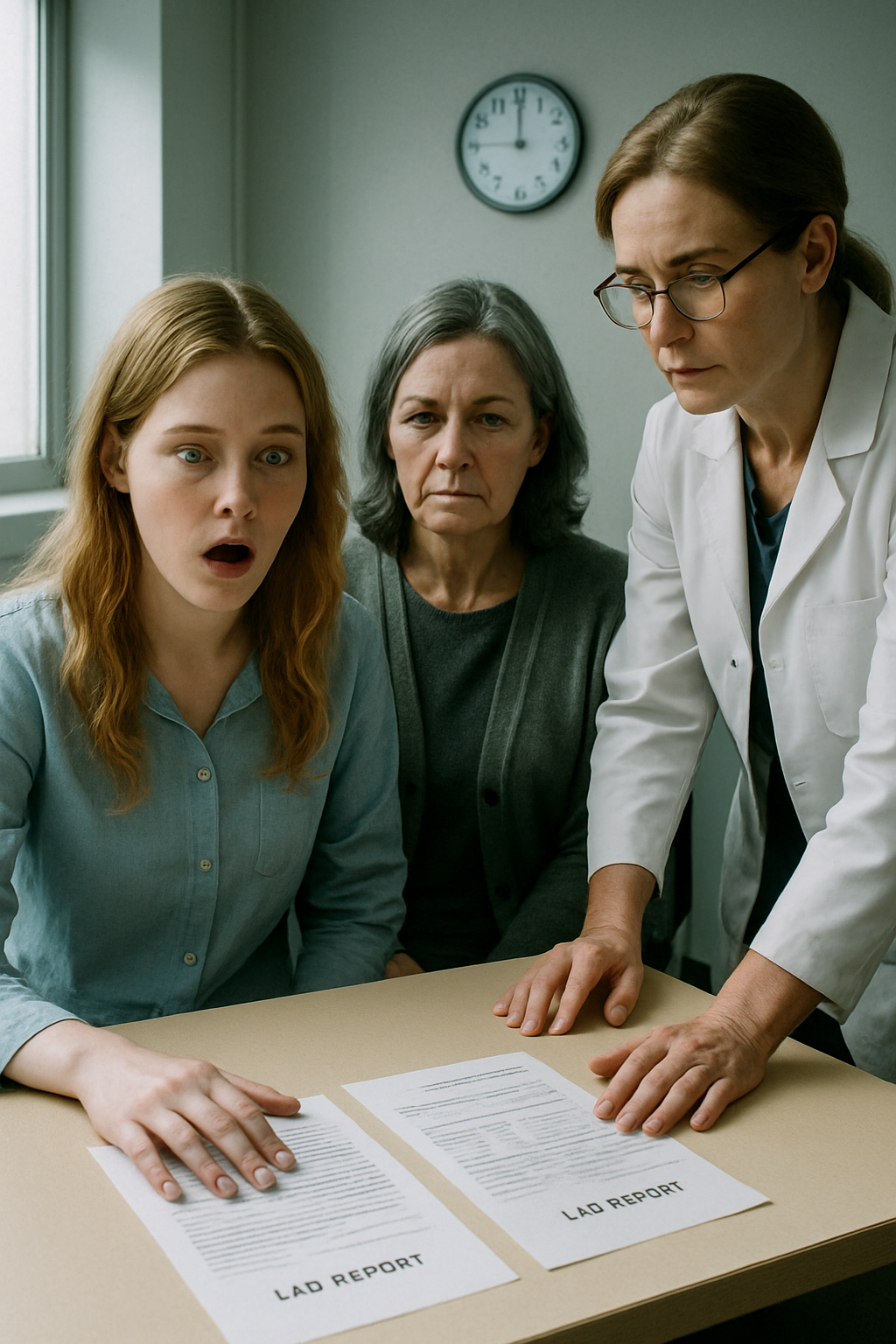
The doctor asked her to sit down.
Iris Banks had been standing at the window, watching a sparrow on the ledge outside, and when Dr. Wade said those words — "Iris, I need you to sit down" — she felt something shift. Not in her chest. Somewhere older than that. Somewhere she didn't have a name for.
She sat.
Dr. Helen Wade was fifty years old and had been delivering difficult genetic news for twenty-two of them. She had learned, over those years, that there was no perfect way to say it. You could soften the language until it meant nothing, or you could say it plainly and watch the person's face rearrange itself into something new. She had come to prefer plain.
She set the printout on the desk between them.
"The panel we ran for your pre-surgery screening came back with some markers I want to discuss with you," she said. "The markers I'm looking at relate to familial genetics. Specifically, the markers we use to confirm biological parentage."
Iris looked at the page. She had honey-blonde hair, which she'd had since childhood, and she'd always assumed it was a genetic quirk — some great-grandmother's recessive trait that had skipped a few generations before landing on her. Her mother had dark hair. Her father had dark hair. Her two uncles had dark hair. She had always been the blonde one. The different one.
"There must be a mistake," she said. She didn't say it anxiously. She said it the way you say something when you are confident it is true. "The lab mixed up a sample or something."
Dr. Wade put a second printout on the desk.
"This is the confirmation panel," she said. "We ran it twice. The markers are consistent."
Iris picked up the second page.
She read it once.
Then she read it again.
The sparrow was still on the ledge. She could see it from where she was sitting, small and brown and completely indifferent to what was happening on the other side of the glass. It hopped twice. Flew away.
"What does this mean," Iris said. It wasn't a question, exactly. It was something that needed to be said out loud before she could process it.
"It means," Dr. Wade said, carefully, "that the two individuals listed as your biological parents on your medical forms are not your biological parents. Neither of them."
Iris set the page down.
"Okay," she said.
She sat very still for a moment. Then she said, "Okay," again, but differently.
"I know this is a significant thing to learn," Dr. Wade said. "I want you to know that this office has experience with situations like this, and we have—"
"How does this happen?" Iris asked.
Dr. Wade had answered this question before. "In most cases like this, the answer is a hospital error at birth. A mix-up in the newborn ward. It happens more often than most people realize, and almost always goes undetected until a medical event creates the need for genetic testing."
Iris thought about that. A mix-up in the newborn ward.
She thought about the photographs on her parents' mantelpiece. The one from the hospital — her mother in the bed, exhausted and smiling, holding a bundle of blankets. The look on her mother's face in that photograph. The look that said: this is the thing I have waited for.
"There would be another baby," Iris said slowly.
"Yes," Dr. Wade said. "There would be another family."
Margaret Banks arrived at the hospital forty minutes after Iris called her.
She had been at the garden center when her phone rang. She'd been holding a terracotta pot and looking at lavender, and when she saw Iris's name she answered it the way she always did — with a small lift of warmth. Her daughter. Calling in the middle of a Wednesday.
"Mom," Iris said. And then: "Can you come to the hospital."
It was not a question.
Margaret put down the pot.
She drove with both hands on the wheel and her jaw set in the way it got when she was managing something. She had always been good at managing. It was what her husband had loved about her, before he left; it was what her colleagues at the school board valued; it was what she had relied on, for twenty-four years, to keep a certain question from becoming a sentence.
When she walked into the genetics consultation room and saw Iris sitting at the desk with two printouts in front of her, Margaret Banks sat down.
She sat down the way you sit when your legs have decided before your mind has.
She looked at the papers. She did not pick them up.
Dr. Wade said, "Mrs. Banks, I understand this is—"
"I know," Margaret said.
The room went quiet.
Iris looked at her. "Mom."
"I have known," Margaret said, "since the day they put you in my arms, that something was different." She said it without drama. Like a woman who had been carrying a single sentence for twenty-four years and had finally been given permission to put it down. "You didn't look like either of us. You didn't look like either side of the family. But you were mine. You were in my arms. They told me you were mine."
Her voice didn't break. That was the thing that undid Iris — not crying, but the flatness of it. The exhaustion of twenty-four years of not asking.
"I didn't push because I was afraid of what I'd find," Margaret said. "And then time passed, and then more time passed, and you were my daughter. You were my daughter in every way that mattered."
Iris reached across the desk and put her hand over her mother's.
"You are my daughter," Margaret said. And then, more quietly: "I just also knew, always, that somewhere there was another one."
The hospital's risk management office moved quickly once they understood the situation.
Birth records from twenty-four years ago, cross-referenced with the genetic results, a search through archived files that took three days and involved two phone calls to a records storage facility in an outer suburb. The name that emerged from that search: Ali. A family named Ali, with a daughter named Zara, born within six hours of Iris Banks at the same hospital, on the same floor, in the same newborn ward where, at some point between dusk and midnight on a Tuesday in late autumn twenty-four years ago, two bassinets had been moved.
Zara Ali was twenty-four years old. She lived forty minutes away.
She had dark hair — thick, dark, almost exactly the shade of Margaret Banks. Warm brown eyes. An easy laugh that her parents had always called the sunniest thing in the house. Her father was a civil engineer. Her mother ran a small catering business from their home kitchen. They were, by every measure, a warm and ordinary family who loved their daughter and had wondered, occasionally, in the private way parents sometimes do, why she had come out with those honey-blonde streaks at her temples that no one on either side of the family could account for.
Iris found out about Zara before Zara found out about Iris.
There was a phone call to the Ali family — made by the hospital, delicately, by a patient liaison who had been trained for exactly this — and then two days of silence, and then a message that came through the liaison: the Ali family would like to meet.
The meeting was arranged at a café. Neutral ground. Neither family's home, neither family's turf.
Margaret chose a table near the window.
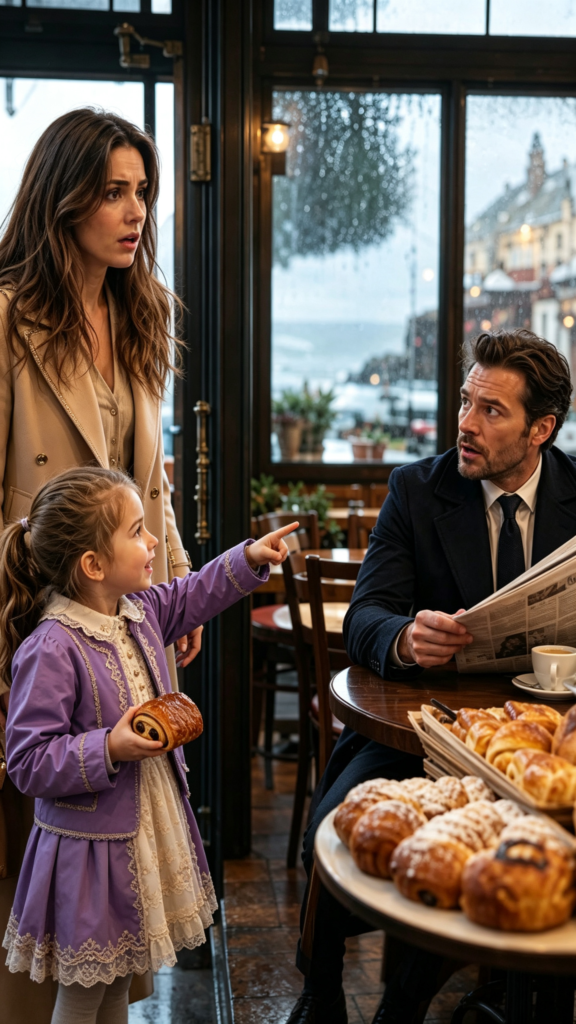
The café was on a street of old terraces, between a florist and a bookshop. It was the kind of place that had timber floors and small round tables and coffee that came in ceramic cups without handles. It was a Wednesday morning, mid-week, quiet enough that the four of them could sit without being overheard.
Iris got there first, with Margaret.
She was wearing a blue shirt. She had brushed her honey-blonde hair and pulled it back and then let it out again, and then pulled it back, and then left it down, because what did it matter, what did any of it matter, you couldn't dress for this. There was no outfit for sitting across from the parents you were supposed to have been born to.
The Alis arrived seven minutes later.
Zara walked in first.
Iris saw her from across the café and felt something she couldn't name. It was not recognition, exactly. It was more like the feeling you get when you see a photograph of a place you've never been but somehow know. Something clicked, very quietly, somewhere behind her sternum.
Zara had dark hair, thick and loose around her shoulders, the same dark hair as Margaret. She had Margaret's jaw. She had something in the set of her eyes — a particular stillness when she was looking at something carefully — that Iris had seen on her mother's face a thousand times.
Zara saw Iris and stopped walking for one full second.
Then she kept walking. She was good at composure, Zara Ali. She had learned it from her mother, who had learned it from necessity.
They sat down.
Riya Ali — Zara's mother, fifty-one, a small woman with precise movements and dark eyes that saw everything — put her handbag on the floor and folded her hands on the table and looked at Margaret Banks with an expression that was entirely composed and utterly unsustainable.
Farouk Ali — Zara's father, fifty-three, a big man with a quiet voice who had been holding his wife's hand since they walked in — said, "Thank you for agreeing to meet."
Margaret said, "Of course."
And then no one said anything for a moment, because what do you say?
It was Zara who broke it. Of course it was Zara.
"So," she said, and the corner of her mouth moved in something that wasn't quite a smile but was trying to be. "This is weird."
Iris laughed. She hadn't expected to laugh, but it came out of her before she could stop it — a real laugh, startled and genuine, and the tension in the café cracked open like a window being pushed wide.
"This is extremely weird," Iris agreed.
"I looked you up," Zara said. "Your Instagram. I hope that's not creepy."
"I looked yours up too," Iris said.
"You have my mom's hair."
"You have my mom's jaw."
They looked at each other. Two young women, twenty-four years old, sitting across a café table in the city where they had both grown up forty minutes apart, each carrying a face that belonged somewhere else.
Riya Ali pressed her lips together. She was not going to cry in a café. She had made this decision in the car on the way here, and she was going to keep it.
She was not keeping it.
Margaret reached across the table — not to her own daughter, but to Riya Ali — and put her hand over Riya's folded hands, and said nothing. Just sat there, hand on hand, two mothers at a table, and the gesture was so simple and so enormous that Zara had to look away.
They sat for two hours.
They ordered coffee and then more coffee and then, eventually, something to eat, because Farouk said he hadn't had breakfast and it turned out no one had, and the waiter came and went three times while they talked. They talked about the hospital. About the error. About what the records showed and what the hospital's lawyers had said and what it all meant, practically, in terms of medical history and inheritance and legal identity — the cold mechanics of it.
And then they talked about the other things.
Zara asked Iris what she did. Iris said she was doing her master's in architecture. Zara said she was an editor at a small publishing house downtown. They discovered they had been, at various points, within six blocks of each other without knowing it.
Riya asked Margaret how long she had been on her own — this came out naturally, the way things do when people are past pretending. Margaret said seven years. Riya said, "That's a long time to be a mother alone." Margaret said, "You learn to be enough."
Farouk said, very quietly, to no one in particular: "We used to joke that Zara got her hair from some distant ancestor no one remembered. Riya's grandmother had lighter hair. We told ourselves it skipped through." He paused. "We wanted to believe it."
No one asked the question that was in the room. No one needed to.
What now?
What came next was not a clean answer. Clean answers don't happen in situations like this. What came next was a series of smaller answers, made one at a time, over the weeks that followed.
Zara had dinner at the Banks house on a Thursday. She sat at Margaret's kitchen table and ate the same lamb stew that Iris had eaten every Thursday of her childhood, and she told Margaret about the book she was editing — a debut novel, a young woman's story about her grandmother's migration — and Margaret said, "That sounds like exactly the kind of book I'd want to read," and meant it completely.
Iris had lunch with the Alis the following Sunday. Riya made lamb biryani and apologized twice for the heat of the chili, and Iris said it was perfect, and it was. Farouk showed her photographs from a civil engineering project in the north of the country — a bridge he'd designed that was still standing — and Iris, who had never cared particularly about structural engineering, found herself asking questions for forty-five minutes.
There were awkward moments. Of course there were.
There was the afternoon Zara found a box of Iris's baby photos at the Banks house and sat on the floor of the hallway looking at them for a long time without saying anything. There was the Sunday Iris looked across the Alis' dining table at Riya and caught herself thinking: that is what I would have looked like, if biology had had its way. There was the day the hospital sent the formal settlement offer and both families had to sit with lawyers and be reminded, formally, of what had been taken from them.
But there was also this:
Zara called Margaret on a Tuesday night, just to talk.
Iris texted Riya a photograph of a building she'd designed — her first real project, a small community center — and Riya wrote back: "This is beautiful. You should be proud."
The Alis and the Bankses had dinner together, all six of them, at a restaurant on a Saturday in early autumn. Farouk brought a bottle of wine he'd been saving. Margaret brought a dessert she'd made that morning. The six of them sat around a large round table and ate and argued about a film and laughed at a story Zara told about a mishap at the publishing house, and at some point during that evening Iris looked around the table and thought: this is the strangest thing that has ever happened to me, and it is also, somehow, entirely fine.
It was late when they got home that night. Iris and Margaret.
The house was quiet. The kind of quiet that only happens after a long evening, when the noise is still ringing slightly in the air and the rooms feel both too small and too large.
Margaret put the kettle on. Iris sat at the kitchen table, still in her coat.
"Are you okay?" Iris asked.
Margaret considered this with the seriousness it deserved.
"I think so," she said. "I think I'm better than okay, actually. Which surprises me."
"Why does it surprise you?"
"Because I spent twenty-four years afraid of this." Margaret set two mugs on the counter. "I spent twenty-four years afraid that if anyone ever found out, or if you ever found out, that something would — break. That you would look at me differently. That I would look at you differently." She paused. "And instead it's just..."
"Just what?"
"Larger," Margaret said. "It just made everything larger. More people. More love. More complication, yes, but also more — more of everything good." She poured the water. "I didn't expect that."
Iris was quiet.
"I looked at Riya today," she said eventually. "I looked at her and I thought about what it would have been like, if the switch had never been found. If I had grown up in that house."
"And?"
"And I think it would have been wonderful," Iris said. "I think Riya would have been a wonderful mother." She paused. "And then I thought about what it would have been like to not have you."
Margaret brought the mugs to the table and sat down.
"I don't think I can hold those two things at the same time," Iris said. "The idea that another life would have been good, and also the absolute certainty that this life — this one, with you — is the one I want. Both of those things are true."
"Yes," Margaret said. "They are."
"How do you live with that?"
Margaret wrapped both hands around her mug. She was quiet for long enough that Iris thought she might not answer.
Then she said: "You just do. You hold both things, and they're both real, and you don't have to choose between them. That's not weakness. That's just — that's just what love is, when it's big enough. It makes room."
The kitchen was warm. The window above the sink was dark, the neighborhood quiet outside.
"I want to tell you something," Margaret said.
Iris looked at her.
"I want to tell you something I should have said twenty years ago, or ten years ago, or any of the years I kept it instead." Margaret set down her mug. "From the moment they put you in my arms — the moment I saw you, before I had time to think, before any of this — I loved you. Not because you were mine by biology. Because you were there, and small, and you opened your eyes and looked at me, and that was it. That was the whole thing. Twenty-four years of everything that followed, all the ordinary days and the hard ones and the ones I'll keep forever — all of it came from that one moment."
Iris didn't say anything.
"I'm telling you this," Margaret said, "because I want you to know that none of what we learned last month changes it. Not one word of it. You were mine the moment I held you. You are mine right now, sitting in this kitchen in your coat because you forgot to take it off. You will be mine when you're fifty and I'm eighty and we're arguing about something completely insignificant." She smiled, the particular smile that had been Iris's whole childhood. "Nothing changes that."
Iris took a breath.
She didn't trust herself to speak, so she reached across the table and took her mother's hand instead.
They sat like that for a long time, in the warm kitchen, while the tea went cold.
Six months later, Zara Ali was a regular at the Banks house on Thursdays.
Iris had her own key to the Alis' place in the inner south — Riya had given it to her on a Sunday in early spring, casually, the way you give someone a key when it's become obvious they should have one.
The four parents had become something that didn't have a name, exactly. Not family, exactly, but something adjacent. Something that met for dinner and called to check in after medical appointments and sent photographs of things that would be funny to each other. Something that had decided, collectively and without a formal meeting, that loss and gain could happen at the same time without canceling each other out.
Zara and Iris had lunch most Tuesdays. They disagreed about most films, agreed about most books, and had discovered a shared habit of walking home from wherever they were instead of taking transport, regardless of how far it was.
"Do you ever think about it?" Zara asked one Tuesday, on a bridge over the river, halfway home.
Iris knew what she meant. "Sometimes."
"Does it make you—" Zara searched for the word. "Sad? Angry? Something?"
Iris thought about it honestly, the way she had learned to think about it. "Sometimes sad," she said. "Not about what I have. Just about the fact that it was an accident. That it happened because someone in a hospital made a mistake one night, and nobody caught it, and two families just — lived with the consequences for twenty-four years without knowing." She paused. "That part is sad. The thing that happened is sad, even if where it led isn't."
"Yes," Zara said. "That's exactly it."
They walked on.
"But here's the thing," Iris said, after a while. "Here's the thing I keep coming back to." She stopped at the end of the bridge and leaned on the railing, looking at the river. "I got to choose."
"What do you mean?"
"I mean that nobody made me stay," Iris said. "Nobody made either of us stay in our families. We were twenty-four. We were adults. We could have said: this changes everything, I want the life I was supposed to have, I'm going to start over." She looked at Zara. "And neither of us did."
Zara was quiet.
"I chose Margaret," Iris said. "Not because she gave birth to me. Not because biology or law or twenty-four years of habit made me. I chose her because she is the person I love most in the world, and she is my mother, and I looked at everything I had with her and I chose it, freely, as an adult who knew the truth."
She paused.
"That matters to me," she said. "That I got to choose."
Zara looked at the river for a long moment.
"I chose mine too," she said quietly.
"I know."
"I looked at your mom and I thought — she is wonderful, and I am so glad she exists, and she is not my mother."
"I know," Iris said again. And then, because it was true and because Zara deserved to hear it: "For what it's worth — watching Riya be your mother is one of the most beautiful things I've ever seen. She loves you in a way that has nothing to do with DNA."
Zara looked at her. Her eyes were wet.
"Don't," she said. "I will actually cry on this bridge."
"You're already crying."
"I'm not. This is river spray."
Iris laughed. Zara laughed. A couple walking past gave them the look that people give two women laughing and crying on a bridge, which is a look that means: I don't know what's happening here but I hope you're both okay.
They were both okay.
That was the thing. That was the whole improbable, complicated, twenty-four-year-in-the-making thing.
They were both okay — not despite what happened, but somehow, in a way that made no tidy sense, because of how it ended. Because two families, handed the worst kind of news, had looked at each other across a café table and decided that the answer to what now was not subtraction but addition. Not replacement but expansion. Not the life you were supposed to have instead of this one, but this one, and also more.
The error was real. The loss was real. The twenty-four years of a question held quietly in a mother's heart — those were real.
And so was this: a Thursday dinner at the Banks house, six people at a table that used to seat three, arguing about a film they all saw and all had different opinions about, while someone's phone kept buzzing and the lamb was slightly overcooked and Farouk was telling a story about a bridge and nobody wanted him to stop.
Real in the way that matters.
Real in the way you choose.