PART 1
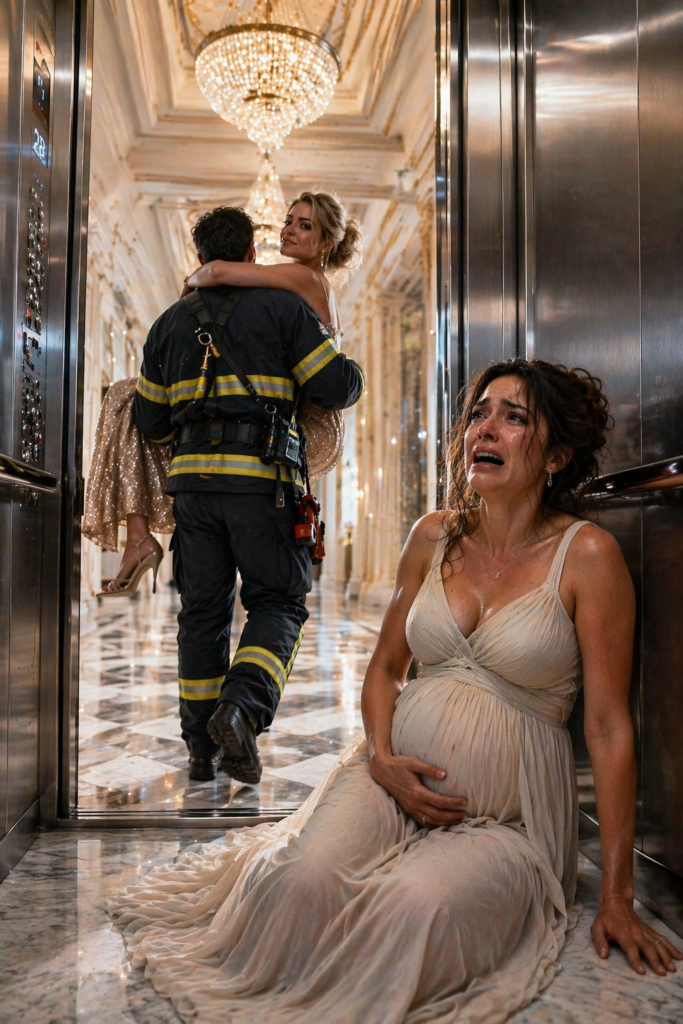
The scream erupted from the depths of the elevator as if someone had torn through the air.
—The pregnant lady fainted, and the baby isn’t moving anymore!
When the doors finally yielded after 7 agonizing hours stuck in a tower on Paseo de la Reforma, everyone expected Diego to rush toward Mariana.
But Diego walked right past her.
He didn’t even glance her way.
Mariana was 31 years old, 24 weeks pregnant, with her hands pressed tightly against her belly. Her shirt clung to her body, soaked with sweat, lips dry, breathing shallow.
Having been an emergency nurse at the General Hospital, she tried to keep calm from the first moment.
Eight people were in the elevator: a 70-year-old man, a 6-year-old boy with a fever, 2 students, a delivery guy, a cleaning lady, Renata, and herself.
Renata was no ordinary woman.
She had been Diego's first love, the girlfriend his mother never stopped mentioning, and ever since she returned to Mexico City, she seemed to need him for everything.
A water leak in her apartment.
An anxiety attack.
A flat tire on Viaducto.
She couldn’t sleep alone because “the memories haunted her.”
Mariana never shouted at her. She simply watched as Diego left cold dinners, prenatal appointments, and unfulfilled promises every time Renata called.
Inside the elevator, Renata sat across from her and murmured:
—I wish Diego were here.
Mariana didn’t reply.
She simply broke her water bottle and offered half to Renata.
By the fifth hour, the air began to thin. The boy cried without tears. The elderly man’s face turned ashen. Mariana asked everyone to silence their phones, arranged the boy and the old man near a crack, and took notes on symptoms in a notebook.
—I need that spot —Renata suddenly said.
—It’s for the boy and the old man —Mariana responded, her voice weary.
Renata stood up and grabbed her wrists.
—You hate me because you know Diego still cares about me. Do you want me to die here?
The delivery guy tried to separate them. Though trembling, Mariana gently pulled Renata’s hands away.
—If you can scream like that, you’re not the worst off.
Renata clutched her chest and collapsed to the floor.
—I can’t breathe...
Mariana checked her pulse, searched for an inhaler in her bag and found only anti-anxiety pills, makeup, and Diego’s phone with 14 missed calls.
—You don’t have asthma —she whispered—. Stop scaring everyone.
Renata’s gaze shifted.
No longer fear.
Only anger.
Moments later, Mariana felt the baby stop moving. At first, she thought it was just fatigue. Then she waited for a kick, a pressure, any sign.
Nothing.
With trembling hands, she wrote: “Pregnant 24 weeks. Decreased fetal movement. Dizziness. Shortness of breath.”
Then she removed her ring.
Diego was a sub-inspector with the Heroic Fire Department. On their wedding day, in a terrace in Coyoacán, he had promised before everyone:
—Even if the world is falling apart, when you need me, I will run first to you.
That’s why, when she heard the rescue tools on the other side, Mariana still believed in him.
The doors opened with a metallic bang. Light, dust, and voices flooded in.
Diego appeared with a helmet, gloves, and a twisted expression.
—Diego! —Renata screamed from the floor.
He crossed the elevator, walked right past the unconscious Mariana, lifted Renata in his arms, and ran out.
—I’m here, it’s okay, I’m here.
Renata wrapped her arms around his neck and before disappearing, glanced back at Mariana.
She smiled faintly.
Like someone who has just won.
A young firefighter named Emiliano knelt beside Mariana.
—Ma'am, hang on. Don’t close your eyes.
She placed the ring in his hand.
—Give it to Diego.
—What do you want me to say?
Mariana breathed as if she had glass in her chest.
—Tell him his son and I will no longer wait for him.
After that, everything went black.
And while the stretcher raced toward the ambulance, no one imagined that the true disaster wasn’t inside the elevator, but in a lie buried for 10 years.
PART 2
Mariana woke in a fetal care unit at the hospital in the Roma neighborhood. The white ceiling hurt her eyes. A monitor was strapped to her belly, and a nurse was reviewing a chart without smiling.
—Is the baby okay? —Mariana barely asked.
The doctor lowered her voice.
—There was a significant deceleration. We managed to stabilize him, but the next 24 hours are critical.
Mariana closed her eyes.
—Where is Diego?
The nurse hesitated.
—He accompanied another patient to trauma.
She didn’t need to ask who.
Half an hour later, footsteps echoed in the hallway. Emiliano spoke first.
—Sub-inspector, your wife asked me to give you this.
There was a small jingle.
The sound of the ring hitting a tray.
Then silence.
—She also said that her son and she will no longer wait for you.
Diego requested to enter. Mariana shook her head before seeing him. The nurse barely opened the door.
—You can’t go in right now.
—Mariana, please. I made a mistake.
She heard his voice on the other side. A broken voice, but too late.
—Renata was lying there, screaming my name. I thought Mariana would hold on longer. She’s a nurse. She’s strong.
Mariana let out a dry laugh that turned into sobs.
Be strong.
That word had condemned her for years.
Be strong not to complain when Diego canceled a medical appointment.
Be strong to understand that Renata “was going through a hard time.”
Be strong to endure her mother-in-law, Doña Teresa, saying that a secure wife doesn’t get jealous.
Be strong to pay the household bills for her mother-in-law’s house, loans from cousins, medicines, and even family meals where she was treated like an unwelcome guest.
Now being strong meant she could faint at the bottom of an elevator.
The door swung open without permission at noon.
Renata walked in with a tiny band-aid on her forehead, dark sunglasses, and Diego behind her.
—I never asked you to pull me out first —she said, crying—. I was terrified.
Mariana stared at her without moving.
—Get out of my room.
Diego frowned.
—Mariana, you don’t have to talk to her like that. She suffered too.
The phrase landed like a slap.
Then Doña Teresa appeared with a designer bag and expensive perfume.
—Enough with the drama. Renata almost died of fright, and you’re here punishing my son.
Mariana slowly turned her face.
—Your grandson almost died.
—But he didn’t die, did he? Don’t exaggerate.
The doctor looked up. Even she was stunned.
Mariana took her cell phone. Opened the banking app. Canceled the monthly transfer she had been making to Doña Teresa’s account for the past 3 years.
—From today, my money is for my son and me.
—How dare you? —spat the mother-in-law.
—I dared since you all confused my patience with obligation.
Renata clutched her chest.
—Diego, I’m feeling unwell again.
He instinctively reached out.
Mariana watched him.
And that image shattered what was left.
At that moment, Karla, her college friend and family lawyer, entered. She carried a blue folder and her eyes were filled with fury.
—Here are the divorce papers and the provisional measures.
Diego went pale.
—Divorce? Because of this?
Mariana spoke without raising her voice.
—Not for saving a person. For leaving behind those who were worse off to save who you wanted to save.
Before Diego could respond, Emiliano appeared with another folder.
—Sub-inspector, the rescue testimonies arrived. The Correctional Office requested to review them today.
Doña Teresa smiled disdainfully.
—Perfect. Let everyone hear how this girl staged a show.
Emiliano opened the folder.
He first read the testimony of the mother of the 6-year-old boy. It confirmed that Mariana ceded the only ventilated space to the boy and the old man, even though she was already dizzy.
Then he read the delivery guy’s testimony. It stated that Renata had tried to force her way into that space, grabbed Mariana by the wrists, and feigned an asthma attack even though she had no inhaler.
Diego's face changed.
—Renata… did you touch Mariana?
—I was desperate —she sobbed—. You don’t know what it’s like to feel like you’re dying.
Mariana placed both hands on her belly.
—No. You don’t know what it’s like to feel your baby stop moving while everyone expects you to keep being strong.
Emiliano took a deep breath.
—There’s more. From the moment the sub-inspector removed Miss Renata until Mrs. Mariana received care, 3 minutes and 20 seconds passed. During that time, the patient was already unconscious, and the monitor reported fetal distress.
The doctor pressed her lips together.
—3 more minutes could have changed the baby’s life forever.
Diego sat as if his legs no longer responded.
—I didn’t know it was that bad.
Mariana looked at him for the first time.
—you didn’t know because you weren’t looking.
The internal investigation began that afternoon. The radio records and building cameras confirmed that Diego did not apply basic triage. He first rescued a woman with minor injuries and a panic attack, while he left inside an elderly man with hypoxia, a dehydrated boy, and an unconscious pregnant woman.
Local press didn’t take long to find out. “Firefighter rescues ex-girlfriend first and leaves pregnant wife trapped,” read a headline on Facebook.
The comments exploded.
Some said that in emergencies no one thinks clearly.
Others asked why Renata always ended up being the priority.
But the worst part came 2 days later, when Diego was summoned to testify at the central station.
Mariana attended with Karla. Not for revenge, but because the report could legally protect her child.
During the meeting, a veteran firefighter named Salgado requested to speak.
He was over 60 years old and had a scar near his eyebrow.
—Sub-inspector, there’s something from the past that should have been clarified years ago.
Diego looked up.
—What are you talking about?
Salgado placed an old folder on the table.
—About the warehouse collapse in Iztapalapa, 10 years ago. The accident where you were trapped with Renata.
Renata, who had gone “to support,” stopped crying.
Diego clenched his jaw.
That story was sacred to him. He always said that Renata had kept him awake among the rubble, that she crawled out to call for help, and that thanks to her, he was still alive.
That’s why he owed her so much.
That’s why he took care of her.
That’s why Mariana always came second.
Salgado opened the file.
—The woman who called for help was not Renata. It was a 17-year-old girl named Alma Hernández. She heard your screams, entered the rubble, kept you conscious, and then ran 5 blocks to find the unit.
Diego blinked, confused.
—No. Renata was there when I woke up.
—She was next to the stretcher —Salgado replied—. But she was not the one who pulled you out or called for help.
Renata shook her head.
—That’s a lie. They want to destroy me.
Salgado pulled out 2 testimonies and a blurry photograph. In the image, a teenager in high school uniform, covered in dust, pointed to the collapsed entrance.
—Alma moved to Puebla with her family weeks later. She never asked for recognition. Renata allowed everyone to believe she was the savior.
The silence was brutal.
Diego took the folder with trembling hands.
He read the last line.
“First call for help made by Alma Hernández, 17 years old. Accompanied Renata M. located later in a safe zone, without significant injuries.”
The lie of 10 years had just shattered before everyone.
Diego turned to Renata.
—Is it true?
Renata stopped pretending.
Her face hardened.
—I was with you when you woke up. That counts too.
The cruelty of that phrase cut through the room, but it also carried an uncomfortable truth.
Renata had lied.
But Diego had chosen to turn that lie into an altar.
Mariana stood up.
She didn’t need to hear any more.
Karla accompanied her to the apartment she rented near the hospital. It was small, with a living room that barely fit a couch, a narrow kitchen, and a window that looked out onto a tree filled with wires and birds.
But there, no one called her dramatic.
No one asked her to apologize for surviving.
No one demanded she compete with a ghost.
Diego started sending flowers, soups, fruits, and messages.
“I’m going to change.”
“I understand now.”
“Let me show you.”
Mariana rejected everything.
One night he sent a picture of the baby’s room in the house they had shared. Crib set up, diapers arranged, parenting books on the table.
“I’m learning,” he wrote.
Mariana looked at the image without tenderness.
It was the perfect assignment turned in after the exam.
Doña Teresa wouldn’t accept the separation. She arrived at the building with Renata, banging on the gate as if she still had a right.
—My grandson will not grow up away from his family because of your tantrum.
Mariana responded through the intercom.
—If you don’t leave, I’ll call the police.
Renata approached the camera.
—Diego is destroyed. Don’t you feel sorry for him?
Mariana breathed slowly.
—For years, you confused pity with love. I no longer do.
Days later, Diego’s family organized a meal at Doña Teresa’s house to “fix things.” Mariana went with Karla, not to reconcile, but to slam the door in everyone’s face.
An aunt said any decent wife would forgive a man under pressure.
Mariana pulled out her notebook.
She read 12 prenatal appointments that Diego missed.
In 9, the reason had been Renata.
Then she read family expenses paid by her: medicines, utilities, loans, home repairs, meals, and tuition for a nephew.
The total exceeded 120 thousand pesos.
—I wasn’t a daughter-in-law —she said—. I was an ATM with a belly.
No one laughed.
Then she read the report from the elevator.
Minor injury to Renata.
Panic attack without respiratory diagnosis.
Attempted displacing a minor and an elderly adult from the ventilated area.
Physical contact with a pregnant patient.
Doña Teresa lowered her gaze for the first time.
—I owe you nothing —Mariana said—. Neither money, nor silence, nor forgiveness for you to sleep soundly.
Diego’s disciplinary hearing took place 1 week later. He was temporarily suspended from command, forced to recertify in rescue protocols, and lost the promotion he had been expecting that year.
But what truly broke him was hearing the doctor explain that the baby could suffer irreversible damage due to the delay.
Upon leaving, Diego caught up with Mariana in the hallway.
—I now understand what I did.
She didn’t stop.
—No. Now you know the consequences. Understanding would have been looking at me before carrying her.
Renata still tried to appear at a prenatal class. She entered crying, saying that Mariana had ruined her life.
A woman stood up among the attendees.
It was the mother of the boy from the elevator.
—I was there. Mariana kept my son alive while you wanted to take away his air.
Security escorted Renata out. She tried to grab Diego’s arm, who was at the entrance.
This time he didn’t hold her.
—You always did that, didn’t you? —he said—. You needed an audience for me to run to you.
Renata disappeared weeks later, but not without sending threatening messages. Karla obtained a restraining order.
Doña Teresa stopped receiving money. For the first time, she had to ask her own son for accountability and not the woman she had so criticized.
At 38 weeks, Mariana’s water broke in the early morning. Karla took her to the hospital. Diego was notified but waited outside because that’s what Mariana requested.
The labor lasted 9 hours.
When Mateo cried for the first time, Mariana felt the air return to the world.
Diego entered later, accompanied by a nurse. He stayed 2 meters from the bed.
—Thank you for letting me meet him.
Mariana didn’t respond. She simply settled the baby against her chest.
Diego cried silently.
—I’m sorry, son. I failed you before I met you.
Mariana felt no hatred.
Nor love.
Only a quiet sadness for a man who needed to lose everything to learn to look.
A month later, they signed the divorce. Diego accepted supervised visits, alimony, medical expenses, and therapy. He didn’t dispute custody.
He left the ring on the table.
—I never learned to get to the places that really mattered first.
Mariana placed it in an envelope.
—Maybe you can still learn not to be late for your son.
That was the last conversation as spouses.
Over time, Diego built a relationship with Mateo without using him as a bridge to come back. Mariana returned to the hospital when the boy turned 6 months old and started giving talks to pregnant women about emergencies, boundaries, and signs that should never be ignored.
A young woman asked her how she managed to stay calm for 7 hours in an elevator.
Mariana looked at Mateo asleep in his stroller.
—It wasn’t calm. It was responsibility. Lives depended on me.
Then she added, her voice firm:
—But being strong doesn’t mean accepting being left for last.
That afternoon she got into an elevator with her son. For a moment, the walls seemed to close in again.
Mateo squeezed her finger.
The doors opened on the ground floor.
This time, Mariana didn’t wait for anyone to come rescue her.
She stepped out carrying her son, took a deep breath, and kept walking.