PART 1
The sound of water hitting the patio froze his blood before he crossed the threshold.
Diego Mendoza had just returned to San Miguel de Allende two days earlier than expected, a suitcase in one hand and a black folder tucked under his arm.
He still had road dust on his shoes when he heard a sharp laugh, the kind that doesn’t bode well.
It was Brenda’s laugh.
The same woman who, since his father’s death, had paraded through the family home as if she owned everything.
Diego advanced down the stone corridor.
And then he saw her.
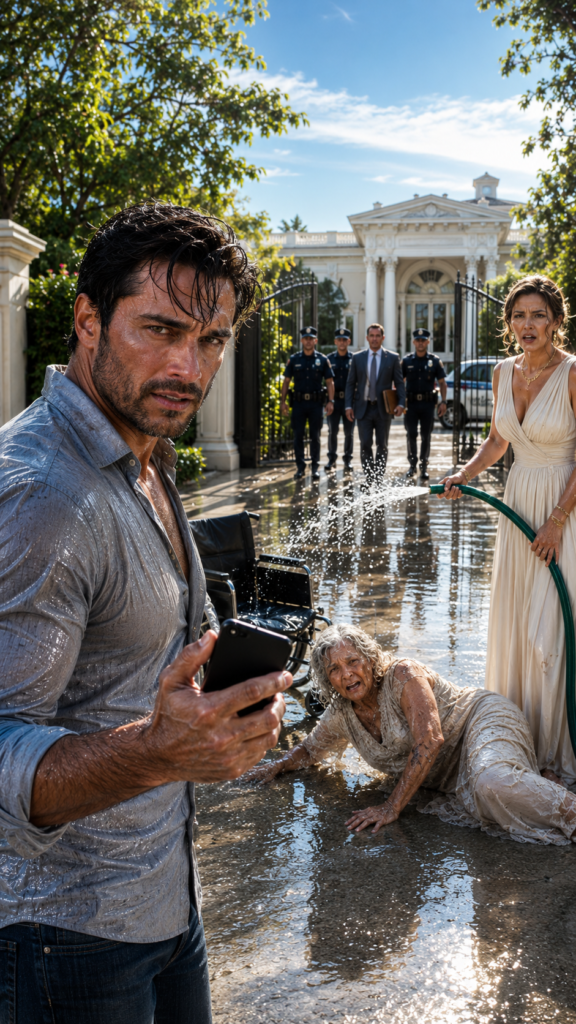
His mother, Teresa, lay sprawled on the patio tiles, drenched from head to toe, her shawl plastered to her body, trembling hands hovering over the puddle.
Since the stroke that had robbed her of mobility, Teresa couldn’t lift herself.
She could barely move her arms.
She could hardly defend herself with her gaze.
Brenda held a green hose as if it were a whip.
"Get moving, you useless old hag!" she shouted. "This house shouldn’t smell like a hospital anymore."
Teresa tried to cover her face.
The stream hit her chest, her neck, her white hair.
Her wheelchair lay several meters away, overturned against a broken pot.
Diego felt something inside him break.
It wasn’t sadness.
It was a silent rage, the kind that doesn’t make noise because it’s already loaded with resolve.
Teresa barely lifted her head.
Her eyes, filled with shame and fear, found her son’s.
"Dieguito…" she whispered.
Brenda turned.
Upon seeing him, she didn’t let go of the hose.
On the contrary, she smiled brazenly.
"Look at this. The important lawyer is back from Mexico City. Did you finally remember your mommy?"
Diego dropped the suitcase to the ground.
He didn’t run.
He didn’t scream.
He just looked at the tiny camera hidden under the eaves, next to the old garden lamp.
The red light kept blinking.
"Turn off the water, Brenda."
She burst into laughter.
"And if I don’t? Are you going to report me? With what proof, buddy? Your mom can’t even speak properly."
Diego pulled out his phone and tapped the screen.
"I don’t need her to talk."
Brenda’s brow furrowed.
For the first time, her smile cracked a little.
"What did you do?"
Diego walked to his mother, knelt in the dirty water, and covered her shoulders with his jacket.
Teresa trembled like a child.
"I’m sorry, Mom," he said softly. "It’s over now."
Brenda took a step toward them.
"Don’t put on a show. This house is mine. Your father left it to me. I’m in charge here."
At that moment, the electric gate began to open.
Brenda turned quickly.
Outside, engines roared, voices sounded, and firm footsteps crunched on the gravel.
"Who did you call?" she asked, her confidence wavering.
Diego didn’t answer her.
He just took his mother’s wet hand.
And when the first officer crossed the garden, Brenda understood too late that her cruelty had just been broadcast live to the wrong people.
PART 2
Two paramedics entered first, carrying a special chair and a thermal blanket.
Behind them appeared lawyer Mariana Ríos, agent of the Public Ministry, accompanied by two municipal police officers and a notary in a dark suit.
Brenda’s eyes widened as if she had just seen a ghost.
"What is this?" she shouted. "They’re invading my property!"
The notary pulled documents from his portfolio.
"That is yet to be clarified, Mrs. Brenda Salgado."
"Don’t call me Mrs. like I’m some kind of nobody!" she spat. "This house belongs to me. Don Ernesto left everything signed."
Diego helped the paramedics lift Teresa.
His mother squeezed his wrist with the little strength she had left.
"Don’t do anything bad for me, son."
He tucked her wet hair behind her ear.
"I won’t do anything bad, Mom. I’m going to do what’s right."
Brenda heard that and laughed.
"Oh, how sweet. The good boy comes to save the invalid. But you’re too late. Your father loved me. He wanted me here."
Teresa closed her eyes.
Diego stood up slowly.
"My father was afraid of you, Brenda. And you know it."
The woman paled for just a second.
But she lifted her chin again.
"Lies. Ernesto adored me. He promised me this house before he died."
Lawyer Mariana turned on a tablet.
"Mrs. Salgado, for eight weeks, we received recordings of mistreatment, threats, isolation, and possible irregular administration of medications against Mrs. Teresa Aguilar."
Brenda let out a nervous laugh.
"Recordings? Don’t make things up. That old lady is crazy. After the stroke, she loses her mind."
Diego pointed to the patio eaves.
"She didn’t record anything. I did."
Brenda looked up.
She saw the small black camera.
Then another, hidden by the gate.
And another, on the flowerbed.
Her expression changed.
It was no longer rage.
It was calculation.
"That’s illegal," she said. "You recorded me without permission."
"That was my mother’s house," Diego replied. "And I’ve been her legal guardian for three months."
The word "guardian" fell like a stone.
Brenda fell silent.
Because that she hadn’t expected.
For months, she had repeated in the market, during mass, and even with the neighbors that Teresa was "losing her mind."
She claimed that she, Brenda, was the only one who cared for her.
The only one who endured her tantrums.
The only one who deserved to keep the house.
And many people believed her.
Because Brenda knew how to cry when there was an audience.
She knew how to bring flowers to Ernesto’s grave.
She knew how to dress in black on Sundays and say:
"I’m just fulfilling my love’s last wish."
But inside the house, she was another person.
She fired Lupita, the nurse who cared for Teresa.
She changed the locks.
She took away the cellphone.
She wouldn’t let the neighbors in.
And when Teresa asked about Diego, Brenda told her:
"Your son has gotten tired of you. He’s not coming back."
Diego had never grown tired.
He had only learned to wait.
His father, Ernesto Mendoza, owner of a small agave farm and an old house in the center, had died of a sudden heart attack.
Or so they said at first.
But five days before he died, Ernesto called Diego crying.
He wasn’t a sentimental man.
He was stubborn, dry, proud.
That’s why that call stuck in Diego like a splinter.
"Son, if something happens to me, don’t leave your mother alone," he told him. "Brenda isn’t who she seems."
Then the call dropped.
When Diego arrived from Mexico City, his father was already buried.
Brenda already had keys.
She already had papers.
She already had a prepared version.
"Your father left me the house because you never came," she told him. "Besides, your mom needs a woman nearby. You don’t know how to care for the sick."
Diego could have made a scene that day.
But he didn’t.
He was an estate lawyer.
He knew that a fight in front of everyone would only serve for Brenda to play the victim.
So he feigned doubt.
He feigned fatigue.
He pretended to accept reviewing everything "calmly."
And while Brenda celebrated, he installed cameras under the pretense of checking for leaks in the roof.
He also requested his mother’s bank account movements.
He talked to Ernesto’s former accountant.
He sought out the real notary.
And found something worse than he imagined.
Lawyer Mariana showed some printed sheets.
"We have records of transfers from Mrs. Teresa’s account to your personal accounts."
Brenda raised her hand.
"That was for medical expenses."
"Medical expenses for designer bags?" Diego asked. "For jewelry from Querétaro? For two trips to Cancun?"
The police officers exchanged glances.
Brenda clenched her jaw.
"Your father owed me a dignified life."
Teresa opened her eyes.
Her voice came out cracked but clear.
"Your dignified life wasn’t built on my pain."
Everyone fell silent.
It was the first time in months that Teresa spoke without fear in front of Brenda.
Ernesto’s mistress turned to her with hatred.
"Shut up, ridiculous old woman."
Diego stepped in.
"Don’t you ever talk to her like that again."
Brenda tried to advance, but one of the police officers raised his hand.
"Don’t come near."
She lost control.
"You don’t know anything!" she screamed. "That woman humiliated me my whole life! She was always the holy wife, the respectable lady, the one everyone greeted in the square. And what about me? The hidden one? The other?"
Teresa lowered her gaze.
Not out of shame.
But out of exhaustion.
Diego took a deep breath.
"My mother didn’t take anything from you, Brenda. You chose to live hidden with a married man."
"Because he chose me!" she shrieked. "He was going to divorce!"
The notary raised an eyebrow.
"Curious, because Mr. Ernesto left a letter dated twelve days before his death indicating otherwise."
Brenda stood frozen.
"What letter?"
Diego opened the black folder.
He pulled out a yellowed envelope, protected in plastic.
"I found it in the safe. It wasn’t just the real will. This was there too."
Brenda looked at the envelope as if it were poison.
Lawyer Mariana nodded.
"The document has already been verified."
Diego read with a firm voice.
"If Brenda insists on staying in the house, it will only be under supervision and with a monthly pension conditioned on the dignified care of Teresa. If mistreatment, negligence, or economic abuse is proven, she will lose all benefits."
Brenda shook her head.
"No. No. That old man couldn’t have done that to me."
Diego continued.
"I also note that I fear for my safety. I have discovered unauthorized bank movements and pressures to modify my will."
Brenda’s face crumbled.
She no longer looked like the elegant woman flaunting red nails in the downtown cafe.
She looked like someone trapped in her own lie.
"That’s false," she murmured.
"What’s false," the notary said, "is the clause you presented, which supposedly granted you complete ownership of the house."
Mariana added:
"The preliminary expert report indicates alteration in the last page. Also, the notary appearing in that copy lost his license six years ago."
One of the neighbors, watching from the fence, let out a "no way" almost in a whisper.
Brenda heard it.
And that enraged her more than any accusation.
Because Brenda could tolerate losing money.
But she couldn’t tolerate losing her image.
For months, she enjoyed being called "the lady of the house."
She enjoyed silencing people.
She enjoyed seeing Teresa reduced to a shadow.
Now everyone was watching her.
Wet, disheveled, cornered.
"You planned all this," she said to Diego. "You set a trap for me."
Diego looked at her without blinking.
"No, Brenda. I installed cameras. The cruelty was yours."
The phrase left her breathless.
The paramedics finished checking Teresa.
She had old bruises on her arms.
Skin irritated from poor hygiene.
Signs of malnutrition.
A young paramedic pressed his lips together, indignant.
"Lawyer, this didn’t start today."
Teresa heard and covered her face.
Diego crouched in front of her.
"Don’t hide, Mom. The shame isn’t yours."
She cried silently.
And that cry was worse than any scream.
Because it wasn’t just pain.
It was the sorrow of a woman who had spent years holding up a family, only to end up sprawled in the patio of her own home.
Brenda tried to run to the entrance.
"I’m going for my things."
A police officer blocked her path.
"You can’t enter without authorization."
"It’s my clothes!"
"There are also documents under investigation," Mariana replied.
Brenda turned to Diego.
Her gaze filled with hatred.
"Your father loved me more than you two."
Teresa raised her head.
And then the twist nobody expected happened.
"No, Brenda," she said softly. "Ernesto was going to report you."
The mistress let out a dry laugh.
"What do you know?"
Teresa breathed with difficulty.
"Because he apologized to me the night before he died."
Diego froze.
He didn’t know that part.
Teresa looked at her son.
"Your father came into my room. He cried. He told me he had been a coward. That he had let an ambitious woman into our lives. He promised that the next day he would go with you to the Public Ministry."
Brenda began shaking her head.
"Shut up."
Teresa continued.
"He also told me that you were giving him drops to 'sleep better.'"
Lawyer Mariana became serious.
"Drops?"
Diego felt a punch in the stomach.
"Mom, why didn’t you tell me?"
"Because after that he died," Teresa whispered. "And she took the phone from me."
Brenda screamed:
"That’s slander!"
Mariana signaled to an officer.
"Request an expanded investigation and toxicological review of medications found in the house."
Brenda lunged for Teresa.
She didn’t make it.
The police officer grabbed her by the arms before she could touch the chair.
But the camera recorded everything.
Again.
The same woman who claimed to be a caregiver had just attempted to attack a defenseless person in front of an authority.
"Let me go!" she shrieked. "She’s lying! Everyone’s envious of me!"
Mariana pulled out handcuffs.
"Brenda Salgado, you are under arrest for suspected crimes of equivalent family violence, abuse against a person in a vulnerable situation, fraud, forgery of documents, and whatever else results."
Brenda stopped screaming for a second.
As if she had just understood that this was no longer a backyard dispute.
It was jail.
"Diego," she said, changing her tone. "We can fix this. You know your father promised me something. I took care of him."
Diego looked at her with a calm that hurt.
"You didn’t take care of him. You drained him dry."
"I loved him."
"No. You loved what he had."
Brenda squeezed her eyes shut.
For the first time, her voice cracked.
"I lost too."
Teresa watched her from the chair, wrapped in the blanket.
"You lost because you confused love with possession."
No one said anything.
The phrase hung in the patio like a bell.
The police officers took Brenda the same way she had entered so many times, flaunting high heels and expensive perfume.
But this time she walked with her hands cuffed.
The neighbors watched from the fence.
Some murmured.
Others looked down, embarrassed for not having asked about Teresa sooner.
Doña Meche, the neighbor across the street, approached, crying.
"I’m sorry, Teresita. I thought you were ill, that you didn’t want visitors."
Teresa took her hand.
"I also thought everyone had forgotten me."
That phrase broke more than one heart.
Diego didn’t cry at that moment.
Not yet.
He had too much anger filling his chest.
But when he entered his mother’s room and saw the expired medications, the dirty sheets, and a notebook where Teresa had tried to write her name several times, he sat on the edge of the bed and covered his face.
That’s when he broke down.
Not for Brenda.
For the lost time.
For the visits he postponed.
For the calls he thought were enough.
For believing that sending money was caring.
Six months later, the house smelled again of pot coffee, sweet bread, and fresh flowers.
Teresa still couldn’t walk.
But she no longer looked down.
She received therapy five times a week.
Lupita, the nurse Brenda had fired, returned to work with her.
The patio was restored.
Where there had once been puddles and humiliation, Diego had flowers planted.
The trial wasn’t as swift as everyone wanted.
But it was firm.
The cameras, bank statements, messages, and Ernesto’s letter were enough to destroy the lie.
Brenda lost her pension.
She lost any right to the house.
She lost her contacts.
And, above all, she lost the victim persona she had rehearsed so well.
When the local press published the case, many had opinions.
Some said Diego should have acted sooner.
Others said Teresa should have spoken up.
Some, as always, defended Brenda with silly phrases:
"Who knows what they did to make her react like that."
"Some handcuffs are very difficult."
"Surely the gentleman promised her something."
But the majority understood the truth.
No one has the right to destroy a defenseless person just because they didn’t get the place they wanted in a family.
One Sunday afternoon, Teresa asked to go out to the patio.
Diego took her in her wheelchair.
The sun fell gently on the yellow walls.
In the distance, a band could be heard rehearsing for a patronal feast.
Teresa looked at the new fountain.
Then she looked at her son.
"Your father would be ashamed."
Diego didn’t know how to respond.
She squeezed his hand.
"But he would also be at peace knowing the truth is finally out."
Diego nodded.
"I’m still angry with him."
"So am I," Teresa said. "Loving someone doesn’t mean erasing what they did wrong."
That phrase stuck with him.
Because in Mexico many families teach silence to "not make a scene."
To forgive quickly to "keep the peace."
To endure humiliation because "that’s life."
But that afternoon, in that patio, Teresa taught something else.
Peace doesn’t come when everyone is silent.
Peace comes when the truth is no longer locked away.
Diego looked at the cameras, now visible, installed for security.
Then he looked at his mother, sitting under the bougainvillea, her face illuminated by a new calm.
There was no revenge through blows.
There were no final screams.
There was no blood.
Just an abusive woman leaving in handcuffs.
A mother reclaiming her dignity.
And a son understanding too late that caring isn’t sending money or merely asking how someone is.
Caring is looking closely.
Believing the vulnerable.
And not waiting for the water in the patio to reveal what the entire family preferred not to see.