PART 1
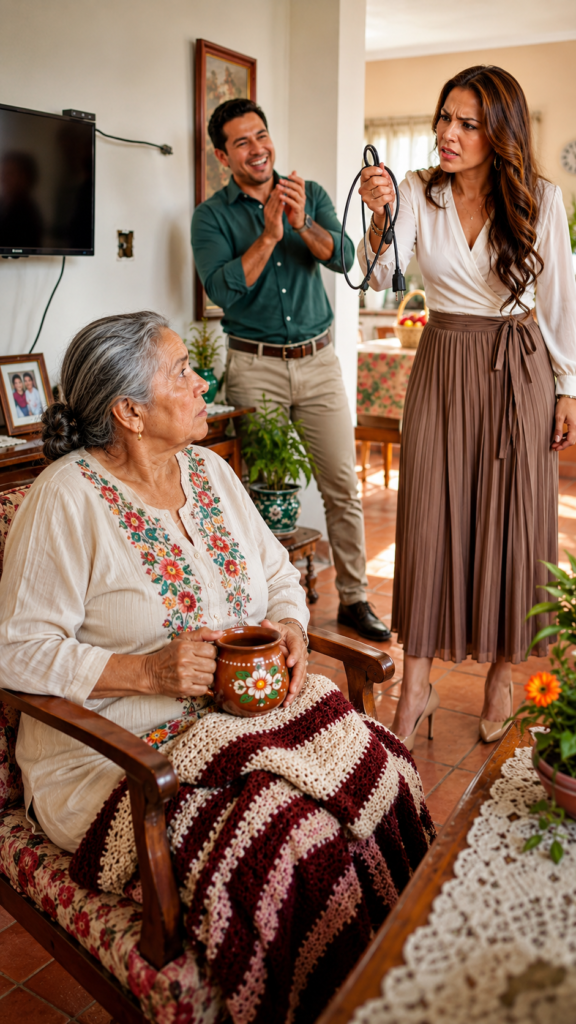
—In this house, there will be no more trashy novels —Fernanda shouted, yanking the television cord with such rage that she almost ripped the outlet from the wall.
Doña Mercedes remained still in her armchair, a blanket draped over her legs and a cup of coffee cradled in her hands. At 72, her neatly styled white hair framed a face carrying the weary patience of a woman who had swallowed too much silence.
She didn't ask for much.
Her quiet home in a neighborhood of Guadalajara, her bougainvillea pots, her little saints on the shelf, and her 6 PM soap opera—watched not out of ignorance, but because it reminded her of the stories she heard as a young girl at the San Juan de Dios market.
But Fernanda barged in as if the living room belonged to her.
She wore high heels, had long nails, expensive perfume, and a look of contempt that had become her second skin.
—Honestly, ma'am, it’s a shame. Sitting here all day, watching screams, betrayals, and nonsense. How do you expect this house to have good energy?
Doña Mercedes lifted her gaze.
—That television was bought by me, child.
—Well, you should also pay for the electricity to make yourself dull —Fernanda shot back—. Alejandro and I need to live in a finer, more modern environment. Not in a hick house.
Doña Mercedes’s fingers trembled, but her voice remained steady.
She had worked for 39 years as an elementary school teacher. She had taught children who were now doctors, mechanics, lawyers, and merchants. She had raised Alejandro alone since her husband died in a car accident.
And now, in her own living room, her daughter-in-law treated her like an old piece of furniture.
At that moment, the door swung open.
Alejandro entered with a wrinkled shirt, a cellphone in hand, and an annoyed expression. Doña Mercedes thought someone would finally set a boundary.
He was her son.
The boy she carried through fevers. The young man for whom she sold jewelry to pay for college. The man she welcomed into her home when he and Fernanda lost their apartment due to debt.
Alejandro glanced at the cord lying on the floor, then at his wife, and finally at his mother.
Doña Mercedes waited.
She waited for a, “Fernanda, don’t talk to my mom like that.”
She waited for a hint of shame.
But Alejandro smiled.
—Well done, love. It was about time. My mom gets too caught up in these things. This house needs a different vibe.
That comment hurt more than the severed cord.
Doña Mercedes lowered her gaze. She didn’t cry. She only felt a dry cold in her chest, the kind that doesn’t make a sound but shatters the soul.
Fernanda threw the cord onto the table.
—We'll talk tomorrow about the back room —she said—. That space is wasted. It could be my dressing room. Besides, ma’am, you hardly use so many things anymore.
Alejandro said nothing.
He simply followed Fernanda into the kitchen.
Doña Mercedes heard them open her refrigerator, serve themselves food, and share a laugh over something in low voices.
That house was hers.
Every brick held a story: Alejandro’s homework, nights of coughing, neighborhood posadas, birthdays without luxury but filled with love. However, in recent months, Fernanda had been encroaching on everything.
First, she changed the curtains.
Then she removed the portraits of the late Don Julián because they “gave off a sad vibe.”
Next, she threw away pots because they “looked too rustic.”
Later, she took over the room where Doña Mercedes kept books, boxes with photographs, and old letters.
That night, the old woman picked up the severed cord.
She didn’t throw it away.
She tucked it into the pocket of her apron like a piece of evidence.
Slowly, she ascended to her bedroom, locked the door, and opened the secret drawer of the cedar wardrobe her husband had made for her in Tonalá.
Inside an old Bible lay the title deed to the house.
“Owner: Mercedes Aguilar Widow of Robles.”
Doña Mercedes ran her fingers over the paper.
Alejandro had never wanted to read it. He always believed that, as the only son, everything was already his.
That night, she couldn’t sleep.
She pulled out a notebook and wrote three words:
Locksmith.
Bank.
Lawyer.
At dawn, when Alejandro and Fernanda left, Doña Mercedes brewed strong coffee and called Don Toño, the locksmith from the neighborhood.
—I need to change all the locks in my house. All of them. Today.
Half an hour later, Don Toño arrived with his toolbox.
—Simple change, ma'am?
Doña Mercedes opened the door wide.
—No, Don Toño. Complete change. Nothing that opened before should open again.
As the drill bit into the wood, she felt something inside her chest disengage as well.
But when she went up to the back room to see what Fernanda had stuffed in there, she found a bank envelope hidden among expensive magazines.
She opened it.
And upon reading the first page, she felt the air leave her body.
She couldn’t believe what she was about to uncover…
PART 2
The envelope was addressed to her.
“Mercedes Aguilar Widow of Robles.”
Doña Mercedes read it slowly, as if each letter could change if she looked at it with enough focus. It was a statement for a Platinum card she had never applied for.
Restaurant in Polanco: 13,800 pesos.
Designer boutique: 21,600 pesos.
Luxury spa: 8,200 pesos.
Electronics store: 26,900 pesos.
Imported wines: 6,400 pesos.
The total debt exceeded 180,000 pesos.
Doña Mercedes had to brace herself against the desk to avoid collapsing.
It wasn’t a misunderstanding.
Someone had taken out an additional card using her information. Someone had forged her signature. Someone had been hiding her mail for months.
And that someone was sleeping under her roof.
She took a deep breath. She didn’t scream. She didn’t cry. After so many years as a teacher, she knew one thing: when there’s chaos, you first organize the evidence.
She opened drawers, checked bags, and sifted through papers.
In a pink notebook belonging to Fernanda, she found the phrase that broke her heart completely:
“Appointment with architect. Turn the old lady’s room into a walk-in closet.”
Beneath it, with a happy little face, it read:
“Look for an affordable nursing home. Get Alejandro to sign quickly before the old lady makes a scene.”
Doña Mercedes felt the cold in her hands.
Not only were they robbing her.
They were planning to evict her from her own home.
“The old lady’s room.”
That’s what they called the room where she kept her husband’s letters, the photos of Alejandro in school uniform, the memories of a lifetime built with pure effort.
She went down with the envelope, the notebook, the severed cord, and the copies of the deed. Don Toño had just finished the last lock.
—All set, ma'am. Now no one gets in unless you want them to.
Doña Mercedes accepted the new keys as if her dignity were being returned to her in the palm of her hand.
Then she called the bank.
—I want to block that card, dispute all the charges, and revoke any permission my son Alejandro Robles has on my accounts. Yes, ma’am. I also want to file a fraud report.
The executive asked her twice if she was sure.
—More sure than ever —she replied.
Then she called lawyer Barragán, a retired attorney who had been the father of two of her students.
—Mercedes, don’t touch anything else. Take pictures. Keep everything. I’m on my way.
But before the lawyer arrived, Doña Mercedes did something she never imagined.
She went up to Alejandro and Fernanda’s room.
There was clothes strewn everywhere, expensive perfumes, shoe boxes, shopping bags, and crumpled receipts. Fernanda talked about elegance but lived like a hurricane.
Doña Mercedes pulled out two large suitcases.
She didn’t fold a thing.
She stuffed in dresses, shirts, shoes, creams, suits, ties, chargers, makeup, jackets—everything that wasn’t hers.
She brought the suitcases down to the entrance and wrote a note on a white sheet:
“This house has an owner. Your keys no longer work. Your debts will not be mine either.”
She stuck it inside, next to the glass of the door.
At 6:10 PM, she heard the car.
First, a key scraped against the new lock. Then another. Then pounding.
—What did you do, Alejandro? —Fernanda said outside—. It won’t open.
—It must be stuck.
—Oh, come on, you’re useless even at opening a door. Give me that.
The key turned, failed, and failed again.
The doorbell started ringing over and over.
—Mercedes! —Fernanda shouted—. Open the door!
Doña Mercedes walked to the entrance. She didn’t open it completely. She left the chain on.
—Don’t shout, Fernanda. I’m not deaf.
Alejandro peeked through the crack and saw the suitcases.
His face went pale.
—Mom, what is that?
—Your luggage.
Fernanda shoved her husband.
—Did you touch my things? Old busybody!
Doña Mercedes looked at her without raising her voice.
—A busybody is someone who opens other people’s mail. A thief is someone who uses a card in another person’s name. Cruel is someone who plans to turn an old lady’s room into a dressing room while seeking to send her to a cheap nursing home.
Alejandro swallowed hard.
—Mom… it’s not what you think.
—Then explain the Platinum card.
Fernanda stopped shouting.
For the first time, her makeup couldn’t hide her fear.
—That was an emergency —Alejandro murmured—. We were going to pay it back.
—With what? Selling my house?
No one answered.
That pause was the clearest confession.
Fernanda gritted her teeth.
—You can’t kick us out. We live here. If you want war, you’ll have war. I’ll say you’re losing your mind, that you can’t take care of yourself.
Doña Mercedes smiled slightly.
—Go ahead. My lawyer is on the way. And if you don’t leave in five minutes, I’ll call the police and file a report for fraud against an elderly person.
Alejandro looked at her with the eyes of a frightened child.
—I’m your son.
It hurt Doña Mercedes. Of course, it hurt. But she had confused a mother’s love with permission to be trampled too many times.
—Precisely why I'm letting you walk out and not cuffed.
She pushed the suitcases outside.
Fernanda cursed, cried, threatened. Alejandro carried the things without looking at his mother.
Finally, they left.
But the next day, upon opening the curtains, Doña Mercedes saw the car parked in front of the gate.
They had slept there.
Minutes later, a patrol car arrived.
Fernanda ran to the police, crying like a soap opera actress.
—Help us! My mother-in-law is demented. She left us on the street. She’s dangerous. We don’t know what she might do.
Several neighbors were already pretending to sweep the sidewalk.
Because in Mexico, a family dispute is never completely private. There’s always a curtain that moves, a woman who lowers her voice, and someone who says, “I won’t get involved, but I saw everything.”
The officer, a gray-mustached man, approached the gate.
—Good morning, ma’am. They report a family conflict and possible abandonment of vulnerable persons.
Doña Mercedes opened the door but not the gate.
She wore a blue dress, her hair up, and a folder under her arm.
—Good morning, officer. Please come in alone. I’ll gladly show you the documents. They do not enter.
Fernanda shouted:
—Did you see? She’s aggressive!
The officer looked at Doña Mercedes. He didn’t see a confused woman. He saw a calm, firm woman, owner of every word.
—I’ll go in —he said—. You wait outside.
Alejandro tried to advance.
—But it’s my house.
—If it’s your house, you’ll show me papers later —the officer replied.
Inside, Doña Mercedes placed the deed, statements, copies of signatures, photographs from Fernanda’s notebook, the bank report, and lawyer Barragán’s number on the table.
—Officer, this house is in my name. My son and his wife lived here as guests. Yesterday I discovered they forged my signature, spent over 180,000 pesos, and planned to evict me from my bedroom to send me to a cheap nursing home.
The policeman read in silence.
His expression changed.
—Did you sign this?
—No.
—Do you recognize these expenses?
—No. I don’t go to spas, I don’t buy designer bags, and I would never pay 13,800 pesos for dinner in Polanco.
The officer let out a heavy sigh.
—Do you have a lawyer?
—He’s on his way. And the bank has already filed a report.
Outside, Fernanda continued to speak loudly so the neighbors could hear her.
—We just want to take care of her. The lady isn’t well anymore.
Doña Mercedes looked out the window.
—That’s what hurts the most, officer. That they still want to act like victims.
When they exited, Fernanda smiled, thinking she had won.
But the officer stood in front of her.
—Mrs. Fernanda, the property belongs to Doña Mercedes. Furthermore, there are indications of financial fraud against an elderly person. I recommend you leave and seek a lawyer.
The smile vanished.
The neighbors stopped sweeping.
Doña Petra, the woman across the street, crossed herself.
Alejandro lowered his head.
—Mom, please. We have nowhere to go.
Doña Mercedes felt a pang in her chest. That was her son. But he was also the man who cheered while she was humiliated.
—You have your health, Alejandro. You have hands. You’re old enough to work. I built this house with less than what you have now.
Fernanda exploded.
—Bitter old woman! You’ll die alone!
The officer stepped forward.
—Watch your words.
Doña Mercedes didn’t move.
—Better alone than robbed. Better alone than treated as a burden in my own home.
Alejandro said nothing.
They loaded the suitcases and left.
Three months later, Doña Mercedes’s house began to breathe again.
The bougainvilleas returned to the patio. The portraits of Don Julián were restored to the living room. The television had new cable, and bright locks on the main door reminded her of a lesson: dignity also needs a key.
The case didn’t end in jail, but it did end in justice.
Alejandro acknowledged the debt before a notary and agreed to pay back the money each month. Fernanda disappeared when she understood there would be no house, card, or easy money. She left for Querétaro with a friend, claiming Alejandro was useless.
One Saturday, Alejandro arrived with the first payment receipt.
He wore a delivery uniform and looked tired.
Doña Mercedes received him at the gate.
She didn’t let him in.
—Mom… Fernanda left.
—I’m sorry, son.
And yes, she felt sorry. But no longer with the guilt that once made her open doors while her soul was kicked.
—I’m renting a room. I’m working double shifts.
—Honest work does not humiliate, Alejandro. Stealing from the one who gave you everything is what humiliates.
He cried silently.
—Forgive me.
Doña Mercedes took her time to respond.
—Maybe someday I can. But forgiveness doesn’t mean giving you the keys again.
Alejandro nodded.
For the first time, he seemed to understand.
Doña Mercedes’s greatest victory wasn’t to recover the money or to evict Fernanda from her house.
It was to regain her voice.
She turned the back room into a small reading circle for the women in the neighborhood. She put up a sign on the gate:
“Coffee, books, and conversation. It’s never too late to start anew.”
First, three neighbors came. Then seven. Soon fourteen.
They talked about pensions, deeds, wills, abusive children, controlling daughters-in-law, and loneliness hidden behind pretty doors.
One afternoon, Doña Rosa arrived, frightened because her nephew wanted her to sign some papers.
Doña Mercedes told her:
—Don’t sign anything you don’t understand. And if someone pressures you, even worse.
Children also came to do homework. The table where Fernanda left absurd receipts was now filled with notebooks, pencils, and laughter.
Sometimes, as evening fell, Doña Mercedes sat in her armchair with the remote in hand.
She watched the news, documentaries, and of course, her soap opera.
Not because it was trash.
But because she felt like it.
She learned that family isn't measured by blood, but by respect.
And that when someone calls you old, useless, or a burden, sometimes the best response isn’t to yell.
It’s to change the lock.