PART 1
—If Mom asks, we tell her Dad wanted a quick cremation. With how shattered she is, she won’t even remember —Ricardo said, standing next to the coffin as if discussing canceling an appointment.
Inés Castañeda's hands froze.
The funeral home was in an old house in the Americana neighborhood of Guadalajara. There were white flowers, candles, coffee from a clay pot, and people whispering that Don Esteban Robles had been a hardworking man.
For 46 years, Inés had watched him rise before the sun to open his auto parts shop. Then came three warehouses, two houses in Zapopan, a plot of land in Tequila, and a family business that Esteban cared for as if it were another son.
But his real sons, Ricardo and Darío, no longer looked at him as a father.
They looked at him as an inheritance.
Ricardo accepted hugs with a serious face, wearing an expensive suit and a shiny watch. Darío paced back and forth, pretending to be nervous, but Inés felt something pierce her chest: neither of them had truly cried.
—Poor Doña Inés —a neighbor whispered—. At least she has her boys.
Inés lowered her gaze.
For months, “her boys” had taken more than they had given.
First, they told her not to drive anymore because she was “too old.” Then they started combing through her statements. Afterward, Ricardo insisted she sign a power of attorney “just in case she got sick.” Darío kept repeating that she should sell the big house; it was too much responsibility for a 69-year-old woman.
Esteban had noticed.
—Don’t let them scare you, Inesita —he told her one night—. When a son uses affection to rush you into signing, he’s no longer taking care of his mother. He’s calculating how much time he has left to take it all.
Three days later, Esteban collapsed next to the breakfast table.
The coffee cup lay shattered on the floor.
Dr. Aurelio Montalvo, a friend of Ricardo’s, arrived too quickly. He checked Esteban, touched his neck, and said:
—Massive heart attack. There’s nothing more to be done.
Ricardo organized everything in under two hours: funeral home, certificate, mass, and cremation at 8 in the morning.
—Dad didn’t want to be buried —he repeated.
Inés never heard Esteban say that.
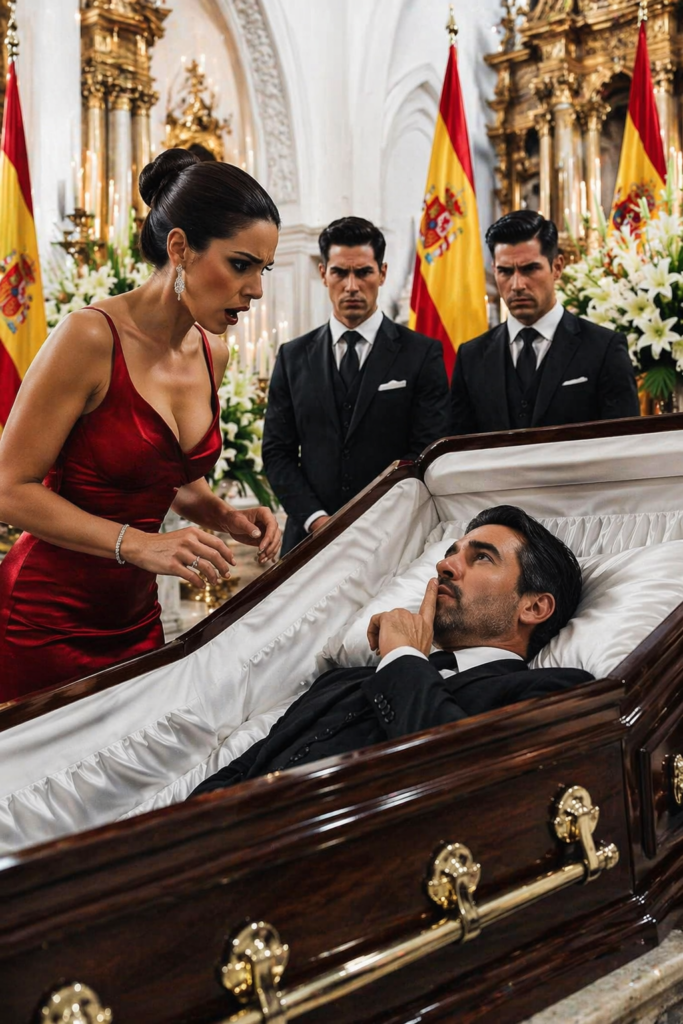
Around midnight, when people began to leave, she approached the coffin. Her husband’s face lay behind the glass, pale, motionless, with his mouth barely open.
Inés placed her palm on the wood.
—Stubborn old man —she murmured—. You said I would go first.
Then Esteban opened his eyes.
Inés felt the world bend beneath her feet.
It wasn’t imagination. It wasn’t a flicker from the candles. Esteban looked at her with fear, lifted one finger barely, and brought it to his lips.
Silence.
She wanted to scream, but Ricardo appeared behind her.
—What are you doing, Mom?
Inés held onto the coffin.
—I got dizzy.
Darío gripped her arm too tightly.
—You’re seeing things. You should sit down.
Inés looked at him. She heard no concern in his voice.
She heard urgency.
Later, at the house in Zapopan, Ricardo brought her a cup of chamomile tea.
—Drink it all. You need to be calm tomorrow.
Inés brought her nose closer.
Beneath the sweet smell was a metallic bitterness, identical to the coffee Esteban drank before “dying.”
She pretended to drink but let the liquid fall onto a napkin hidden in her lap.
Darío left a white pill on her bedside table.
—the doctor said this will help you sleep.
Inés hid it under her tongue, swallowed some water, and waited.
When her sons left, she rushed to the bathroom and spat out the pill.
Then she heard voices in the hallway.
—Montalvo will come early with the final certificate —Ricardo said—. Lawyer Baeza already has Mom’s guardianship ready.
Darío asked, trembling:
—What if Dad wakes up before the oven?
Inés held onto the sink.
They weren’t saying goodbye to her husband.
They were sending him alive to the cremation.
PART 2
Inés didn’t scream.
Not because she wasn’t scared, but because she understood that a scream could kill Esteban faster than any poison.
She waited until the house fell silent. Outside, a dog barked, and in the distance, a cart selling corn passed with a tired horn. Life continued as if inside that room there weren’t a man trapped among flowers and lies.
Inés descended barefoot, a screwdriver hidden in her sweater’s sleeve. Each step creaked like it was going to betray her.
When she reached the coffin, she pressed her ear to the wood.
—Esteban —she whispered.
At first, nothing happened.
Then she heard two weak knocks.
Inés bit her lips to keep from crying. She forced the locks until a crack opened. A chemical smell burst forth. Esteban was cold, with dry lips and sunken eyes, but he was breathing.
—Inesita… slowly —he murmured.
She wanted to lift the entire lid.
—I’ll get you out of here right now.
Esteban gripped her wrist.
—No. If they see me alive without proof, they’ll say you’re crazy. They’ve already prepared everything.
—Your sons did this.
Esteban closed his eyes.
—Our sons. And that hurts worse.
Inés felt something shatter in her chest.
Esteban spoke with difficulty. He had overheard conversations while the substance rendered him immobile. Ricardo had diverted money from the company for four years. Darío signed false sales to cover gambling debts. Dr. Montalvo received payments to declare a heart attack. And lawyer Baeza prepared papers to declare Inés incapable and leave their sons as administrators.
—they wanted to cremate me before anyone asked for an autopsy —Esteban said—. Then they would medicate you until you signed.
Inés shook her head.
—Darío wouldn’t be capable of that.
Esteban looked at her with a burning sadness.
—Darío didn’t push first, but he didn’t pull his hand away from Ricardo.
She took a deep breath.
—What do I do?
—in my office, behind the agave painting, there’s a safe. The code is our wedding date: 21-11-78. There’s a blue memory stick, false contracts, recordings, and the number of Mariana Rivas, my lawyer. Not Baeza. That guy never earned my trust.
Inés almost smiled, even with the fear hanging over her.
A noise rose from the hallway.
She closed the coffin, leaving a hidden crack beneath a flower crown.
Darío entered with his cellphone in hand. He stared at the box.
—Sorry, Dad —he murmured—. But if you didn’t let go of the company, Ricardo would sink us all.
He recorded an audio.
—Mom’s asleep. Tomorrow she signs, and it’s over.
When Darío left, Inés opened it again.
Esteban had tears in his eyes.
—We lost him.
—not yet —she said—. But he’s going to pay.
She went up to the office, opened the safe, and found the blue memory stick. She also took a letter addressed to her, receipts of transfers to Montalvo, and audios where Ricardo spoke about “lowering Dad’s pulse.”
She stored the tea in a jar, wrapped the coffee cup in a clean bag, and hid the pill in a napkin.
At 5:15, someone knocked on the service door.
It was Tomás, the family driver. He was 73, with a white mustache and shaky hands.
—Doña Inés —he said—, Don Esteban told me that if anything strange happened, I should take you to Lawyer Mariana. I heard things. Ugly things. Really ugly.
Inés didn’t ask more.
Tomás took her to a discreet office near Chapalita. Mariana Rivas was waiting for them with a chemical expert, a notary, and two agents from the prosecutor’s office.
Inés handed everything over.
Mariana listened without interrupting. Then she said:
—You’re going to come back. They must think you’re still scared. When they ask you to sign, insist on doing it in Don Esteban’s office. There are cameras there.
—And my husband?
—Tomás and a trusted doctor will get him out before the cremation. We’ll take him to a private clinic. You just hold on.
Inés returned before 7.
Ricardo was waiting for her in the dining room with folders, pens, and feigned patience.
—Where were you?
—in the garden. I couldn’t breathe.
He looked at her as if checking if a door was properly closed.
At 7:20, Dr. Montalvo arrived, well-groomed, impeccable, carrying a black briefcase. Behind him came lawyer Baeza, with a salesman’s smile.
—Doña Inés —Baeza said—, let’s make this simple. Your sons just want to protect you.
Protect her.
The word already sounded like chains.
Montalvo sat down in front of her.
—Have you had visions since last night?
Inés lowered her eyes.
—I think I saw Esteban open his eyes.
Ricardo sighed theatrically.
—See, Mom? That’s why we need help.
Montalvo wrote something down.
—Grief delirium. Very common.
Inés raised her gaze.
—is it also common for a widow’s tea to smell just like a dead man’s coffee?
The dining room fell still.
Darío paled.
Ricardo clenched his jaw.
—Sign and stop making scenes.
—Sure —Inés said—. But I want to sign in Esteban’s office. I feel closer to him there.
Baeza looked at Ricardo. Ricardo hesitated but accepted.
In the office, Inés sat in her husband’s chair. She touched the wood of the desk as if asking for strength.
Baeza placed a sheet in front of her.
—First, agree to medical accompaniment. Then the family guardianship.
—Guardianship?
—a procedure for your own good.
Inés took the pen.
—Doctor, one question. When a substance makes a living man appear dead, how long do they have before he wakes up inside the oven?
Baeza’s pen fell onto the table.
Then the door opened.
Mariana Rivas entered first, serious, with a thick folder. Behind her were two agents, a chemical expert, a notary, and Tomás, who for the first time in years didn’t enter as an employee but as a witness.
Ricardo stood up, furious.
—What the hell is this?
Mariana didn’t blink.
—An authorized procedure. And before you say this is your house, I remind you that the legal owner is Doña Inés.
Ricardo turned to his mother.
—Did you bring these people in?
Inés stood up. Her legs trembled, but her voice didn’t.
—It’s not your house.
Darío covered his face.
Mariana placed a tablet on the desk.
—We’re going to listen to something.
On the screen, Ricardo appeared, talking to Montalvo in that very office.
—I need it to look natural —Ricardo was saying—. If there’s an autopsy, everything falls apart.
Montalvo replied:
—There won’t be an autopsy if they cremate him quickly. The dose lowers the pulse, cools the body, and relaxes the muscles. Any funeral doctor would buy it as a heart attack.
Then Darío's voice was heard:
—What if he wakes up?
Ricardo answered without hesitation:
—He’ll wake up too late.
Inés closed her eyes.
A mother can endure many things: tantrums, lies, failures, bad decisions. But hearing a son calculate his father’s death as if it were a procedure tears away from a woman something that never returns whole.
The chemical expert displayed the bags.
—we have samples from the tea, from a pill, and residues from the coffee cup. The preliminary reagents match depressants capable of simulating a severe cardiac event.
Montalvo sweated.
—that doesn’t prove intent.
Mariana opened another folder.
—There are also six transfers from Ricardo Robles to an account linked with you, messages about dosages, and a certificate issued before the body’s examination was finished.
Baeza tried to speak.
—I only prepared documents with family information.
—and prepared guardianship with a false diagnosis —Mariana said—. That can also be explained to the Public Ministry.
Darío began to cry.
—I didn’t know about cremating him alive. Ricardo said it was just to pressure him, that Dad would give in and Mom would sign.
Inés looked at him as if facing a strange child wearing her son’s face.
—Was it just to pressure a 74-year-old man? Your father?
Darío fell to his knees.
—I owed money, Mom. A lot. Ricardo said if Dad didn’t sell Tequila, they were going to kill us.
Ricardo slammed the desk.
—Shut up, coward!
Mariana raised her hand.
—There’s another person who can testify.
Montalvo turned pale.
—Impossible.
From the hallway came the sound of wheels.
Everyone turned.
Esteban appeared in a wheelchair, covered with a gray blanket. He was pale, weak, with cracked lips, but alive. Tomás pushed him slowly. A doctor walked beside him.
Inés felt the air return to the world.
Darío broke down.
—Dad…
Esteban lifted a hand.
—Don’t use that word yet.
Ricardo stepped back as if the real dead man were him.
—This is a trap.
Esteban looked at him without anger. That was worse.
—I thought the same when I heard my son talk about the oven.
The agents arrested Montalvo for attempted homicide, forgery, and criminal conspiracy. Then they handcuffed Baeza.
When they went for Ricardo, he didn’t beg at first. He looked at Inés with that offended child look she had known since elementary school.
—Mom, you can’t let them take me.
Inés saw the baby she had cradled, the child who hid from firecrackers, the young man Esteban taught to drive. Then she saw the man who wanted to drug her to take away her house, her signature, and her voice.
—I gave you life —she said—. But I’m not going to gift you impunity.
Ricardo hardened his face.
—All of this was going to be ours.
Esteban breathed painfully.
—No, son. It was a responsibility. And you never learned to carry it.
They also took Darío. He was crying, but Inés didn’t rush to embrace him.
—Mom, I didn’t want to kill them.
She answered with a dry sadness:
—but you accepted that we would stop living.
The house fell silent.
The coffin remained open in the living room, surrounded by already wilting flowers.
Esteban looked at it from the wheelchair.
—to be honest, it was expensive and ugly.
Inés let out a broken laugh.
—After almost cremating you alive, you still criticize the coffin?
—If one returns from the dead, one can at least complain about the decor.
She took his hand.
—Don’t ever get into a box without telling me.
—Don’t ever open it alone.
—Then don’t pretend to be dead.
Esteban smiled faintly and closed his eyes, exhausted.
They transferred him to a private clinic. He slept for 18 hours under supervision. Inés didn’t leave his side.
The case exploded in Guadalajara. On social media, they called it “the Zapopan coffin.” Some said the sons were monsters. Others asked how many families did the same without coffins, using papers, pills, and fear.
The investigation revealed that Ricardo had emptied accounts over four years. Darío had signed false sales. Montalvo altered certificates. Baeza had prepared Inés's legal incapacity.
Esteban’s true will protected half of the assets for his wife. Another part went to a foundation for elderly people abused by their families. His sons would only receive shares if they worked for five years under audit.
Ricardo discovered that.
That’s why he was in a hurry.
That’s why Esteban had to disappear.
The trial lasted months. Ricardo never apologized. In one hearing, he said his father humiliated him by not trusting him with the company.
Esteban responded:
—I entrusted my last name to you. The rest you had to earn.
Darío confessed and received a lighter sentence, but he didn’t come out clean of anything. From prison, he wrote letters. Inés kept them unopened for a long time.
One dawn, she read the first one.
“I don’t ask for inheritance or forgiveness. I just want to say that keeping quiet was another way of killing. I didn’t put the poison, but I saw the cup. I didn’t close the coffin, but I let them close it. I didn’t give you the pill, but I accepted that they did. I chose wrong, Mom.”
Inés cried until dawn.
Then they sold the big house, not to a developer, but to an association that turned it into a legal center for the elderly. They named it Casa Agave.
There, Inés repeated to anyone who came in fear:
—Blood doesn’t grant the right to take away your voice. If your family loves you, they don’t need to destroy you to obey.
Years later, Darío was released from prison and worked in a carpentry shop in Tonalá. Inés and Esteban went to see him. He didn’t ask for hugs. He just left the sander on a crooked table and cried silently.
Esteban touched the wood.
—it’s uneven.
—Esteban —Inés scolded him.
Darío let out a broken laugh.
—Yeah. It’s crooked.
Esteban ran his hand over the table.
—Then it can still be fixed.
No one talked about forgiveness.
No one talked about forgetting.
They bought the table and placed it in the patio of Casa Agave. The glasses tilted a bit, and Esteban said that gave it character.
Ricardo never wrote. He never asked about his parents. In seven years, he only sent a legal request to review the will.
That too was an answer.
One afternoon, under a bougainvillea, Esteban had coffee with Inés and looked at the patio filled with elderly people receiving advice.
—Thank you for not drinking the tea —he said.
She rested her head on his shoulder.
—Thank you for opening your eyes.
In the distance, the tamale cart sounded. Guadalajara remained alive, noisy, stubborn.
Inés understood that her story didn’t end inside a coffin.
She began again the day she decided to believe what she saw, even though her own children tried to convince her she was crazy.
Because sometimes surviving the family is also a form of justice.
And defending one’s own life, no matter how painful, is the last act of love that no one should ever have to apologize for.