PART 1
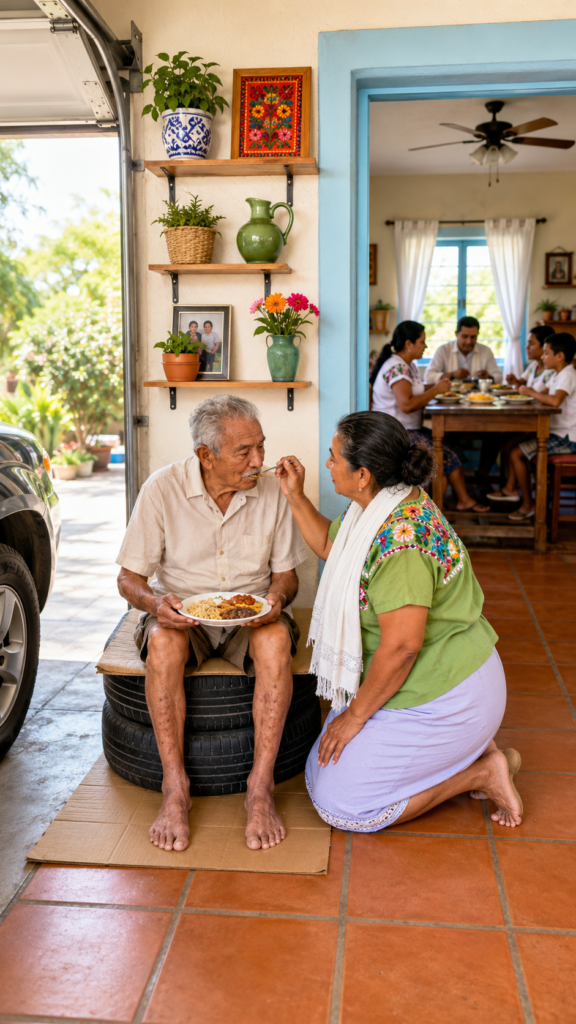
Pedro was made to eat on the floor of the garage, on a crushed cardboard box, wedged between a spare tire and some old buckets.
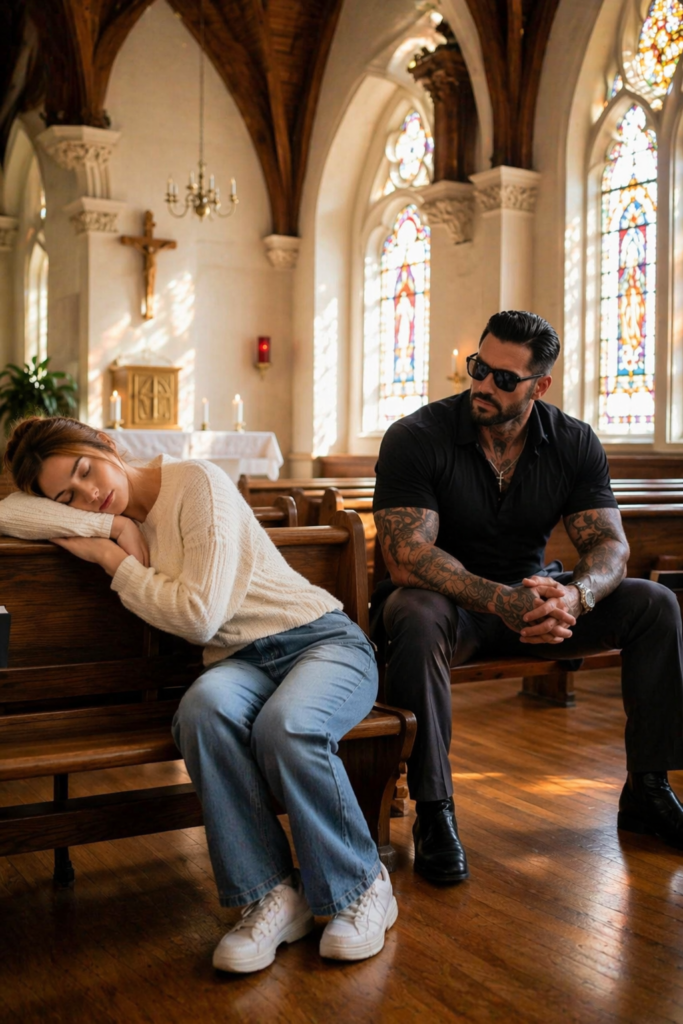
Inside, however, there was a white tablecloth, pots of mole poblano, and twelve places set for Liliana’s prayer group.
Pedro suffered from advanced Parkinson’s. His right hand trembled so violently that the spoon rarely reached his mouth filled.
Liliana felt ashamed for her guests to see him spill soup.
Carmen, his wife, was showering when she heard a shout from the hallway.
—Get him out of here! It makes me nervous to see how he makes a mess.
The girl who helped around the house tried to protest, but Liliana pointed to the garage.
—Let him eat out there. Put a cardboard under him. He won't even notice.
Carmen emerged with wet hair and bare feet. She crossed the living room while six women prayed with their eyes closed around a table full of food.
Among them was Doña Carmela, a woman from her old parish, famous for preaching the love of one’s neighbor.
None of them opened their eyes.
In the garage, Pedro had the plate on his lap. He chased a piece of chicken with the spoon, but his hand wouldn’t obey.
He didn’t lift his gaze when Carmen approached.
That was what hurt him the most.
Pedro had been the man who, for 44 years, got up before her to leave coffee next to her bed.
Even when they had no money, he would break the bread in half and give her the bigger piece.
Now he sat like a burden, staring at the cement.
Carmen returned to the living room and confronted her daughter-in-law.
—How dare you? You spend your whole day talking about God.
Liliana adjusted the gold cross she wore around her neck.
—Don’t start, Carmen. I need to protect my energy. Your husband disrupts the atmosphere and my guests come to heal.
—He’s a sick man, not an animal!
—It’s my house. If you don’t like it, take him away. Let’s see how long you last taking care of him by yourself.
The phrase hit Carmen in the chest because it touched on a guilt that no one knew.
A week earlier, while washing dishes with Liliana, she had cried from exhaustion.
She had said she couldn’t stand the sound of the spoon clinking against the plate, that living in a constant state of attention to Pedro was robbing her of peace.
She said it in a moment of desperation.
And Liliana hadn’t forgotten.
But Carmen didn’t know that Pedro had heard her from the hallway.
Liliana took her bag, her Bible, and her shawl.
—I have a healing mass. When I come back, I expect this to no longer be a drama.
She left without looking back at the garage.
Carmen returned to Pedro, sat on the cement, and began to feed him slowly.
He continued to avoid her eyes.
Then the house fell silent.
Their son Mauricio had come back early from work.
He stood in the back door, jaw clenched and eyes filled with tears.
He saw his father on the cardboard.
He saw his mother kneeling in front of him.
And he also saw something in the plate that neither of them had noticed yet.
Mauricio didn’t scream.
He simply stepped inside, grabbed the house keys, and began to pack.
When Liliana returned from praying, she would discover that her family had made a decision capable of destroying her marriage forever.
PART 2
Liliana returned two hours later, still scented with incense and talking on the phone about how powerful her prayer had been.
The house was too quiet. She found no sign of Mauricio in the living room or her in-laws in the back room.
On the table lay a folded sheet of paper. Her husband’s handwriting said:
“Today I realized that your prayers are just noise. You cannot love a God you cannot see while humiliating the person in front of you. I’m taking my parents. You can keep your spiritual peace and your empty house.”
Liliana read the note three times. Then she shouted that Carmen had manipulated Mauricio and called her friends, but none wanted to return.
Meanwhile, Mauricio was settling his parents into a small apartment in Puebla. There were two bedrooms, a narrow kitchen, and a living room that barely fit a sofa.
—There’s nothing extra here —he said—, but they will never treat my dad like he’s a nuisance again.
Carmen wanted to hug him, but Mauricio stepped back. He placed the plastic plate from the garage on the table, covered with a cloth napkin.
—He heard you —he said softly.
Then he entered his room and closed the door.
Carmen remembered the night of the dishes when she confessed that Pedro took away her peace. She had thought the house was asleep.
The next morning she sought Mauricio.
—How much did your dad hear?
—Everything.
That night Pedro had gotten up to go to the bathroom. Hearing his name, he stopped in the hallway and heard Carmen say that she could no longer watch him tremble.
He didn’t claim. The next morning he tried to get up early to prepare her the usual coffee.
His hand failed, and the cup fell to the floor.
Mauricio found him on his knees, picking up the pieces with trembling fingers so Carmen wouldn’t wake up.
—He was crying, Mom. He apologized because it would be the first morning in 44 years that he couldn’t leave you coffee.
Carmen covered her mouth.
The memory took her to the room where she and Pedro began their marriage. They had no dining table or refrigerator, just a stove, a mattress, and two chipped cups.
Pedro went to work at 5 in the morning. Even so, he would heat water and cover Carmen’s coffee with a plate to keep it warm.
He said no woman should wake up alone in the dark.
For 44 years, she received that gesture. Over time, she stopped thanking him, as if love were a tap that would always have water.
—I love him —she murmured—. I was just tired.
—I know —Mauricio replied—. But he knows it too. And that’s the worst part.
Carmen spent hours in front of the covered plate without touching it. She needed to understand why her son had arrived just when Pedro was in the garage.
Mauricio could no longer hide it.
—I didn’t arrive by chance. I had been looking for weeks for a place to bring them.
Pedro had mornings when his mind cleared. In those hours, he would secretly call Mauricio.
He didn’t ask for a better house. He asked him to take Carmen away and leave him in any public nursing home.
—He would say: “Your mom has done her part. I took care of her for 44 years. I don’t want her to remember me as the man who took away her peace.”
Carmen felt the air disappear.
—Were you going to abandon him?
—No! That’s why I took so long. It was easy to find a place for one. The hard part was finding something for all three of us.
Mauricio had sold his car and taken out a loan. Liliana knew he was gathering money and planning to leave with his parents.
For months they debated. She said their house was not a clinic, that the smell of medicines scared her friends, and that Pedro’s tremors opened an old wound.
Her own mother had died from a similar illness. Liliana had cared for her since she was thirteen, listening to the sound of a spoon hitting a plate for years.
Then she sought refuge in religious groups that promised healing and “clean energy.” Pedro’s arrival brought her back to the room she had been fleeing from for half her life.
Carmen understood her fear, but not her cruelty. Pain could explain why she distanced herself, not why she made an old man eat on the floor.
That afternoon, Liliana arrived at the apartment and demanded to speak with Mauricio.
—Your mother is turning you against me. No one thinks about what I lived through.
Mauricio opened the door but didn’t let her in.
—Being scared doesn’t give you the right to humiliate him.
—Your mom said first that she could no longer stand him!
Carmen felt her blood run cold. Liliana had kept her confession as a weapon.
—I was the one —Carmen admitted—. I said it. And he heard me.
Liliana smiled, believing she had won.
Mauricio shook his head.
—My mom was wrong and ran to him. You saw the same thing, grabbed your Bible, and left. Seriously, don’t make things up: that’s not faith.
Liliana began to cry. For the first time, she didn’t seem like the impeccable woman in the photos but a scared girl in front of a hospital bed.
—I couldn’t live through that again —she whispered.
—Then you should have asked for help, not made my father pay for your fear.
Mauricio closed the door.
Carmen didn’t feel triumph. She understood that fear and malice could wear the same face, but they didn’t produce the same act.
That night she entered Pedro’s room. He lay under a light blanket, staring at the lamp.
Carmen knelt and took his trembling hand.
—Forgive me. It wasn’t you who took away my peace. It was my fatigue and my embarrassment of not being able to handle everything.
Pedro turned his head. She didn’t know if he recognized her.
—I want to stay with you. Even when I’m tired, even when I cry, and even when I have to ask for help.
Pedro squeezed her hand.
Maybe it was an answer. Maybe it was just the tremor.
Carmen cried because sometimes the courage to ask for forgiveness comes when the other’s memory is already closing the door.
She fell asleep on the floor, next to the bed, holding onto his arm.
At dawn, she returned to the kitchen. The plate from the garage still sat on the table.
She took a deep breath and lifted the napkin.
Underneath was a piece of chicken, two spoonfuls of rice, and a little folded tortilla, carefully set aside.
Pedro had hardly eaten. Getting each bite to his mouth was a battle for his hand.
But what little he managed to collect, he hadn’t taken to his mouth.
He set it aside for Carmen.
Sitting on the cardboard, hearing that he was a nuisance and knowing that his wife had said she could no longer stand caring for him, Pedro still thought to save her the best part.
Mauricio had seen him hide the food under the napkin. That’s why he took the entire plate.
For years, when there was only one piece of meat, Pedro would give it to Carmen and swear that he had already eaten at the factory.
He shared his hunger with her.
In the garage, he did the same with the last bit his body could still control.
Carmen crumbled in front of the table.
She cried for the coffees she had received without gratitude, for that night in the kitchen, and for the seconds it took to run to Pedro.
The food was cold and hard. She too had arrived late to that act of love.
She didn’t throw the plate away. She washed it, dried it, and placed it alone on the highest shelf.
From then on, every morning she prepares coffee for Pedro. She leaves it on his bedside table covered with a small plate, just as he did for 44 years.
Then she serves breakfast on the plastic plate from the garage and sets aside the biggest piece for him.
There are days when Pedro no longer knows who she is. Even so, he accepts the spoon when Carmen sits beside him.
Mauricio knows that his mother is no saint and that his father doesn’t need a martyr. They need help and the courage to say “I can’t do this anymore” before turning exhaustion into cruelty.
With part of the loan, Mauricio hired a caregiver three afternoons a week. This way, Carmen could sleep, go to the market, or sit in the park without feeling guilty.
She understood that asking for rest didn’t mean stopping loving. The danger began when exhaustion hid until it transformed into contempt.
Liliana was left alone in the big house. Some condemned her; others said Carmen was guilty too.
But Mauricio never changed his mind.
Anyone could make a mistake. What revealed a person was what they did afterward, after seeing the damage.
Carmen looked and returned.
Liliana looked and left.
Every morning, when Carmen's hand trembles while bringing the coffee, it’s not from illness.
It trembles from memory.
And while Pedro slowly eats the best part of the plate, she hopes that in some corner of his mind, there is still a certainty:
this time, the one who keeps the best for him is the woman who chose to sit by his side.