PART 1
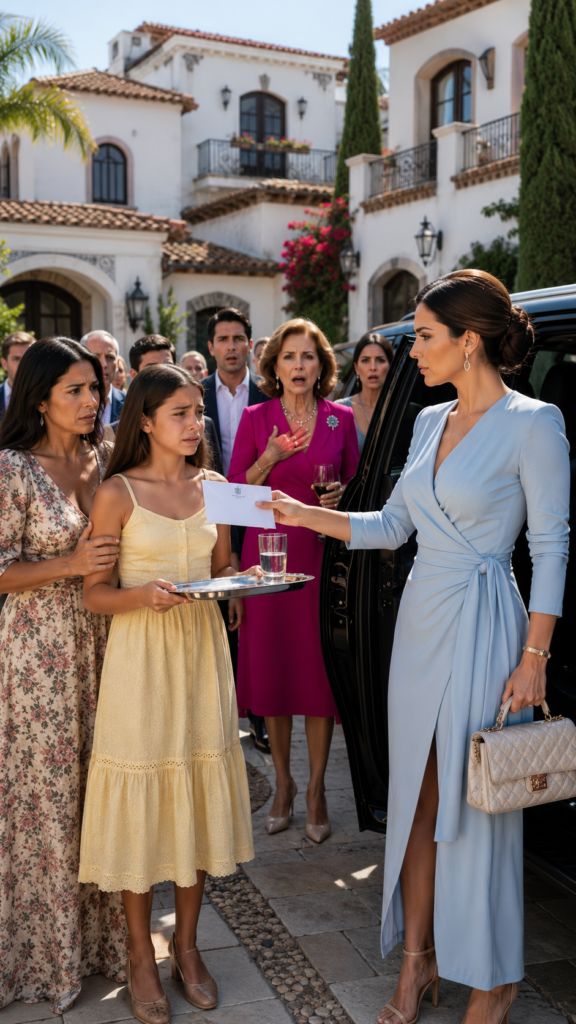
—Let Valeria serve the drinks. She has to be useful for something, right? —Berenice flung this at the entire family, thrusting a tray into Valeria's hands.
Laughter from several guests mingled with the sound of the grill.
Valeria, 14 years old, wore a simple yellow dress, purchased with the money she had saved from babysitting her neighbor's twins. It wasn’t designer, but she had chosen it with excitement.
Mariana, her mother, watched as the girl lowered her gaze.
Her blood boiled.
The gathering was at Berenice’s house, in a private neighborhood in Querétaro, complete with pristine gardens, electric gates, and neighbors who seemed to have no problems.
Doña Socorro, the mother of the two sisters, had insisted all week.
—You can’t keep Valeria away from her family —she told Mariana—. Then don’t complain when she grows up resentful.
But Mariana knew these gatherings well.
Berenice always found a way to brag about her husband’s construction business, her children attending private school, and how she’d never had to count coins to pay rent.
Mariana, on the other hand, worked at a stationery store and sold food on weekends.
Since she arrived, Berenice had scrutinized Valeria from head to toe.
—What a curious dress. Did they sew it at the middle school?
Laughter erupted.
Valeria pretended not to hear.
—I think it’s beautiful —Mariana said.
—Oh, sister, don’t take it personally. It’s a joke. Seriously, everything offends you.
Minutes later, Berenice had Valeria serving drinks while her own children played on their phones.
The teenager searched for her mother with her eyes.
Mariana wanted to take her away immediately, but Doña Socorro squeezed her arm.
—Don’t make a scene. She needs to learn to socialize.
Valeria walked between the tables with flushed cheeks. No one thanked her.
Then Berenice struck again.
—Hey, Vale, are you sure you bought that dress? It looks like it was made from a curtain.
This time the laughs grew louder.
Valeria blinked to hold back tears.
Mariana let go of her mother’s arm.
—That’s enough. My daughter didn’t come here to be humiliated.
Silence fell in the yard.
Berenice crossed her arms.
—Well, if she can’t handle a joke, the world will eat her alive. You’ve raised her too sensitive.
—She’s not sensitive. You all are cruel.
Doña Socorro stood up, furious.
—Respect your sister. Thanks to her, you’re still invited to these gatherings.
The words hit like a slap.
Valeria set the tray down on the table.
—Let’s go, Mom —she whispered.
Mariana grabbed her bag.
But before they could reach the door, the roar of an engine made everyone turn.
An elegant black truck with tinted windows halted in front of the house.
A tall woman stepped out, dressed in an ivory suit. She carried a white folder and walked with a confidence that silenced all conversations.
Berenice fixed her hair, thinking she was there to see her.
The stranger didn’t even glance her way.
She crossed the yard and headed straight for Valeria.
The young girl still had wet eyes.
The woman bent down in front of her, smiled, and said:
—Valeria Salgado, we finally found you. I’m here to take you to the ceremony where your national scholarship will be announced.
The tray slipped from Berenice’s hands.
And when the woman opened the folder, Doña Socorro turned so pale that Mariana realized this visit carried not just a scholarship but a truth capable of destroying the entire family.
PART 2
—What scholarship? —Berenice asked, regaining her voice—. This must be a mistake.
The woman took off her glasses.
—I’m Renata Alcázar, director of the link for the Jóvenes Creadores Monteluz program. Valeria’s middle school counselor submitted her portfolio to a national call.
Mariana looked at her daughter.
She knew Valeria sketched clothes in old notebooks, but she never imagined someone else would see those designs.
Renata opened the folder.
—We received over 400 proposals from all over Mexico. Valeria was selected for a full scholarship for six weeks in Mexico City. It includes accommodation, transportation, materials, and mentorship with professional designers.
—Did my drawings win? —Valeria asked.
—Not just won. The jury said you have a unique voice and an extraordinary way of turning memories into design.
Mariana felt tears welling up in her eyes.
Berenice, on the other hand, let out a dry chuckle.
—How strange that you show up unannounced. Besides, are you really taking her dressed like that?
Renata glanced at the yellow dress.
—That dress is actually featured in one of her projects. Valeria explained that she bought it with her savings because she wanted to remember that not everything valuable needs a pricey label.
Berenice fell silent.
Mariana stepped closer to her sister.
—Ten minutes ago you said it looked like a curtain.
—Oh, come on, don’t exaggerate.
—No. You’re going to listen today. You mocked her because you thought she had nothing to show off.
Doña Socorro intervened.
—Mariana, be grateful for the news and review the papers at home. You’re not handing the girl over to a stranger.
Renata extended the official documents.
—We attempted to reach you several times —she explained—, but the registered number no longer worked. The counselor told us we would find Valeria here today. The welcome ceremony is tonight.
Valeria glanced at her mother, fear in her eyes.
—Can I go?
Mariana read each page.
Everything was legitimate.
That scholarship was a door Valeria had opened without anyone’s help.
—Yes —she replied—. You’re going.
Valeria began to cry.
Mariana hugged her, but before they walked toward the truck, Doña Socorro launched a venomous remark.
—I hope it doesn’t go to her head. That girl turned out just as dreamy as her father. Always believing she deserves more than she has.
Renata paused.
She rifled through the folder and pulled out a plastic-protected envelope.
—How curious that you mention her father.
Doña Socorro lost color.
Berenice dropped her gaze.
Mariana felt a chill.
—What does he have to do with the program?
Renata took a deep breath.
—Monteluz isn’t just the name of the institution. It’s the last name of its founder: Diego Monteluz Rivera.
Mariana felt the ground disappear.
Diego.
The man who, according to her family, fled upon learning of the pregnancy.
For 14 years, Mariana had repeated the same story: Diego didn’t want to be a father, never asked about Valeria, and never sent a single peso.
It was what Doña Socorro and Berenice had assured her.
—There are many men with that name —the grandmother quickly said.
Renata didn’t let herself be intimidated.
—Diego Monteluz passed away three years ago. When we reviewed his file, we found letters addressed to Mariana Salgado and documents where he mentioned having a daughter named Valeria.
The teenager looked at her mother.
—Did my dad found this program?
—It seems so —Mariana answered, nearly voiceless.
Renata handed her a copy of the letter.
Mariana recognized the handwriting immediately.
Diego explained that he never left willingly. He detailed how Doña Socorro assured him that Mariana didn’t want to see him again and that if he insisted, she would report him for harassment.
He also wrote that he returned three times.
On all three occasions, Berenice and her mother chased him away.
They returned gifts, letters, and a small dress he had bought for the baby.
Mariana lifted her gaze.
—Did you do this?
—That man wasn’t right for you —Doña Socorro replied—. He had no money or future. I protected you.
—You stole 14 years of truth from me.
—I spared you from disaster.
Renata pulled out more documents.
—There are also records of rejected transfers. Diego tried to send money for years. Someone responded, in Mariana’s name, that she wouldn’t accept anything.
—I never signed that —Mariana said.
Berenice pressed her lips together.
Doña Socorro fell silent.
And that silence was a confession.
Valeria looked at her grandmother.
—Did my dad really know I existed?
The woman didn’t respond.
—I asked you something, Grandma.
Renata spoke gently.
—Yes, Valeria. He knew about you. In his letters, he says he wanted to meet you and that he created part of the program thinking of talented young people whom no one gave a chance.
Valeria brought a hand to her mouth.
She only looked at Berenice and Doña Socorro with a pain that made everyone uncomfortable.
—You always treated me as if my mom and I should be grateful to sit at your table —she said—. And while you mocked me, you knew my dad hadn’t abandoned me.
Berenice tried to approach.
—Don’t mix things up, Vale. Adults make tough decisions.
Valeria stepped back.
—You just had me serve drinks because you thought I was worth less than your children. Of course it has to do with it.
No one could contradict her.
For years, they were told they were too sensitive.
The truth was different.
Their family needed to keep them small to feel superior.
Doña Socorro tried to regain control.
—Mariana, don’t do this in front of everyone. Let’s talk about it privately.
Mariana let out a bitter laugh.
—Now you want privacy? You didn’t care that they humiliated my daughter in front of everyone. You only worry that now they are looking at you.
Uncle Arturo set down his plate.
—Socorro, did you really hide the letters?
The grandmother lifted her chin.
—I did what any mother would have done.
—No —Mariana replied—. A mother protects. You decided for me, forged my will, and let my daughter grow up believing she wasn’t wanted.
Berenice exploded.
—Enough! Diego was a deadbeat. Mom prevented you from ruining your life.
Renata looked at her seriously.
—That “deadbeat” created a foundation that has supported hundreds of students. In his notes, he wrote that his greatest pain was not being able to help his own daughter.
The words pierced Valeria.
Tears began to fall silently.
Mariana hugged her.
But she could stop this family from continuing to write her story.
—Is the ceremony still on? —she asked.
—Yes —Renata replied—. And you are not obligated to decide now.
Mariana looked at Valeria.
—Do you want to go?
The young girl observed the relatives who had laughed at her dress just moments before.
Then she looked at the truck.
—Yes. I want to go.
—Then let’s go.
Berenice let out a laugh.
—Of course, run away. As always. Then you’ll say the whole family is bad.
Mariana turned around.
—We’re not leaving to elicit pity. We’re leaving because my daughter has a life waiting for her, and you will no longer decide how much she can shine.
Doña Socorro placed a hand on her chest.
—Are you going to take my granddaughter away?
—You lost her when you preferred to see her humiliated rather than admit the truth.
Valeria grabbed her backpack.
Before getting into the truck, she picked up the tray of drinks and handed it to Berenice.
—I think this belongs to you.
Then she closed the door.
During the ride to Mexico City, she held Diego’s letter against her chest.
At the ceremony, she entered wearing the same yellow dress.
—Do you think my dad would be proud? —she asked that night.
Mariana swallowed hard.
—Very much.
For six weeks, Valeria changed.
She learned design techniques, met students from Oaxaca, Monterrey, and Guadalajara, and discovered that her ideas weren’t “little doodles,” as Berenice used to say.
They were stories.
At the final presentation, she showcased a piece inspired by the yellow dress: a skirt with soft layers, Mexican embroidery, and a silver bracelet sewn into the sleeve, just like the one she wore at the barbecue.
The audience stood and applauded.
Mariana wept in the front row.
After the event, Valeria ran to her.
—Mom, I did it.
—No, my love. You just started.
Upon returning to Querétaro, Mariana found dozens of messages.
None said “sorry.”
All asked her not to make the problem bigger, to think of family, and to understand that Doña Socorro was suffering.
Mariana didn’t respond.
Months later, Valeria was accepted into an advanced arts program. She began to participate in class, to defend her ideas, and to stop apologizing for taking up space.
One afternoon, while sorting through clippings, she touched Diego’s letter.
—I used to think I didn’t belong anywhere —she said—. Now I think I was just surrounded by people who didn’t want to see me.
Mariana looked at her with pride.
—You were never the problem. The problem was those who needed to make you small to feel big.
They never returned to Berenice’s house.
Doña Socorro never apologized.
She only wrote: “I hope one day you get over this.”
But Mariana had already understood something that no one would ever make her forget: family peace isn’t worth the soul of a daughter, and sharing blood doesn’t turn cruelty into love.
At that barbecue, they tried to teach Valeria what her “place” was.
They gave her a tray.
They laughed at her dress.
They treated her like a second-class guest.
Yet she didn’t need a spot at that table.
She was destined to build her own.