PART 1
No one in the lobby of the Golden Cloud Hotel imagined that the man in the soaked jacket, worn-out sneakers, and a sleeping girl in his arms was the owner of the entire building.
It was almost midnight in Mexico City. Outside, rain poured down hard on Paseo de la Reforma, as if the sky had split open. Cars splashed water everywhere, and the hotel entrance gleamed with marble, elegant lamps, and impeccably dressed staff.
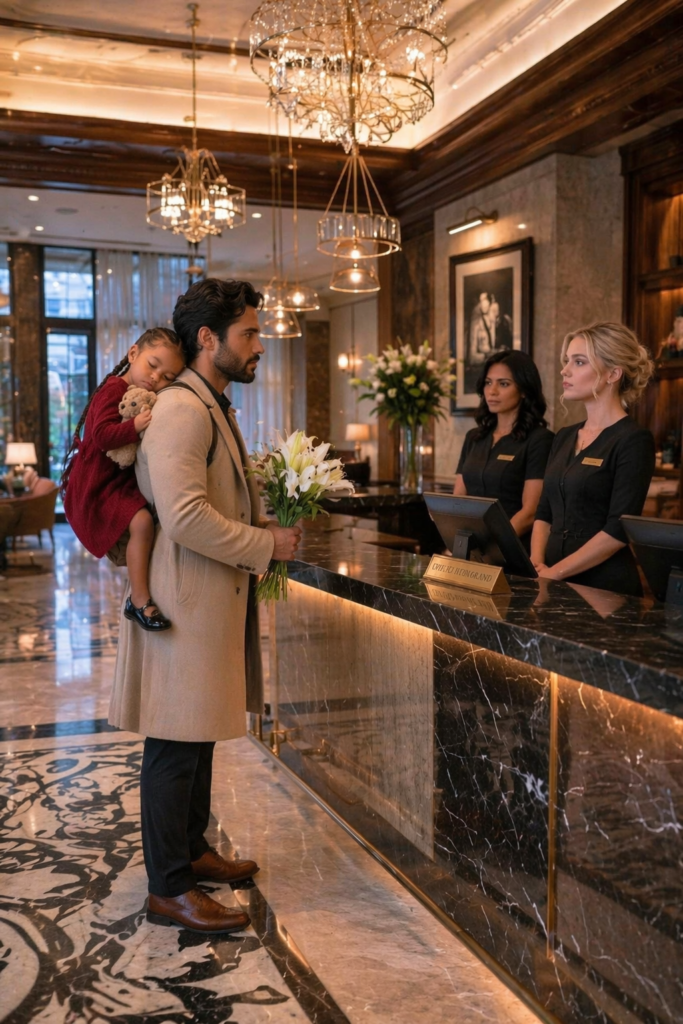
Leonardo Salvatierra entered, carrying his daughter Renata, who was eight years old. The little girl was fast asleep, her face pressed against his chest, clutching a rag doll tightly in her arms.
They had arrived from Mérida. The flight was delayed by four hours due to the storm, Renata had a fever, and all Leonardo wanted was a clean room, a hot shower, and silence.
He hadn’t called ahead.
He hadn’t asked for special treatment.
He hadn’t contacted the manager.
Leonardo preferred to visit his hotels unannounced. He believed true service wasn’t visible when someone arrived in a suit and an expensive watch, but when a tired, wet person who looked like they had no money walked in.
His mother, Doña Aurelia, taught him that, having worked 26 years cleaning rooms in luxury hotels in Acapulco. She would come home with her hands raw from bleach, yet always said:
—Son, no one is worth more for paying for a suite, nor less for making that bed.
So, when Leonardo founded Salvatierra Group, he had a bronze plaque placed at every reception:
“Before being a guest, every person deserves dignity.”
That night, beneath that plaque was Iván Robles, the night receptionist. He wore a perfect uniform, his hair slicked back, and a smile that lit up or dimmed depending on the customer's shoes.
When he saw Leonardo, his smile died.
—Good evening —Leonardo said softly—. I need a room for my daughter and me. Any room will do.
Iván looked at the soaked jacket, the old backpack, and the muddy sneakers.
—Sir, this hotel operates on reservations.
—I understand. It was a complicated trip. I can pay right now.
Iván didn't even check the screen properly.
—This is not an economy hotel, sir.
The phrase fell like a humiliation.
Leonardo took a deep breath and adjusted Renata in his arms.
—I just want to sleep for a few hours. My daughter isn’t feeling well.
—We’re full.
—Is there no room left?
—None. There are simpler hotels a few blocks away. Maybe they will take you there.
Leonardo remained silent.
At that moment, an elegant couple walked in. The man wore a shiny watch. The woman had on a beige coat, high heels, and a designer suitcase.
—We don’t have a reservation —the man said—, but we’d like to stay tonight.
Iván’s face changed in one second.
—Welcome to the Golden Cloud. Of course, we’ll be happy to assist you.
Leonardo watched as a room appeared in less than two minutes. They were also offered breakfast, a spa, and a view of Reforma.
Renata stirred slightly.
—Dad… are we going to sleep now?
Leonardo kissed her warm forehead.
—In a bit, my love.
When the couple stepped into the elevator, Leonardo returned to the counter.
—I want to speak to the manager.
Iván swallowed hard.
—Sir, it has already been explained to you.
—Call the manager.
The night manager appeared from an office at the side. His name was Octavio Beltrán. He was 49, wore a dark suit, and had that look that made people feel small.
Iván approached him and whispered something. Octavio listened without looking at Leonardo.
When he walked toward him, he was already determined.
—Sir, we have no availability.
—You just gave a room to a couple without a reservation.
Octavio smiled with contempt.
—My staff knows how to distinguish when a request is viable.
Leonardo looked at the bronze plaque behind them.
—Distinguish based on what?
Octavio didn’t answer.
Renata opened her eyes wide. She saw the rain, the guards approaching, and her father’s serious face.
—Dad, why are they treating us like we did something wrong?
The lobby fell silent.
Octavio hardened his voice.
—Sir, I’m going to ask you to leave. You are disturbing our guests.
Leonardo tightened his embrace around his daughter.
—My daughter is sick.
—Security —Octavio ordered.
Two guards approached.
Renata clung to Leonardo's neck.
—Are they going to throw us out into the street?
Octavio pointed to the wet door.
—Take them outside.
Then Leonardo pulled out his cell phone, dialed a number, and said with a calmness that froze the entire lobby:
—Come down now. Bring legal and human resources. Yes, it’s me.
PART 2
Octavio let out a dry chuckle, as if he had just heard a ridiculous threat.
—Sir, calling your acquaintances isn’t going to change the hotel’s rules.
Leonardo put his phone away without breaking eye contact.
—I’m not calling acquaintances.
Iván lowered his eyes to the computer. His fingers trembled, though he still tried to pretend everything was under control.
In the lobby bar, two tourists stopped talking. A woman with an expensive bag took off her glasses to see better. A waiter froze with a tray of glasses in hand.
The rain hammered against the windows like stones.
Renata hugged her rag doll.
—Dad, I don’t want to sleep on the street —she whispered.
Leonardo felt those words break something inside him.
—You’re not going to sleep on the street, my love.
Octavio adjusted his jacket.
—Then I suggest you find another place before it gets later.
Leonardo looked at him with cold sadness.
—Is this how you treat a father with a sick daughter?
—I deal with rules, sir.
—No. You deal with prejudices.
Octavio stepped toward him.
—Look, I don’t know what you’re used to, but we care about the hotel’s image here.
Renata lifted her face.
—Do we make the hotel look bad?
No one said anything.
The question from an eight-year-old girl laid bare the cruelty that the adults wanted to disguise as protocol.
Iván turned pale.
One of the guards, the youngest, clenched his jaw and looked at the floor. It was clear he was embarrassed.
Octavio, on the other hand, didn’t stop.
—Take them away.
The young guard hesitated.
—Mr. Manager, it’s raining very hard…
—I said to take them away.
Leonardo took a step back, not out of fear, but to shield Renata with his body.
—Let’s be clear: you are throwing out a sick minor in the dead of night, after denying a room that indeed existed.
Octavio raised his voice.
—You’re not going to come here and teach me how to run this hotel.
At that moment, the private elevator at the back chimed.
The doors opened.
First came Mariana Echeverría, executive director of Salvatierra Group, with her hair tied back and a tense face. Behind her were Arturo Mena, head of human resources, and lawyer Paula Cárdenas, legal director.
The three hurried across the lobby.
Octavio frowned.
Iván stopped breathing.
Mariana didn’t greet anyone. She walked straight to Leonardo, stopped in front of him, and lowered her head.
—Mr. Salvatierra, I apologize for the delay.
The entire lobby froze.
The woman with the expensive bag opened her mouth.
The waiter almost dropped the tray.
Octavio lost color in his face.
Renata looked at Mariana and then at her dad.
—Do you know her?
Leonardo stroked her wet hair.
—Yes, my love.
Mariana turned to the staff.
—To eliminate any doubt: he is Leonardo Salvatierra, founder and owner of Salvatierra Group. This hotel, this brand, every uniform, every room, and every lamp in this building exist because he built them.
Iván had to lean against the counter.
Octavio tried to speak.
—Mr. Salvatierra, if we had known you were…
—That’s the problem —Leonardo interrupted—. You didn’t know who I was. So, you treated me as you think one can treat someone without power.
Octavio swallowed hard.
—It was an operational misunderstanding.
—It wasn’t a misunderstanding. Iván denied me a room without checking properly. Then he gave it to a couple without a reservation. You defended that, said my presence was disturbing, called security, and ordered me to be thrown out into the street with my sick daughter.
Renata tightened her grip on her doll.
Leonardo looked at the bronze plaque behind the reception.
—My mother cleaned rooms for 26 years. In hotels like this, many guests wouldn’t even look her in the face. Still, she taught me that dignity doesn’t depend on clothing, last name, or bank card.
His voice didn’t tremble, but his eyes were wet.
—I didn’t build these hotels for someone in an expensive suit to humiliate another human being over Italian marble.
Octavio looked down.
—Sir, I can correct this. Tomorrow we’ll have a meeting and review protocols.
—No.
That word was low, but definitive.
Leonardo stepped a little closer.
—you didn’t lose your judgment out of exhaustion. You showed who you are when you thought no one important was watching.
Octavio pressed his lips together.
—I’ve been working here for nine years.
—And in those nine years, how many people left humiliated without being able to call the owner?
No one breathed.
The question weighed more than any scream.
Leonardo looked at Arturo, the head of human resources.
—Take the minutes. Octavio Beltrán is immediately terminated from his position. We’ll review cameras, previous complaints, and internal orders.
Octavio’s eyes widened.
—Are you firing me over a misunderstanding?
—No. I’m firing you for turning service into classism.
Octavio clumsily removed his badge. He searched for support with his gaze, but no one held his eyes.
Not Iván.
Not the guards.
Not the guests.
He walked toward the side office with a stiff back, as if he still wanted to appear important. But when he closed the door, he was no longer a manager. He was just a man who had lost his position for mistreating someone he thought defenseless.
Leonardo turned to Iván.
The receptionist cried silently.
—Mr. Salvatierra, I’m sorry. Really. I didn’t know…
—You didn’t know he was the owner —Leonardo said—. That is already clear.
Iván looked down.
—I made a mistake.
—You made a mistake before you touched the keyboard. You saw my clothes, you saw my sleeping daughter, you saw my old backpack, and you decided we didn’t belong here.
Iván couldn’t respond.
—I’m not going to fire you tonight.
The young man looked up in surprise.
Leonardo continued:
—But starting tomorrow, you will leave reception. You’re going to take complete training in service, dignity, biases, and humane treatment. Plus, you’ll work three weeks with housekeepers, bellboys, kitchen staff, and maintenance.
Iván blinked.
—Also with cleaning staff?
Leonardo took another step closer.
—Especially with cleaning staff. I want you to see the hotel through the eyes of those who work the hardest and are seen the least.
Iván nodded, broken.
—Yes, sir.
—And when someone arrives wet, poorly dressed, afraid, or with children in their arms, you will remember this night.
Then Leonardo looked at a young concierge who had remained near the tourist brochures. Her name was Tania, she was 30 years old, and her eyes were filled with guilt.
—You saw everything —he said.
Tania swallowed hard.
—Yes, sir.
—You wanted to intervene.
She clenched her hands.
—Yes, but I was scared. Octavio had already fired two colleagues for contradicting him in front of guests. I thought if I spoke up, it would happen to me.
Mariana looked at Arturo harshly.
Leonardo took a deep breath.
—Then the problem wasn’t just Octavio. It was an environment where decent people learned to stay silent to keep their jobs.
Tania looked down.
—I’m very sorry.
—I don’t want you to feel sorry. I want this to change.
Leonardo pointed to the lobby.
—Starting tomorrow, Tania will be the supervisor of guest experience during the night shift. And there will be a new protocol: any employee can stop an unjust decision without fear of retaliation.
Tania placed a hand on her chest.
—Me?
—You saw the injustice. That already puts you above those who preferred to hide it.
The legal director took notes.
Leonardo asked to review the actual availability. There were 17 rooms free.
When Mariana offered him the presidential suite, he shook his head.
—A standard room. That’s what I asked for from the beginning.
Renata gently tugged at her dad's sleeve.
—Are they going to let us sleep now?
Some people let out a small, nervous laugh of relief.
Leonardo smiled wearily.
—Yes, my love. Now they will.
They went up to the sixth floor. The room was simple, clean, with two beds, a window overlooking the wet city, and a soft light over the nightstand.
Leonardo laid Renata down, took off her sneakers, and placed the rag doll beside her pillow.
The little girl opened her eyes halfway.
—Dad.
—What is it?
—When someone arrives tired, shouldn’t a hotel feel like home?
Leonardo sat beside her.
—It should feel like a refuge.
—Then today they forgot.
He felt a knot in his throat.
—Yes. Today they forgot.
Renata closed her eyes.
—Tell them to remember your mom.
Leonardo remained silent.
The next morning, the story was already circulating among the employees. Not because Leonardo had published it, but because everyone understood that something big had broken that night.
But the real blow came two days later when they reviewed cameras, internal emails, and hidden reports.
It wasn’t the first time.
They found the case of an elderly couple from Oaxaca sent to another hotel because they “didn’t give a good image.” A mother with three children from Veracruz who wasn’t allowed to use the lobby bathroom. A delivery man forced to wait in the rain because he “spoiled the entrance.”
Eleven complaints were also found hidden in a folder that never made it to management.
Tania, trembling, delivered messages where Octavio ordered “to filter out common people” during high occupancy nights.
The phrase left Leonardo frozen.
“Common people.”
That’s how Octavio had referred to people like his mother.
Like Doña Aurelia, who for years entered through the back doors to clean the rooms where others rested.
Leonardo called a general meeting in the hotel’s main hall. It wasn’t a fancy meeting with expensive coffee and a beautiful screen. It was an uncomfortable conversation, the kind that hurts because it’s necessary.
In front of housekeepers, waiters, receptionists, bellboys, cooks, and managers, he recounted the story of his mother.
He told how Doña Aurelia would hide her cracked hands when she picked him up from school.
He told of a time, in a hotel in Polanco, when a guest asked her to clean the same bathroom three times just to mock her.
He told that night, when he and Renata were turned away, he felt like the past spat in his face.
—This hotel isn’t luxury if it needs to humiliate to feel elegant —he said—. The true luxury is having a person enter feeling afraid and leave feeling respected.
No one applauded at first.
It wasn’t necessary.
Many were crying.
Iván asked to speak. He stood up with a broken voice.
—I thought that providing good service meant treating better those who seemed to bring more money. I was taught that here, but I also accepted it because it suited me. Yesterday, I worked with the housekeepers, and I was ashamed to see everything I had never noticed.
An older housekeeper named Chayo raised her hand.
—Well, I hope now they see us too. Because some treat guests nicely but treat those who clean up after them poorly.
The hall fell silent.
Leonardo nodded.
—That will change too.
And it did.
In three months, the Golden Cloud stopped being a pretty hotel with a cold soul.
They reviewed protocols. They opened anonymous reporting channels. They banned the unwritten order to “maintain the image” by excluding simple people. The housekeepers participated in leadership training. The guards received clear instructions: security did not mean abuse.
Iván completed his three weeks in operational areas. He washed sheets, carried luggage, cleaned spilled coffee, served breakfast at 5 AM, and listened to stories from employees who had been invisible for years.
When he returned to reception, he no longer looked first at the shoes.
He looked into the eyes.
Tania, as supervisor, changed the night shift with calm firmness. She didn’t shout. She didn’t humiliate. But no one ever used the word “profile” again to deny dignity.
One September night, around 11 PM, a family from Chiapas entered the hotel. The father wore a simple shirt, the mother carried a sleeping baby, and two children were soaked because the bus had dropped them off far away.
They carried plastic bags instead of suitcases.
Before they could touch the counter, Tania rushed out with towels.
—Welcome to the Golden Cloud. First, we’re going to dry the kids. Then we’ll check your room, does that sound good?
The father stood surprised.
—We don’t know if we can afford to stay here.
Iván, from reception, replied respectfully:
—We’ll review options together, sir. But first, no one stands around with wet children.
From a corner of the lobby, Leonardo observed with Renata. They had arrived unannounced, as always.
The little girl held her rag doll under her arm.
They watched as hot chocolate was offered to the children. They saw how the mother relaxed her shoulders. They saw how the father, who had entered apologizing for being wet, ended up sitting like any dignified person.
Renata smiled.
—Dad, now it looks like a good hotel.
Leonardo looked at the bronze plaque.
“Before being a guest, every person deserves dignity.”
The marble was the same.
The lamps were the same.
The building remained elegant.
But that night, at last, it didn’t seem built to separate the upper class from the lower class.
It seemed a place where anyone could arrive tired and continue being treated like someone important.
Renata rested her head on her dad's arm.
—Would your mom be happy?
Leonardo imagined Doña Aurelia entering through the main door, not through the service entrance. He imagined her in her blue uniform, her battered hands, and her head held high.
His eyes misted.
—Yes, my love. I think she would finally feel she was welcome too.
And as the rain fell again over Reforma, Leonardo understood that he hadn’t built hotels to prove he belonged to the world of the rich.
He had built them so that no one, ever again, had to beg to belong.