PART 1
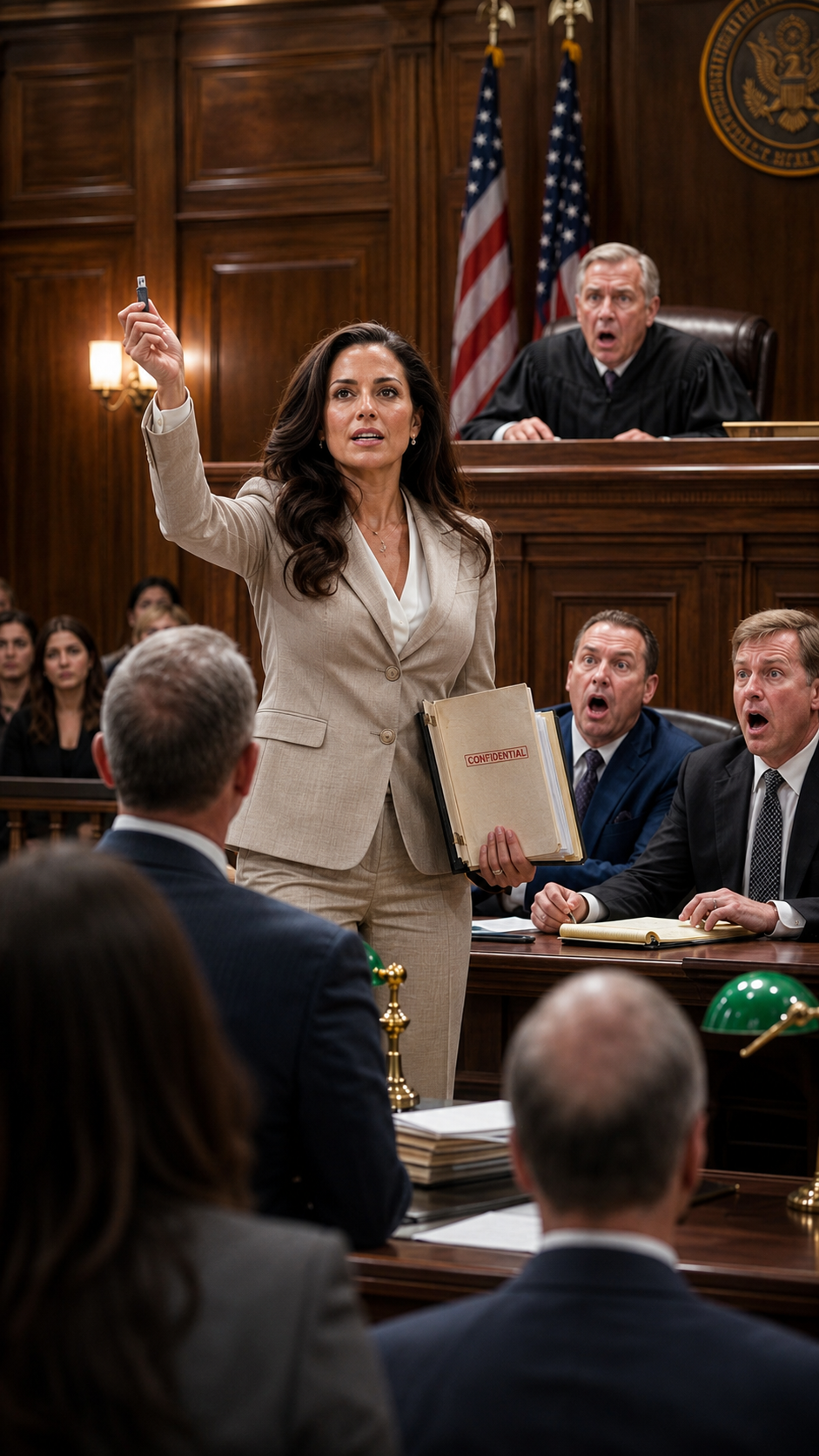
The laughter died instantly when Mariana Rivas placed a black hard drive on the judge's table.
Just seconds earlier, everyone in the room seemed to revel in her humiliation.
Her father smiled as if victory were already his.
Her brothers mocked her without restraint.
Her Aunt Teresa, sitting in the front row, gazed at her with that self-satisfied look that only those who believe another's misfortune is theirs to savor can possess.
Judge Aguirre scanned the papers with a weary expression, as if this case were just another rich family's squabble over money.
No one imagined that Mariana hadn’t come to plead for an inheritance.
She had come to fulfill her mother’s last command.
Six months earlier, Amalia Rivas, founder of Grupo Bahía Norte, had died in a private hospital in Mexico City.
The company was worth over 30 million dollars.
It had boutique hotels in Los Cabos, wineries in Querétaro, and tourism contracts in Mérida.
Everyone believed that with Amalia's death, Víctor Rivas, her husband, would seize absolute control.
And Víctor believed it too.
That’s why, on that day, dressed in a navy suit and an expensive tie, he spoke as if Mariana were a family embarrassment.
—Your Honor, my daughter lacks the experience to manage anything. She rents an apartment in Narvarte, has no stable job, and has never even run a small store.
Some burst into laughter.
Leonardo and Bruno, her brothers, exchanged glances that said: “It’s over.”
Víctor continued:
—My late wife was very noble, but Mariana was always emotional, impulsive, resentful. We can’t leave a legacy like this in the hands of someone who couldn’t even keep a steady job.
Mariana didn’t lower her gaze.
Inside, her chest burned, but she didn’t crack.
Because her mother had taught her something since childhood: when everyone shouts, money speaks softly.
Amalia hadn’t raised her as an ornament.
While her brothers went to clubs in Polanco and flaunted new trucks, Mariana sat with her mother reviewing balances, invoices, contracts, and account statements.
—Honey, secrets aren’t hidden in words —Amalia would say—. They’re hidden in signatures.
Three days before she died, Amalia handed her a memory stick and a yellow envelope.
Her hands were cold, but her gaze was firm.
—Don’t trust anyone, Mariana.
Mariana cried.
—Mom, don’t say that.
—Especially not your father.
At first, she thought it was the pain or the medication.
But that very night, she opened the files.
Fake invoices.
Duplicate payments.
27 ghost companies.
Small transfers repeated over 8 years.
Almost 12 million dollars vanished.
All coming from the heart of Grupo Bahía Norte.
The judge raised his eyes.
—Miss Rivas, do you have anything to declare?
Víctor smiled, confident he would watch her sink.
Mariana stood up.
—Yes, Your Honor.
She took a deep breath.
—I am the person my mother secretly chose to discover who was emptying the company’s accounts before she died.
The room fell silent.
Víctor let out a dry laugh.
—What nonsense.
Mariana placed the hard drive in front of the judge.
—Here are the proofs.
Víctor’s face lost color.
His lawyer sprang up.
—Objection!
The judge frowned.
—On what grounds?
The lawyer didn’t respond immediately.
And that silence was enough for everyone to understand that something was very wrong.
Mariana then pulled out the yellow envelope.
—My mother also hired a forensic audit. The final report arrived yesterday.
Víctor stepped toward her.
—Don’t open that, Mariana.
But the clerk was already walking toward the judge.
When Aguirre broke the seal and began to read, the mockery disappeared from every face.
Then he lifted his gaze.
—Mr. Víctor Rivas… can you explain why your signature is linked to each of the fraudulent transfers?
Víctor swallowed hard.
Leonardo stopped smiling.
Bruno went pale.
But the worst came when the judge turned to the last page.
His expression changed again.
Because Víctor hadn’t acted alone.
And the second signature belonged to someone sitting in that very room.
PART 2
Judge Aguirre held the last page for several seconds.
No one dared to breathe too loudly.
Mariana felt her heart pounding so hard she could barely hear the murmurs behind her.
Víctor wasn’t looking at the judge.
He was staring at Teresa.
His own sister.
The aunt who had long presented herself as the good woman of the family, the one who brought food when someone was sick, the one who hugged at funerals, the one who said “family first” every time there was money on the table.
Teresa froze.
Then she smiled nervously.
—It must be a mistake, Your Honor.
The judge read aloud:
—Teresa Rivas Morales is listed as the final beneficiary of 9 of the 27 companies used to disperse funds from Grupo Bahía Norte.
The room erupted in murmurs.
Leonardo stood up from his seat.
—What? My aunt?
Bruno turned to Víctor.
—Dad, what’s going on?
Víctor gritted his teeth.
—Shut up, both of you.
That sentence spoke louder than any confession.
Mariana looked at Teresa.
Not with rage.
With a heavy, old sadness.
Because Teresa had been the one who hugged her at Amalia’s burial.
The one who whispered in her ear:
—Your mom left worried about you, dear. Don’t make a fuss. Let your dad handle everything.
Now she understood.
It wasn’t love.
It was fear.
The judge ordered the accounting expert waiting outside to come in.
A woman with short hair, a gray suit, and a thick folder entered.
She introduced herself as Claudia Santillán, the forensic auditor hired by Amalia Rivas before she died.
Víctor tried to interrupt.
—This is a farce.
Claudia remained unfazed.
—Mrs. Amalia knew that money had been diverted for years. That’s why she didn’t go to her husband first. She suspected him.
Mariana felt a knot in her throat.
Claudia continued:
—The transfers were made to non-existent suppliers. Then the money passed through accounts in Monterrey, Guadalajara, and Panama. Finally, it landed in companies controlled by Mr. Víctor Rivas and Mrs. Teresa Rivas Morales.
Teresa began to cry.
—I didn’t know anything. Víctor told me they were legal transactions.
Mariana looked at her coldly.
—Was it also legal to forge my mom’s signature?
Teresa fell silent.
Víctor turned to Mariana in fury.
—You don’t know what you’re getting into.
—Yes, I do —she replied—. I got into what my mother died trying to stop.
Víctor’s lawyer requested a recess, but the judge denied it.
Then Mariana pulled out another document.
One neither of her brothers knew about.
—There’s something else, Your Honor.
Víctor’s eyes widened.
—Mariana, no.
She didn’t stop.
—My mother changed her will 2 weeks before she died.
The judge took the sheet.
Leonardo approached, confused.
—That can’t be. Dad said Mom divided everything among us.
Mariana shook her head.
—Dad lied.
The clerk read the document.
Amalia had left her majority stake in Grupo Bahía Norte under temporary administration by Mariana.
Not as a prize.
Not as a whimsical inheritance.
But as protection.
The will explained that Mariana was to take control while the misappropriations were investigated, and that any heir involved in fraud would lose rights to shares and dividends.
Bruno slumped onto the bench.
—So… we were used.
Mariana turned to him.
—You let yourselves be used.
That sentence stung.
Because it was true.
For 6 months, Leonardo and Bruno had called her dependent, a failure, bitter.
They had repeated every lie Víctor told without questioning why their mother, an intelligent woman until her last day, would have trusted Mariana.
Víctor lost his composure.
—Your mother was sick! She didn’t know what she was signing!
Mariana then pulled out a smaller memory stick.
—That’s why she recorded a video.
The judge authorized its playback.
On the courtroom screen appeared Amalia Rivas.
Thin.
Pale.
With a scarf covering her head.
But her eyes were alive.
Her voice filled the room.
—If you’re watching this, it means Mariana had the courage to see it through.
No one spoke.
Amalia continued:
—Víctor, I know what you did. I know you convinced Teresa to help you. I know you used my children to isolate Mariana because she was the only one who could uncover you.
Teresa covered her mouth.
Víctor lowered his gaze.
—And to my children —Amalia said in the video—, I leave a truth that may hurt more than money: your sister wasn’t the weak one. She was the only one paying attention.
Leonardo began to cry silently.
Bruno wiped his face with his sleeve, like a scolded child.
But the video wasn’t finished yet.
Amalia breathed with difficulty.
—Mariana, I’m sorry for leaving you this burden. But you were the only one who wouldn’t sell out for comfort. The only one who understood that a company isn’t worth its buildings, but the people who rely on it.
Mariana pressed her lips together to keep from breaking down.
At that moment, the entire room stopped seeing her as the failed daughter.
They saw her for what she was: the heir chosen not by blood, but by character.
The judge turned off the screen.
He ordered immediate precautionary measures.
Freezing of accounts.
Immediate suspension of Víctor and Teresa from any administrative positions.
Delivery of corporate documentation.
And referral of the case to the prosecution for suspected fraud, forgery, and mismanagement.
Víctor reacted like a cornered animal.
—This is all your fault! —he yelled at Mariana—. You destroyed this family.
Mariana looked at him without blinking.
—No, Dad. I just turned on the light.
Security agents approached as Víctor tried to snatch the hard drive from her.
That image was etched in everyone present: the great businessman of a respected surname, held by two guards, while the daughter he humiliated stood firm, with tears in her eyes.
Teresa crumbled.
—I just wanted what was mine. Amalia was always the brilliant one, the beloved one, the owner of everything. I was Rivas too.
Mariana responded with a calm that hurt more than a scream.
—My mom gave you work, a home, support, and trust. You didn’t want what was yours. You wanted what wasn’t yours.
Outside the courthouse, several reporters were already waiting.
The news spread quickly.
“Scandal at Grupo Bahía Norte.”
“Businessman accused of embezzling 12 million dollars.”
“Humbled daughter reveals family fraud.”
On social media, people were divided.
Some said Mariana did the right thing.
Others questioned whether it was worth publicly destroying her own father.
The next day, Leonardo came to find her.
He arrived without a chauffeur, without dark glasses, without arrogance.
He found her in her mother’s office, sorting through boxes of documents.
—I’m sorry —he said.
Mariana didn’t respond immediately.
—I called you useless.
—Yes.
—I laughed at you.
—Me too.
Leonardo lowered his head.
—I don’t know how to fix this.
Mariana closed a folder.
—Start by telling the truth.
Bruno did the same three days later.
Both delivered emails, messages, and recordings where Víctor asked them to discredit Mariana so the judge wouldn’t take her seriously.
She didn’t forgive them immediately.
Blood doesn’t erase cruelty overnight.
But she didn’t close the door either.
Because Amalia hadn’t taught her to hate.
She had taught her to distinguish between justice and revenge.
Two months later, Mariana walked into the Grupo Bahía Norte boardroom for the first time as the provisional administrator.
The employees looked at her with curiosity.
Some with hope.
Others with doubt.
She didn’t give a long speech.
She simply placed a photo of Amalia on the main table.
—My mother built this with honest work. Anyone who wants to remain in this company will have to get used to one simple rule: here, no one robs, and no one humiliates the one who tells the truth.
There was silence.
Then a woman from accounting started to clap.
Then another.
And another.
Until the entire room was filled with applause.
Mariana didn’t smile as someone who had won.
She smiled as someone who could finally breathe.
That night, she returned alone to the Narvarte apartment they had all mocked her for.
It wasn’t a mansion.
It had no marble or private garden.
But it was hers.
She had paid for it with her work, not with stolen money.
On the table, she left the black hard drive, the yellow envelope, and a letter Amalia had written before she died.
The last line read:
“When a family asks you to keep quiet to protect its name, ask yourself if it still deserves to be called family.”
Mariana cried then.
Not for Víctor.
Not for Teresa.
She cried for the mother who had prepared her for a war without being able to accompany her in victory.
And while thousands debated online whether a daughter should denounce her own father, she understood something that no one could take from her:
Sometimes the greatest loyalty isn’t to stay silent for family.
Sometimes it’s having the courage to save what’s left of it, even if everyone calls you a traitor.