PART 1 In San Lucas del Mezquital, Hidalgo, they still whispered about the night Mateo Reyes broke the padlock on his uncle Tomás.
He was only seven, hands stained with blood, heart pounding like a carnival drum. In front of the village store, his father, Julián Reyes, yanked him by the hair, forcing him to face everyone.
—If that crazy man hurts anyone, you’ll pay, kid. Remember that well.
From that moment on, no one treated Mateo like a child. To the neighbors, he was the brat who had unleashed a threat. To his family, he was a traitor.
Tomás Reyes, Julián’s younger brother, had been tied up next to the corral for months. Don Anselmo claimed he had lost his mind. Doña Rita prayed every time she saw him. Julián, on the other hand, humiliated him without a shred of shame.
—He’s not sick. It’s a disgrace that he breathes.
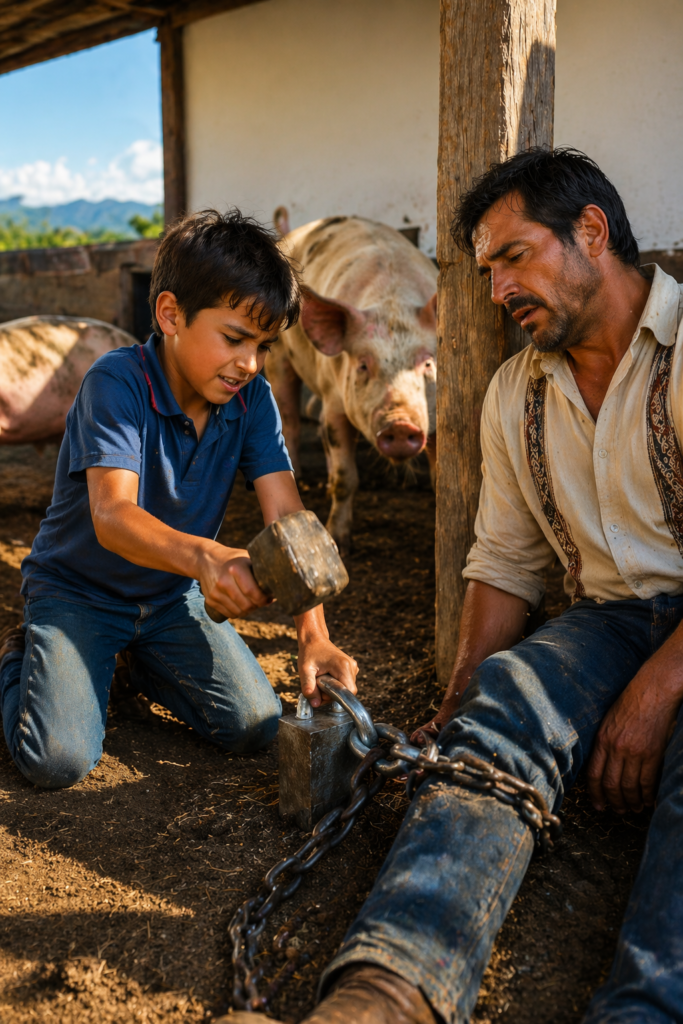
He wore a rusty chain around his ankle, tethered to the trunk of a mesquite tree. When it rained, he slept in mud; when it was cold, they tossed him a sack.
Mateo couldn’t understand why everyone was afraid of him. Tomás didn’t scream or threaten. He only stared at the sky with sad eyes.
The only one who took pity on him was Inés, Mateo’s mother. Secretly, she brought him tortillas, beans, and pieces of bread for the boy to take.
One afternoon, Tomás broke a bolillo in half and offered the other piece to Mateo.
—You’re hungry too, nephew.
That was the first time the boy heard him speak.
On Mateo’s birthday, the family made mole, but not for him. It was for Bruno, his cousin. Mateo was left with just cold rice.
From the corral, Tomás tugged at the chain. When Mateo stepped out, he found a grasshopper made of dry leaves in his hand.
It was his gift.
Before he could take it, Julián stomped on it.
—Just the foolishness of a madman.
That dawn, Mateo heard his father and grandfather talking by the fire. They said that the next day they would take Tomás to the hill, “to make him stop causing trouble.”
The boy didn’t grasp it all, but he understood the fear.
He picked up a stone and struck the padlock once, twice, until his skin split open. Tomás pleaded with him to leave.
—Don’t do this, Mateo. They’ll destroy you.
The padlock shattered.
Tomás hugged him, whispered, “I remember,” and vanished into the cornfield.
At dawn, Julián dragged Mateo in front of everyone and beat him until he was exhausted.
Fifteen years later, as Inés coughed up blood in a cheap clinic and Bruno bragged about the stolen money for her treatment, a line of black trucks stopped in front of the Reyes’ house.
From the last one, a well-dressed man stepped out, touched the old mark on the mesquite tree, and looked at Mateo with tears in his eyes.
—Nephew... I finally found you.
What was about to happen next was so brutal that no one in that yard was ready to believe it.
PART 2 Mateo did not recognize Tomás at first.
He was no longer that skinny man, with feet sunk in mud and clothes reeking of the corral. He wore a dark suit, had a well-groomed beard, and a presence that silenced even the dogs. Behind him came lawyers, bodyguards, and a man with a folder from the Public Ministry.
Julián was the first to pretend.
“Tomás, brother… thank God. We’ve been searching for you for years.”
Tomás looked at the chain thrown beside the mesquite, rusty, almost buried by time.
“I didn’t come for hugs, Julián. I came for the truth.”
Doña Rita began to pray. Don Anselmo sat down as if his legs no longer served him. Bruno quickly tucked Inés’s bank card away, but Mateo had already seen him.
“Give that back,” Mateo said.
“Don’t be dramatic, man. Your dad lent it to me.”
Mateo lunged at him, but Tomás raised his hand.
“First your mother.”
The name Inés broke the air.
Mateo recounted that she was in the clinic, coughing blood, that they had taken away her papers and the money for her studies. Tomás didn’t ask for permission. He ordered them to get in the truck.
But before they could leave, a neighbor came running.
“Mateo, your mom is no longer in the clinic. They say she escaped.”
They found her behind the old chapel, next to the cemetery, wrapped in a gray shawl. She had dried blood on her lips and a tin of cookies clutched against her chest.
“Don’t come closer,” she whispered. “If they know I brought her, they’ll kill us.”
Tomás knelt in front of her.
“Inés.”
The woman lifted her face and began to cry.
“Forgive me. I should have spoken up fifteen years ago.”
At that moment, Julián, Don Anselmo, Doña Rita, Bruno, and other relatives arrived. Julián was holding a shovel.
“Give me that tin, old woman. Don’t make your drama.”
Mateo stepped in front of his mother. He was no longer a child trembling under blows. He was a man who had swallowed humiliation for too long.
“Touch her, and it all ends, Dad.”
Julián let out a dry laugh.
“You don’t boss here.”
Tomás stood at his side.
“Today, I do.”
Inés opened the tin. Inside were yellowed papers, a deed, a photo of young Tomás with his mother, Soledad, and a letter with burned edges.
The lawyer took the letter and read aloud.
Soledad Reyes had not died of fever, as the family had claimed. She had written that Don Anselmo owed money from gambling, that Julián wanted to sell their lands, and that Tomás had seen something he shouldn’t have.
Tomás closed his eyes.
“I said there was a dead man under the mesquite.”
Don Anselmo shouted:
“Shut up!”
That shout was more of a confession than a defense.
Suddenly, a torch fell through the broken window of the chapel. The fire began to climb up the old benches. Bruno ran out, but one of the bodyguards caught him. In his jacket, he had another stolen page from the tin.
It was an IOU.
The debtor: Anselmo Reyes.
The guarantor: Julián Reyes.
And below, written in old ink, a clause that made everyone fall silent: if they didn’t pay, they would hand over Soledad’s lands and the minor Tomás Reyes as “labor” until the debt was settled.
“They were going to sell me,” Tomás said, his voice broken.
Julián tried to justify himself.
“It was a different time. The family had to survive.”
“No, Dad,” Mateo replied. “That wasn’t survival. That was rotting away.”
The fire grew. Tomás carried Inés. Mateo took the tin. As they stepped out through the smoke, Julián tried to pull his wife by the shawl.
“Leave her. That old woman was always a busybody.”
Mateo hit his hand with a rock. For the first time, Julián stepped back.
In the Pachuca hospital, Inés was taken to emergency care. Julián arrived shouting that he was the husband and that no one could authorize a surgery without him. The doctor looked at him coldly.
“If you interfere with medical care again, I’ll call security.”
Tomás had already called the Prosecutor’s Office.
While they waited, a retired teacher, Professor Vidal, appeared. He carried an old folder. He said Soledad had given it to him before she died, in case Tomás ever returned.
Inside were pharmacy receipts, copies of deeds, and a notebook where payments to Don Hilario, the town healer, were recorded for signing false diagnoses.
Tomás was never insane.
They drugged him for weeks to make him seem confused. Then they chained him so that no one would believe his memories.
Mateo felt his chest splitting.
“And me? Why did I have to carry that?”
The professor looked down.
“Because you saw shadows digging one night. They knew you could remember too.”
The doctor came out of emergency care. Inés had survived, but before falling asleep, she asked them to check “the west wall.”
Mateo understood immediately. It was the wall of his old room.
The police accompanied Tomás and Mateo back to the ranch. The whole town was outside, watching as if it were a soap opera. The same ones who had called Tomás crazy and Mateo cursed now murmured “poor things.”
In the west wall, they found loose bricks. Behind it was a bag containing Mateo’s childhood sweater. In the lining, Inés had hidden a pharmacy receipt with two names: Rita Reyes and Julián Reyes.
The medication matched that of a syringe that Doña Rita had tried to sneak into the hospital, hidden under her skirt.
She was arrested that same afternoon.
But the worst was yet to come.
Tomás kept staring at the mesquite. The ground beneath the trunk was more sunken. The Prosecutor’s Office began to dig. Don Anselmo lost control.
“Not there! It’s holy ground!”
Mateo felt a strange chill at the nape of his neck.
“It’s not holy. It’s hidden.”
The shovel struck something hard.
They pulled out a rotten sack, tied with wire. Inside were human remains and a black ring. Professor Vidal recognized it instantly: it belonged to the collector who had come for the debt fifteen years ago.
Tomás had seen him die.
That’s why they called him crazy.
That’s why they chained him.
That’s why they wanted to make him disappear in the hills.
The truth spread through San Lucas like wildfire. Julián, Don Anselmo, Rita, and Bruno were arrested for illegal deprivation of liberty, attempted murder, forgery, concealment, and evidence tampering. Another uncle fell for trying to burn down the chapel.
At first, some defended Julián on social media.
“A son shouldn’t raise a hand against his father.”
“They're probably exaggerating for money.”
“Blood is blood.”
Then Tomás published the complete videos from the cameras of their trucks: Bruno stealing the page, Julián dragging Inés, Rita trying to enter the hospital with the syringe, and Don Anselmo shouting not to dig under the mesquite.
The town fell silent.
Then came the apologies.
“I always suspected.”
“I wanted to help.”
“I was scared of your dad too.”
Mateo didn’t respond. Tomás didn’t either.
“Brave people arrive before the fire,” Tomás said, “not when the news comes out.”
Inés woke up four days later. She was weak, with tubes and a soft voice, but alive. Mateo took her hand.
“Mom, everything came out.”
She cried.
“I left you alone for too long.”
“You didn’t leave me alone. You taught me not to be like them.”
Tomás entered with a cup of atole. Inés looked at him as if she were witnessing both a miracle and a guilt at the same time.
“Forgive me, Tomás. I gave you food, but I couldn’t set you free.”
He slowly shook his head.
“You saved my mother’s papers. You saved Mateo. Sometimes surviving is also a way to fight.”
Months later, Mateo visited Julián at the Public Ministry. He didn’t go to forgive him. He went to confirm that his voice no longer bent him.
Julián, handcuffed, tried to speak softly.
“I’m your father. Tell your mother to drop the charges. Don’t destroy the family.”
Mateo looked at him without anger.
“The family was destroyed by you when you traded love for fear.”
“Ungrateful,” Julián spat.
Mateo almost smiled.
“That word used to break me. Today it just confirms I did the right thing.”
He left without looking back.
A year later, Tomás took Mateo and Inés to the ranch for the last time. The house was empty. The corral had collapsed. All that remained of the mesquite was a dry trunk.
PART 3 Mateo left a grasshopper woven from leaves on the ground, just like the one Julián had stepped on when he was seven.
No one said a word.
As they got into the truck, Inés asked if he wanted to say goodbye to the village.
Mateo looked at the road, the clear sky, and the closed doors of the people who had never helped.
—No, Mom. You don’t always have to say goodbye to the places where you survived. Sometimes, it’s enough to leave alive.
And as the truck pulled away, for the first time in fifteen years, no one in the Reyes family had to lower their voice to feel free.
But freedom felt like a fragile thread, one that could snap at any moment, as the memories of betrayal loomed large in the distance.