PART 1
The Lupita Inn was already closed when the blow shook the back door as if someone had thrown a sack of stones against the metal.
It was 2 AM, rain was pouring down a narrow street in the Guerrero neighborhood of Mexico City, and Sofía Morales was just finishing up turning off the iron, putting away the red rice, and counting the coins in the cash register.
At 24 years old, she lived in the small room above the inn and carried a life that felt too heavy for her age.
She had left nursing school three years ago to take care of her mother, Doña Carmen, when cancer began to silently consume her.
Her mother was gone.
The debts were not.
Since then, Sofía had been serving coffee, cleaning tables, smiling at drunken customers in the early morning hours, and pretending it didn’t hurt when someone asked if she would ever go back to school.
That night, when she heard the second blow, she stood frozen with a damp rag in her hand.
It wasn’t a knock.
It was a body falling.
“Who’s there?” she asked, trying to sound firm.
No one answered.
She only heard a broken, heavy breath, as if someone were drowning behind the door.
Any sensible person would have called 911.
Sofía took the old metal rod she used to stir the coals of the comal and walked slowly.
She opened the door just a crack.
The man fell inside.
He was tall, broad-shouldered, soaked in rain, wearing an expensive black coat clinging to his body, and one hand pressed against his side. Blood slipped between his fingers, staining the white kitchen floor.
Sofía dropped the rag.
“Oh my God…”
The man lifted his face.
His dark hair clung to his forehead, a cut on his eyebrow, and hard eyes that didn’t ask for permission to enter any place.
But in that moment, he didn’t seem dangerous.
He seemed on the verge of dying.
“Don’t call the police,” he murmured.
“You’ve been shot.”
“No police.”
“Hospital?”
The man clenched his jaw.
“Neither.”
Sofía thought he was insane until he tried to stand, and the coat opened slightly.
That’s when she saw what he had strapped to his chest.
It wasn’t a vest.
It was two babies.
A boy and a girl, no more than six months old, wrapped in a thick blanket. Their eyes were open, swollen from sleep and fear, but they weren’t crying.
That was what chilled her blood the most.
The man followed her gaze.
The hardness of his face broke for the first time.
“Please,” he whispered. “Hide them.”
Headlights illuminated the alley.
Then tires screeched against the wet pavement.
Sofía stopped thinking.
“Get up, come on.”
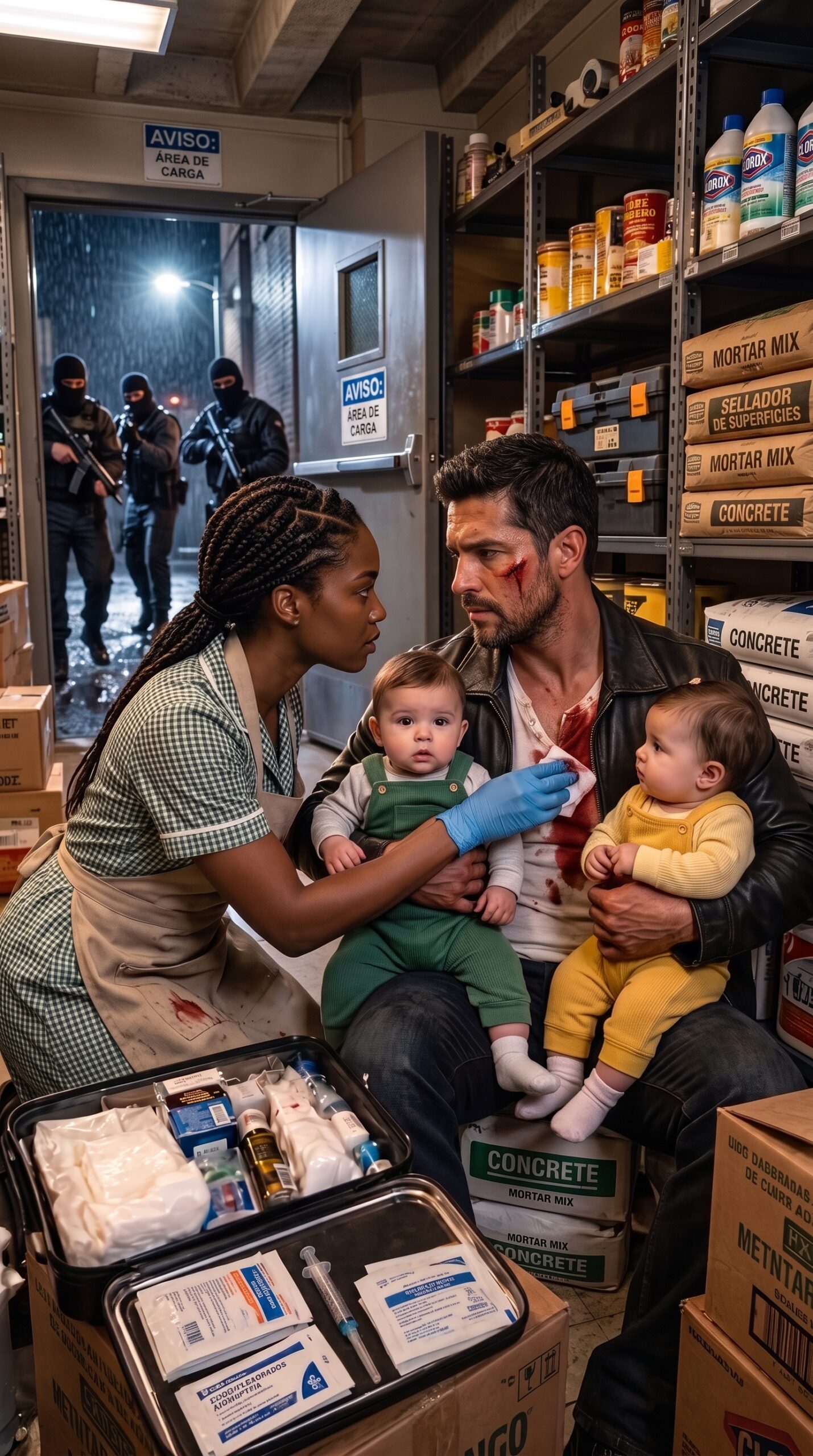
She pulled him as best she could, carrying almost all his weight, and took him to the storage room where she kept sacks of flour, cans of chilies, and boxes of soda.
The man collapsed against the shelves.
Sofía returned to the kitchen, grabbed bleach, and began scrubbing the blood off the floor in desperation.
Outside, boots splashed in the water.
Someone tried to open the back door.
“Check everything,” a voice growled. “That bastard couldn’t have gone far.”
Sofía hid behind the bar, holding her breath.
The footsteps faded after an eternity of minutes.
The engine roared again.
Only then did she realize her legs were shaking.
She grabbed the industrial first aid kit, a bottle of water, and some clean towels. When she returned to the storage room, the man had carefully released the baby carrier.
He had the two little ones on his lap, protecting them as if his own body were a wall.
The boy whimpered softly.
The man, though bleeding out, adjusted the blanket with a tenderness that didn’t match his face or the gun Sofía caught a glimpse of under the coat.
“Let me check the wound,” she said.
He looked at her for a long time.
As if saying his name also delivered a sentence.
“My name is Damián Robles.”
Sofía felt the air disappear.
All of Mexico knew that name.
Damián Robles, the businessman who appeared in business magazines, the supposed owner of half the port of Veracruz, the man the news mentioned carefully: benefactor, investor, alleged crime boss.
They had never proven anything against him.
They had never touched him.
And now he was bleeding in the storage room of her inn with two babies clinging to his chest.
Sofía took a step back.
He lowered his gaze to the children.
“If you want to run, do it now,” he said. “But if they find you, they won’t just kill me.”
At that moment, the baby opened her eyes and looked at Sofía without crying.
And Sofía understood that, although she didn’t know anything yet, she was already caught up in something that would not spare anyone's life.
PART 2
Sofía closed the storage room door quietly.
She didn’t run.
She didn’t call the police.
She also didn’t know if that made her brave, stupid, or both.
She knelt in front of Damián Robles and opened the first aid kit.
“Take off the coat.”
He didn’t move.
“Mr. Robles, if I don’t see where the bullet entered, I can’t know how serious it is.”
“You said you left nursing.”
Sofía glared at him.
“I left, I didn’t lose my brain.”
Damián held her gaze for a few seconds. Then, carefully, he laid the babies down on a clean blanket she spread on the floor.
He touched them as if they were made of glass.
First, he held the boy’s head.
Then he adjusted the girl.
That tenderness made Sofía even more confused.
Because the man in front of her had a reputation for ordering definitive silences, buying wills, entering any room and making it his without raising his voice.
But his hands trembled as the babies breathed oddly.
“Are they yours?” she asked.
“Yes.”
“And their mother?”
The silence weighed heavier than the rain against the roof.
“She died.”
Sofía swallowed hard.
“I’m sorry.”
He barely nodded.
She cut away the soaked, blood-stained shirt. The bullet had passed through his side, not staying inside, but he had lost too much blood.
“You need a hospital.”
“No.”
“You could have internal damage.”
“I’ll stay here until dawn.”
“You’re not asking for permission, are you?”
“I’m trying not to die before I keep them safe.”
The girl moved her mouth, restless.
The boy made a small, desperate sound.
Damián tried to lean closer, but the pain drained the color from his face.
“He’s hungry,” he said.
“How do you know?”
“Because that’s his hungry cry.”
Sofía rummaged through the baby carrier and found two bottles of formula, diapers, and a change of clothes.
“You came prepared.”
“I tried.”
The answer stabbed her.
As she warmed the formula with lukewarm water, Sofía heard another sound.
Three soft knocks at the front door.
Not violent.
Measured.
Damián tensed immediately.
“Don’t open.”
“It could be a customer.”
“At 2:30 in the morning, with the sign turned off.”
Then a voice called from outside.
“Sofi? It’s Officer Medina.”
Sofía closed her eyes.
Mateo Medina was a neighborhood cop. He had known her since high school. He had attended her mother’s wake and many nights stopped by for coffee when his shift was heavy.
“He’s not bad,” she whispered.
“That doesn’t mean you can trust him.”
“Should I trust you instead?”
Damián didn’t respond.
Sofía stepped into the kitchen and wiped her hands on her apron. She opened the door just wide enough.
Mateo stood under the awning, his raincoat dripping.
“Everything okay?” he asked.
“Yeah. Just cleaning up.”
He looked at her intently.
“You look pale.”
“I’m tired.”
The radio on his shoulder crackled with interference.
“They reported gunshots near Eje Central. Also a black truck circling around here.”
Sofía’s mouth went dry.
“How scary.”
“Can I come in to check?”
She felt her heart pounding against her ribs.
Ten steps away, in the storage room, was a shot man, two babies, and a gun hidden among the sacks.
“I already closed, Mateo.”
“Sofi…”
The way he said her name nearly broke her.
Mateo didn’t entirely believe her.
And he was right.
A car passed slowly behind him, with dark windows.
No visible plates.
Mateo turned his head.
The car continued.
When he looked back at her, his expression had changed.
“Lock up tight. And if you hear anything, call me.”
“Sure.”
“Are you sure you’re okay?”
Sofía was about to tell him everything.
But she remembered how Damián had asked to hide the children.
Not for him.
For them.
“I’m fine.”
Mateo left.
Sofía locked the door and returned to the storage room.
Damián was already standing, leaning against a shelf.
“We’re leaving,” he said.
“You can’t even cross the kitchen.”
“They’re going to come back.”
“Those guys in the truck?”
“Or someone worse.”
He pulled a small key from his coat.
“There’s a car in a parking lot two streets over. It’ll take us to a house in Puebla.”
“Yours?”
“My sister’s.”
Sofía stared at him.
“You have a sister?”
For the first time, Damián seemed offended.
“I wasn’t born of a stone.”
“Given your reputation, one doubts.”
He let out a tired smile that barely managed to surface.
“She distanced herself from me many years ago. The house was my grandmother’s. No one knows I kept it.”
Sofía glanced at the babies.
Then she looked at the photo of her mother taped to the wall of the storage room. Doña Carmen appeared in a red apron, smiling, in front of the freshly painted inn.
Her mother always said that helping wasn’t the same as letting oneself be destroyed.
“I have conditions,” Sofía said.
Damián raised an eyebrow.
“No guns in the car.”
He pulled out the gun and placed it on a shelf.
“You tell me where we’re going exactly.”
“Atlixco.”
“You let me know if you think we’re being followed.”
“Sure.”
“And don’t give me orders as if I worked for you.”
“That’s going to cost me.”
“Well, practice it, dude.”
Damián looked at her in surprise.
Then he nodded.
Sofía packed formula, diapers, water, towels, a clean change of clothes, and the little cash she had hidden under the cash register.
She wrote a note for her assistant.
“Family emergency. Don’t open until I call.”
It wasn’t a complete lie.
The babies were an emergency.
They left through the basement, which connected to the service hallway of the neighboring building. The rain had turned into a fine drizzle.
The car turned out to be an old green truck, one of those that nobody looks at twice.
In the back seat, there were two baby carriers installed.
Sofía stood frozen.
“You prepared this beforehand.”
Damián stared ahead.
“Three days ago, I suspected someone in my crew had sold information.”
“Information about your children?”
“About where they were.”
“And you didn’t get them out sooner?”
“I moved them twice.”
“Then someone knew every move.”
Damián didn’t answer.
That was response enough.
They headed toward the city exit. Sofía drove with her hands tightly gripping the wheel. Every light in the rearview mirror felt like a threat.
Damián was turning gray.
“You’re getting worse.”
“I know.”
“You won’t make it to Atlixco.”
“I will.”
“That’s not up to you. It’s up to your body.”
“My body obeys.”
“No, that’s your ego talking.”
He closed his eyes.
“You’re very direct.”
“Only with shot bosses who fall into my kitchen.”
For a moment, the silence grew strange.
Almost human.
In the back, the babies were sleeping.
“Her name was Isabel,” Damián suddenly said. “She died from complications after the birth. He held them for less than an hour.”
Sofía slowed down.
“I’m sorry.”
“She made me promise they wouldn’t grow up surrounded by fear.”
“And did you keep it?”
Damián looked at the children in the mirror.
“No.”
There were no excuses.
There was no pose of an untouchable man.
Just a broken father.
“I thought power could buy safety,” he murmured. “But all it did was give them an address on their foreheads.”
The boy began to cry.
Sofía pulled into a closed gas station. She turned off the lights and moved to the back seat to feed him.
The girl woke up too.
Damián carefully held his daughter, though pain doubled him over. As he tilted his head, a silver chain slipped out from his shirt.
It hung an oval locket.
Inside was a small photo.
Sofía saw it for just a second.
And stopped breathing.
“Show me that.”
Damián closed his hand.
“No.”
“The photo. Show it to me.”
“Why?”
“Because I know that face.”
He remained motionless.
“Impossible.”
“Show it to me.”
Damián slowly opened his hand.
The woman in the photo was young, with dark hair, a tired smile, and eyes that Sofía had seen all her life.
In a photo taped to the storage room.
In the frame on her nightstand.
In her own reflection.
“That’s my mom,” Sofía whispered.
Damián shook his head.
“No. She’s Isabel.”
“My mom was named Carmen.”
“Then you’re mistaken.”
“I’m not mistaken about my own mother.”
Sofía pulled out her cell phone and showed him the photo of Doña Carmen in front of the inn.
Damián looked at her.
All the blood seemed to drain from his face.
With trembling hands, he pulled from his coat a folded document inside a sleeve. He opened it on his lap.
At the top was the name of a hospital in Veracruz.
There were two baby fingerprints.
A date from 24 years ago.
Sofía’s age.
And a name written next to a line that said Female Baby A.
Sofía.
She felt the world shatter.
“What does this mean?”
Damián looked at the document, then at her face.
For the first time, the most feared man didn’t sound like a threat.
He sounded like a lost brother.
“I think your mother was my sister.”
Sofía recoiled against the door of the truck.
The rain pounded against the roof.
The babies breathed between them.
Everything she knew about her life dissolved in an instant.
Her mother was not just the woman who had raised her.
She was someone who had fled with her, changed her name, and hidden a surname capable of killing.
Damián closed his eyes, as if remembering something he had buried.
“My sister disappeared with a newborn baby. My father said she died. I was young. I believed him. Later I found that certificate, but I never found the girl.”
Sofía trembled.
“And now you came to my inn by coincidence?”
“I didn’t know.”
“Do you really expect me to believe that?”
“If I had known, I would have never brought danger to your door.”
Baby Eva began to cry.
That cry broke something in Sofía.
Because it didn’t matter if Damián was telling the truth or not.
It didn’t matter if her mom had lied for 24 years to protect her.
The story was repeating itself.
Once again, children were being chased by a surname.
Once again, a woman had to decide whether to flee, to hand someone over, or to stay.
Then headlights turned on in the distance on the road.
A black truck slowly entered the gas station.
Damián tried to sit up.
Sofía didn’t scream.
She didn’t cry.
She took the babies, secured them, and returned to the wheel.
“Get down,” she ordered.
“Sofía…”
“You said you wouldn’t give me orders. Now it’s my turn.”
She started the old truck before the men got out.
The engine roared as if it were about to die.
But it moved forward.
They left the gas station with the tires skidding over the water.
The black truck followed them.
Damián pressed on the wound, pale as paper.
“Don’t take the highway,” he said. “There’s a dirt road to the right.”
“That sounded like an order.”
“It’s survival.”
Sofía swerved sharply.
The road was full of mud, potholes, and darkness. Behind them, the headlights followed like animal eyes.
In the distance, dawn began to break.
Damián, half-unconscious, murmured a number.
“What is that?”
“A phone number. It belongs to my sister… if she’s still alive under another name, she might have kept it active for emergencies.”
“After 24 years?”
“My sister was smarter than all of us.”
Sofía dialed from her cell phone on speaker.
One tone.
Two.
Three.
A woman’s older voice answered.
“Who’s speaking?”
Sofía couldn’t say anything.
Damián opened his eyes.
“Aunt Elena?”
There was silence.
Then a sob.
“Damián… did you find the girl?”
Sofía felt tears burning her.
The black truck was closing in.
Damián looked at Sofía, then at the babies.
“Yes,” he said with a broken voice. “And she’s saving my children.”
Elena directed them to a detour toward an abandoned ranch where there were still people loyal to Carmen, or Isabel, or whatever name she had to assume to stay alive.
When they arrived, Damián barely breathed.
Sofía got out first with the babies.
A group of people emerged from among the trees. They weren’t hitmen. They were older men and women, farmers, neighbors, ordinary people who recognized in her face something she still didn’t understand.
An elderly woman took her face in both hands.
“You have her eyes,” she said, crying. “The eyes of your mother.”
The men from the black truck didn’t get to enter. Mateo Medina arrived behind them with two patrol cars because he never completely believed Sofía and had followed the trail from the inn.
This time, she told him everything.
Damián survived by a hair’s breadth.
The betrayal came from his own organization, from a man who wanted to hand over Luca and Eva to force him to yield routes, money, and power.
But the blow failed because a humble inn, a debt-ridden girl, and an old lie of 24 years had crossed their path.
Weeks later, Sofía returned to the Lupita Inn.
She was no richer.
She wasn’t less in debt.
But she no longer felt alone in the world.
On the wall of the storage room, she placed two photos side by side.
One of Doña Carmen in her red apron.
Another of Isabel, the young woman with the locket, before changing her name to save her daughter.
Below, she wrote a phrase in black marker:
“There are mothers who lie out of fear. And there are lies that, over the years, end up saving more lives than they destroyed.