PART 1
Aurelio Santacruz was the kind of man whom no one dared to look at for more than three seconds in Mexico City.
He owned restaurants, warehouses, bought politicians, and had a reputation that walked before him. In his world, saying his name in a hushed tone was almost like a twisted prayer.
But for the past month, he had been showing up at a little diner in the Guerrero neighborhood every morning, sitting at the same corner table, drinking a horrible coffee that even he didn’t understand why he kept ordering.
The reason was named Renata.
She was a waitress, wearing a worn green apron, her hair pulled back with a cheap hair tie, and a smile so dim it seemed to apologize for her very existence. Old bruises marked her arms, and she had a strange way of looking at the doors, as if she always expected someone to come through.
Aurelio thought he knew fear.
He had seen it in debtors, traitors, and tough men when they realized they had no way out. But Renata’s fear was different. It wasn’t common fear. It was a mask.
His younger brother, Julián, mocked him during a family meal in Las Lomas.
“Seriously, brother, a waitress has you like this? You’re getting soft, man.”
Doña Mercedes, their mother, said nothing but shot him a disappointed look. To her, a Santacruz didn’t mix with women without last names, without money, and without stories.
Aurelio didn’t respond.
That night, he returned to the diner.
At 1:27 a.m., two drunk men entered, wearing leather jackets, dirty boots, and smelling of cheap beer. One sat down without asking and whistled at Renata as if she were a dog.
“Hey, doll, bring us something hot… and you better smile a little, right?”
Renata placed two glasses of water on the table.
“The kitchen is closed.”
The man grabbed her wrist. Aurelio slowly set down his cup and reached into his jacket.
But Renata didn’t scream.
She merely lowered her gaze to the man’s hand.
“Let go of me.”
“Oh, don’t be such a tease. We’re just playing.”
She leaned in, calm and cold.
“I don’t play.”
The man released her, confused by something he couldn’t explain. He left, cursing her, along with his friend, and the diner fell silent.
Aurelio understood something that sent chills down his spine: Renata hadn’t been defenseless. She had been measuring distance.
At 2:05 a.m., she closed up shop, put on a black jacket, and walked under the rain toward a dark street behind the market.
Aurelio followed her.
He told himself it was to protect her.
But the truth was different: he wanted to know who the hell this woman was.
Renata entered a dead-end alley. Aurelio stepped out of his armored truck, pulled out his gun, and pressed against the wall.
Then two men appeared from the shadows.
One aimed at Renata.
“Hand over the memory.”
She didn’t move.
“You’re late.”
Aurelio raised his gun, ready to intervene, but he didn’t make it in time.
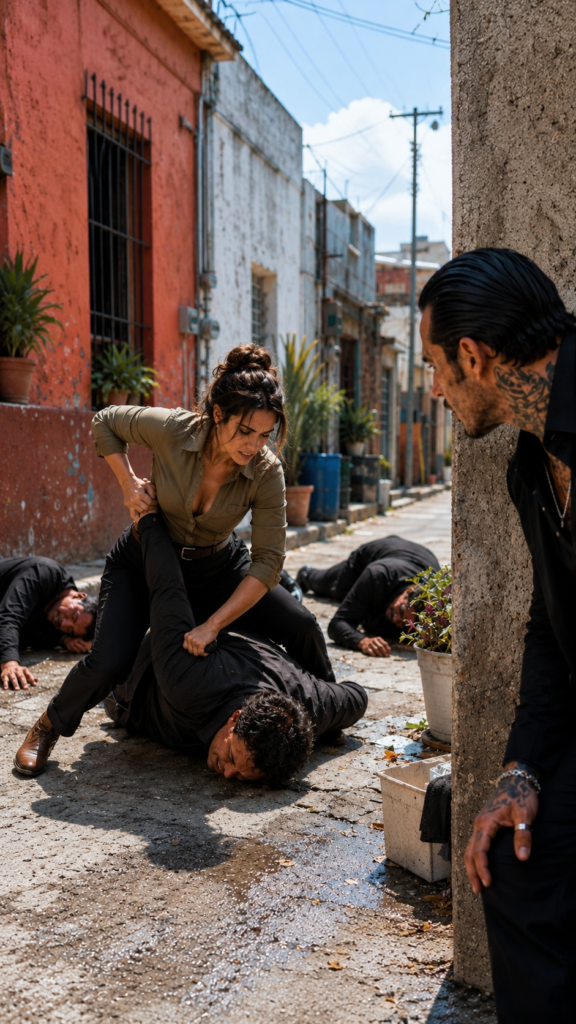
Renata spun with brutal speed. She disarmed the first man, broke his knee against the pavement, and left him gasping for air. The second man fired, but she ducked, struck his wrist with a metal bar, and took him down against some trash cans.
In less than 15 seconds, the two armed men were on the ground.
Renata picked up a black USB from one of their pockets, wiped the blood from her brow, and walked toward the exit.
As she passed by the wall, without looking back, she spoke softly:
“Don’t follow me again, Mr. Santacruz.”
Aurelio stood frozen, gun in hand, realizing the woman he tried to save had just become the greatest danger of his life.
PART 2
For six days, Aurelio didn’t return to the diner.
But Renata lodged herself in his mind like a cursed song.
He couldn’t forget how she had taken down those two men without taking a breath, nor the calm way she had uttered his name. No one outside his circle dared to call him “Mr. Santacruz” with such confidence, as if they knew him before, as if they had read his entire life.
He ordered an investigation.
His people checked records, cameras, receipts, rentals, phone numbers, everything.
Renata Molina didn’t exist.
The ID she used to rent a room in the Santa María la Ribera neighborhood belonged to a woman who had died 29 years ago in Tamaulipas. The number wasn’t in her name. Her deposits came from ghost companies. No public database had a real photo of her.
When Tacho, Aurelio’s hacker, opened a locked folder related to her, three computers shut down simultaneously.
“Boss,” Tacho said, pale, “this girl isn’t a waitress. She’s either someone the government buried or someone the government is afraid to touch.”
Aurelio didn’t respond.
That same afternoon, in a warehouse in Azcapotzalco, he received a visit from Víktor Sokolov, a Russian who moved guns, money, and favors from Veracruz to the northern border.
Sokolov arrived with four trucks and a butcher’s smile.
“You’re hiding the woman.”
Aurelio stared at him without blinking.
“I don’t hide anyone.”
“That USB isn’t yours. If it doesn’t show up in 48 hours, we’re going to burn your routes, your warehouses, and your house with your mother inside.”
Aurelio’s men raised their guns. The Russians did the same. The air filled with a tension so thick that even the lights seemed to buzz louder.
Sokolov didn’t flinch.
“You don’t know what that waitress stole, do you?”
Aurelio remained silent.
“It has names. Undercover agents. Witnesses in protection. Cops, journalists, entire families. More than 300 people will die if that list gets sold to the highest bidder.”
For the first time in years, Aurelio felt something akin to shame.
He thought Renata was a beaten woman escaping someone. Then he thought she was a killer. Now he understood that maybe she was trying to prevent a massacre.
Leaving the meeting, he requested to be taken to the diner.
The place was closed with a chain. On the door was a handwritten note: “Closed for repairs.”
Renata had vanished.
That night, at the family home in Las Lomas, Doña Mercedes gathered Aurelio and Julián at the dining table. The table was set for twelve, even though there were only three of them. It was an old family custom: to eat like kings even when everyone hated each other.
“You’re putting the family name in danger for a stranger,” their mother said.
Julián laughed.
“She’s not a stranger, mom. She’s your brother’s favorite waitress.”
Aurelio shot him a look.
“Watch it.”
“Or what? Are you going to silence me in front of mom? Everyone knows, brother. Since that woman appeared, you’ve been distracted. People are talking.”
Doña Mercedes slammed her palm on the table.
“A man like you can’t have weaknesses.”
Aurelio set down his utensils.
“Maybe the problem isn’t having weaknesses. Maybe the problem is believing blood is always loyal.”
Julián smiled, but for one second, the color drained from his face.
Aurelio noticed.
He said nothing.
The next day, at 11:40 p.m., a fake patrol blocked the path of his truck on Viaducto. Two black vehicles appeared behind them. The windows rolled down, and gunfire erupted.
The armored truck held up, but his driver, Chava, took a bullet in the shoulder. Aurelio threw himself to the floor, shattered the side window, and returned fire as best as he could.
They were too many.
When a homemade grenade rolled under the vehicle, Aurelio thought it was all over. With his name, his money, and his reputation reduced to smoke on the wet pavement.
Then a shadow fell from a pedestrian bridge.
Renata appeared dressed in black, her hair loose, and a silenced pistol in hand. She moved between the cars as if she had rehearsed this scene a hundred times. She disarmed one shooter, pushed another against the fake patrol car, and kicked the grenade into an open sewer before it could explode.
Aurelio emerged from the truck, covered in dust, rain, and rage.
“I told you not to follow me,” she said.
“And you just saved my life.”
“I didn’t come for you. I came for this.”
Renata showed him a small phone. On the screen were audios, transfers, and messages.
Aurelio listened to the first recording.
Julián’s voice filled the night.
“Hand over my brother’s route, and I’ll hand over the woman. But Aurelio has to die. If not, I’ll never sit in his chair.”
Aurelio felt something shatter inside him, but it wasn’t surprise. It was confirmation.
Renata looked at him without pity.
“Your brother sold your head to Sokolov. And your mother knows.”
Aurelio slowly shook his head.
“My mother wouldn’t do that.”
Renata opened another audio.
Doña Mercedes spoke with a firm voice, without tears, without doubt.
“Julián is more manageable. Aurelio no longer listens. If the woman distracts him, use her. But the Santacruz house must not fall.”
Aurelio lowered his weapon.
The rain ran down his face as if the city dared to see him cry, even though he shed not a single tear.
“Who are you really?” he asked.
Renata put the phone away.
“They called me Regina Salvatierra. I was an undercover agent for eight years. They declared me dead after an operation in Nuevo Laredo. That USB contains people who are still alive because I disappeared.”
“And why were you working in a diner?”
“Underneath the diner runs a private data line used by Sokolov. I needed to copy the encryption key without raising alarms.”
“And the bruises?”
Renata smiled faintly, without joy.
“Some were makeup. Others weren’t. A cover has to hurt for everyone to believe it.”
Aurelio didn’t know what to say.
He, who commanded men capable of burning half the city, found himself speechless before a woman who had turned her own pain into a disguise.
At 5:30 a.m., Aurelio returned to Las Lomas.
He entered without visible escorts, his shirt stained, and his gaze dead. Doña Mercedes was in the living room, praying a gold rosary. Julián came down the stairs in a silk robe, pretending to be sleepy.
“What a miracle, brother. I thought you were still busy with your waitress.”
Aurelio placed the phone on the marble table.
He played the audio.
Julián’s voice rang clear.
Then Doña Mercedes’s.
The silence that followed was worse than a gunshot.
Julián tried to pull a hidden gun from behind a vase, but two of Aurelio’s men came out of the kitchen and aimed at him.
“Kill me,” Julián spat. “That’s what you want, right? Show mom you’re the monster.”
Aurelio stared at him for a long time.
Doña Mercedes stood up.
“He’s your brother.”
“No,” Aurelio replied. “He’s the man who sold my death.”
“Family forgives.”
Aurelio let out a bitter laugh.
“How curious, mom. You never said that when it was me who failed.”
She opened her mouth, but found no defense.
Aurelio didn’t kill Julián.
He did something worse for a man like him: he turned him in alive, with audios, accounts, routes, and names, to the same agents Renata was trying to save. He also delivered part of Sokolov’s deals, enough to bring down warehouses, contacts, and bought cops.
Doña Mercedes collapsed onto the couch.
She didn’t cry for Aurelio. She cried for Julián.
And that shattered something Aurelio had carried since childhood: the foolish hope that his mother would someday choose him.
Hours later, in a safe house near the highway to Puebla, Renata connected the USB to an isolated machine. The files were sent to four countries simultaneously. The list was secured. Sokolov lost his bargaining chip. Many names that were going to die before Friday woke up on Saturday with their children still alive.
But Renata couldn’t stay any longer.
Aurelio drove her to Veracruz in an old cargo truck, hidden among boxes of papaya and spare parts. No elegant escorts. No expensive suits. Just highway, heat, and uncomfortable silences.
At the port, a cargo ship was leaving before nightfall.
Renata carried a small backpack. Her entire life fit in there: two changes of clothes, fake documents, a folded photo, and the now-empty USB.
“You’re going to disappear again,” Aurelio said.
“That’s what the dead do.”
“I can protect you.”
She looked at him sadly.
“No, Aurelio. You’re just beginning to learn to protect yourself from your own family.”
He didn’t reply.
Renata stepped closer and adjusted the collar of his shirt, just like she did in the diner when she served him coffee and pretended not to know who he was.
“You’re not good,” she said. “But that night, you could have chosen to sell me, and you didn’t.”
“You’re not innocent either.”
“No. But I still care about who dies because of me.”
Aurelio swallowed hard.
“Is that your way of saying goodbye?”
Renata pulled out a crumpled packet of sugar from her pocket, with the diner’s logo.
“Your coffee was always horrible because you never put this in.”
He took it as if it were a relic.
Renata boarded the ship without looking back.
Aurelio stayed on the dock until her silhouette vanished among containers and salty smoke. That night, he returned to the closed diner. The sign was still off, the chairs were on the tables, and the smell of burnt coffee clung to the walls.
Months later, Julián testified against Sokolov to save his life. Doña Mercedes locked herself in the Las Lomas house and never sat at the head of the table again. The Santacruz family didn’t fall, but they stopped feeling invincible.
Aurelio continued to be feared.
But something changed.
From then on, every morning, in whatever city he was in, he ordered black coffee and left an untouched packet of sugar next to the cup.
His men thought it was a quirk.
No one knew it was a way to remember the only woman he wanted to save… without understanding that she had already saved herself many times.
And maybe that’s the question that hurts the most: does blood deserve forgiveness when it betrays you, or are there families one must also learn to escape?