PART 1
Dr. Alejandro Robles had operated on stopped hearts, attended to impossible accidents, and watched people die in front of him.
But nothing prepared him to recognize the woman bleeding out on the emergency room table at San Gabriel Hospital in Mexico City.
It was Valeria Cruz.
The woman he had loved in college.
The same one he abandoned 5 years ago when his powerful family accused her of trying to get pregnant to take his money.
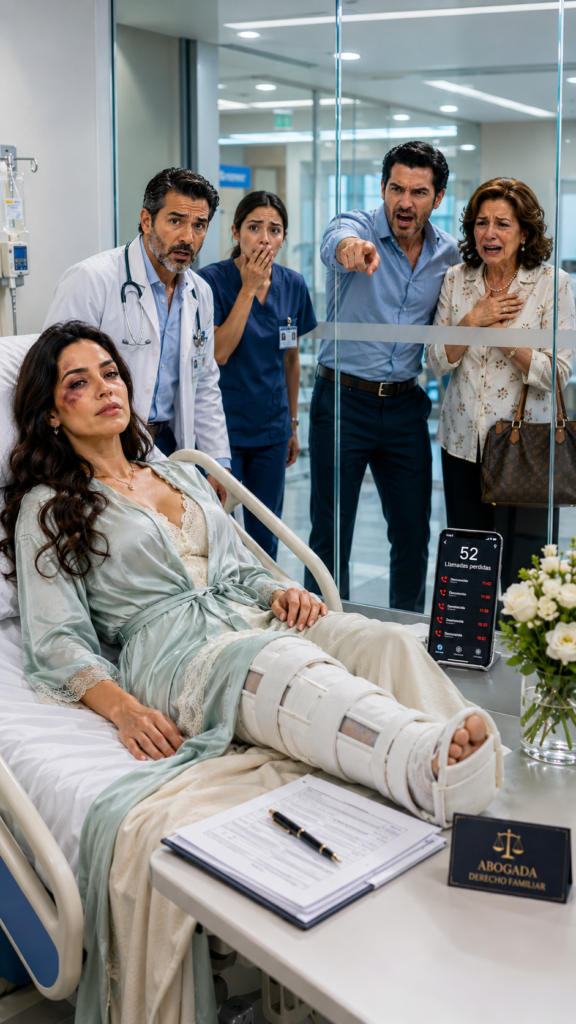
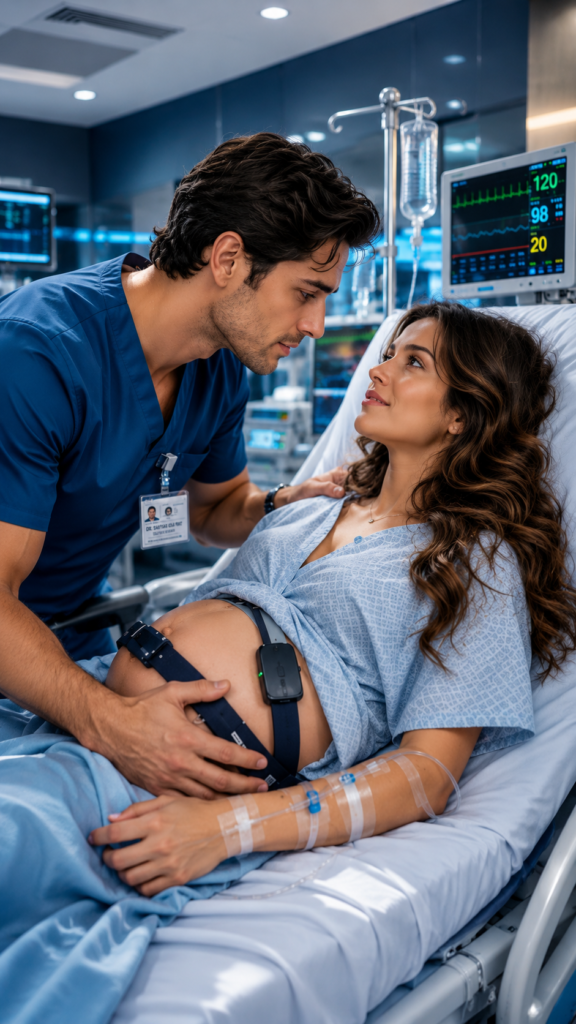
Valeria arrived unconscious, 31 weeks pregnant, with a hemorrhage that left no time for questions.
Alejandro led the emergency C-section.
Two babies were born: Luna and Mateo.
They were tiny, fragile, and needed intensive care, but they were alive.
Valeria survived too.
When she awoke, she didn’t cry upon seeing Alejandro. She just looked at him with a coldness that hurt more than any scream.
“Don’t come near my children.”
Alejandro complied.
He knew that 5 years before, he hadn’t listened when she swore that their first daughter hadn’t died at birth.
The Robles family fertility clinic gave him a death certificate, but Valeria always maintained she had heard her baby cry.
Everyone called her unstable.
Alejandro too.
That same afternoon, a nurse handed him an envelope without a return address.
Inside was a photograph of a 5-year-old girl smiling by a lake. On her wrist, she wore a compass charm identical to the one Alejandro had given Valeria when they were dating.
On the back of the photo, it only said:
“Sofía is alive. Don’t trust the clinic. Go together to this address on Friday.”
Valeria was breathless.
Sofía was the name she had chosen for the daughter who supposedly died.
But the envelope hid something even worse.
There was a recent DNA report.
According to the document, Alejandro was the biological father of Luna and Mateo.
“That’s impossible,” Valeria whispered. “I chose an anonymous donor at a clinic in Guadalajara. I checked his history, his profile, everything.”
Alejandro read the report three times.
The samples had been taken from the twins after birth, without Valeria’s authorization.
The clinic where she underwent the treatment belonged to a subsidiary of the Robles Group.
“Your family did this,” she said, trembling with rage. “First they took Sofía from me, and now they used your genetic material to impregnate me without my permission.”
Alejandro wanted to defend himself, but for the first time, he understood that his good intentions meant nothing.
“I’m going to talk to my father.”
He found Rodrigo Robles at the family foundation’s offices on Paseo de la Reforma.
The businessman tried to evade him until Alejandro put the photograph of Sofía on the desk.
“Did you sign the authorization to remove Valeria’s daughter from the clinic?”
Rodrigo paled.
He didn’t ask which girl he was talking about.
He just said:
“You shouldn’t have found this out.”
Alejandro felt the ground move beneath him.
“Is she alive?”
His father lowered his gaze.
“Yes.”
At that moment, the door opened, and Beatriz Robles, Alejandro’s mother, entered with a distraught face.
“Rodrigo, shut up,” she ordered. “If you tell the truth, not only will we lose the company. This whole family will be destroyed.”
Alejandro clenched the photograph in his hands.
And no one could imagine what was about to happen...
PART 2
Alejandro locked the door.
For the first time in his life, he didn’t speak as the obedient son of the Robles family but as a doctor.
“I want dates, names, and documents. If you lie again, I’m leaving here and going straight to the District Attorney.”
Rodrigo sank into a chair.
He confessed that the family was financing a secret program to study a hereditary cardiomyopathy that had killed several men in the Robles family.
Alejandro had been examined from a young age, but his results were never truly negative.
There was a rare variant in his DNA.
Dr. Esteban Salgado, the clinic director, promised to develop a way to detect and prevent the disease before birth.
What he never explained was that he also stored genetic samples from the entire family.
Including a sample from Julian, Alejandro’s older brother, who had died years earlier.
“What does that have to do with Valeria?” Alejandro asked.
Beatriz answered with a broken voice.
When Valeria and Alejandro were dating, she needed fertility treatment after surgery. Both left samples at the clinic, believing they would only be used to create embryos for the couple.
Salgado did something different.
He used Julian’s genetic material.
Valeria became pregnant without knowing that the biological father was not Alejandro but a man dead 7 years before Sofía was born.
Alejandro recoiled, disgusted.
“And you allowed this?”
“We didn’t know until afterward,” Beatriz said.
But that didn’t excuse her.
Six months after the birth, Salgado showed her a video of Sofía alive. The girl was in a house with nurses and other babies.
Then he threatened her.
If Beatriz reported the project, the girl would disappear forever.
Beatriz paid for 11 months to keep her alive.
Then Salgado stopped responding.
“You told Valeria she was crazy,” Alejandro said. “You offered her money and sent her out of the city.”
“I thought if she kept looking, they’d kill her.”
“No, Mom. You chose to protect the family name.”
Rodrigo admitted something even more outrageous.
He signed the transfer of Sofía to a supposed pediatric residence but never checked the destination.
When he discovered the death certificate was fake, he hired private investigators.
All in secret.
“That’s how powerful people apologize,” Alejandro said. “In silence, so no one sees the damage they’ve caused.”
He returned to the hospital and told Valeria everything.
She didn’t scream.
She just stared at Sofía’s photo with a sadness so deep that Alejandro couldn’t meet her gaze.
“So they even took away my right to know who my daughter’s father was.”
Alejandro nodded.
“And they also stole 5 years with her from you.”
Valeria pressed her lips together.
“Who sent the envelope?”
Valeria’s old phone gave the answer.
The security team recovered deleted messages from an encrypted app.
“DON’T TRUST THE CLINIC.”
“THE TWINS WERE NOT AN ACCIDENT.”
“THE HOUSE IS FUNCTIONAL AGAIN.”
The last message said:
“I FOUND SOFÍA. I HAVE THE ORIGINAL CERTIFICATE. CALL DANIEL.”
Daniel Ortega was the brother of Camila, a nurse who had worked with Salgado.
For years, Daniel managed the clinic’s IT systems.
He had created the program Salgado used to alter records, hide samples, and fabricate certificates.
When he discovered the truth, he tried to erase the system.
Salgado threatened him, and Camila fled with the only baby she could get out of the residence.
Sofía.
Daniel bought the old house by the lake through a trust in Valeria’s name.
He didn’t want to trap them.
He wanted to return the child’s identity to her and deliver all the evidence at the crime’s origin.
Valeria was still weak from surgery, but she refused to stay behind.
“They’ve decided for me too many times.”
The doctors authorized a brief ambulance transfer.
Alejandro went with her.
A specialized prosecutor, 2 agents, and an independent pediatrician also accompanied them.
When they arrived in Valle de Bravo, the house seemed abandoned.
The windows were covered, and the garden was overgrown.
Valeria got out of the ambulance with help.
Each step hurt, but she kept moving forward.
Daniel opened the door.
He was pale, with dark circles, holding a memory drive with hundreds of files.
“Sorry for taking so long,” he said. “I swear I didn’t think I’d make it in time to get her out.”
Camila appeared behind him.
And beside her, a girl with dark hair, huge eyes, and the compass charm on her wrist.
Valeria stopped breathing.
“Sofía?”
The girl hid behind Camila.
She didn’t recognize the woman who had searched for her for 5 years.
That was the cruelest part.
Valeria didn’t rush to her or try to hug her forcefully.
She knelt with difficulty and took out the other half of a charm from her bag.
“This compass was your mom’s,” she said with a trembling voice. “The other half is with you.”
Sofía looked at Camila.
Camila nodded.
The girl approached slowly and put the two pieces together.
They fit.
“Are you really my mom?” she asked.
Valeria broke down in tears.
“Yes, my love. And I’m so sorry it took me so long to find you.”
Sofía didn’t hug her immediately.
First, she observed her, confused.
Then she raised a hand and touched the visible scar on her wrist, the same one Camila had told her that her mother had.
Then she threw herself into her arms.
When the embrace ended, Sofía returned to Camila and took her hand.
Valeria felt a pang of jealousy, followed by shame.
Camila had taken the place that had been stolen from her.
But she wasn’t the enemy.
“She helped me when I had nightmares,” Sofía said.
Valeria swallowed hard.
“Then she’ll always have a place in your life. No one will force you to choose between us.”
Camila covered her mouth to hold back her tears.
That response confirmed something Alejandro was just beginning to understand.
Valeria didn’t want to reclaim her daughter as if she were a possession.
She wanted to get to know her, respect her memories, and rebuild the bond without destroying the woman who had protected her.
Alejandro turned away to cry.
He didn’t know what place he would have in that child’s life.
Biologically, he was her uncle.
Emotionally, he had been the man who didn’t believe in her mother.
He had no right to demand anything.
Daniel handed over the evidence.
The files proved that Salgado used Julian’s material to create Sofía in a clandestine protocol.
Then he used Alejandro’s material in Valeria’s treatment to conceive Luna and Mateo.
He wanted to compare two generations of the same family and study the cardiac variant.
To him, the children were files.
Not people.
The most brutal surprise appeared in a recent video.
Salgado planned to reopen the residence and move the twins there once they were stable.
Valeria’s hemorrhage hadn’t been induced, but someone from the clinic had been monitoring her pregnancy, waiting for the time of delivery.
The DNA report sent to the hospital was a warning from Daniel.
Not a threat.
With the information from the memory drive, the District Attorney arrested Salgado that same night at Toluca airport.
He was trying to leave the country.
Two researchers and an administrator who had forged documents were also arrested.
The Robles Group lost contracts, the clinic was secured, and dozens of families demanded their children’s records be reviewed.
Rodrigo resigned from the presidency.
Beatriz was charged with covering up and financing illegal payments.
She insisted that she had acted to keep Sofía alive.
Valeria listened without blinking.
“Maybe you were scared,” she said. “But your fear condemned me to bury an empty box and to believe I was crazy. That was violence too.”
Beatriz had no response.
Alejandro resigned from his position on the family board and transferred his shares to a fund for the clinic’s victims.
He didn’t do it to look like a hero.
He knew money couldn’t buy forgiveness.
Valeria accepted medical help and temporary housing but demanded everything be put in writing and without conditions.
Alejandro agreed.
Days later, Luna and Mateo remained in intensive care.
Valeria took Sofía to meet them.
The girl pressed her nose against the incubator glass.
“Are they my siblings?”
“Yes,” Valeria replied. “And they’re going to need a very brave sister.”
Sofía smiled.
Alejandro stayed several steps back.
Valeria looked at him and gestured for him to come closer.
“They also need to know who you are,” she said.
It wasn’t forgiveness.
Nor was it a promise of love.
It was merely a chance to do the right thing.
Alejandro placed a finger next to Mateo’s tiny hand.
The baby grasped it with minimal strength.
And the man who had spent years believing the Robles name protected him understood something too late:
Families aren’t saved by hiding the truth.
They’re saved when someone dares to break the silence, even if it means destroying the prestige, the inheritance, and the image of those they love.
Valeria got Sofía back, but she would never recover the 5 birthdays, the first words, or the nights her daughter cried for a mother she didn’t know.
Beatriz might have thought paying kept the girl alive.
Rodrigo might have thought investigating in secret justified his guilt.
Alejandro might have thought that not knowing made him innocent.
But in the end, each had to face the same question:
How many lives can a family destroy before they stop calling “protection” their cowardice?