# The Old Woman Left Her Entire Estate to the Cleaning Lady. At the Reading, Her Daughter Realized She Had Seen Her Before.
## Part One: The Drive Over
James had done the math somewhere between the tunnel and the bridge.
He didn't say it out loud. But Caroline knew, the way she always knew with her brother — the way his jaw went just slightly tight when he was thinking in numbers, when he was reducing a situation to its most useful components.
The estate had been appraised in 2023. The house alone was worth $2.4 million. The art collection — pieces their mother had acquired across five decades of quiet, stubborn taste — had been independently valued at $890,000. The savings, the investment accounts, the municipal bonds their father had accumulated and their mother had never touched: a further $1.6 million.
Nearly five million dollars.
James was doing 40/60. He'd decided, somewhere in the tunnel, that he would propose a 40/60 split in her favor. A gesture. She was the daughter, after all. Their mother had always been harder on her, in ways James had the luxury of not fully understanding.
"Do you know how long this will take?" Caroline said.
"Shouldn't be more than an hour."
"I have a flight at six."
"You'll make it."
She looked out the window. The city moved past her, grey and indifferent.
She had flown in from Geneva. She had not been to the house since Christmas — the Christmas before last, because last Christmas there had been the situation with Theo's family, and it had simply been impossible. She had called. She had sent a very good arrangement of white orchids.
Her mother had thanked her for the flowers in a tone that suggested she was aware they were a substitute for something else.
Margaret Cole had always had that tone.
Caroline adjusted her mourning earrings — small pearl drops, perfectly appropriate — and told herself she was ready.
## Part Two: The Woman in the Waiting Room
The law offices of Hargrove & Dean occupied the fourteenth floor of a building that took itself seriously. The receptionist had offered them water. James had accepted. Caroline had declined.
They were shown to a conference room with a long oval table and a view of the river.
There was already someone seated there.
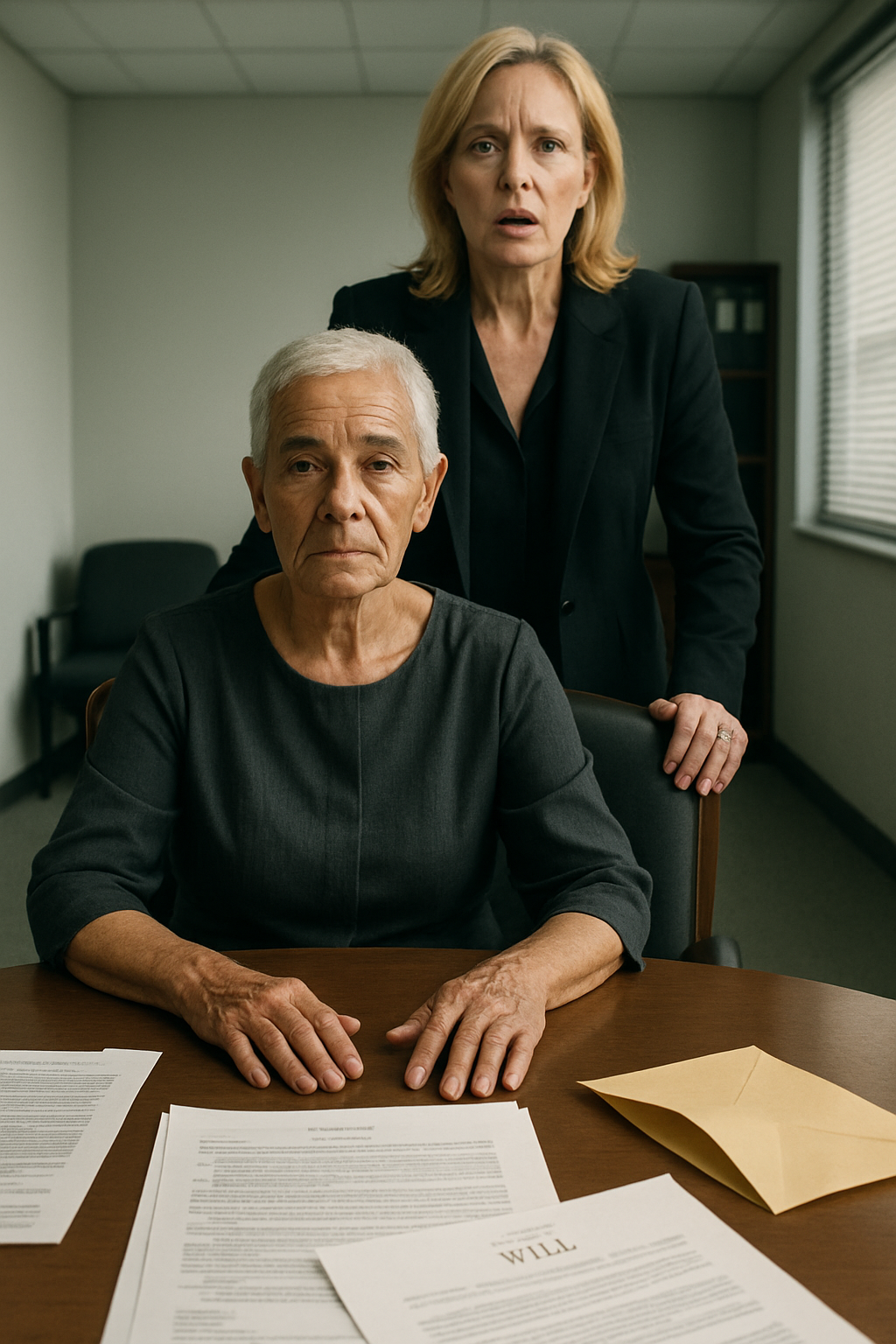
A woman. Older, maybe late fifties. Silver-white hair cut very close to her head. A face that had seen weather and hadn't tried to hide it. Small hands resting flat on the table in front of her, perfectly still. She wore a dark grey blouse and a matching skirt — not expensive, but clean and pressed with evident care. She had the look of someone who had chosen these clothes deliberately, the way you choose clothes for a thing that matters.
She looked up when Caroline and James entered.
She did not smile. She did not look nervous. She simply looked at them, noted them, and returned her gaze to the middle distance.
"Good morning," James said.
"Good morning," the woman said. Her voice was quiet and slightly accented. Portuguese, or something close to it.
Caroline sat down. She looked at the woman again. There was something.
Something familiar in the line of the jaw, or the particular way she held her stillness — not the stillness of patience but the stillness of someone who had learned that stillness was the safest response to certain rooms.
She couldn't place it.
The lawyer entered. Richard Dean, sixties, the kind of careful grey that expensive suits produced. He greeted them all by name.
Caroline heard him say: "Mrs. Santos."
The woman in grey gave a small nod.
Caroline filed the name. Tried to attach it to something. Couldn't.
Richard Dean settled his papers and looked across the table.
"Thank you all for coming. Before we begin, I want to say that Margaret Cole was a client of this firm for thirty-one years. It was an honor." He paused, briefly and genuinely. "She was also, for what it's worth, one of the clearest-minded people I have ever worked with. What I'm about to read reflects her considered and legally unambiguous wishes."
Something in his tone made James set down his water glass.
## Part Three: The Reading
The will was three pages. Richard Dean read it in full.
The language was formal, careful, and absolutely without ambiguity.
The house, the contents, the art collection, the savings accounts, the investment portfolio, the municipal bonds — all of it, the entirety of the estate of Margaret Eleanor Cole, was bequeathed to Vera Antonia Santos.
The children received nothing.
There was a clause. It stated clearly that this was not an oversight, not a product of diminished capacity, and not subject to challenge on those grounds. It referenced a letter, sealed, which Margaret had directed Richard Dean to read aloud in the presence of all parties at the conclusion of the document.
Caroline heard the words. She heard them the way you hear something underwater — the sounds arriving, the meaning assembling itself slowly, the understanding building until it was large enough to be impossible.
The house.
The art.
The money.
All of it.
To the woman in grey.
To Vera Santos.
The silence in the room lasted four full seconds.
Then James said: "I'm sorry. Could you read that section again."
Richard Dean read it again.
The language remained what it was.
"This isn't possible," Caroline said. Her voice was very controlled. She had a gift for that — for keeping things controlled right up until they weren't. "My mother had — she wasn't — in the last two years she was—"
"Mrs. Cole was assessed by two independent physicians in March of this year," Richard Dean said. "At her own request. Both confirmed full cognitive capacity. Both reports are attached as exhibits."
James had picked up his phone. His thumb was already moving.
"I'll need to see everything," he said. "All of it. This will be contested."
"That is of course your right," Richard Dean said. He said it pleasantly, which was somehow worse.
Caroline turned to look at Vera Santos.
The woman had not moved. Her hands were still flat on the table. She was looking at Richard Dean. She was not looking at Caroline, which meant Caroline could look at her fully, could study the face — the jawline, the close silver hair, the particular quality of the stillness.
Where had she seen this woman?
"Who are you?" Caroline said.
Vera Santos turned and looked at her.
"I cleaned your mother's house," she said. "For fourteen years."
"I know what you did. I'm asking who you are."
Vera looked at her for a long moment. There was no anger in it, and no apology.
"I think," she said, "you should hear the letter first."
## Part Four: The Letter
Richard Dean opened the sealed envelope. He smoothed the pages with the precision of a man who understood that what he was about to read would be remembered.
"This is a personal letter from Margaret Eleanor Cole, dictated and signed on April 14th of this year. She asked that it be read in its entirety."
He began.
To my children, and to Vera — who already knows everything I'm about to say.
I have never been a sentimental woman. I think you both know that. I never told you I loved you often enough, and by the time I understood why, the habit was too established to break. I am sorry for that. I am not sorry for much else.
Caroline. James. I want you to understand something before you spend money you don't have trying to overturn this will. I want you to understand it not because I think it will stop you — James, I know you too well for that — but because I believe you deserve to know what kind of woman your mother was, and what kind of people you became without knowing it.
I will start with the night of October 3rd, 2018.
I had fallen. In the kitchen. I had been reaching for the high shelf — the one with the good olive oil, the one your father had always reached for — and I had forgotten, for one moment, that I was eighty-two years old and my balance was not what it had been. I was on the floor for approximately forty minutes before Vera found me.
She was not supposed to be there. It was a Tuesday. She came on Thursdays. But she had had a feeling — this is what she told me later — a feeling that she could not account for or explain, and she had driven forty minutes out of her way to check on me.
I had broken my hip. I did not know this yet. I knew I could not get up.
Vera called the ambulance. She stayed with me on the kitchen floor. She held my hand, which I found — I still find — extraordinary, because I had never given her any particular reason to want to hold my hand. I was not a warm woman. She held it anyway. She talked to me about small things. The garden. A film she had seen. Her granddaughter's first word.
She rode in the ambulance with me. She waited four hours in the hospital. She called the surgeon's office herself — she speaks excellent English, which I realize I had never fully registered in fourteen years, because I had never truly listened — and she made certain I was assigned the best person available.
You will say: this is what a kind person does. This does not justify inheritance.
I am not finished.
While I was in the hospital, Vera managed my house. She contacted my doctor, my pharmacist, the woman who handled my correspondence. She sorted my medications. She organized the mail. She dealt, quietly and firmly, with the situation that arose with the neighbor on the west side — a dispute about the fence that had been unresolved for three years — and she resolved it in forty-five minutes by simply going over and speaking to him.
She visited me every day for the eleven days I was hospitalized. Every day. Sometimes twice.
You visited me on day four and day nine.
I am not saying this to punish you. I am saying it because it is true, and I spent too much of my life leaving true things unsaid.
After I came home — after Vera had prepared the house for my return, had purchased the walker I refused to admit I needed, had learned how to administer my new medication protocol — I asked her why she had come that Tuesday. The day that wasn't her day. The day she had driven forty minutes out of her way on a feeling.
She said: "I thought about you at dinner the night before. I thought about you eating alone. I thought about whether you had enough of the soup you liked. I thought that if something happened to you and I hadn't checked, I wouldn't be able to forgive myself."
I had been alone in that house for seven years. Since your father died. Seven years of careful, managed solitude, because I did not want to need anyone and because needing people had always struck me as a form of exposure I could not afford.
In seven years, none of the people I had known all my adult life had thought about whether I had enough soup.
Vera had.
I am not a sentimental woman. But I am a precise one. And the precise truth is this: Vera Santos has been present in my life for fourteen years. She has been present not in the way of obligation — not in the way of someone who comes because they are paid — but in the way of genuine witness. She noticed when I was tired. She noticed when I had been crying. She never mentioned it. She simply stayed a little longer, or brought me a cup of tea without being asked, or suggested, very casually, that perhaps I might enjoy the program she had seen about the gardens of Portugal.
She did not treat me as someone to be managed. She did not treat me as a problem to be scheduled around. She treated me as a person.
I have not always been able to say the same for you.
There is one more thing.
I want to address the other matter — the matter I expect you will not have thought of, because neither of you knew about it.
In 2021, there was a situation with the accounting firm that handled my investments. I had been made aware of certain irregularities — the kind of irregularities that could have cost me a significant portion of my estate if they had gone unaddressed. I was not well at the time. I was managing the aftermath of my second surgery, and I was not, if I am honest, entirely myself.
Vera found the discrepancies. She found them because she had, over the years, become someone I trusted with my mail on difficult weeks, and because she is considerably sharper than anyone who has ever met her in her professional capacity has ever given her credit for being. She found them, she documented them, and she brought them to me with a folder she had organized herself, with tabs and summaries, written out in her careful handwriting.
She did not know what the numbers meant in full. But she knew they were wrong.
I contacted my attorney. The matter was resolved. I recovered approximately $340,000 that would otherwise have vanished. I do not know what Vera was paid that week. I believe it was $280 for eight hours of work.
She did not ask for a bonus. She did not ask for anything. When I tried to give her additional money, she said: "Margaret. I was just paying attention."
Just paying attention.
I have thought about those words for five years.
The house is Vera's because it was Vera's long before I died. She is the one who knew where the draft came in on the east window. She is the one who knew which step creaked and why. She is the one who knew my mother's portrait needed dusting every eleven days or the varnish would cloud. She is the one who knew, without being told, that I liked the chair moved three inches closer to the garden window in the afternoons.
You both knew the address. You knew the appraised value. That is not the same thing.
I love you both. I have loved you in the ways I knew how to, which were insufficient, and I am sorry for that. But love is not the same as deserving. And what Vera deserves, she has earned through fourteen years of showing up — not just on Thursdays, not just when it was convenient, but on a Tuesday in October when no one asked her to and she came anyway.
That is all.
Margaret Eleanor Cole April 14th
## Part Five: What Caroline Remembered
The room was very quiet.
Richard Dean folded the letter and placed it on the table.
James had stopped looking at his phone. He was looking at the surface of the table in the particular way of a man whose calculation had just been made irrelevant.
Caroline was looking at Vera Santos.
The memory had arrived. Quietly, the way memories sometimes did — not a flash but a slow filling-in, like water finding level.
October 2018.
She had come on day four. She remembered now — she had been late, had flown in from Geneva that morning, had gone straight from the airport. She had walked into her mother's hospital room carrying a cashmere blanket and a specific type of mineral water that Margaret had once mentioned she preferred.
There had been a woman in the chair next to the bed. Silver hair. Small hands. She had stood up immediately when Caroline entered, moved back out of the way with practiced efficiency, found another chair and placed herself against the wall.
Caroline had not asked who she was. She had assumed — she had not quite assumed anything, she had simply not asked, had turned her full attention to her mother, had arranged the blanket, had opened the mineral water, had done the things that signaled presence without requiring her to be fully present.
When she left, two hours later, the woman had still been there.
Sitting against the wall.
Waiting.
Caroline had not said goodbye to her. Had not, in fact, registered her as a person requiring acknowledgment.
She saw it now, clearly, with the particular cruelty of clarity arrived at too late: she had looked through Vera Santos the way you look through furniture. The way you look through anything that serves a function so reliably you stop seeing it entirely.
"You were in her room," Caroline said. "In 2018. When she was in the hospital."
Vera nodded.
"Every day."
"Yes."
"I didn't — I should have—" She stopped. The sentence had no clean ending.
"You were there," Vera said. "That was what mattered to her. That you came."
The generosity of this hit Caroline harder than the will had.
James pushed back from the table. He was very controlled. He said: "I'll be in touch, Richard." He picked up his jacket. He said, to Vera, without looking at her: "This isn't settled."
Vera said nothing.
He left.
Caroline did not get up.
## Part Six: Vera's Fourteen Years
The first Thursday had been in the autumn of 2010.
Margaret Cole had opened the door herself. She had looked at Vera for a long moment without saying anything, then stepped aside.
The house was large and very clean. Not the clean of neglect but the clean of control — nothing in disorder, nothing out of place, nothing that admitted mess or softness or the kind of evidence that people live in a space rather than maintaining it.
Margaret had shown her the cleaning supplies and the schedule and the list of preferences. The list was handwritten and very specific. It included the exact product to be used on the mahogany bannister, the number of times the downstairs bathroom should be checked during each visit, the protocol for the mail.
"I do not want to be chatted at," Margaret had said.
"All right," Vera had said.
She had not been chatted at.
For the first six months, they had barely spoken. Vera cleaned. Margaret read, or wrote letters, or moved through the house in the particular way of someone who had learned to coexist with solitude without quite making peace with it.
Then, in the spring, the garden had done something extraordinary. Vera had been working on the kitchen windows and had paused, looking out, at the roses along the south wall. They were fully open, blowsy and impractical, the kind of roses that committed fully to the idea of themselves.
"Those are beautiful," she said. She hadn't meant to say it aloud.
Margaret, behind her, said: "My husband planted them."
A pause.
"He was a better gardener than me," Margaret added. "I've been trying to kill them for seven years but they keep coming back."
Vera turned around. Margaret was standing in the kitchen doorway with a cup of tea. She looked, for a moment, like someone else — like the woman she might have been in the early years of the marriage, before the posture had set in so completely.
Vera said: "I think they're stubborn."
Margaret said: "So was he."
Something shifted. Not much. Just enough.
Over the years, Vera had learned the house the way you learn a language — not by studying it but by living in it, by making mistakes and correcting them, by developing an instinct for what it needed.
She learned that the third step on the back stairs was loose and would squeak if you stepped in the center but not on the right edge. She learned that the east window had a seal that had failed and needed a towel at the base on rainy days or the floor would warp. She learned that the portrait of Margaret's mother in the upstairs hall — a severe woman with good bone structure — needed to be dusted every eleven days with a specific cloth, or the varnish developed a cloudiness that Margaret found distressing, though she never said so directly.
She learned that Margaret ate alone at the kitchen table, never in the dining room, since her husband had died. She learned that Margaret read two newspapers and the literary review and nothing that could be classified as entertainment. She learned that Margaret kept a photograph in the bottom drawer of her desk — a photograph of herself and her husband, very young, at a beach somewhere — and that she looked at it when she thought no one was around.
Vera was often around. But she had learned the difference between being present and intruding.
In 2015, she had found Margaret crying.
Not obviously. Margaret did not do anything obviously. She was sitting at the kitchen table with the newspaper folded in front of her and her cup of tea and she was simply — wet-eyed. Composed. The way a person cries when they've had a long practice of crying alone and have learned to contain it to the smallest possible space.
Vera had put the kettle on. She had not said anything. She had made a fresh pot of tea and placed it on the table and poured a cup without being asked.
Margaret had said: "Today would have been our fiftieth."
Vera had sat down across from her. Not presuming. Just — sitting.
They had drunk their tea. Margaret had talked, eventually, about the trip they had planned. Rome. They had been going to go to Rome for the fiftieth. Her husband had made the reservations himself, which he rarely did. He had been dead for three years by then and she had never gone.
"You should still go," Vera said.
"Alone?"
"Why not."
Margaret had looked at her. "What would I do there, alone?"
"The same things you'd do with him. But slower. And you'd remember him being there."
Margaret had not gone to Rome. But she had kept talking. That afternoon, and others. Not about everything. About selected things. The things that had been accumulating in the house with no one to give them to.
Vera had listened. This was, she would tell her daughter years later, the most useful thing she had ever done for anyone.
## Part Seven: The Irregularities
The folder had taken her three evenings to put together.
She was not an accountant. She had worked cleaning houses for twenty-two years. Before that, she had worked in a fish-packing plant in Setúbal, and before that she had studied two years of economics at a university she had had to leave when her mother got sick. She still thought in numbers the way people who've once been near a discipline always do — attentively, with respect for what they reveal.
The statements had been in the mail pile during a week when Margaret was recovering from surgery. Vera had been managing the correspondence, sorting it as Margaret had shown her — urgent, non-urgent, personal, discard. She had looked at the investment statements because they were not the usual kind. They had a different header. A different firm name from the one she usually saw.
The numbers did not track.
She did not know all of what she was seeing. But she knew addition. She knew that a number in column A and a number in column B should, if you were honest about what each column meant, produce a number in column C, and that the number in column C should match the number in the transfer record, and that it did not.
She made copies. She found the previous statements — she knew where Margaret kept her files, because she had been organizing them for three years — and she made a second set. She sat at her own kitchen table for two evenings and wrote out the discrepancies in a lined notebook, carefully, with page references.
Then she organized it into a folder with tabs.
She drove to the hospital and she put the folder on the bed beside Margaret and she said: "I may be wrong. But I think someone is taking money from you."
Margaret had looked at the folder for a long time. Then she had opened it. Then she had read everything Vera had written, slowly, twice.
Then she had said: "Call Richard Dean. His number is in the address book under D, not under H."
Vera called Richard Dean.
The matter was resolved. The money was recovered. The accounting firm was fired. A referral was made to the appropriate authorities.
When it was over, Margaret had tried to write Vera a check. A substantial one.
"Please," Vera had said. "Don't."
"Don't be foolish."
"I wasn't doing a favor. I was paying attention. That's the job."
Margaret had looked at her with an expression Vera had not seen on her face before. It took her a moment to identify it.
Gratitude was part of it. But the larger part was something more complicated. Something like recognition — the look of a person who has been seen by someone they had not expected to be seen by.
"All right," Margaret had said. "Then I'll pay attention too."
Vera had not understood, at the time, what she meant.
## Part Eight: What the Lawyer Said After
When James had left and the room had gone quiet, Richard Dean poured two glasses of water and placed them on the table.
He sat back down. He looked, not unkindly, at Caroline.
"Your mother asked me to answer any practical questions today. There's no rush. We can take as long as you need."
Caroline had not moved for several minutes. She was looking at her own hands, which were folded in her lap in a posture she did not usually allow herself. The posture of someone who had stopped performing.
"When did she decide this," Caroline said.
"The will was drafted in 2022. It replaced one from 2019 that would have divided the estate between you and James, with some charitable bequests."
"What changed in 2022?"
Richard Dean looked at Vera. Vera gave a very small nod.
"Mrs. Cole had a conversation with me in early 2022," he said. "She said she had been thinking about the nature of presence. About who had been present in her life and in what way. She said she had reached a conclusion she was comfortable with."
Caroline looked at Vera.
"I didn't know about the money," she said. "The accounting thing. She never told us."
"She didn't want to worry you," Vera said.
"Or she didn't think we'd—" Caroline stopped. She picked up the glass of water. She put it down without drinking. "Was she lonely?"
A silence.
"She was," Vera said. "At first. Less so, later."
"Was that—" Caroline's voice shifted slightly. "Was that because of you."
"It was because she allowed herself to be less lonely," Vera said carefully. "I was just there."
"Don't do that," Caroline said. "Don't minimize it. I've been minimizing it for twenty years and I can see where that goes."
Vera looked at her.
Caroline said: "I looked through you. In the hospital. I walked into that room and you were sitting next to her and I looked right through you. I do that. I do it all the time and I never—" She stopped again.
The window showed the river. It moved without urgency.
"She knew you loved her," Vera said. "She talked about you."
"What did she say."
"She said you were the most capable person she had ever raised. She said you got your pride from her and she felt about that the way she felt about the roses — guilty and glad at the same time."
Caroline made a sound that was not quite a laugh.
"That's her," she said. "That's exactly her."
## Part Nine: The Drive Back
Vera did not take a car service. She had driven herself — a ten-year-old Volvo, clean and well-maintained. She sat in the parking structure for a few minutes before starting the engine.
Her hands were on the wheel. Her hands had always been her most reliable feature — small, strong, used to work. They did not shake.
She had not wanted the estate. This was not false modesty. It was simply true. What she had wanted — what she had had — was harder to name and more valuable: the experience of being known by someone who was not easy to know.
Margaret Cole had been a difficult woman. She had been sharp and sometimes cold and she had had opinions about things that were not her business and she had never apologized for any of it. She had been the kind of woman who, if you did not look at her carefully, you could easily dislike.
Vera had looked at her carefully.
And underneath the difficulty — under the armor of someone who had been told too many times in her life that wanting things was a form of weakness — there was a person of considerable intelligence and unexpected humor and a specific kind of loyalty: the loyalty of someone who, once they decided you were real to them, committed fully.
Margaret had committed fully.
Vera started the car. She had an appointment at one with her granddaughter — Elena, three years old, who had a new word every week and who had learned, last month, to say avó with the Portuguese pronunciation, which Vera had taught her, which had made her cry in the kitchen for ten minutes while Elena watched with calm, scientific interest.
Elena would grow up in the house, if Vera decided to keep it. The garden with the stubborn roses. The portrait on the stairs. The east window with the faulty seal.
She thought she would keep it.
She thought Margaret had known she would.
## Part Ten: What James Did Next
He filed the challenge six days later.
Richard Dean had expected it. He had prepared for it. The physicians' reports were thorough. The documentation from 2022 was thorough. The letter itself — sealed, witnessed, dated — was thorough.
Margaret Cole had been a precise woman.
The challenge was withdrawn four months later.
James called Vera once, during this period. It was a short call. He said he wanted her to know he bore her no personal ill will. He said he thought their mother had made a decision that he didn't fully understand, but that he was prepared to accept.
Vera said: "I know she loved you. She told me, many times."
A silence on the line.
"She had a particular way of showing love," James said. "It wasn't always easy to—"
"I know," Vera said.
Another silence.
"Thank you," he said. "For being there."
"She made it easy," Vera said. "Once you knew how to listen."
## Epilogue: October 3rd, Every Year
Vera moved into the house in the late autumn.
She kept most things as they were. The portrait. The chair by the garden window. The specific cloth for the mahogany bannister. The protocol for the mail.
She let the roses do what they wanted.
Every October 3rd, she made soup.
Not a particular recipe. Just soup — the kind Margaret had liked, which was not a recipe so much as an attitude toward vegetables: serious, unsentimental, and better the next day.
She ate it at the kitchen table. Alone, mostly, though sometimes Elena was there, and once Caroline had come — had called ahead, had been diffident and careful about asking, had arrived with a bottle of wine and stayed for three hours.
They had talked about Margaret. About what she had been like before the posture set in. Caroline had photographs — old ones, from the early years of the marriage — that Vera had not seen.
In one of them, Margaret was laughing at something outside the frame. Full-on laughing, caught by the camera in an unguarded moment.
Vera had held the photograph for a long time.
She had known Margaret for fourteen years, across thousands of hours, across grief and surgery and garden mornings and silent afternoons. She had known her better, perhaps, than anyone.
But she had never seen her laugh like that.
This was the thing no one told you about the people you came to know late in their lives: there was always a country of their earlier self that you did not have access to. You received the version shaped by everything that had come before you.
You paid attention to what you had.
You tried to be worth paying attention to in return.
Vera placed the photograph on the counter next to the other one — the husband at the beach, the young man with the squinting smile, the roses still decades away from being planted.
She finished her soup.
She washed up.
She turned off the kitchen light and moved through the house in the dark, which she knew perfectly, every step and creak and draft and particular quality of silence.
It was, she thought, a good house.
It had always been a good house.
Now she would make sure it knew that someone was home.
End.