PART 1
When Mariana returned to her parents' house in Coyoacán, all she wanted was to surprise them.
She bought freshly baked rolls, green grapes, and a stick of butter that her dad always claimed was "just like any other," even though he finished it in two days.
It had been almost a week since she last saw them.
Her mom, Doña Teresa, had insisted she take a container full of chicken soup.
"You look thin, daughter. That job is going to leave you dry."
Don Ramón, her dad, waved her off from the door wearing his old Diablos Rojos cap.
Mariana promised to return on Saturday.
But Saturday came with obligations.
Then an extra shift at the clinic followed.
After that, her husband, Andrés, had to cover a shift.
And when she finally thought about going, she woke up with a fever.
Life, that damned routine, kept pushing her visit aside as if her parents could wait forever.
On Tuesday afternoon, her sister Karla sent her a message.
"Can you stop by Mom and Dad's to pick up the mail? We’re heading to Cuernavaca for a few days. The patio door is stuck again."
Mariana felt a sting of guilt.
Karla lived closer, yet she always found a way not to go.
Still, Mariana didn’t respond with anything bad.
She simply wrote: "Sure, I'll stop by after work."
She drove to Colonia Roma to buy some things and then headed to Coyoacán.
When she arrived, it was already getting dark.
The street smelled of old rain and warm tortillas from a nearby eatery.
Everything seemed normal.
But the house was too quiet.
The TV where her dad watched the news wasn’t on.
The yellow kitchen light wasn’t on.
Her mom didn’t come out saying, "Come in, sweetie, don’t just stand there."
Mariana rang the doorbell.
Nothing.
She knocked on the door.
"Mom? Dad? It’s Mariana."
Only silence answered.
Nervously, she took out her key and opened the door.
The air inside was heavy.
As if someone had closed the house around a rotting secret.
The living room was lit by a small lamp.
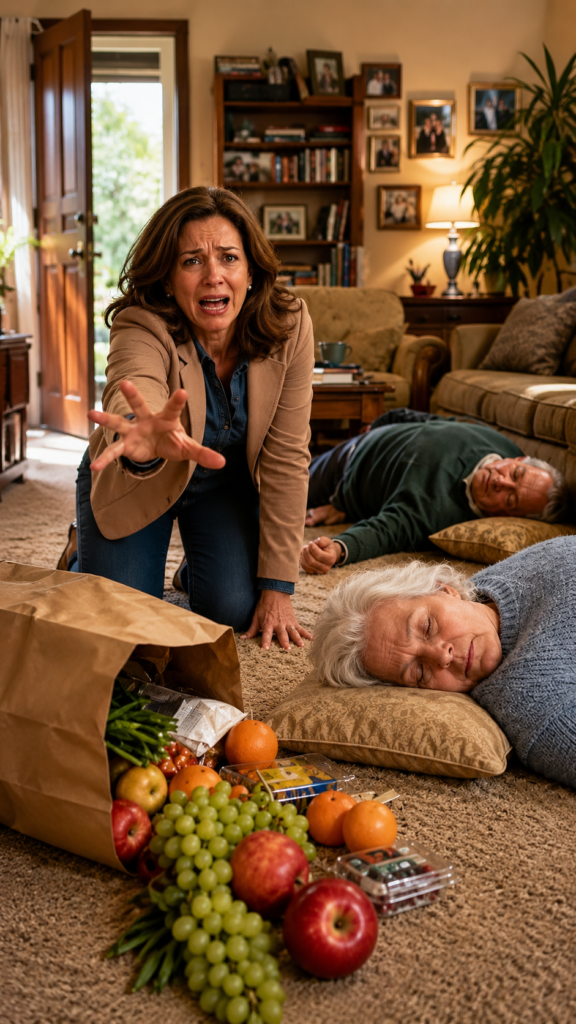
Then she saw them.
Doña Teresa lay sprawled next to the coffee table.
Don Ramón was on the floor, near the armchair, his glasses askew and a hand pressed against his chest.
The grocery bag had fallen.
The grapes rolled across the floor like green marbles.
Mariana wanted to scream, but her voice caught in her throat.
She ran to her mom.
She touched her face.
It was cold, but she was breathing.
Then she checked her dad's pulse.
Weak.
Almost nothing.
She called 911, shaking so much she could barely say the address.
While waiting, she saw two cups on the table.
A spoon lying on the rug.
And a plate with remnants of red mole, her father's favorite.
Hours later, at the hospital, a doctor came out with a serious face.
"They’re alive, but we found a toxic substance in their systems."
Andrés hugged Mariana before she collapsed to the floor.
Karla cried on the phone.
"Who would do something like this? Who, Mariana?"
Mariana didn’t know how to respond.
But seven days later, Andrés entered their kitchen pale, soaked from the rain, holding a tiny memory card.
"Your dad’s old doorbell never stopped recording."
And when Mariana saw the first frame of the video, she felt her blood run cold.
PART 2
Andrés didn’t want to play it in front of everyone.
First, he closed the kitchen door.
Then he lowered the phone's volume.
Mariana sat there with swollen eyes from lack of sleep.
The hospital called every few hours.
Her mom was still critical.
Her dad had just woken up ten minutes ago, confused, asking if América had played.
The police said they couldn’t accuse anyone without clear evidence.
Meanwhile, Karla kept repeating in the family group that "it was probably a botched robbery."
But nothing was missing.
Not the TV.
Not Doña Teresa's jewelry.
Not the envelope with cash that Don Ramón kept in a cookie tin.
Then Andrés connected the memory card.
The image was blurry but enough.
You could see the front door of the house.
The date read Monday, 8:46 PM.
A gray car parked in front of the curb.
Mariana leaned closer to the screen.
The first person to get out was Karla.
She held a grocery bag in her hand.
Mariana felt a dry thud in her chest.
"It can’t be her," she murmured.
Andrés said nothing.
In the video, Karla knocked on the door.
Doña Teresa opened with a smile.
She hugged her.
Then another man appeared.
A tall guy, wearing a black jacket and a cap, whom Mariana took a few seconds to recognize.
It was Óscar, Karla’s husband.
But he didn’t enter casually.
He looked both ways down the street before stepping inside.
"Why did she say they were in Cuernavaca?" Mariana asked, her voice breaking.
Andrés fast-forwarded the video.
For almost an hour, nothing happened.
Then the door opened again.
Óscar came out first.
He held a folded napkin in his hand.
Karla followed, crying.
But it wasn’t a cry of pain.
It was anger.
Doña Teresa appeared in the doorway.
She seemed to be arguing.
Don Ramón stood behind her, pointing at something with his finger.
The camera didn’t record audio.
But Karla’s face was enough.
She was furious.
Then Karla pushed her mother’s hand away.
Óscar pulled her by the arm.
And before leaving, Karla turned to the house with an expression Mariana had never seen.
As if she hated her own parents.
Mariana wanted to vomit.
Andrés called the investigator.
That same night, they handed the memory card to the police.
The next day, Karla was summoned.
She arrived wearing dark glasses, chewing gum, as if it were just another errand.
"I went to see them, yes. So what? That doesn’t mean anything."
Mariana was in the waiting room when she heard her voice behind the door.
"My mom made me coffee. My dad made mole. We talked. Then we left. Period."
But the police already had more.
In the house's trash, they found a crumpled receipt.
It was from a farm supply store in Tlalpan.
The purchase: rat poison.
The electronic signature: Óscar Medina.
Karla said it was for a pest problem in her apartment.
Óscar said the same.
But then came the first twist.
The poison found in her parents' bodies didn’t exactly match that product.
It was a manipulated mix.
Someone had ground it up and combined it with blood pressure medication.
And the one who knew Don Ramón's medication schedule wasn’t Óscar.
It was Karla.
Mariana didn’t want to believe it.
She still told herself that her sister could be selfish, envious, dramatic, yes.
But a murderer, no.
The truth began to emerge when Doña Teresa woke up.
She had a raspy voice and could barely move her lips.
Mariana leaned closer to the bed.
"Mom, what happened that night?"
Doña Teresa closed her eyes.
A tear slipped out.
"Karla wanted the house."
Mariana felt the world stop.
Don Ramón and Doña Teresa had decided to sell the Coyoacán property to move to Querétaro, near Mariana.
They wanted to use part of the money to pay for their treatments and the rest to divide between their two daughters.
But Karla found out first.
She rummaged through documents.
Opened drawers.
Found the contract with a real estate agency.
And exploded.
"She said that house belonged to her because she 'was closer' —" Doña Teresa whispered. "— But she hardly ever came, daughter. Only when she needed money."
Mariana remembered every loan.
Every invented emergency.
Every "I need it urgently, I’ll pay you back later."
Karla owed more than 900,000 pesos.
Not only to their parents.
But also to lenders, to friends, and, as they later discovered, to some very dangerous people.
Óscar was deeply involved in underground gambling.
The Coyoacán house was his lifeline.
But the parents wouldn’t sign anything.
So Karla prepared dinner "to make amends."
She brought red mole.
Said it was from a trusted restaurant.
Insisted on serving them.
And when Doña Teresa wanted to save some for Mariana, Karla almost snatched the container away.
"Not that one, Mom. That one's too spicy."
Doña Teresa didn’t understand at that moment.
Later, she did.
The police found deleted messages on Karla’s phone.
They couldn’t recover all of them, but they got some.
"If they sell, we’ll be left with nothing."
"My dad can’t handle another scare."
"My mom takes whatever she’s given if she believes it’s homemade food."
Mariana read those phrases in the prosecutor's office and felt something deeper than trust being ripped away.
Karla, her sister.
The girl who slept with her during storms.
The one who cried at her wedding.
The one who called "Mom" the very woman who almost let her die for a deed.
But there was one more blow to come.
The investigator showed Mariana a notarized document.
Karla had tried to register a false power of attorney three days before the poisoning.
In that letter, Don Ramón supposedly ceded her total administration of the house.
The signature was clumsy.
Fake.
But there was a witness.
Óscar.
And a second signature that left Mariana breathless.
It was her Aunt Beatriz’s, Doña Teresa’s sister.
The aunt who always said Karla was "the poor one" and Mariana "the favored one."
Beatriz later confessed that she didn’t know about the poison.
But she knew about the fraud.
Karla promised her 300,000 pesos if she helped pressure the old folks.
"I didn’t think something like this would happen," Beatriz said, crying in the prosecutor's office.
Mariana looked at her unwaveringly.
"You didn’t think because you also wanted your piece."
Karla was arrested in front of the hospital.
She arrived dressed in black, pretending to be worried, with a bag of sweet bread.
When she saw the agents, she turned pale.
"Mariana, tell them it wasn’t me. We’re sisters, you can’t do this to me."
Mariana didn’t shout.
She didn’t insult her.
She just got close enough for Karla to hear her.
"You did this to Mom and Dad for a house."
Karla started crying.
But no one knew if she cried out of guilt or because she had been caught.
Óscar tried to flee to Puebla.
He was arrested two days later at a bus terminal.
He had cash, a backpack, and Don Ramón’s gold chain.
That chain hadn’t disappeared during the supposed robbery.
He had taken it after dinner, planning to sell it if everything went "well."
The trial was long.
Painful.
Doña Teresa testified from a wheelchair.
Don Ramón, thinner and trembling, wore his Diablos Rojos cap like armor.
When asked how he felt knowing his daughter tried to kill them, he looked down.
"You raise children believing love is enough. But sometimes you also raise ambition and don’t realize it."
The phrase went viral when a reporter published it.
Thousands commented.
Some said Karla was a monster.
Others questioned whether the parents were to blame for indulging her so much.
And many defended Mariana, because no one should carry the shame of their own blood's sins.
Karla was sentenced.
Óscar too.
Aunt Beatriz received punishment for forgery and complicity in the fraud.
The Coyoacán house was finally sold.
But Mariana didn’t touch a penny until her parents were settled in Querétaro, in a small house with bougainvilleas and a kitchen full of light.
Doña Teresa made chicken soup again.
Don Ramón pretended the expensive butter "wasn't that good."
One afternoon, Mariana found her mom looking at an old photo of Karla.
She didn’t tear it up.
She didn’t put it away.
She just left it on the table.
"She was my daughter too," Doña Teresa said. "And that’s what hurts the most."
Mariana didn’t respond.
Because she understood that justice could imprison Karla, but it couldn’t erase 36 years of memories.
Months later, Don Ramón had the old doorbell repaired.
Andrés asked him why, if there were new cameras.
The old man smiled sadly.
"Because that little device saw the truth when we were all blind."
Since then, every time someone rang the doorbell, Mariana felt a hollow ache in her chest.
Not out of fear.
But because she learned that sometimes danger doesn’t enter by breaking locks.
Sometimes it comes with a grocery bag, calls you "family," and sits at your table waiting for you to trust until the last bite.