PART 1
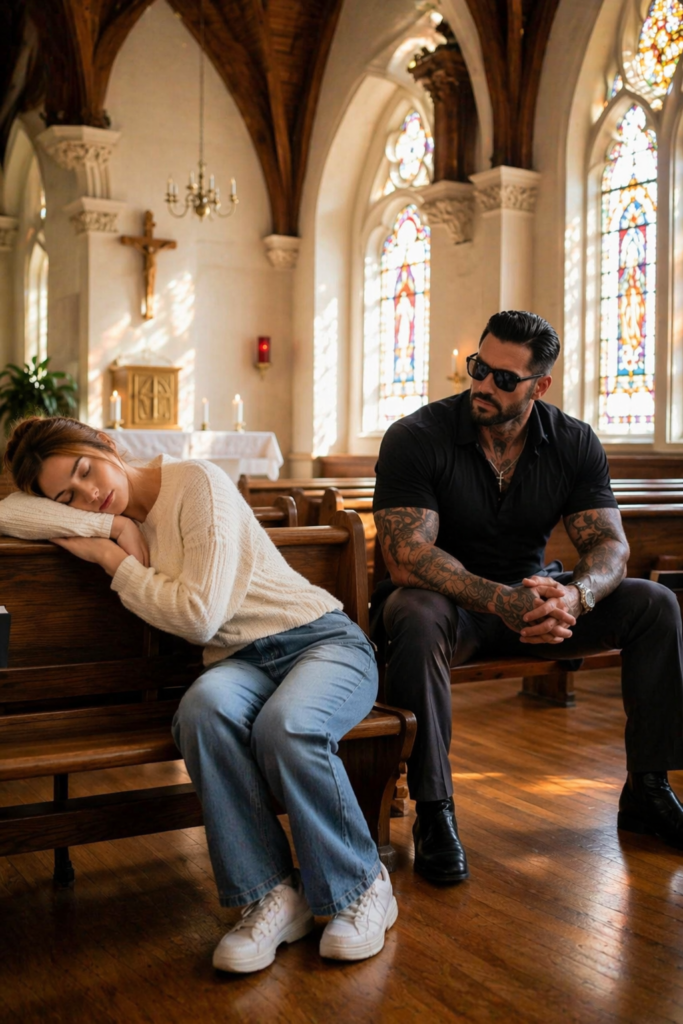
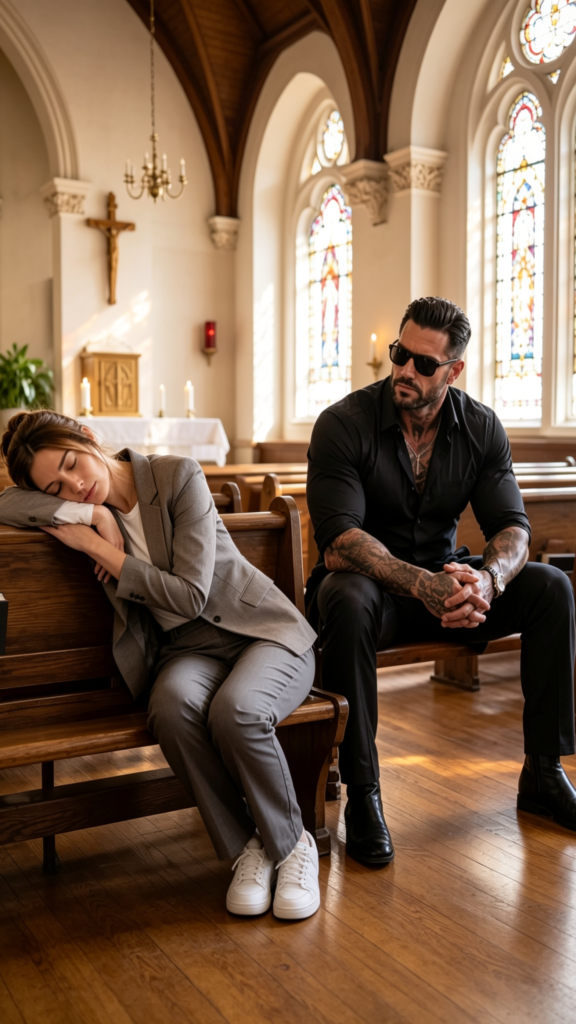
At 2:17 in the morning, Lucía Mendoza woke up in the chapel of San Gabriel Hospital to find a stranger sitting two pews behind her.
The rain battered against the stained glass as if the city were weeping from outside. In the Doctores neighborhood, ambulances continued to arrive one after another, but inside the chapel, everything felt frozen: lit candles, whispered prayers, and that smell of old coffee that only hospitals have at night.
Lucía, 29 years old, worked as a respiratory therapist and had been on duty for 18 hours. The green scrubs clung to her, wrinkled; her hair was pulled back with a loose band, and her eyes were red from running between emergencies, intensive care, and families asking what no doctor dared to promise.
She had entered the chapel just to sit for five minutes.
But exhaustion overwhelmed her.
She fell asleep on the third pew, clutching a cup of cold coffee as if it were the only thing keeping her alive.
When she opened her eyes, she saw him.
He was a tall man in a black suit, a dark coat soaked from the rain, and shoes so clean they didn’t seem to have touched the sidewalk. He possessed a rare serenity, the kind of presence that commanded without raising a voice.
Lucía jolted upright, embarrassed.
“Sorry… I didn’t know someone was here.”
The man looked at her calmly.
“Don’t apologize. You looked more tired than guilty.”
The phrase didn’t sound mocking. It sounded sad.
Still, Lucía felt a knot in her stomach.
She had heard his name in hushed corridors: Emiliano Valcárcel. Owner of private clinics, construction companies, laboratories, and half the world in contracts with politicians. To some, he was a businessman. To others, a dangerous man with lawyers, bodyguards, and buried favors.
“Do you have a family member hospitalized?” she asked, more out of nerves than genuine interest.
He took a moment to respond.
“Not anymore.”
Lucía didn’t know what to say.
Her pager vibrated.
Fourth floor. Respiratory emergencies.
She got up quickly, grabbed her backpack, and adjusted her name badge.
“Good night.”
“Good night, Lucía.”
She froze at the sound of her name.
He looked down at the badge hanging from her chest, as if that explained everything.
Lucía left the chapel with her heart racing.
For three days, she tried to convince herself it had been just another strange scene at the hospital. But on Thursday, after another brutal shift, she returned to the chapel and found a hot coffee on the same pew where she had fallen asleep.
On the cup, it said:
“For Lucía.”
She looked around.
Nothing.
All she caught was the elevator doors closing in the distance.
Since then, Emiliano began to appear in impossible places: in the cafeteria at 4:40 a.m., under the parking structure when it rained, by the windows where families cried quietly.
One dawn, Lucía found him sitting with a cup of coffee and an old photograph on the table.
“Here you are again,” she said, trying to sound calm.
“Looks like it.”
“You never told me your name.”
“Emiliano Valcárcel.”
Lucía pretended not to be surprised.
She had already searched for him online.
Photos of hospital inaugurations. Smiles with governors. Lawsuits without verdicts. Rumors of purchases, favors, and silences.
“And what is someone like you doing here every night?”
Emiliano looked at his cup.
“Doing the same as you. Surviving until dawn.”
For the first time, Lucía allowed herself a small smile.
But when he stood up, he left the photograph on the table.
Lucía didn’t want to touch it.
She just stared.
And the air left her chest.
In the picture was a young woman by a lake, with dark hair, large eyes, and a smile Lucía would have recognized even after a hundred years.
She looked almost identical to Sofía.
Her sister.
Dead for eight years in an accident on the way to Cuernavaca.
That afternoon, Lucía found Emiliano in the parking lot, next to a black SUV.
“Who is the woman in that photo?”
He slowly closed the door.
“Someone I haven’t been able to forget.”
“She looks like my sister.”
Emiliano’s face changed.
It wasn’t surprise.
It was fear.
“What was her name?”
Lucía swallowed hard.
“Sofía Mendoza.”
The rain fell harder on the metal roof.
Emiliano looked down.
“Then the truth has caught up with us.”
“What truth?”
He didn’t answer.
And Lucía understood, with ice-cold skin, that this man hadn’t come into her life by chance.
He had been searching for her long before she knew she should fear him.
PART 2
For a week, Emiliano disappeared.
Lucía tried to tell herself it was better this way. A man like him didn’t bring calm. He brought black SUVs, expensive lawyers, secrets that smelled of old hospitals, and problems that a tired worker didn’t need in her life.
But every night, as she passed the chapel, she glanced at the third pew.
There was no coffee.
No damp coat.
No more that uncomfortable presence that inexplicably made her feel less alone.
On Saturday, just before midnight, Lucía went down to the clinical records room to help doña Meche, a 62-year-old employee who had spent half her life taking care of files as if they were relics.
“Help me with this scanner, dear. This thing jams more than a combi during payday,” the lady said, frustrated.
Lucía let out a tired laugh and sat down in front of the desk.
While organizing some old boxes, a folder opened, and several papers fell to the floor. Among them was a yellowed photograph.
Lucía bent down.
And froze.
It was the same woman from Emiliano’s photo.
But now it was attached to a medical form with a name written above it:
Sofía Mendoza Ortega.
Donor patient. Date: 8 years ago.
Lucía felt the floor drop beneath her.
“Doña Meche… why is there a file on my sister here?”
The woman paled.
“Oh, dear… I didn’t know it was your sister.”
Lucía opened the folder with trembling hands. Several pages were crossed out. Others seemed torn away. But there was one complete document, signed in Sofía’s handwriting.
Donation authorization.
Lucía covered her mouth.
Her mother had always said everything happened too fast. That Sofía died almost immediately. That there was no time to say goodbye, to ask, to do anything.
She never spoke of donation.
She never spoke of a signature.
She never spoke of Sofía having left a last will.
At the back of the folder was a brief note:
Urgent recipient. Reserved case. High priority.
Beneath it, handwritten and nearly erased, appeared a name:
Tomás Valcárcel.
Lucía needed no more.
Valcárcel.
Her phone vibrated in her pocket.
Unknown number.
The message read:
“We need to talk. Rooftop. Now.”
It wasn’t signed.
It didn’t need to be.
Lucía climbed up with the folder pressed against her chest. The rain had stopped, but the city remained damp, glistening, as if everything were still freshly wounded. From the rooftop, she could see the distant lights of Reforma and the dark buildings of Doctores.
Emiliano stood by the railing.
No bodyguards.
No arrogance.
Just him.
“Who was Tomás?” Lucía asked without greeting.
He closed his eyes.
“My younger brother.”
Lucía lifted the folder.
“And why is my sister’s name linked to his?”
Emiliano took a deep breath.
For the first time, his voice didn’t sound powerful.
It sounded broken.
“Because Sofía saved his life.”
Lucía felt her legs weaken.
He took a step but stopped before getting too close.
“Tomás was 23. He needed an urgent transplant. My family had money, contacts, doctors, lawyers… all that stuff people think can buy life. But there was no compatible donor.”
Lucía stared at him, unblinking.
“My dad offered millions. My mom prayed daily. I called every hospital I knew. Nothing worked. Until one night they told us there was someone compatible. Someone who had authorized donation.”
Lucía pressed the folder against her chest.
Sofía had always been like that.
The one who brought soup to the sick neighbor. The one who rescued injured dogs. The one who shared her jacket even if she was freezing. The one who said helping didn’t count if you bragged about it.
“How long did your brother live?” Lucía asked.
Emiliano swallowed hard.
“8 more years.”
The answer shattered her inside.
“He graduated. He visited Oaxaca. He fell in love. He opened a small café in Coyoacán because he said coffee was a decent way to hug someone without invading them. Every birthday, he toasted to ‘his unknown angel.’”
Tears began to fall silently from Lucía’s eyes.
She didn’t know whether to feel proud, furious, or destroyed.
“Why did you search for me?”
Emiliano looked down.
“Tomás died six months ago.”
The silence weighed heavier than the dawn.
“Before he left, he wrote in a notebook. He said he didn’t want to die without knowing who had given him those 8 years. I started searching. Incomplete files, retired doctors, erased names, old favors. Everything brought me here. Everything led me to Sofía. And then I saw you asleep in the chapel.”
Lucía wiped her tears angrily.
“You could have told me the truth from the start.”
“I didn’t know how to tell you that your dead sister was the reason my brother had lived.”
“And the coffees? The photo? Appearing like a ghost?”
He clenched his jaw.
“At first, I wanted to confirm it was you. After that… I didn’t know how to leave.”
Lucía wanted to hate him.
She really did.
But in front of her stood not the man of rumors. He was a broken, clumsy, guilty brother trying to find a way to say thank you when it was already too late.
Then she reopened the folder.
On the last page was a torn photo. Sofía appeared in the hospital courtyard wearing a volunteer’s gown. Beside her, someone had been ripped from the image.
Lucía turned over the photo.
On the back was a phrase written by Sofía:
“Today I met someone who reminded me that living is also a loan.”
Lucía lifted her gaze.
“Emiliano… I think Sofía met Tomás before the transplant.”
He stood frozen.
That possibility changed everything.
For four days, they searched through boxes, volunteer lists, visitation records, albums from holiday campaigns, and papers nobody had touched in years. Doña Meche secretly helped them, even though she repeated that if the director found out, they’d fire her without severance, “and it’s not like I breathe air.”
San Gabriel Hospital had changed administrators, owners, agreements, and logos. But some things survive disaster: forgotten ID badges, old photographs, letters never delivered.
On the fifth day, they found a box marked:
Volunteering, fifth floor, 8 years ago.
Lucía opened it with fear.
Inside were photos of young people distributing blankets, jello, pastries, and books to hospitalized patients.
Then Emiliano turned pale.
In one image, Sofía sat next to a thin boy with a gray hat, a huge smile, and a cup of hot chocolate in his hands.
Below it read:
Sofía and Tomás. Sunday.
Emiliano took the photo as if it were sacred.
“They did meet,” he whispered.
Lucía began to cry before understanding everything.
But the real bombshell was at the bottom of the box.
An undelivered letter addressed to the Valcárcel family.
It was from Sofía.
Lucía recognized her handwriting instantly.
The letter said she had met a patient named Tomás during her volunteer shifts. It said he was scared but made jokes so his mom wouldn’t cry. It said sometimes people meet for just a little time, but still change each other’s lives.
Then came the phrase that shattered both of them:
“If someday my body can give Tomás time, I want my decision to be respected. My life wouldn’t be less mine for continuing to care for someone else.”
Emiliano covered his face.
Lucía couldn’t stand anymore.
Sofía hadn’t been a donor by accident.
She hadn’t been a name lost on a list.
She had chosen.
She had chosen from compassion, from a tenderness so great it hurt, from her way of carrying others’ suffering as if it were her own.
But there was still one more wound to unravel.
That night, Lucía went to her mother’s house with copies of the folder. Doña Teresa was in the kitchen, preparing chamomile tea, as if hot water could fix eight years of silence.
“Why didn’t you ever tell me Sofía donated?” Lucía asked.
The teaspoon fell to the floor.
Doña Teresa didn’t ask how she knew.
She just sat down.
“Because I didn’t want you to remember her in an operating room.”
Lucía felt pain and anger simultaneously.
“She signed. She wanted to do it.”
“She was 24, Lucía. She was my daughter.”
“And she was also a woman with will.”
Doña Teresa began to cry.
“I didn’t want her touched. I wanted to take her whole.”
“But you allowed it.”
The mother clenched her apron between her hands.
“Because a social worker came with the letter. She told me Sofía had already decided. That she could save a life. That refusing was betraying her.”
Lucía froze.
“Then you betrayed her later by hiding it.”
Doña Teresa closed her eyes.
“I didn’t know how to live knowing a part of my daughter remained within someone from that family.”
“From that family?”
The mother looked out the window.
“The Valcárcels arrived that night with SUVs, lawyers, men in suits. I thought they had pressured everything. I thought for them my girl was just an opportunity. I was scared, Lucía. And I was angry.”
The confession hurt her.
But it also explained the silence.
Doña Teresa hadn’t concealed the truth out of malice. She hid it because she confused love with confinement, mourning with resentment, and protection with lies.
“Sofía knew Tomás,” Lucía said.
Her mother lifted her face.
Lucía showed her the photo.
Doña Teresa broke down.
“Oh, my Sofi…”
For the first time in eight years, she cried without holding back. She didn’t cry like a strong woman or a resigned mother. She cried like a woman who had just understood that her daughter had left a will larger than her death.
The next day, the hospital director tried to take the file from them.
He summoned them to a cold room, with two lawyers and a superior look that made Lucía nauseous.
“These documents are confidential. They cannot circulate. There are legal risks for the institution.”
Lucía looked him in the eye without lowering her head.
“What’s hidden is a story.”
The director adjusted his glasses.
“Miss Mendoza, you work here. It would be wise to consider your actions.”
Emiliano, sitting beside her, didn’t raise his voice.
But the room froze.
“Threaten her again and tomorrow you’ll have a federal audit, six reporters outside, and my legal team reviewing every contract of this hospital for the last ten years.”
The director turned pale.
Lucía looked at him in surprise.
Emiliano added:
“And this time, I won’t use my last name to open doors. I’ll use it to knock down the ones that concealed the truth.”
No one touched the folder again.
Three months later, San Gabriel Hospital inaugurated a rest room for families of critical patients.
It bore no politician’s name.
It bore no businessman’s name.
On a clear wooden plaque, it read:
Sofía and Tomás Room.
A place to breathe when life hurts.
Lucía arrived in a simple blue dress. For the first time in years, she didn’t look like a woman surviving solely on caffeine and guilt. She had reduced her shifts, returned to Sunday dinners with her mom, and started sleeping without feeling that resting was betraying her sister.
Doña Teresa came too.
She stood before the plaque with a photo of Sofía in her hands.
Emiliano arrived later, in a gray suit and two coffees.
He handed one to Lucía.
“For Lucía.”
She smiled through tears.
“You still think coffee fixes everything.”
“Not everything. But it helps a lot.”
Before the ceremony, they entered the chapel together.
The same one where it all had begun.
The morning light streamed through the stained glass, painting the floor in soft colors. Lucía sat down on the third pew. Emiliano sat beside her.
Neither spoke for several minutes.
It wasn’t necessary.
They had found a painful truth. They had also found a way to remember without sinking.
“Do you think Sofía and Tomás knew how important they were going to be to each other?” Lucía asked.
Emiliano looked toward the altar.
“I believe some people save us before we even know their names.”
Lucía rested her head on his shoulder.
He took her hand carefully, as if he were still learning that happiness could also stay.
Outside, families began entering the new room. A mother wept silently. A child slept in his father’s arms. Doña Meche arranged pastries beside the coffee maker as if it were a sacred ceremony.
Life went on.
Fragile.
Unjust.
Beautiful.
Lucía thought of Sofía.
Emiliano thought of Tomás.
And for the first time, neither felt they had lost them completely.
Because some farewells don’t end in a grave.
Sometimes they end in a signature, in a hidden letter, in a cup of coffee, in a chapel pew where two broken people discover that love can also travel from one body to another, from one life to another, from one pain to another.
That morning, when they discovered the plaque, Lucía didn’t cry from sadness.
She cried because she finally understood that her sister hadn’t gone away alone.
She had left a light on.
And that light, eight years later, had guided the most feared man in the hospital to the third pew of a chapel, just in time for two families to stop fighting with the dead and finally learn to honor them by living.