PART 1
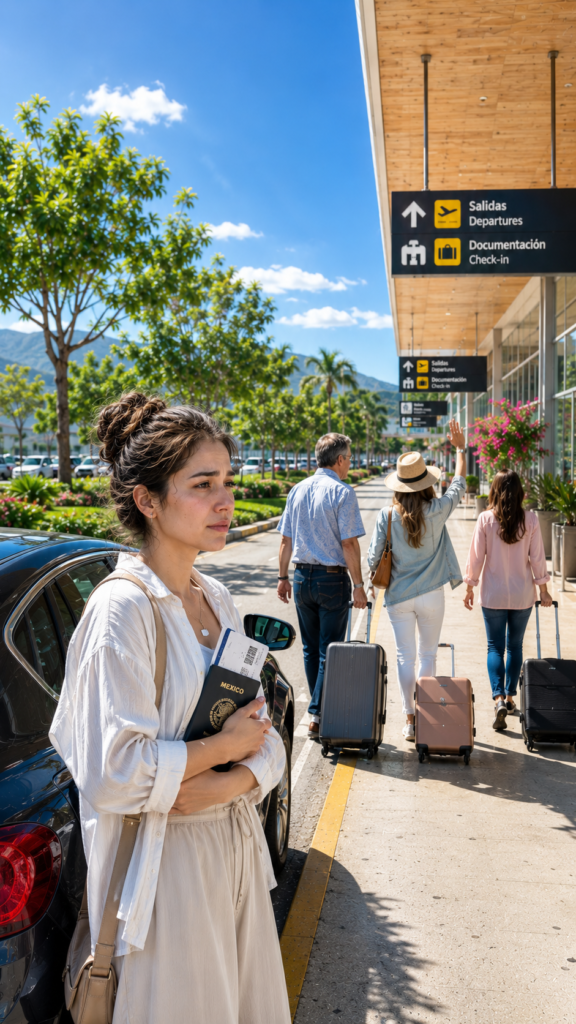
At 12:17 AM, Mariana arrived at her mother's house, the baby sleeping against her chest, a diaper bag slung over her shoulder, and her heart shattered into pieces.
She carried no suitcase. No money. No pride.
Only the message she had read on her husband Esteban's phone:
"Just tell her you don’t love her. I’m not going to keep being the other woman."
The other woman was named Renata.
Mariana didn’t scream. She didn’t break anything. She just grabbed the child, a few bottles, three diapers, and left the apartment in Ecatepec before Esteban could spin another lie.
She believed her mother, Doña Alicia, would open the door for her.
But when she recounted what had happened, the woman didn’t even let her step into the entryway.
—A decent woman doesn’t leave her home over nonsense —she said, wearing a robe and a face of shame—. Men are like that. Learn to endure.
—Mom, he cheated on me —Mariana whispered—. He humiliated me.
Doña Alicia looked at the baby, then glanced towards the street as if the neighbors could smell the scandal.
—You’re not bringing your dramas into my house. Go back to your husband.
And she closed the door.
The slam of the door sounded louder than the betrayal.
Mariana walked aimlessly for five blocks, the child pressed tightly against her chest. She called two friends. No one picked up. A taxi passed by, but she had no money to pay for it.
Then, not understanding why, she found herself in front of Doña Rosario's house.
Esteban’s mother.
The mother-in-law of the man who had just shattered her life.
She barely knocked.
Doña Rosario opened before the second knock. She wore a gray shawl, her hair up, and her hands covered in dough.
Without asking anything, she said,
—Come in, daughter. And hand me the baby for a bit; no one should be left outside in this cold.
Mariana froze.
The kitchen smelled of chicken broth. A folded blanket sat on a chair. In the back room, a crib was set up beside the bed.
—How did you know I was coming? —Mariana asked, trembling.
Doña Rosario didn’t answer.
She just served broth and told her to eat.
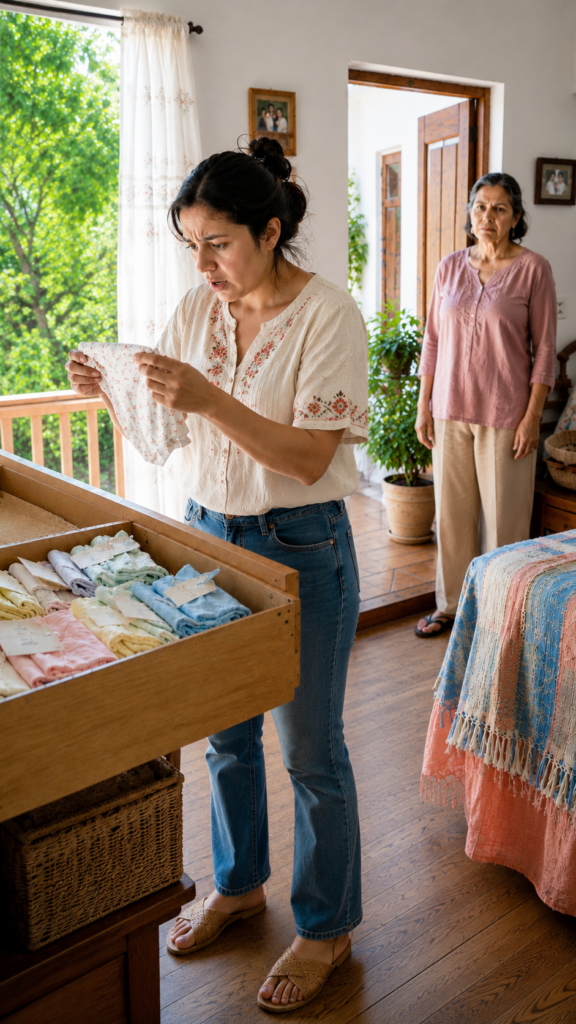
The next day, Mariana opened a drawer looking for a small blanket.
She found baby clothes perfectly folded. But they weren’t for her son.
Each outfit had a little note pinned with a safety pin.
“Verónica.”
“Lupita.”
“Mayra.”
“Dulce.”
And at the very bottom, separated from everything, there was a new onesie with a note that read:
“Mariana.”
PART 2
Mariana felt the blood drain from her face.
She squeezed the note between her fingers and stared at the drawer as if she had just discovered a small tomb in the middle of a clean house.
In the kitchen, Doña Rosario sang softly while stirring the broth with a wooden spoon.
That sweet voice, which had seemed like salvation the night before, suddenly filled her with dread.
Mariana thought about grabbing her baby and running away.
But the child was still asleep in the crib, breathing peacefully for the first time since they left the apartment. She had no money, no home, no mother.
And, painful as it was to admit, that mysterious mother-in-law was the only person who had offered her a warm meal.
She tucked the note into her sweater pocket and closed the drawer.
She said nothing.
That afternoon, Esteban arrived.
He brought flowers from the market, a fake look of remorse, and the same perfume Mariana had smelled on his shirt three nights earlier.
—I’m here for my family —he said from the sidewalk.
Doña Rosario stepped out to the gate.
—There’s no family lying around here for you to pick up whenever you feel like it.
—Mom, don’t get involved.
—I got involved too late many times, Esteban. Not anymore.
Mariana listened from the hallway, the baby in her arms.
Then she saw something that took her breath away.
Behind Esteban was a young girl with a backpack, swollen eyes, and a months-old baby sleeping on her chest.
Esteban turned to her with annoyance.
—Renata, I told you to wait on the corner.
Mariana opened her mouth, but no sound came out.
Renata. The other woman.
The woman from the message.
The mistress was crying too.
—He kicked me out —Renata said, looking at Doña Rosario—. He told me you knew what to do.
Esteban turned pale.
—No way, Mom. That’s not true.
Doña Rosario looked at her son like she looked at a wall full of cracks that she had grown tired of painting.
Then she opened the gate.
Not for him.
For Renata.
—Come in, daughter. And bring the baby. No one should be left outside.
Mariana felt rage. A nasty rage, the kind that burns from within.
—Her too? —she exploded—. Are you really letting the woman who destroyed my home in as well?
Renata lowered her head.
Doña Rosario didn’t answer right away. She closed the gate in Esteban’s face.
—We don’t entertain men who break and then come to collect the pieces —she said.
Esteban began to pound on the metal.
—Mom! Open up! Mariana, don’t be ridiculous!
No one opened.
Renata entered the kitchen trembling. Mariana looked at her with hatred, but she also saw something she hadn’t expected: the girl had an old bruise near her wrist.
It wasn’t paint. It wasn’t a shadow.
It was a finger mark.
Doña Rosario heated more broth, wrapped the baby in a blanket, and then turned to Mariana.
—You saw the drawer, didn’t you?
Mariana couldn’t lie.
She pulled out the note with her name on it.
—What is this? What kind of house is this? How many women has your son brought here?
Doña Rosario removed her shawl and sat down slowly, as if she suddenly carried a hundred years on her shoulders.
—He doesn’t bring them, daughter. They come on their own. Like you arrived. Like she arrived.
Renata began to cry silently.
Mariana remained standing, her body rigid.
—And you already had my name? Since when?
—For three weeks.
The answer hit her harder than a slap.
—You knew Esteban was cheating on me?
Doña Rosario closed her eyes.
—Yes.
Mariana took a step back.
—And you didn’t tell me anything?
—Because when a woman is in love, sometimes she doesn’t listen. And because I was cowardly too.
The word hung in the kitchen.
Cowardly.
Doña Rosario got up, went to the back room, and returned with an old notebook, its cover brown. She placed it on the table.
—Open it.
Mariana didn’t want to. But she opened it.
There were no curses. No strange plans. No hidden money.
There were names.
Verónica, Lupita, Mayra, Dulce, Itzel, Norma, Carolina, Renata.
Next to each name was an address, a date, and a small note.
“Verónica: opened a fonda in Toluca.”
“Lupita: lives with her sister in Morelia.”
“Mayra: finished high school.”
“Dulce: sells clothes by catalog and never went back to him.”
Mariana turned the pages with frozen hands.
—They aren’t memories —Doña Rosario said—. They’re proof that they left alive.
Renata lifted her gaze.
—Alive?
Doña Rosario didn’t answer right away.
She went to the drawer, pulled out a tiny yellow dress, and placed it on the table.
It was baby clothes. Little girl clothes. It was folded so carefully that it was sad to touch it.
—the first one was called Clara —she said.
Mariana looked at the notebook. Clara’s name had no address.
Just a date.
—Esteban was 24 when he married her. I loved her very much. She was quiet, worked in a stationery store, and always brought me sweet bread on Sundays.
Doña Rosario's voice broke.
—One night she called me crying. She said Esteban wasn’t coming home, that he smelled like another woman’s perfume, that he yelled at her, that he threw the keys at her. I told her to calm down. That young men are fools. That they change with time.
Mariana felt embarrassment, but also pain.
They were the same phrases her mother used.
The same chains, repeated by a different mouth.
—Eight days later, Clara left her house with her baby. She didn’t come to me. She was ashamed. She thought I would defend my son.
Doña Rosario clutched the yellow dress to her chest.
—They found her two days later at a bus terminal. The baby was alive. Clara was not.
Renata covered her mouth.
Mariana felt that the hatred towards that girl began to mix with something else. Something uncomfortable. Something human.
—Since that day —Doña Rosario continued— I swore that no woman of my son would sleep on the street if I could avoid it. Not a wife, not a mistress, not the one he cheated on, nor the one he used to cheat. None.
—But you protected him —Mariana said, finally crying—. You let him continue.
Doña Rosario didn’t defend herself.
—Yes. I protected him. And by protecting him, I did more harm. I cleaned up the messes so he would never see the blood. That was my fault too.
Outside, Esteban kept shouting.
—Mom, open or I’ll call the cops!
Doña Rosario let out a bitter laugh.
—Call them. Let’s see if you’re ashamed to tell them how many women you’ve left homeless.
Mariana looked at Renata.
The girl could barely hold her baby.
—I didn’t know he was married at first —Renata said—. When I found out, I was already pregnant. He told me you were crazy, that you hit him, that you wouldn’t let him see the baby. Honestly, he sold me a different story.
Mariana wanted to hate her.
But she saw the bruise again.
—Did he hit you?
Renata rolled up her sleeve.
—He grabbed me hard when I told him I was going to talk to you.
The kitchen fell silent.
Then Mariana understood the true size of the monster.
Esteban didn’t just cheat. Esteban chose vulnerable women, told them what they wanted to hear, separated them from other women, and then let them drop when they no longer served him.
And Doña Rosario had spent years picking up broken bodies instead of confronting the son who broke them.
That night a patrol car arrived.
But it wasn’t Esteban who called.
It was Mariana.
When the police knocked, she came out with the notebook, the messages, the photos of Renata’s bruise, and the audio where Esteban threatened to take the baby away if she left.
Esteban stopped shouting.
For the first time, he fell silent.
—Mariana, love, don’t do this —he said, changing his tone—. We can fix this.
She looked at him from the gate.
—You fix women like they’re furniture. I’m not your furniture.
Renata stood behind her, still trembling.
Doña Rosario came out too.
She didn’t hide.
—Officer, that’s my son —she said—. And I’m here to file a complaint against him.
Esteban looked at her as if his last name had been ripped away.
—You too, Mom?
Doña Rosario took a deep breath.
—Above all, I do.
The complaint didn’t solve everything in one night.
Real life doesn’t work like a soap opera.
There were hearings. There were cheap lawyers and other very expensive ones. There were calls from Doña Alicia telling Mariana she was exaggerating, destroying her marriage, what would the family say?
Mariana only answered once.
—What the family says didn’t give me a bed when you kicked me out.
And she hung up.
Renata stayed for four weeks at Doña Rosario’s house. Mariana stayed for three months.
At first, they didn’t talk much. It was strange sharing a roof with the woman who had been “the other.” But a baby crying at 3 AM doesn’t ask who’s to blame.
One heated water. The other searched for diapers.
One rocked a child to sleep. The other washed bottles.
Unknowingly, they stopped seeing each other as enemies and began to see each other as survivors of the same fire.
Doña Rosario sold gelatins outside an elementary school to help with expenses. Mariana got a job at a pharmacy. Renata began doing nails at home.
And Esteban, for the first time, had to explain his lies without his mother coming out to clean up the mess.
Months later, a judge ordered support for both babies and protective measures for both women.
It wasn’t perfect justice.
But it was a start.
Doña Rosario died two winters later, in her bed, with the notebook on the nightstand and the gray shawl hanging on the chair.
In her will, she left the house to Mariana and Renata in equal parts.
The neighbors gossiped horribly.
How was it possible? One was the wife and the other the mistress. That didn’t look good. What an example for the children.
Mariana heard it all from the gate and then put up a sign at the entrance:
“In this house, we don’t ask if you were a wife, girlfriend, mistress, or deceived. We ask if you’ve eaten yet.”
Since then, the women in the neighborhood know.
When one arrives at night with a baby, without a suitcase, and with swollen eyes, they don’t send her to the social services first. They don’t upload her to Facebook to expose her. They don’t tell her to endure.
They send her to that house.
There are two cribs set up.
Always.
In the drawer, there are clean clothes with blank tags, in case someone arrives with nothing.
And at the back, separated from everything, the tiny yellow dress of Clara remains.
Mariana takes it out every so often, smooths it with her hand, and puts it back.
Not to live in the pain.
But to not forget what happens when a door closes out of shame, when a mother prefers what others will say, when a mother-in-law protects her son so much that he becomes a harm to others.
Because sometimes the family that demands you endure doesn’t love you.
And sometimes the woman who should hate you is the only one who understands how to save you.