PART 1
Dinner felt like anything but a family bomb.
There was marinated chicken on the table, red rice, nopales with tomato, and a candle lit next to the salt shaker because Jimena said the ceiling light made the food look "like from a sad diner."
Doña Elena sat at the head of the table, her napkin neatly folded over her lap.
Across from her, her 16-year-old granddaughter Emiliana pushed a piece of potato around with her fork, too afraid to lift her gaze.
Marco, her only son, stood next to the kitchen counter, arms crossed, as if he had rehearsed the conversation before the mirror.
Jimena, his wife, sipped white wine from a huge glass and checked her phone with a calmness that was infuriating.
Then Marco spoke.
—Mom, Jimena needs the master bedroom.
Doña Elena blinked slowly.
—My bedroom?
—Yes —he replied, as if it were the most normal thing in the world—. She’s very stressed. She needs more space, more light, more privacy. The junk room has a window. We can fix it up nice for you.
The junk room.
The room where the Christmas boxes were, the old SAT papers, a treadmill no one had used since 2014, and the broken lamps that Daniel, her late husband, never got around to fixing.
Doña Elena had been sleeping in that bedroom for 32 years.
She had cried there when Daniel died.
She had kept his watch there, forever stopped at 8:12, the time he took it off before entering the hospital.
She had folded Marco’s clothes when he came back “for a few months” because his design business wasn’t taking off.
She had wrapped Emiliana’s birthday gifts there.
And now her son was offering her a room full of boxes.
Emiliana murmured:
—Dad…
Jimena cut her off with a glare.
—Don’t get involved, Emi.
Marco sighed, annoyed.
—Mom, don’t make this harder. The family sacrifices.
It almost made her laugh.
Doña Elena had been sacrificing since she was 23.
She worked as a freelance accountant, took on clients who paid late, cooked at dawn during tax season, paid for Marco’s college, his wedding, his debts, his business mistakes, and even the groceries of that house where they now treated her like an inconvenience.
When Marco, Jimena, and Emiliana arrived two years ago, they said it was temporary.
Temporary became their clothes in the washer, Jimena’s perfumes in the bathroom, Marco’s meetings at the dining table, and the phrase “our house” every time visitors came.
Doña Elena set her fork down on the plate.
—And what happens if I say no?
Marco clenched his jaw.
Jimena finally lifted her gaze.
—Elena, no one wants to be cruel. But this house has to work for the family.
Doña Elena looked around the table.
At Marco, who could no longer hold her gaze.
At Jimena, who had invaded her life room by room.
At Emiliana, whose face was pale with secondhand embarrassment.
Then Marco dropped the bomb.
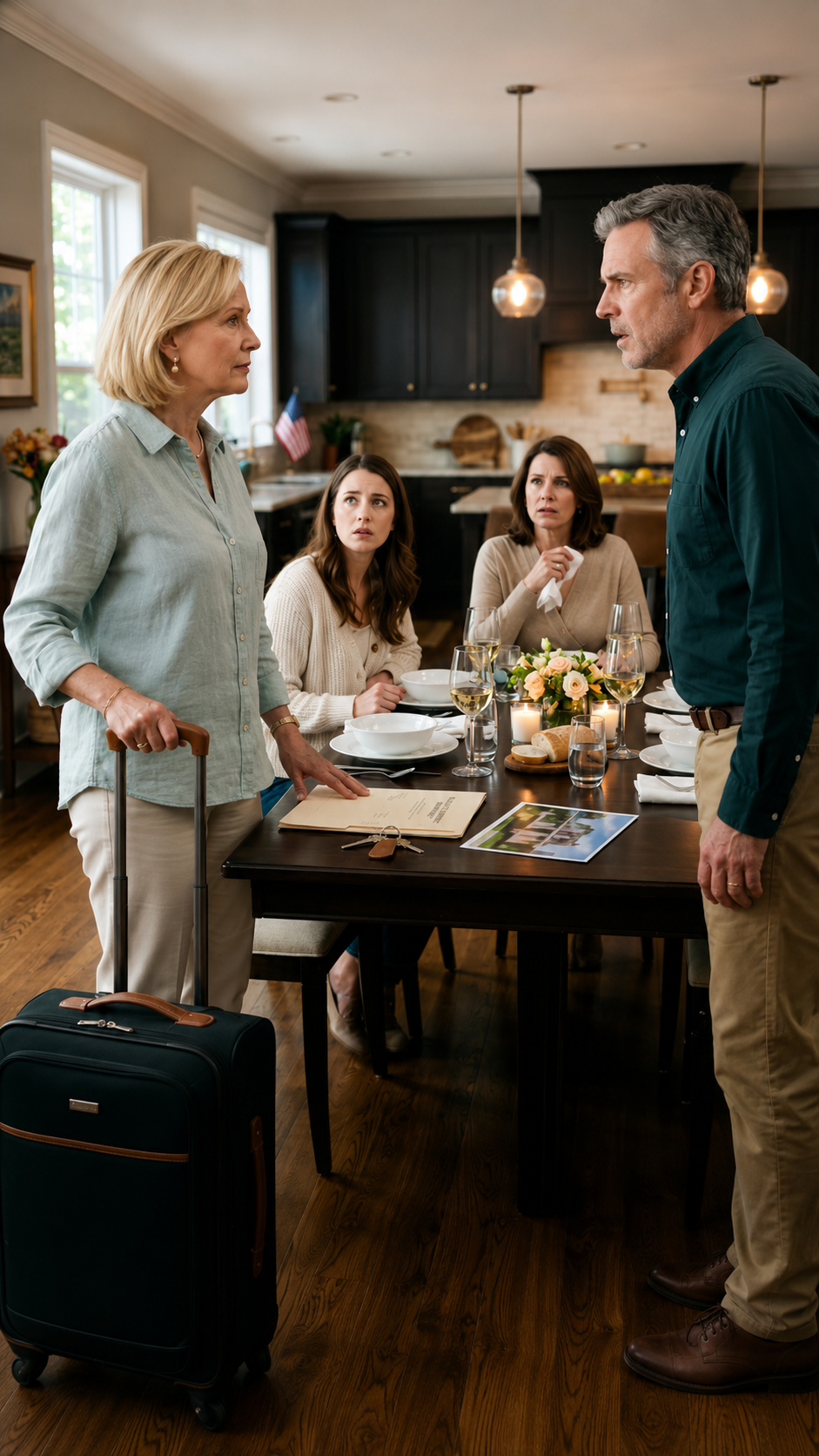
—Either you give your bedroom to my wife, or you leave.
The candle flickered.
No one said anything.
Doña Elena waited for Marco to regret it.
She waited for him to say, “I didn’t mean that.”
She waited for Jimena to feel at least a little uncomfortable.
But no one moved.
Then she stood up, folded her napkin once, and left it next to her plate.
—Alright, Marco. I’ll pack.
He opened his eyes wide.
—Oh, Mom, don’t be dramatic.
—I’m not.
She walked upstairs at a slow pace.
In her bedroom, she opened a suitcase. Just one.
She packed Daniel’s watch, her diary, a family Bible, three sweaters, her laptop, the crooked blue mug Emiliana had made for her in middle school, and a folder she kept in the top drawer.
The deed.
The mortgage release letter.
The property tax receipts.
Everything was in her name.
All hers.
That was what Marco had forgotten.
Or maybe he never knew because she had been too kind to remind him.
At midnight, sitting on the edge of the bed, Doña Elena opened an old message from her friend Chayo.
It was the listing for a little house near Tecolutla.
White, small, with blue windows, a worn porch, and the ocean in the background if one stood at the right angle.
Doña Elena had saved for years without telling anyone.
Not because she planned to leave.
But because a woman, deep down, should always have a door that opens only with her own key.
She called Chayo.
—Elena? Did something happen?
—I think I’m ready to see the beach house.
There was a silence.
Then Chayo said:
—I’ll pick you up at 8.
The next morning, Marco made coffee as if nothing had happened.
—Mom, we’ll talk tonight.
—No —she said—. Not anymore.
Jimena turned from the counter.
—Where are you going?
—to see a house.
Marco let out a dry laugh.
—You’re not going to buy a house over a fight.
Doña Elena grabbed her bag, with the folder inside.
—No, son. I’m going to buy it for all the arguments I swallowed.
PART 2
The beach house wasn’t luxurious.
The porch creaked, the kitchen needed paint, and the bathroom had green tiles that looked like survivors from three different decades.
But when the agent opened the back door, Doña Elena heard the ocean.
She didn’t hear the city traffic.
She didn’t hear Jimena saying the towels were folded wrong.
She didn’t hear Marco asking what was for dinner.
Just waves.
Chayo, standing behind her, wiped a tear with the back of her hand.
—It’s small.
Doña Elena took a deep breath.
—It’s complete.
The agent warned her that the property was sold as-is.
Doña Elena smiled.
—So am I.
That same afternoon, she made a cash offer.
By 5, it was accepted.
That night, upon returning to the city house, she said nothing.
She prepared noodle soup because Emiliana loved it and because she wanted one last normal night before everything broke.
Marco talked about work.
Jimena complained about a neighbor.
Emiliana watched her grandmother as one watches a door slowly closing.
After dinner, she found her in the laundry room.
—Are you really going to buy another house?
Doña Elena folded a towel.
—Yes.
—Because of my dad?
—Because of me.
Emiliana swallowed hard.
—He shouldn’t have said that.
—No. He shouldn’t have.
—My mom says you’re exaggerating.
Doña Elena arranged the towel calmly.
—Your mom can be wrong, too.
The girl almost smiled, but her eyes filled with tears.
—Are you leaving me too?
That question hurt.
Doña Elena left the towel and hugged her.
—No, my girl. I’m not leaving you. I’m stepping out of a place where they forgot how to treat me. It’s not the same.
Emiliana cried silently on her shoulder.
—You’ll always know where I am —Doña Elena whispered—. And when you come, you’ll have your own bedroom.
—Not a junk room?
—Never a junk room.
The next day, Doña Elena went to see lawyer Roberto Salgado, the one who had handled Daniel’s will.
His office was downtown, above a notary, with old fans, the smell of coffee, and walls filled with diplomas.
Doña Elena placed the folder on the desk.
—I want to sell my house.
Roberto took off his glasses.
—Are you sure?
—My son told me to leave.
The lawyer didn’t ask more.
He simply opened the folder, reviewed the papers, and nodded.
The house was solely in Doña Elena’s name.
Daniel had left her his share.
She paid off the mortgage years later, through hard work, sleepless nights, and annoying clients who called her at 11 p.m. because they had lost an invoice.
Marco had no legal rights.
Neither did Jimena.
Living there didn’t make them owners.
Having an opinion didn’t either.
Roberto also updated her will.
60% of her assets would be protected for Emiliana, in a trust for education, housing, and future.
The other 40% would go to Marco only if he respected her decisions, didn’t contest anything, and didn’t pressure his daughter.
If he did, that money would go to a reading foundation for children in coastal communities.
—It’s called a no-contest clause —Roberto explained.
Doña Elena put her pen away.
—I call it learning the hard way.
Over the following days, Doña Elena walked through the house like someone guarding a secret under her shawl.
She stopped paying for the entire grocery bill.
She stopped picking up Marco’s laundry.
She stopped replacing Jimena’s almond milk.
When Jimena opened the refrigerator and saw there were no chicken breasts, she asked:
—Are you going to the supermarket?
—No.
—What do you mean no?
—I have other plans.
Marco looked up from the couch.
—Mom, don’t start.
Doña Elena looked at him calmly.
—I already started, son. It’s just that you didn’t notice.
Three days later, the agent called.
There were buyers for the big house.
A young couple, fast payment, possession on Monday.
Doña Elena was sitting at the same table where Marco had asked her for her bedroom.
She looked at the yard, the lemon tree Daniel had planted, the walls that once held clean laughter.
It hurt.
Of course, it hurt.
But she also felt something else.
Space.
—I accept —she said.
The signing was at the notary, with Chayo sitting by her side as emotional backup.
Doña Elena signed where she needed to sign.
Not once did her hand tremble.
That night, she asked everyone to gather in the living room.
Marco arrived annoyed.
Jimena, distrustful.
Emiliana, nervous.
Even Carol, Jimena’s sister, was there because she had come to measure curtains for the “new suite.”
Doña Elena stood by the coffee table.
She wore navy blue pants, a white blouse, and Daniel’s watch on her wrist for the first time since the funeral.
It didn’t work.
But it reminded her that something could be stopped and still be worth so much.
—I need to inform you of something —she said.
Marco checked his phone.
—Can it be quick? I have a call.
—No.
He looked up, surprised.
Doña Elena opened a cream-colored folder.
—I sold the house.
Silence fell like a broken plate.
Jimena was the first to react.
—What?
—The new owners take possession on Monday.
Marco let out a fake laugh.
—That’s not funny.
—It wasn’t a joke.
—You can’t sell the house.
Doña Elena pulled out a copy of the deed and placed it on the table.
—The house was always mine.
The phrase changed the air.
Marco picked up the paper.
He read it.
His face lost color.
Jimena rushed forward, as if the letters would change by glaring at them with anger.
Carol covered her mouth.
Emiliana didn’t cry. She just looked at her grandmother with a mix of fear and pride.
—Mom… —Marco said.
—You lived here because I allowed it.
Jimena raised her voice.
—But this is our house too!
—No, Jimena. It was the place where you were welcomed.
—It’s the same!
—No. And that’s precisely the problem.
Marco left the deed on the table.
—You sold our house without consulting me.
Doña Elena tilted her head.
—Did you consult me before deciding I should sleep in the junk room?
No one answered.
That silence was justice.
Marco breathed heavily.
—I was angry. Jimena is stressed. We just wanted space.
—And now you’ll have it.
Jimena let out a dry laugh.
—You’re punishing us.
—No. I’m freeing myself.
—From your family?
—From my family using me.
Marco sank into the couch.
For the first time in years, he didn’t seem like the man giving orders.
He looked like the boy who once ran to his mother’s bed when there was a storm.
Doña Elena’s heart shifted.
She wanted to comfort him.
She wanted to fix it.
She wanted to make it less hard.
But she stayed still.
Because she finally understood that not all pain should be avoided.
Sometimes pain is the bill that arrives after years of abuse disguised as trust.
Then she opened a blue folder.
—I also updated my will. Emiliana’s future is protected. Marco, your share depends on your respecting my decisions.
Jimena exploded.
—You put conditions on your own son?
—No. I put conditions on my money.
—You’re dividing the family.
Doña Elena breathed slowly.
—No, Jimena. I’m writing down how it was already divided.
Emiliana began to cry softly.
Doña Elena looked at her tenderly.
—You didn’t do anything wrong, my love.
—I know —she replied, wiping her tears—. That’s why I’m proud of you.
Those words hurt more than any insult.
Because they came from the only person who had understood everything from the beginning.
On Monday morning, the movers arrived at 10.
Doña Elena already had her boxes ready: photos, books, clothes, the Bible, recipes from her mother, important papers, Daniel’s watch, and Emiliana’s blue mug.
Marco came down to see her off.
—I’m sorry, Mom.
She looked at him.
—Why?
He opened his mouth, but hesitated.
—Because I treated your love like an obligation.
Doña Elena felt something break and settle at the same time.
—That’s a real apology.
—Can I help with the boxes?
She almost said yes.
But no.
—You can start by taking care of your own.
Marco nodded.
It wasn’t redemption.
It was barely the first brick.
Jimena came out last, wearing dark glasses even though the day was cloudy.
—This is going to hurt Emi.
Doña Elena looked at her firmly.
—Don’t use that girl as a curtain to cover your pride.
Marco said quietly:
—Jimena, enough.
It was the first time Doña Elena heard him set a boundary.
It wasn’t enough.
But it wasn’t nothing either.
At 3 p.m., she handed the keys to the new owners.
A young couple with a small child and another baby on the way.
The woman said they loved the lemon tree.
The man promised to take care of the house.
Doña Elena believed them.
But, more importantly, she understood that it was no longer her job to ensure anything.
The drive to Tecolutla took almost four hours.
Chayo drove behind, calling her every so often to make bad jokes and ask if she was crying yet.
—I’m driving —Doña Elena responded.
—That doesn’t answer anything.
She cried when she saw the ocean.
The little house awaited her under a pink sky, small, worn, with blue windows open to the wind.
Chayo carried the first box.
Doña Elena carried Daniel’s watch, Emiliana’s mug, and the blue folder.
Before unpacking, they made coffee.
They sat on the porch.
The ocean sounded like a huge, calm breath.
—It’s not a mansion —Chayo said.
—No.
—It needs paint.
—Yes.
—The bathroom is really ugly, for real.
Doña Elena let out a laugh.
First small.
Then bigger.
Then Chayo started laughing too.
And the two women ended up laughing with coffee in hand as the sky faded over the water.
That night, Doña Elena slept in a room that didn’t belong to anyone’s expectations.
Upon waking, she saw the blue mug on the nightstand and Daniel’s watch next to her.
For the first time in decades, her first thought wasn’t:
“What does everyone need today?”
It was:
“What do I want?”
The question felt almost dangerous.
Over the months, Marco started therapy.
He called without asking for money.
He learned to ask before giving an opinion.
One day he said:
—I treated your love like a resource, not a gift.
Doña Elena, sitting in front of the ocean, replied:
—That’s true.
—I’m trying to change.
—I hope you succeed.
—Can I visit you?
She looked at the waves.
—Not yet.
It hurt to say it.
But she had learned that setting boundaries could also hurt without being wrong.
Emiliana did visit every month.
They painted the guest room light yellow together.
They burned pancakes.
They had cereal for dinner.
They walked on the beach with hoodies and sand-filled feet.
One afternoon, Emiliana said:
—My dad is different.
—Different how?
—He asks me real questions. Not just about school and homework.
Doña Elena smiled slightly.
—That’s good.
—And my mom is still angry.
—That’s not your burden to carry.
Emiliana looked at her.
—I’m learning that from you.
In September, Doña Elena opened her diary and wrote:
“I’m not selfish for caring for my peace.”
Then added:
“Love shouldn’t ask a woman to disappear within her own home.”
She stared at that sentence.
Then wrote another one:
“I can love my son without returning to the junk room of his expectations.”
She closed the diary.
Outside, the ocean came and went without asking for permission.
Doña Elena had packed because her son told her to leave.
But she had left because she finally listened to herself.
And in the end, the smallest house she ever had was the first place where no one demanded she earn the right to stay.