PART 1
The family courthouse in Toluca smelled of reheated coffee, old papers, and fear lurking beneath expensive suits.
Mariana Salgado, 48, stood outside Room 4 in a simple black jacket, a blue folder tucked under her arm, her weary gaze that of a woman who had buried her husband just two months prior.
Beside her was Ana, her 22-year-old daughter, pale, with trembling hands clutching a cloth bag.
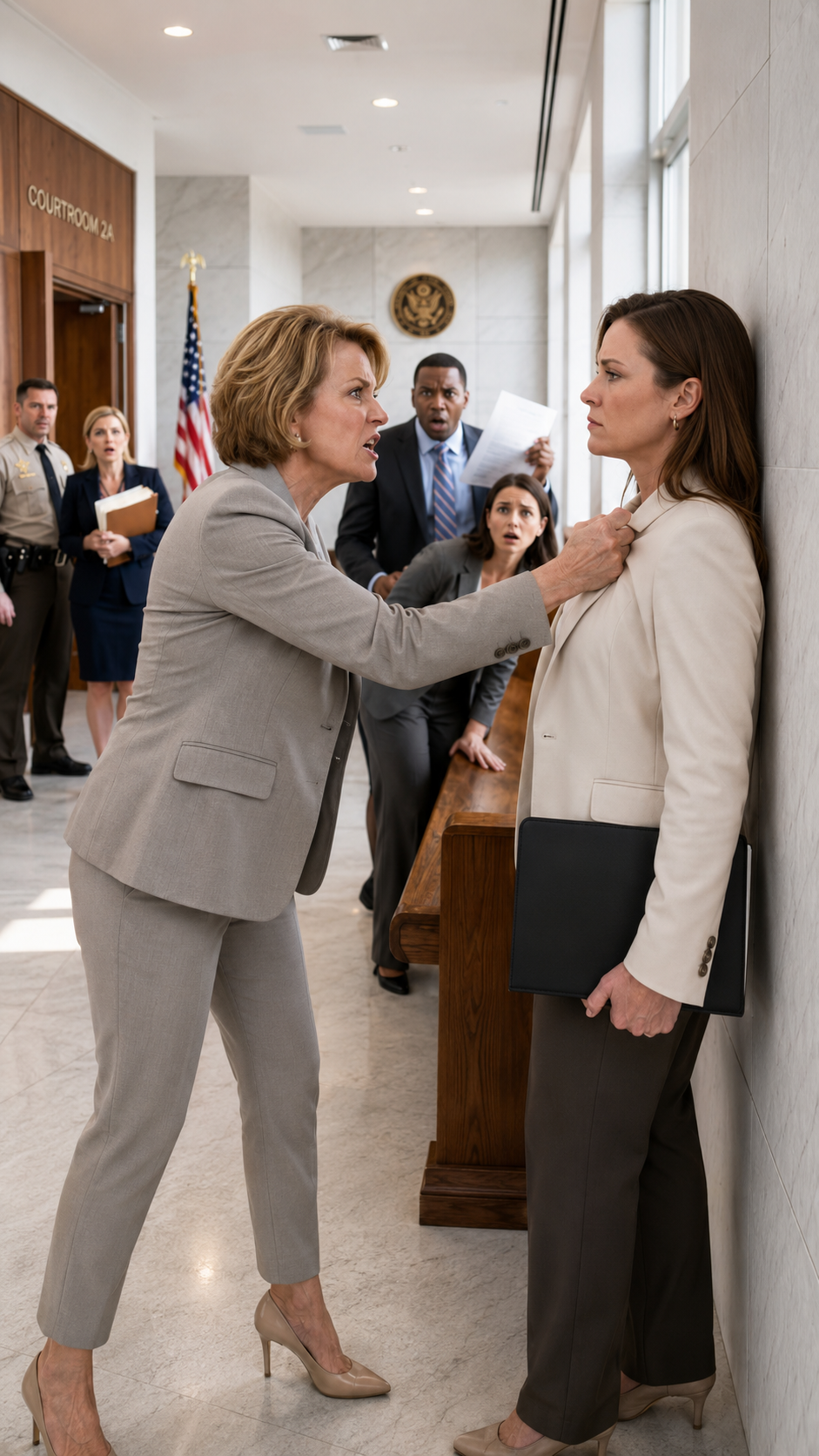
Across the hallway, Doña Eugenia Robles strode forward as if the entire building belonged to her.
She wore a beige dress, a pearl necklace, dark glasses perched on her head, and three lawyers trailing behind her. She didn’t walk; she paraded.
“Just look at her,” Eugenia said loudly so everyone could hear. “The poor widow trying to take my son’s house.”
Mariana remained silent.
She had learned over twenty years that sometimes silence irritated more than any scream.
“My son Francisco was sick,” Eugenia continued. “He had cancer, was weak, confused. This woman manipulated him into taking the house in Valle de Bravo.”
Ana stepped forward.
“Grandma, please, Dad wasn’t manipulated. He wanted to protect Mom.”
Eugenia turned so quickly that her earrings glinted under the bright hallway lights.
“You shut up, ungrateful little brat.”
And then she shoved her.
Ana fell against a wooden bench. The thud was loud. Several people turned, but no one moved.
Mariana dropped the folder and rushed toward her daughter.
“Are you okay, my love?”
Ana nodded, but tears filled her eyes.
Eugenia seized the moment to grab Mariana by the arm. Her red nails dug into the cheap fabric of the jacket.
“Your little play is over, Mariana. Today you sign. Today you hand over the title. Today you understand that a woman like you doesn’t fight against a family like mine.”
One of her lawyers, a man in a blue tie with a fake smile, handed her a package of papers.
“Mrs. Salgado, the smartest thing is to accept the settlement. You don’t have visible representation. We could drag this on for years. The fees will destroy you.”
Mariana looked at the document.
Then she looked at Eugenia.
“And if I don’t sign?”
Eugenia smiled with clean, elegant cruelty.
“Then we will leave you without a house, without money, and without a name. My son is dead, but his estate returns to his true family.”
The word “true” hit Ana harder than the shove.
Francisco had been her father. Mariana had been his wife. They had sold tamales, paid for treatments, slept in hospitals, counted coins to buy medicine.
But to Eugenia, it all boiled down to a house with a lake view.
At that moment, the door to the courtroom opened.
“Case Robles vs. Salgado,” the clerk called out. “The parties may enter.”
Eugenia adjusted her pearls.
“Last chance, Mariana. Enter humble or leave destroyed.”
Mariana picked up her blue folder.
She wiped her sleeve where Eugenia’s nails had left marks.
And she entered without saying that for eighteen years, before retiring, she had been the woman teaching the powerful to fear a well-prepared folder.
PART 2
Room 4 was cold.
Judge Ramiro Castañeda reviewed the case file while Eugenia’s lawyers occupied the left table as if they owned the place.
Mariana and Ana sat on the right side.
No lawyer sat next to them.
That made Eugenia smile.
“Your Honor,” began the blue-tied lawyer, “we come to request the annulment of the property transfer made by Mr. Francisco Robles in favor of his wife, Mariana Salgado, three weeks before his death.”
He opened a thick folder.
“We have reason to believe that Mr. Robles was not in full use of his mental faculties. Mrs. Salgado took advantage of his illness to seize a family property valued at twelve million pesos.”
Eugenia lowered her gaze, feigning pain.
“My son didn’t know what he was signing, Your Honor. That woman had him isolated. She wouldn’t let me see him.”
Ana clenched her fists.
Mariana touched her knee under the table.
“Calm down.”
The judge looked at Mariana.
“Do you have legal representation?”
“No, Your Honor.”
Eugenia let out a quiet chuckle.
Mariana continued:
“I will represent myself.”
Eugenia’s lawyer raised his eyebrows.
“With all due respect, this matter may be too technical for someone without legal training.”
Mariana looked directly at him for the first time.
“Counselor, technique doesn’t scare me.”
The judge paused.
“Proceed, Mrs. Salgado.”
Mariana opened the blue folder.
There were no loose sheets or crumpled papers. Everything was separated with tabs, dates, certified copies, and color-coded codes.
The lawyer’s smile faded slightly.
“First,” said Mariana, “the house in Valle de Bravo was not owned by the Robles family. It was purchased by Francisco and me in 2009 with a joint loan. Here are the bank statements from fourteen years of payments from a joint account.”
She handed documents to the clerk.
“Second, the deed was not signed three weeks before his death. It was modified eleven months earlier, when Francisco was still walking, driving, and working part-time. Here is the medical capacity report issued by Dr. Velázquez.”
The judge took the document.
Eugenia’s lawyer sat up straight.
“That wasn’t in the file.”
“Because you didn’t attach it,” Mariana replied. “Although you were aware of it.”
The courtroom fell silent.
Eugenia pursed her lips.
“Don’t make things up, woman.”
Mariana pulled out another sheet.
“The lawyer’s office received a copy of the report on February 3 at 10:42. Here’s the digital receipt.”
The judge looked up at the lawyer.
“Is that correct?”
The man swallowed hard.
“I would have to verify that.”
“Verify it at your leisure,” said Mariana. “It’s in your email.”
Ana looked at her in surprise.
It was the first time in months she had seen her mother speak without breaking.
Eugenia slammed her hand on the table.
“This changes nothing! My son was manipulated!”
Mariana took a deep breath.
“Let’s talk about manipulation then.”
She pulled out a USB drive.
“I request permission to present a recording made by Francisco Robles five months before his death, in the presence of a notary.”
The lawyer stood up.
“Objection. We are not familiar with that evidence.”
Mariana turned to him.
“It was offered in the initial response. Page 27. Maybe you didn’t read it because you were too busy calculating how long it would take to break me.”
The judge reviewed the file.
His glasses slid slightly down his nose.
“The evidence was offered properly. It is admitted.”
The clerk connected the USB.
On the screen appeared Francisco.
Thin, bald from chemotherapy, a gray blanket over his legs. But his eyes were clear.
Ana covered her mouth.
She hadn’t seen him on video since the funeral.
Francisco’s voice filled the room.
“My name is Francisco Robles Mendoza. I am recording this of my own volition. I want to make it clear that the house in Valle de Bravo is protected for my wife Mariana and my daughter Ana. My mother, Eugenia, knows she has no right to that property.”
Eugenia paled.
Francisco continued:
“For years my mother asked me to remove Mariana from the deed. She also asked me to sell the house to cover my brother Raúl’s debts. I refused.”
Mariana closed her eyes for a second.
That video broke her heart, but it also held her together.
“If my mother tries to sue Mariana after my death,” Francisco said, “I want the account of the family trust to be reviewed. There you will find what she doesn’t want anyone to see.”
The video ended.
The silence was brutal.
The judge looked at Eugenia.
“Would you like to explain what your son meant?”
Eugenia stood up.
“That’s an infamy! My son was high! That woman filled his head with ideas!”
Mariana opened another section of the folder.
“I also wondered what he meant. So I investigated.”
Eugenia’s lawyer tensed up.
“Your Honor, this is straying from the topic.”
“No,” said Mariana. “The topic is that Mrs. Eugenia didn’t come for justice. She came for money. Because she needed to sell the house before someone discovered that she withdrew four million pesos from Francisco’s medical trust.”
Ana’s eyes widened.
“What?”
Eugenia froze.
Mariana laid the bank statements on the table.
“That trust was for treatments, nursing, and medications. But there are transfers to a real estate agency in Metepec, credit card payments, and deposits to an account in Raúl Robles’ name.”
The judge took the papers.
“Where did you get this information?”
Mariana held his gaze.
“From documents voluntarily submitted by Francisco before he died. And from bank requests made according to the law, because I was an authorized co-holder of the medical trust.”
Eugenia’s lawyer murmured something to his assistant.
Eugenia lost control.
“Lie! You filthy leech! You were nobody before you married my son!”
She lunged at Mariana.
Everything happened fast.
Eugenia’s hand flew through the air and struck Mariana’s face in front of the judge.
Ana screamed.
The clerk stood up.
The courtroom officer rushed in immediately.
Mariana didn’t touch her cheek.
She didn’t cry.
She didn’t step back.
She just looked at Eugenia with a calmness that made her seem smaller.
“Thank you,” Mariana said.
Eugenia, flustered, looked at her as if she didn’t understand.
“What?”
“Thank you for confirming in front of the judge the pattern of violence I reported this morning.”
The lawyer was frozen.
“You reported?”
Mariana pulled out one last sheet.
“Before this hearing, I filed a report for threats, attempted dispossession, assault against my daughter, and economic domestic violence. I also requested protective measures.”
The judge looked at the officer.
“Take note of what happened in the courtroom.”
Eugenia shouted:
“You can’t do this to me! Who do you think you are?”
Mariana opened the final tab of her folder.
There was her former professional identification.
“For eighteen years, I was an agent of the Federal Public Ministry specializing in property crimes and money laundering. I retired before Francisco fell ill. I didn’t mention it at family dinners because I had nothing to prove.”
Eugenia’s face crumbled.
Ana looked at her mother as if discovering her for the second time.
Mariana continued:
“I’ve seen businessmen cry when a frozen account brings down their facade. I’ve seen politicians feign heart attacks when a signature appears. Believe me, Mrs. Eugenia, your expensive lawyers don’t intimidate me.”
The judge ordered a brief recess.
But before he stood up, he made it clear that the house could not be sold, transferred, or touched until the investigation was resolved.
Eugenia’s lawyers no longer walked like kings.
They walked like men looking for an exit.
In the hallway, Eugenia tried to approach Ana.
“Sweetheart, you know I wanted to protect your father's things.”
Ana stepped back.
“No, Grandma. You wanted to sell the last place where we still feel him alive.”
Eugenia opened her mouth but found nothing elegant to say.
Days later, the court recognized the validity of Mariana and Ana's property. Eugenia’s lawsuit was dismissed for lack of evidence and bad faith.
The investigation of the trust moved forward.
Raúl, Francisco’s brother, ended up declaring that his mother had pressured him to move money before Mariana checked the accounts.
That was the twist that finally sunk her: Eugenia not only wanted the house out of greed. She needed it to cover up the money she had taken from her own son while he fought against cancer.
When the news spread among the family, all those who had called Mariana “interested” began to send her messages.
“Sorry, we didn’t know.”
“Eugenia deceived us.”
“Francisco would be proud.”
Mariana didn’t respond to them all.
There were apologies that came too late, like flowers on an abandoned grave.
One afternoon, she took Ana to the house in Valle de Bravo.
The lake was still. The living room still smelled of wood, coffee, and the old sweater of Francisco that no one dared wash.
Ana sat on the couch where her father watched games on Sundays.
“Mom, why did you never tell us you were so badass?”
Mariana smiled faintly.
“Because a woman shouldn’t have to scare anyone to be respected.”
Ana rested her head on her shoulder.
Outside, the wind stirred the bougainvilleas that Francisco had planted when he still believed he had many years left.
Mariana looked at the house.
She didn’t see it as a million-dollar inheritance.
She saw it as sleepless nights, broth recipes, birthday laughter, silly arguments, paid bills, ordered medications, fulfilled promises.
Eugenia had thought that a quiet widow was a defenseless woman.
But she confused mourning with weakness.
And that mistake cost her the mask, the fortune, and the family.
Because in Mexico, many still believe that a lone woman can be easily crushed.
Until that woman opens her folder, lifts her face, and proves that the house wasn’t the most valuable thing she was defending.
It was her dignity.